균열을 통한 콘크리트의 염소이온 침투:
실험에서 해석기법까지
Chloride Ingress through Cracks in Concrete: from Experiment to Modeling Strategy
윤 인 석* 성 재 덕**
Yoon In-Seok 1S ung Jae-Duck
Abstract
Over the past few decades, considerable numbers of studies on the durability of concrete have been carried out extensively. The majority of these researches have been performed on sound uncracked concrete, although most of in-situ concrete structures have more or less micro-cracks. It is only recent approach that the attention has shifted towards the influence of cracks and crack width on the penetration of chloride into concrete. The penetration of chlorides into concrete through the cracks can make a significant harmful effect on reinforcement corrosion.
Author of this study examined the effect of cracks on chloride penetration by short term experiment. However, it is necessary to accomplish the effect by long term experiment to get reliable goal. In this study, the long term and short term experiments were carried out. This can be useful for establishing new species model of chloride penetration through cracks in concrete.
요 약 염소이온 침투에 의한 콘크리트의 내구성 저하를 고찰하기 위하여 빠른 시간 내에 염소이온의 침투성을 추정할 수 있는 실험 방법론 및 이론적 해석방법이 다수 제안되었으며 이를 고려한 콘크리트의 내구성 설계 시스템의 개발은 활발히 연구되어 왔다. 그러나, 실제 환경에서 공용 중인 대다수의 콘크리트 구조물에는 환경, 하중 조건, 재료 및 시공 상의 이유로 균열이 존재함에도 불구하고, 대부분의 연구들이 비균열된 콘크리트를 대상으로 염소이온 확산계수의 추정 및 염소이온 프로파일의 예측 등에 집중되었다. 그래서 본 연구에서는 콘크리트의 미세균열이 염소이온 침투에 미치는 영향을 고찰하기 위한 연구의 일환으로 장, 단기 침투 실험결과를 고찰하고 이를 토대로 해석기법 개발의 전략을 수립하고자 한다. 1. Introduction
It is only recently that the attention has shifted towards the influence of cracks and crack width on the penetration of chloride into concrete. Although micro-cracks may not degrade the structural integrity immediately, they can affect the long-term durability performance of concrete structures by permitting penetration of aggressive substances into concrete easily. Accordingly the penetration of chlorides into concrete through the cracks can make a significant harmful effect on corrosion. The objective of this study is to examine the effect in the long term and short term experiment.
* 정회원, 인덕대학 건설정보공학과 교수 ** 정회원, 대림대학 토목환경공학과 교수
2. Strategy
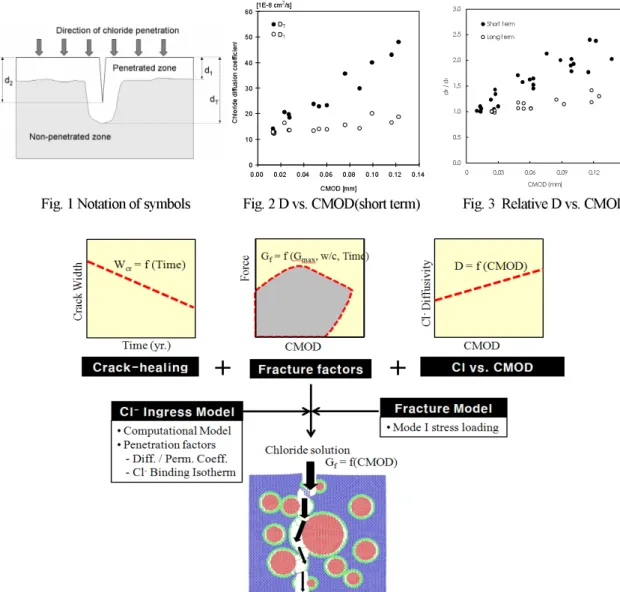
For short term experiment, RCM (Rapid Chloride Migration) testing was performed on the cracked specimens. From these tests chloride diffusion coefficient (D) and chloride penetration depth (d) were obtained. For long term experiment, cracked samples were immersed in artificial sea water for 472 days.
Fig. 1 depicts the notation of symbols. The calculated chloride diffusion coefficient versus CMOD is shown in Fig. 2. It is obvious that concrete sample with large crack width can be influenced by chloride penetration. The calculated diffusion coefficient for the uncracked part of the specimen (D1) is a rather constant value (with some
scatter) independent of the crack width. The diffusion coefficient DT calculated in the part of the specimen where the
crack has been made (using ingress depth dT) increases linearly with increasing CMOD.
Fig. 3 shows relative penetration depth, the ratio of chloride penetration depth of cracked concrete to that of uncracked concrete, at long and short term tests. The increase in penetration depth is correlated with CMOD.
Fig. 4 represents new strategy for multi-species modelling of chloride penetration through cracks. Cracks healing, chloride diffusivity, etc. will be considered in accordance with crack size should be considered and this should be combined with fracture modelling.
0 10 20 30 40 50 60 0.00 0.02 0.04 0.06 0.08 0.10 0.12 0.14 CMOD [mm] C hl or id e di ffu si on c oe ffi ci en t DT D1 [1E-8 cm2/s] DT D1