399
Copyrights © 2014 The Korean Society of Radiology
INTRODUCTION
Glufosinate ammonium (GLA) is a broad-spectrum herbicide used worldwide. As the use of GLA-containing herbicides has increased, poisoning from incidental and deliberate ingestion has also increased, and has been mostly reported from Japan. Most of glufosinate poisoning events were associated with sui-cide attempts using BASTA® (Bayer, Leverkusen, Germany). BASTA®, a herbicide containing glufosinate ammonium (18.5%) and the anionic surfactant, polyoxyethylene alkylether sulfate (30%), has been widely used in many countries since 1984 (1).
Glufosinate poisoning has been reported to induce central ner-vous system (CNS) symptoms, such as drowsiness, memory im-pairment, and seizures. Also, the included anionic surfactant, which increases blood vessel permeability, may cause symptoms
such as reduced circulatory blood volume, altered cardiac func-tion, and systemic peripheral vessel resistance (1). Periventricu-lar white matter ischemias, hippocampal lesions, and both hip-pocampal and striatal lesions have been reported following GLA intoxication, together with radiological findings (2, 3). We describe a patient who developed a reversible callosal lesion by ingesting a GLA-containing herbicide in an attempted suicide.
CASE REPORT
A 38-year-old woman was transferred to the emergency de-partment with nausea, vomiting and sore throat, 3 hours after ingesting a GLA-containing herbicide in a suicide attempt. She had drunk 500 mL of BASTA®. Her initial vital signs were stable and she was mentally alert. Arterial blood gas analysis showed
Case Report
pISSN 1738-2637 / eISSN 2288-2928 J Korean Soc Radiol 2014;70(6):399-402 http://dx.doi.org/10.3348/jksr.2014.70.6.399
Received February 1, 2014; Accepted March 21, 2014 Corresponding author: Dong Woo Park, MD Department of Radiology, College of Medicine, Hanyang University, Guri Hospital, 153 Gyeongchun-ro, Guri 471-701, Korea.
Tel. 82-31-560-2543 Fax. 82-31-560-2551 E-mail: [email protected]
This is an Open Access article distributed under the terms of the Creative Commons Attribution Non-Commercial License (http://creativecommons.org/licenses/by-nc/3.0) which permits unrestricted non-commercial use, distri-bution, and reproduction in any medium, provided the original work is properly cited.
Glufosinate ammonium (GLA) is a broad-spectrum herbicide used worldwide. Tran-sient lesions involving the splenium of the corpus callosum have been described in patients with encephalitis or encephalopathy of varied etiology, but have not been reported in association with GLA poisoning. We describe a patient who had at-tempted suicide by ingesting GLA-containing herbicide, with a focal diffusion-re-strictive lesion in the splenium of the corpus callosum on MRI, which had disap-peared four weeks later with no sequalae.
Index terms
Reversible Splenial Lesion Herbicide Intoxication Corpus Callosum Glufosinate
Reversible Splenial Lesion in the Corpus Callosum on MRI after
Ingestion of a Herbicide Containing Glufosinate Ammonium:
A Case Report
1글루포시네이트 암모늄을 포함한 제초제 복용 후 자기공명영상에서 관찰된
가역적인 뇌량 팽대부 병변: 증례 보고
1Tae-Yoon Kim, MD
1, Dong Woo Park, MD
1, Chung-Ki Park, MD
1, Young-Jun Lee, MD
2,
Seung Ro Lee, MD
21Department of Radiology, Hanyang University Guri Hospital, Guri, Korea 2Department of Radiology, Hanyang University Seoul Hospital, Seoul, Korea
Reversible Splenial Lesion in the Corpus Callosum on MRI after Ingestion of a Herbicide Containing Glufosinate Ammonium
400
J Korean Soc Radiol 2014;70(6):399-402 jksronline.orgcharged. Follow-up MRI, a month after the initial MRI exami-nation, showed that the splenial lesion had disappeared.
DISCUSSION
Reversible lesions restricted to the splenium of the corpus cal-losum (Reversible Splenial Lesion Syndrome, or RESLES) have been described in patients with encephalitis or encephalopathy of varied etiology, including infection, high-altitude cerebral edema, antiepileptic drug therapy, and metabolic disturbances (4). However, RESLES associated with poisoning by a GLA-con-taining herbicide has not been reported.
The clinical presentation of reversible splenial lesion is non-specific. Instead, it is mainly dependent on the event that caused the condition, and most frequently manifests as an encephalop-athy or encephalitis. Glufosinate intoxication has been reported to lead to memory impairment with or without hippocampal le-sions (2, 3). Our patient displayed retrograde and anterograde mild respiratory alkalosis. After gastric lavage followed by
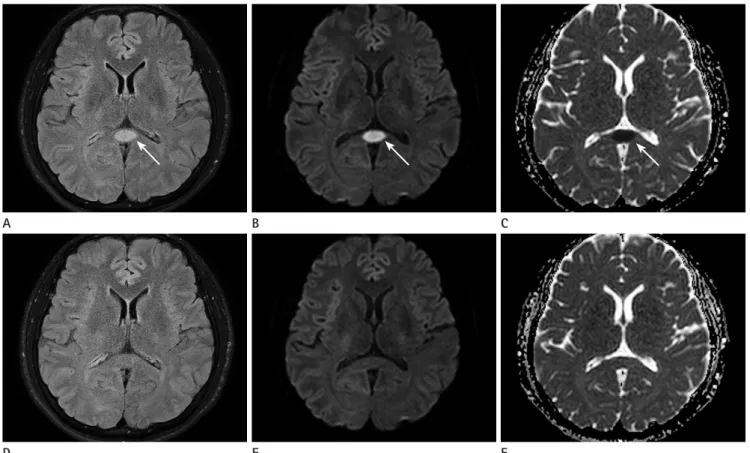
acti-vated charcoal treatment, she underwent hemoperfusion. Four hours later, mild hypotension developed, with a blood pressure of 90/54, and she was admitted to the intensive care unit. A day later, she presented with drowsy mental status, a disoriented sense of time, and retrograde amnesia. Six days later, the drowsy mentality and disorientation had improved, but the retrograde and anterograde amnesia remained. Therefore, conventional and diffusion-weighted 3T MRI were performed. These re-vealed a well-demarcated, oval shaped lesion in the midline splenium of the corpus callosum, which showed high signal in-tensity on T2-weighted and diffusion images, low signal intensi-ty on T1-weighted image, and no enhancement. The mean ap-parent diffusion coefficient (ADC) value of the splenial lesion of the corpus callosum was reduced to 324.5 ± 15.0 (10-5 mm2/s) (Fig. 1). No other brain parenchymal lesion was seen.
On the eleventh day of admission, the patient presented with improved mental status and general condition, and was
dis-Fig. 1. MR images from a 38-year-old woman who ingested glufosinate ammonium-containing herbicide in a suicide attempt. Fluid attenuated inversion recovery (FLAIR) (A) and diffusion-weighted (B) axial MR images show an oval shaped high signal intensity lesion at the mid portion of splenium of the corpus callosum (arrows), which is low signal intensity (arrow) on the apparent diffusion coefficient (ADC) map (C), suggestive of cytotoxic edema. Follow-up axial MRI, one month later, shows complete resolution of the splenial lesion on FLAIR (D), diffusion-weighted MRI (E), and the ADC map (F).
E B D A F C
Tae-Yoon Kim, et al
401
jksronline.org J Korean Soc Radiol 2014;70(6):399-402
cause reversible splenial lesions. Glufosinate together with a sur-face active agent can induce cytotoxic edema in the splenium of the corpus callosum.
REFERENCES
1. Koyama K, Andou Y, Saruki K, Matsuo H. Delayed and se-vere toxicities of a herbicide containing glufosinate and a surfactant. Vet Hum Toxicol 1994;36:17-18 2. Park HY, Lee PH, Shin DH, Kim GW. Anterograde amnesia with hippocampal lesions following glufosinate intoxica-tion. Neurology 2006;67:914-915 3. Lee HY, Song SY, Lee SH, Lee SY, Kim SH, Ryu SW. Vaso- genic edema in striatum following ingestion of glufos- inate-containing herbicide. J Clin Neurosci 2009;16:1372-1373 4. Garcia-Monco JC, Cortina IE, Ferreira E, Martínez A, Ruiz L, Cabrera A, et al. Reversible splenial lesion syndrome (RE-SLES): what’s in a name? J Neuroimaging 2011;21:e1-e14 5. Nakaki T, Mishima A, Suzuki E, Shintani F, Fujii T. Glufosinate ammonium stimulates nitric oxide production through N-methyl D-aspartate receptors in rat cerebellum. Neurosci Lett 2000;290:209-212 6. Moritani T, Smoker WR, Sato Y, Numaguchi Y, Westesson PL. Diffusion-weighted imaging of acute excitotoxic brain injury. AJNR Am J Neuroradiol 2005;26:216-228 7. Fujiki Y, Nakajima H, Ito T, Kitaoka H, Takahashi Y. [A case of clinically mild encephalitis/encephalopathy with a re- versible splenial lesion associated with anti-glutamate re-ceptor antibody]. Rinsho Shinkeigaku 2011;51:510-513 8. Takahashi Y, Kubota Y, Yamasaki E, Matsuda K. [Rasmussen encephalitis and non-herpetic acute limbic encephalitis]. Rinsho Shinkeigaku 2008;48:163-172 9. Pleasure D. Diagnostic and pathogenic significance of glu-tamate receptor autoantibodies. Arch Neurol 2008;65: 589-592 10. Watanabe T, Sano T. Neurological effects of glufosinate poisoning with a brief review. Hum Exp Toxicol 1998;17: 35-39amnesia that may have been associated with mild hippocampal injury that was not evident radiologically.
RESLES cases have been reported with a consistent pattern of neuroimaging abnormalities characterized by round lesions that are hyperintense on fluid attenuated inversion recovery and hy-pointense on T1-weighted sequences. Some of the splenial le-sions showed restricted diffusion, with low ADC values in diffu-sion-weighted imaging, suggestive of cytotoxic edema (4).
The reversible splenial lesion in this case also presented as a diffusion-restricted lesion, probably indicative of cytotoxic ede-ma, as in other reported cases of RESLES.
Glufosinate is a structural analogue of glutamic acid, a typical excitatory amino acid, and is thought to inhibit glutamine syn-thetase and glutamine decarboxylase, resulting in decreased glu-tamic acid levels. It may induce convulsions and memory im-pairment by interfering with the neurotransmitter function of endogenous glutamate (5). Glufosinate can induce neuronal ex-citatoxicity, which is known to cause neuronal cell death and produce degeneration of brain cells. Excitotoxic brain injury is considered a final common pathway for various neuropatholog-ic conditions and causes cytotoxneuropatholog-ic edema (6).
There is a report of a patient who showed mild encephalitis/ encephalopathy with a reversible splenial lesion, and whose ce-rebrospinal fluid contained anti-glutamate ε2 receptor (GluRε2) antibodies (7).
Recently, autoantibodies against glutamate receptor ε2 have been detected in patients with epilepsia partialis continua, which is causally related to Rasmussen syndrome, nonparaneoplastic limbic encephalitis and acute encephalitis (8). And it is consid-ered that glutamtate receptor autoantibodies are capable of in-ducing neuronal excitotoxicity (9). Glufosinate results in excito-toxicity and should have a similar effect to GluRε2 receptor antibodies. Hence glufosinate may play a similar role in the pathogenesis of reversible splenial injury as GluRε2 receptor an-tibodies.
Polyoxyethylene alkylether sulfate, the surface active agent in BASTA, increases the permeability of the blood-brain barrier, favoring access of glufosinate to the CNS and enhancing CNS toxicity, as shown in various animal and human studies (10).
Reversible Splenial Lesion in the Corpus Callosum on MRI after Ingestion of a Herbicide Containing Glufosinate Ammonium
402
J Korean Soc Radiol 2014;70(6):399-402 jksronline.org글루포시네이트 암모늄을 포함한 제초제 복용 후 자기공명영상에서
관찰된 가역적인 뇌량 팽대부 병변: 증례 보고
1김태윤
1· 박동우
1· 박충기
1· 이영준
2· 이승로
2글루포시네이트 암모늄은 전 세계적으로 사용되는 광범위 제초제이다. 뇌량 팽대를 포함하는 일시적인 병변은 뇌염 또는 다양한 원인의 뇌 질환을 가진 환자에서 기술되어 왔지만 glufosinate ammonium (이하 GLA) 중독과 관련하여 보고된 적 은 없다. 우리는 GLA 함유 제초제를 복용하여 자살을 시도했던 환자에서, 자기공영영상의 확산강조에서 뇌량 팽대 부위 의 확산제한병변이 4주 후의 추적검사에서 아무런 후유증 없이 소실되었던 증례에 대해 보고하고자 한다.