Synthesis of Li
4Ti
5O
12Thin Film with Inverse Hemispheric Structure
Sung Je Lee, Kwang Hee Jung, Bo Gun Park,† Ho Gi Kim, and Yong Joon Park†,*
Department of Material Science and Engineering, Korea Advanced Institute of Science and Technology (KAIST), Daejeon 305-701, Korea
†Department of Advanced Materials Engineering, Kyonggi University, Suwon, Gyeonggi-do 443-760, Korea
*E-mail: [email protected]
Received October 6, 2009, Accepted December 21, 2009
Li4Ti5O12 thin film with inverse hemispheric structure was fabricated on a Pt/Ti/SiO2/Si substrate by the sol-gel and dip coating method for use as an anode for 3-dimensional (3D) thin-film batteries. Polystyrene (PS) beads of 400 nm diameter were used to prepare the template for the inverse hemispheric structure. A coating solution prepared using precursor sources was dropped on the template-deposited substrates, which were then calcinated at 400 oC. The template was removed by calcination, and the inverse hemispheric structure was successfully formed by an annealing process. The cyclic performance during high-rate charge/discharge processes of the Li4Ti5O12 film with inverse hemispheric structure was superior to that of the flat Li4Ti5O12 film.
Key Words: Template, Inverse hemispheric structure, Sol-gel, Li4Ti5O12, Thin film
Bead dip coating
Electrode material deposition by sol-gel method
Calcination & crystallization
Concept of structured thin film battery
Figure 1. Fabrication process of the Li4Ti5O12 thin film with inverse
hemispheric structure.
Introduction
Recently, there has been an increasing demand for on-chip power sources for MEMS (Micro-Electro-Mechanical System) devices. Thin film Li-ion battery (TFLIB) is a promising candi-date amongst the several choices for power sources for MEMS devices.1-10 The thin film Li-ion battery fabricated using only solid-state materials by the thin film process, is a very beneficial type of battery because of its excellent safety and good rechar-geability.6-9 However, there are also some limitations caused by the fact that TFLIB uses solid electrolyte, whose ionic conduc-tivity is very low at low temperatures. Therefore, some resear-chers have suggested the use of 3-dimensional (3D) structured thin film batteries in order to obtain better properties such as higher discharge capacity and superior rate capability.1-5 Unfor-tunately, most of the methods used to fabricate 3D structured TFLIB are too expensive and complicated. However, the sol-gel method used along with a removable template such as that form-ed with microsphere beads, is a promising process for synthesiz-ing the 3D structured electrode because it is cheap and it easily fabricates the 3D inverse hemispheric structure.5
In this study, Li4Ti5O12 thin film with inverse hemispheric structure was fabricated by the sol-gel method using 400 nm polystyrene microsphere beads as a monolayer template. Li4Ti5 -O12 is a promising new anode materialdue to its low cost and good cyclic performance.11-15 Particularly, it is a so-calledzero- strain insertion material for application as a negative electrode. Thin film batteries use a solid electrolyte, therefore, the volume change of the electrode during charge and discharge can cause separation on the interfaces of the TFLIB. Since it is known that there is no volume change in Li4Ti5O12 during cycling, it is very suitable as the material for the anode of the 3D structured thin film battery. In this study, Li4Ti5O12 with inverse hemispheric structure was synthesized and characterized. The macroscopic structure, crystal structure, and the electrochemical properties of the Li4Ti5O12 electrode were investigated by SEM, XRD, and the cycler.
Experimental
Polystyrene beads of diameter 400 nm were used to prepare the template with spontaneously ordered inverse hemispheric void spaces for the electrode. An aqueous suspension (1 wt %) of polystyrene microspheres (400 nm) was ultrasonically dis-persed in deionized water, and then it was coated and dried on a Pt/Ti/SiO2/Si substrate by the dip coating method. The solution for the thin film deposition was made by mixing precursors and solvents. The precursor materials were lithium acetylace-tonate [Li(C5H8O2)] (Aldrich, 97%) and titanium(IV) butoxide [Ti[O(CH2)3CH3]4] (Aldrich, 99%). The concentration of each precursor was controlled to adjust the ratio of Li : Ti to 4 : 5. 1-Butanol and acetic acid were used as solvents. The precursors were stirred with a magnetic stirrer for 20 min with 1-butanol, and stirred for an additional 3 h after adding the same volume of acetic acid. The concentration of the solution was controlled
(a) (b)
(c) (d)
Figure 2. SEM images of (a) the template-deposited substrate; (b) the substrate after precursor solution coating; (c) the Li-Ti-O film
calcinat-ed at 400 oC for 30 min (× 30,000); (d) the Li-Ti-O film calcinated at
400 oC for 30 min (× 10,000). Su b . S ub. S ub. Su b . (1 1 1 ) 500℃ 600℃ 700℃ 800℃ ◆ ■ ■ ■ ■ ▼ JCPDS pattern of Li4Ti512 10 20 30 40 50 60 70 80 2 Theta
: Anatase TiO2 ▼: Li3Ti3O7 ■: Rutile TiO2
In te n sity (A . U .) JCPDS Pattern of Li4TiO12 800 oC 700 oC 600 oC 500 oC S ub. S ub. S ub. S ub. (111) ▼
Figure 3. XRD patterns of the Li4Ti5O12 electrodes with inverse
hemis-pheric structure. to be 0.05 M. The solution was passed through a 0.2 µm filter
(Whatman) prior to use. Subsequently, it was dripped by pipette onto a template-deposited substrate and dried at room tempera-ture. The deposited film was heat treated at 120 oC for 30 min and reheated at 400 oC, also for 30 min, to remove organic ma-terials from the precursors and the polystyrene template. Subse-quently, the film was annealed for crystallization at 500, 600, 700, and 800 oC for 1 h using a furnace in air atmosphere. All heating rates were 5 oCmin‒1. Figure 1 is a schematic diagram that illustrates the fabrication of a Li4Ti5O12 thin film with in-verse hemispheric structure. A Li4Ti5O12 thin film with flat sur-face was also prepared for comparison with that with the inverse hemispheric structure. The same precursor solution mentioned above was dripped on a Pt/Ti/SiO2/Si substrate and dried at room temperature. The heat treatment following the drying was the same as for the film with the hemispheric structure.
The evaporation temperature of the polystyrene beads and the decomposition temperatures of the precursors were examin-ed by TGA (thermogravimetric analysis, Thermogravimetry Analyzer (TG209F3)). The analysis of the phases in the Li4Ti5 -O12 thin films was carried out by the X-ray Diffractometer (D/MAX-RC (12 kW), Rigaku) with monochromatized CuKα radiation (l = 1.5406 Å) (angle range : 10o ~ 80o, scan speed : 6o min‒1). The film morphology was observed by SEM (scanning electron microscopy, Philips XL30SFEG). For the electroche-mical measurements, the inverse hemispheric structured Li4Ti5 -O12 thin film was placed in an open beaker cell containing 1M LiPF6 in EC/DEC, a lithium foil counter and reference elec-trodes, which was located inside an Ar-atmosphere glove box. Charge/discharge tests were controlled with a galvanostatic test system (Wonatech, WBCS3000).
Results and Discussion
Figure 2a shows the SEM image of a template consisting of polystyrene-beads on a Pt/Ti/SiO2/Si substrate. It appears that the polystyrene beads have been successfully dispersed and are attached to the surface of the substrate as a monolayer with a hexagonal close-packed structure. The monolayer template is a key factor for the fabrication of electrodes with uniform inver-se hemispheric structure, becauinver-se if the polystyrene beads had been deposited as a multilayer, the open volume formed on the template would have been connected in a zig-zag manner rather than perpendicularly. That would have made it very difficult to fill the open volume with electrolyte and thus form the opposite electrode for true 3-dimensional thin film batteries. The coated bead layer has a good adhesive property for the subsequent per-meation of the precursor solution. It can be noted in the image of the template film coated by precursor solution (Fig. 2b), that the precursor solution uniformly fills the empty space between the substrate and the template layer. Therefore, it is evident that the inverse hemispheric structured Li4Ti5O12 layer can be spontan-eously maintained after the evaporation of the bead template.
To examine the thermal decomposition of polystyrene beads, TGA analysis was performed. The decomposition of polysty-rene beads started at around 200 ~ 250 oC, and was completed before the temperature reached 400 oC. There was no gravita-tional change past 400 oC (not shown in the figures).
Consider-ing this result, 400 oC was chosen as the calcination temperature for removing the polystyrene beads. Figure 2c and 2d display the SEM images of the Li-Ti-O thin film with inverse hemi-spheric structure after calcinations at 400 oC for 30 min. It was confirmed that the uniform inverse hemispheric structure was formed on the film on the removal of the template.
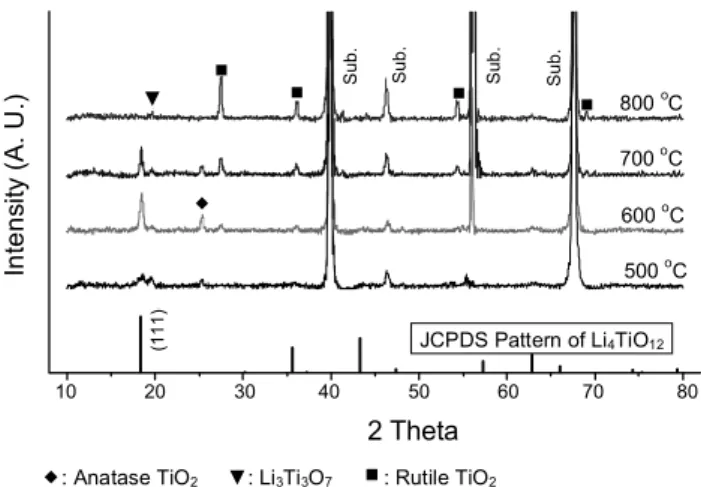
XRD analysis was used to investigate the phase of the Li4Ti5 -O12 thin film with inverse hemispheric structure after annealing. Figure 3 shows the XRD patterns of the film annealed for cry-stallization at 500, 600, 700, and 800 oC for 1 h under air atmo-sphere. Stepped heat treatment was applied in all cases, using a furnace at 400 oC for 30 min for the calcinations. In the diffrac-tion pattern of the film annealed at 500 oC, several diffraction peaks were observed. Among them, the diffraction peak located at 2θ = 18.3o corresponds to the (111) reflection of the typical Li4Ti5O12 spinel structure. The (111) reflection becomes higher and sharper as the annealing temperature is increased to 600 oC. Although the peak indicating TiO2 with anatase structure was also observed, it was confirmed that most of the phase of the
(a) (b)
(c) (d)
(e) (f)
Figure 4. SEM images of the Li4Ti5O12 thin film annealed at (a) 500 oC;
(b) 600 oC; (c) 700 oC; and (d) 800 oC, and tilted SEM images of the
Li4Ti5O12 thin film annealed at 600 oC (e) × 75,000; and (f) × 10,000.
(d)
Inverse hemispheric structured Flat thin film
10 20 30 40 50 Cycle 6 4 2 0 Ca p aci ty (µ A/ cm 2 ) (a)
(e)
Inverse hemispheric structured Flat thin film10 20 30 40 50 Cycle (b) 6 4 2 0 Ca p aci ty (µ A/ cm 2 )
Figure 5. Cyclic performances of the Li4Ti5O12 thin film with inverse
hemispheric and the flat film structure. (Data shows charge capacity
of the sample) (a) 50 µAhcm‒2; (b) 100 µAhcm‒2
film annealed at 600 oC had the Li4Ti5O12 spinel structure. How-ever at higher temperatures (700 and 800 oC) the observed (111) peak of the Li4Ti5O12 structure became less pronounced, and finally almost disappeared. The diffraction pattern of the film annealed at 800 oC matches the rutile structure of TiO
2. This im-plies that the Li4Ti5O12 spinel were decomposed or changed to the TiO2 rutile phase at 800 oC. This phase change leads to the macroscopic structural change, that is, the collapse of the inverse hemispheric structure of the electrode. This structural change is shown quiet well in Figure 4. The films annealed at 500 and 600 oC acquired inverse hemispheric structures with interconnected pores after annealing (Figs 4a, 4b). The pores were highly order-ed, with diameters of approximately 0.5 ~ 0.6 µm, with wall thicknesses between the pores of less than 0.1 µm. However, as annealing temperatures increased (700 oC and 800 oC), the 3- dimensional structure collapsed and finally changed to an almost flat film containing with rod-type crystals, which are probably TiO2 particles with rutile structure (Fig. 4c, 4d). Therefore, the optimum temperature for crystallization of Li4Ti5O12 with in-verse hemispheric structure was confirmed to be 600 oC. The tilted SEM image of the film annealed at 600 oC (Fig. 4e, 4f) demonstrate that Li4Ti5O12 thin film with inverse hemispheric structure was successfully fabricated at 600 oC.
The cyclic performances of the flat thin film electrode and the inverse hemispheric structured electrode were tested under high rates of charge/discharge. Basically, similar amounts of material of two different films are needed to compare the trochemical properties. The thickness of the flat thin film elec-trode was ~100 nm, but it was difficult to measure the exact
thickness of the inverse hemispheric structured film. If we could measure the thickness of the 3-dimensional film, it would be almost impossible to know the amount of the electrode material. Thus, in this work, the test was performed with two electrodes with different structures but of similar discharge capacities. The annealing temperature for both samples was 600 oC and the current densities for cycling were 50 µAhcm‒2 and 100 µAhcm‒2 in the voltage range of 2.5 - 1.0 V.Because of the very small thicknesses, the current densities can be considered high enough to test rate capability, and cyclic performance under that condi-tion. As shown in Figure 5, the Li4Ti5O12 film with inverse he-mispheric structure displayed better cyclic performance than the flat film electrode. Figure 6 displays charge profile of the Li4Ti5 -O12 thin film with inverse hemispheric and the flat film structure at the current density of 100 µAhcm‒2. The rapid capacity fading was observed in the flat Li4Ti5O12 film. However the Li4Ti5O12 thin film with inverse hemispheric structure showed stable charge capacity during cycling. This is likely due to the larger reactive surface area of the film with inverse hemispheric struc-ture. Its extended surface area would facilitate access to the electrolyte as well as lithium diffusion during the charge/dis-charge process, which would enhance the rate capability of the
Initial 4th 10th 30th 50th
(
a
)
0 1 2 3 4 5 6 Capacity (µAh/cm2) (a) 2.5 2.0 1.5 1.0 Vol tage ( V ) Initial 4th 10th 30th 50th(
b
)
2nd 4th 10th 30th 50th 0 1 2 3 4 5 6 Capacity (µAh/cm2) (b) Vol tage ( V ) 2.5 2.0 1.5 1.0 2nd 4th 10th 30th 50thFigure 6. Charge profiles of the Li4Ti5O12 thin films at the current
den-sity of 100 µAhcm‒2 (a) flat film structure; (b) inverse hemispheric
structure.
Figure 7. SEM images of the Li4Ti5O12 thin film with inverse
hemis-pheric after 50 high-rate charge‐discharge cycles. (current rate = 100 µ
Ahcm‒2)
electrode and offer good stability during cycling under high charge/discharge rates. In contrast, the flat Li4Ti5O12 film did not have enough rate capability to react satisfactorily at high charge/discharge rates. Generally, the Li4Ti5O12 film has stable cycle life. However, the flat Li4Ti5O12 film showed rapid capa-city drop under high rate conditions due to the damage caused by the high cycling process.16
Figure 7 displays the SEM image of the Li4Ti5O12 film with in-verse hemispheric structure after 50 cycles at the current rate of 100 µAhcm‒2. The inverse hemispheric structure of the film was not changed after 50 high-rate charge/discharge cycles. Li4Ti5O12 is a zero-strain insertion material, so the 3-dimensional structure was stable and sustained itself during cycling. This is a very desirable property of the thin film electrode because the thin film battery uses a solid electrolyte. As mentioned earlier, if the volume or the structure of the electrode changes, the inter-face between the electrode and the solid electrolyte will separate leading to fatal performance degradation of the battery. The in-verse hemispheric structured architecture of the film could be so delicate that careful control of the heating conditions may be required in order to achieve a stable structure. However, because of their superior properties such as good rate capability and
cyclic stability which can be achieved with cheap and simple processes, thin film electrodes with inverse hemispheric struc-tures fabricated by using polystyrene templates are quite promis-ing.
Conclusion
A Li4Ti5O12 thin film electrode with inverse hemispheric structure was fabricated and assembled by the sol-gel and dip- coating method on a Pt/Ti/SiO2/Si substrate. Polystyrene beads were used as the template to develop the ordered inverse hemis-pheric structure for the thin film electrode. XRD analysis show-ed that crystallizshow-ed Li4Ti5O12 spinel structure was formed by the annealing process. The optimum annealing temperature was 600 oC for the crystallization of the Li4Ti5O12 film with inverse hemispheric structure. The cyclic performance of the Li4Ti5O12 film with inverse hemispheric structure at high charge/discharge rates was more stable than the performance of the flat thin film electrode. The 3-dimensional macroscopic structure was per-fectly sustained after 50 high-rate charge/discharge cycles. In view of these results, the Li4Ti5O12 thin film with inverse hemis-pheric structure synthesized by the sol-gel process is a promising candidate material for the anode of the 3 D thin film batteries.
References
1. Long, J. W.; Dunn, B.; Rolison, D. R.; White, H. S. Chem. Rev. 2004, 104, 4463.
2. Wang, Y.; Cao, G. Adv. Mater. 2008, 20, 2251.
3. Min, H.; Park, B. Y.; Taherabadi, L.; Wang, C.; Yeh, Y.; Zaouk, R.; Madou, M. J.; Dunn, B. J. Power Source 2008, 178, 795. 4. Nathan, M.; Golodnitsky, D.; Yufit, V.; Strauss, E.; Ripenbein, T.;
Shechtman, I.; Menkin, S.; Peled, E. J. Microelectromech. Syst. 2005, 14(5), 879.
5. Park, G.; Ryu, J. H.; Choi, W. Y.; Park, Y. J. Bull. Korean Chem.
Soc. 2009, 30(3), 653.
6. Bates, J. B.; Dudney, N. J.; Neudecker, B. J.; Ueda, A.; Evans, C. D.
Solid State Ionics 2000, 135, 33.
7. Park, Y. J.; Ryu, K. S.; Park, N. G.; Hong, Y. S.; Chang, S. H. J.
Electrochem. Soc. 2002, 149, 597.
8. Jeon, E. J.; Shin, Y. W.; Nam, S. C.; Cho, W.; Yoon, Y. S. J.
Electro-chem. Soc. 2001, 148, A318.
9. Park, Y. J.; Kim, J. G.; Kim, M. K.; Kim, H. G.; Chung, H. T.; Park, Y. J. Power Source 2000, 87, 69.
10. Kuwata, N.; Kumar, R.; Toribami, K.; Suzuki, T.; Hattori, T.; Kawamura, J. Solid State Ionics 2006, 177, 2827.
11. Kanamura, K.; Chiba, T.; Dokko, K. J. European Ceramic Soc. 2006, 26, 577.
12. Gao, J.; Jiang, C.; Ying, J.; Wan, C. J. Power Source 2006, 155, 364.
13. Kitaura, H.; Hayashi, A.; Tadanaga, K.; Tatsumisago, M. J. Power
Source 2009, 189, 145.
14. Huang, C. A.; Wang, T. H.; Weirich, T.; Neubert, V.
Electrochim-ca Acta 2008, 53, 7242.
15. Hao, Y. J.; Lai, Q. Y.; Lu, J. Z.; Wang, H. L.; Chen, Y. D.; Ji, X. Y.
J. Power Source 2006, 158, 1358.
16. Ryu, K. S.; Lee, S. H.; Koo, B. K.; Lee, J. W.; Kim, K. M.; Park, Y. J. J. Appl. Electrochem. 2008, 38, 1358.