2011년도 추계학술발표회 논문요약집 대한방사선방어학회
204 _http://www.karp.or.kr
Development of an analysis software for comparison between
proton treatment planning system and Monte Carlo simulation
Dae-Hyun Kim․Jungwook Shin․Seyjoon Park․Seung Hoon Yoo․Se Byeong Lee․Tae-Suk Suh Department of Biomedical Engineering, College of Medicine, The Catholic University of Korea
Research Institute of Biomedical Engineering, The Catholic University of Korea Proton Therapy Center, National Cancer Center, Goyang, Republic of Korea Department of Radiation Oncology, University of California, SanFrancisco, CA, USA
E-mail : [email protected], [email protected] Key word : Monte Carlo, Proton Radiotherapy, Treatment planning system, Geant4
Introduction
Currently, many proton therapy facilities are used for radiotherapy for treating cancer. The main ad-vantage of proton therapy is the absence of exit dose, which offers a highly conformal dose to treat-ment target as well as better normal organ sparing. The most of treatment planning system (TPS) in proton therapy calculates dose distribution using a pencil beam algorithm (PBA). PBA is suitable for clinical proton therapy because of the fast computa-tion time. However PBA shows accuracy limitacomputa-tions mainly because of the one-dimensional density scal-ing of proton pencil beams in water.
Recently, we developed Monte Carlo simulation tools for the design of proton therapy facility at National Cancer Center (NCC) using GEANT4 toolkit (version GEANT4.9.2p02). Monte Carlo simulation is expected to reproduce precise influences of complex geometry and material varieties which are difficult to introduce to the PBA. The data format of Monte Carlo simulation result has different from DICOM-RT. Consequently we need we analysis software for comparing between TPS and Monte Carlo simulation.
The main objective of this research is to develop an analysis toolkit for verifying precision and accuracy of the proton treatment planning system and to analyze dose calculating algorithm of the proton therapy using Monte Carlo simulation.
Materials and Methods
1. Proton Monte Carlo dose calculation
Out Monte Carlo simulation was based on the proton treatment nozzle at NCC (Proteus 235, Ion Beam Application, Belgium). For Monte Carlo dose calcu-lation, we use the GEANT4 code(Version 9.2.p02). GEANT4 allows precise calculations for proton radia-tion therapy.
The first step of our work was the validation of the Monte Carlo application versus experimental data for all of energies. We used 3-dimensional water phantom (Scanditronix wellhofer AB, SW) and Markus ion chamber (PTW, TW34045).
2. DICOM-RT interface
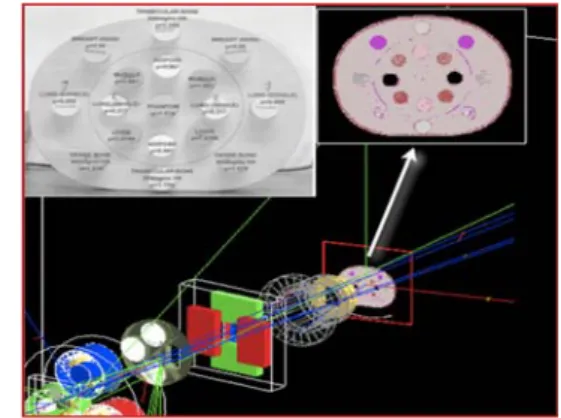
Dose calculation based on patient geometry requires the import CT data set into the GEANT4 code. The al-ready existing DICOM interface in GEANT4 simulation toolkit was embedded into NCC nozzle Library. Figure 1 shows the NCC nozzle Library with DICOM interface.
Fig. 1. NCC nozzle library with electron density phan-tom DICOM data set
2011년도 추계학술발표회 논문요약집 대한방사선방어학회
제5분과(의료 및 생물)_ 205 The correspondence of Hounsfield number and
elec-tron density is an important parameter for radiotherapy planning system duo to guarantee of a precise treatment. In our simulation, it is possible to easily change param-eter of the correspondence. Electron density of each voxel was estimated from Hounsfield values in DICOM data according to a Hounsfield-tissue table. In order to calculate patient dose, we imported not only the patient CT data set, but also specific block and compensator information. The planning informations of the proton treatment such as gantry and patient position system angle, iso-center, snout position were also imported into GEANT4 using user interface of the NCC nozzle library.
3. Analysis software
The analysis sotrware was developed based on DICOM-pyler which is an extensible open source radi-ation therapy resrarch platform based on the DICOM standard. Our analysis software was written in Python and is runs on Windows, MaxOSX and Linux. Major features of our software are import CT data set, DICOM-RT structure set, RT-dose, RT-Plan files and GDD file which made by GEANT4.
In addition, percent dose difference, Gamma Index and Dose volume histogram function were been added for comparing calculated dose between TPS and Monte Carlo simulation.
Results and Discussion
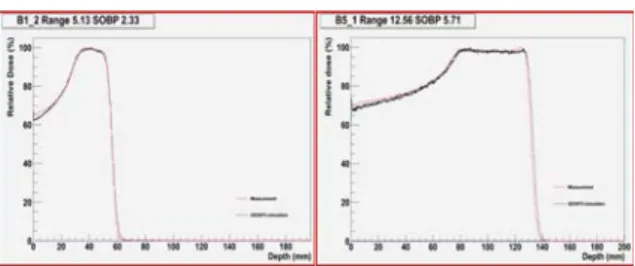
1. Validation of NCC Nozzle LibraryNCC nozzle library was validated with experimental measurement data for all of energies. Fig2 shown the depth dose distribution at the central axis of range 5.13 cm and 12.56 cm respectively. The simulated range of the depth dose agree with measurement with an accu-racy of 1 mm.
Fig. 2. Comparison of depth dose distribution of SOBP at central axis.(Black line : GEANT4 simulation,
Red line : Measurement data)
2. User Interface of the NCC-DICOM
The appearance of NCC-DICOM consists of axial view pane of a 2D image, 4 control panel for adjustment of CT image such as level, brightness, window width and dose evaluation images pane (Dose difference, and Gamma Index)
3. Functions
NCC-DICOM is capable of fusion of a patient image and calculated dose distributions with DICOM-RT generated by TPS and GDD from Monte Carlo simulation. NCC-DICOM provides a function to com-pare dose distribution between TPS and GDD using dose difference and Gamma Index. Also it provides dose volume histogram(Fig3).
Fig. 3. Our analysis software, named NCC- DICOM, which display a dose distribution DICOM-RT and GDD file
Conclusion
In this work, we conclude that we developed an anal-ysis software for GEANT4-based medical application. This toolkit is capable of evaluating the accuracy of calculated dose by TPS with Monte Carlo simulation.
Reference
1. H. Paganetti,"Accurate Monte Carlo simulation for nozzle design, commissioning and quality assurance for a proton radiation therapy facility" Med.Phys. 31(7), 2107-2118 (2004)
2. "DICOM interface and visulaization tool for Geant4-based dose calculation" Nuclear Science Symposium Conference Record, IEEE pp.981- 984 (2005)