© Korean Powder Metallurgy Institute 1282
-Magnetic Properties and Microstructure of Sm
2Co
17Permanent Magnet
Janghong Yi, Liya Li, Yuandong Peng
The State key Laboratory for Powder Metallurgy, the central south university, Changsha 410083, China
Keywords: Terms--Permanent magnets, microstructure, magnetic domain, phase transformation
The coercivity of Sm2Co17-based permanent magnets at
high operating temperature gradually increased with in-creasing Cu and Zr content, but decreased as the Fe content increased. The magnet Sm(Co0.7Fe0.1Cu0.16Zr0.04)6.7 that was
studied had a room temperature intrinsic coercivity of about 30 kOe. For this magnet, the temperature coefficient of coercivity βRT-500oC and Hci at 500oC are -0.148%/oC and
8.6kOe. The magnet is composed mainly by RSm2(Co,Fe)17
cell interior, Sm(Co,Cu)5 cell boundary phase, as well as H
Sm2(Co,Fe)17 lamellar phase. There is a maze- like domain
structure in the magnet. The HRXRD evidence shows that the phase transformation at high temperature leads to the degraded magnetic properties of the magnets.
The Sm2Co17 based magnets with the highest Curie
temperature among the commercial rare-earth permanent magnets have attracted considerable interest as an attractive candidate for high-temperature applications.
0 100 200 300 400 500 30 60 90 120 150 180 210 240 No.3 No.2 No.1 (B H) ma x ,kJ. m -3 T,℃
0 100 200 300 400 500 0 300 600 900 1200 1500 1800 No.3 No.2 No.1 Hci , kA /m T,℃
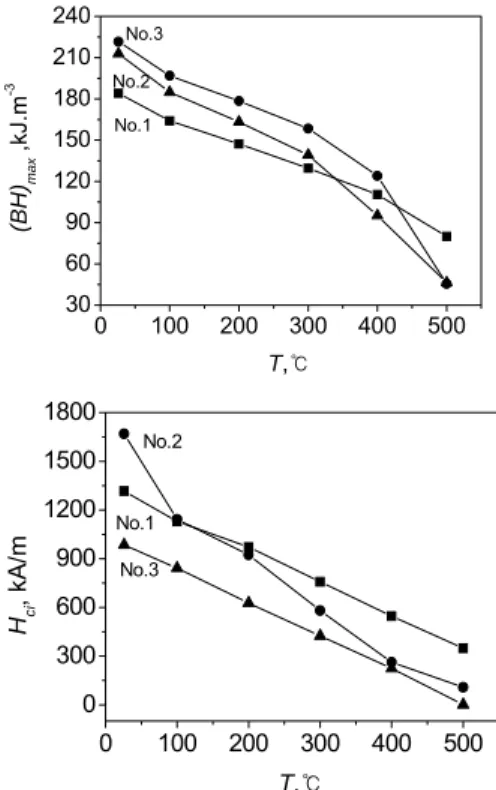
Fig. 1 Dependence of (BH)max(a) and Hci(b) on tempe rature(T) for Sm2Co17-based magnets
It can be seen from Fig.1that the magnet with 10.53wt% Cu-contenthas a room temperature intrinsic coercivity of 30.3 kOe. The temperature coefficient of coercivity βRT-500
and Hci at 500oC are -0.148%/oC and 8.6kOe. The
coercivity of the sample with low Cu content decreases much faster than that with high Cu content. Sample B has a coercivity of 20.87kOe at room temperature, but only 1.36kOe at 500oC. Sample A has a lower coercivity at room
temperature(16.46kOe), but a coercivity of 4.37kOe at 500oC. Higher Cu-content and lower Fe-content may
increase the magnetic properties at high temperature. Fig. 2 shows a typical TEM image of Sm(CobalFe0.197
Cu0.049Zr0.026)7.5 magnet, respectively. The microstructure of
the magnet consists of a perfect cellular microstructure with a cell size of 90nm and with a cell boundary thickness of 20nm. The cell interior is a RSm2(Co,Fe)17 phase, and the
boundary is Sm(Co,Cu)5 phase.
Fig. 2 Bright-field image(a) of the typical cellular mi crostructure of sample A
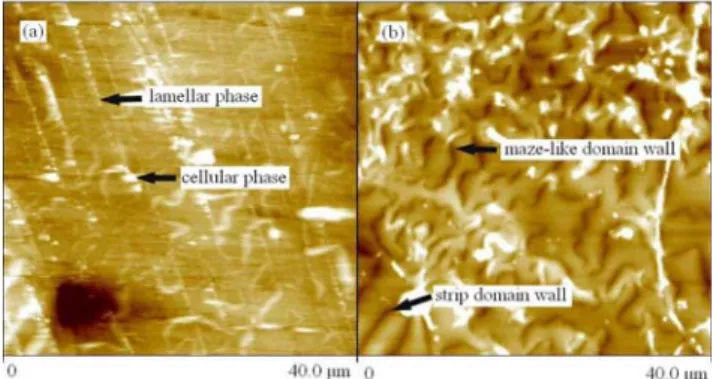
A fairly uniform maze-like domain structure is apparent in the magnet, as shown in Fig.3. A maze-like pattern is consistent with the formation of interaction domains consisting of many single domain grains of approximately uniform magnetization clustered together. In addition, there is a small number of stripe domain walls in the magnet. However, no distinctive domain wall pinning sites along the lamellar phase can be observed
2006 POWDER METALLURGY World Congress
C09-05-1
© Korean Powder Metallurgy Institute 1283
-Fig. 3 A 40µm×40µm MFM image of (a) the typical microstructure and (b) the corresponding domain s tructure of sample A 20 40 60 80 100 ○ ▼ ▼ ▼ ▼ ▼ 700℃ 26℃ Int en si ty 2θ / o ○ ○ ○ △ △ △ ▼ ▼ ▼ ▼ ▼ 200℃ 100℃ 300℃ 400℃ 500℃ ● ▼ ▼ ▼▼ ▼ ● 600℃
Fig.4 In situ high temperature XRD patterns of Sm2 Co17-based magnets from 293K to 973K
(▼—RSm2(Co,Fe)17 phase , △—Sm(Co,Cu)5 phase , ○—HSm2(Co,Fe)17 phase,●—Sm2Co7 phase)
We can see from Fig.4 that high temperature X-ray diffraction suggests that following occurred:
RSm2Co17+SmCo5+H Sm2Co17→ amorphous structure (773K)
Amorphous structure → RSm2Co17+Sm2Co7 (873K) Sm2Co7 phase grows (973K)
The results show that the phase transformation at high temperature leads to degraded magnetic properties of the magnets.
REFERENCES
1. A. Yan, A. Bollero, O. Gutfleisch, K.-H. Müller, L. Schultz, Materials Science and Engineering A, 375–377, 1169(2004).
2. M. Gjoka, I. Panagiotopoulos, D. Niarchos, T. Matthias, J. Fidler, J. Alloys Comp.,367, 262(2004).