et al. 2010),
동물플랑크톤과 자치어의 사망률 증가
(Lima
and Chretiennot-Dinet 1984; Zagarese
et al. 1994; Leech and
Williamson 2000),
요각류의 대사량 증가 및 형태적 변형
(Marshall
et al. 1935; Zagarese et al. 1994; Leech and
William-son 2000)
등을 유발하는 것으로 알려져 있다
.
이러한 부정
적인 영향에도 불구하고
,
수표층은 식물플랑크톤
,
동물플
랑크톤 및 유기 쇄설물 등 먹이 자원이 풍부하기 때문에
,
치어류 혹은 크릴류와 같은 대형 부유 생물 등의 중요한
https://doi.org/10.11626/KJEB.2020.38.3.461서 론
수표 환경은 지속적으로 강한 자외선에 노출될 뿐만 아
니라
,
파랑 작용
,
급격한 수온 및 염분 변화
,
계절적 해류
변동
,
상위 포식자 위협 등의 영향에 상시 노출되어 있어
부유 생물에게는 극한적인 환경일 수 있다
(Holdway and
Maddock 1983; Davenport and Rees 1993).
특히
,
수표층
에서의 자외선 노출은 식물플랑크톤의 생산력 감소
(Ha
Original article
여름 남해 서부 해역에 출현하는 수표성 동물플랑크톤에 미치는 환경요인
최장한, 김대진
1,*
,†, 서호영
2,*
,†전남대학교 환경해양학과, 1전남대학교 선박실습센터, 2전남대학교 해양융합과학과
Environmental factors affecting neustonic zooplankton in the
southwestern area of Korea in summer
Jang Han Choi, Dae-Jin Kim
1,*
,†and Ho Young Soh
2,*
,†Department of Environmental Oceanography, Chonnam National University, Yeosu 59626, Republic of Korea
1Training Ship Administrative Center, Chonnam National University, Yeosu 59626, Republic of Korea 2Department of Ocean Integrated Science, Chonnam National University, Yeosu 59626, Republic of Korea
Korean J. Environ. Biol.
38(3) : 461-475(2020) ISSN 1226-9999(print) ISSN 2287-7851(online) * Corresponding author Ho Young Soh Tel. 061-659-7147 E-mail. [email protected] Dae-Jin Kim Tel. 061-659-7116 E-mail. [email protected]
† These authors contributed equally to
this work as co-corresponding authors.
Received: 29 June 2020
Revised: 16 September 2020
Revision accepted: 16 September 2020
Abstract: This study was conducted in the southwestern area of Korea using a neuston
net in September(14 stations) 2017 to understand the environmental factors affecting neustonic zooplankton. Temperature, salinity, chlorophyll a concentration, suspended solids, and microplastics were included as environmental factors. Based on the density of the copepods, the study area was divided into three regions: the Seomjin River water influence area, the frontal mixing area, and the warm water affected area(Jeju warm current and Tsushima warm current). In the latter two areas, the major species were Pontella chierchiae, Canthocalanus pauper, and Oncaea spp. Also, neustonic zooplankton showed a significant relationship between the density of phytoplankton and microplastics in the frontal mixing area, and temperature and suspended solids in the warm water affected area, respectively(p<0.05). This indicates that microplastics can affect the offshore zooplankton community.
Keywords: neuston, environmental factors, microplastics, feeding habits, East China
서식처로 여겨져 왔다
(Zaitsev 1971; Kingsford and Choat
1986; Brodeur 1989).
또한
,
수표성 동물플랑크톤은 수괴 특
성
,
해류 변화 등과 같은 해양환경변화를 반영하기 때문
에 오래전부터 해양환경지시자로 이용되어 왔다
(Holdway
and Maddock 1983; Padmavati and Goswami 1996).
한편 최근의 플라스틱 사용량의 증가와 함께 다양한 경
로로 해양에 유입된 큰 플라스틱은 태양의 자외선
,
파도
,
바
람 또는 플라스틱 자체의 화학 작용에 의해
5
mm
보다 작
은 크기의 미세플라스틱으로 잘게 부서진다
.
특히
,
흠집이
나 틈이 있는
1
mm
이하의 플라스틱 조각은 빠르게 부서지
는 것으로 알려져 있다
(Cózar
et al. 2014).
작게 부서진 플
라스틱은 해양생태계 먹이망에서 일차생산자인 식물플랑
크톤을 섭식하고 상위 포식자들에게 영양을 전달하는 동
물플랑크톤에 부정적인 영향을 미친다
.
동물플랑크톤이 먹
이 생물로 오인하여 섭식한 경우
,
장에 축적되거나 배설물
(fecal pellet)
로 배출되며
,
이후 다른 상위 포식자에 의해 섭
취된다
(Turner 1984, 2015; Cole
et al. 2016).
또한 낮은 영양
단계에서 섭취된 미세플라스틱은 먹이사슬을 타고 올라가
높은 영양 단계의 생물에게 농축되어 결국 인류에게까지
위협이 될 수 있다
(Li
et al. 2015).
본 연구 지역인 남해 서부 해역은 여수와 제주도 사이의
수심
200
m
미만의 대륙붕이 넓게 발달한 지역으로 다양한
수괴가 영향을 미치고 있다
.
가장 큰 영향을 미치는 쓰시
마난류
(Tsushima warm current)
는 북태평양의 서부를 따
라 북상하는 쿠로시오 해류에서 분지되어 제주도 동쪽과
대한 해협을 경유해 동해로 빠져나간다
.
계절적으로 여름
에는 동중국해에서 중국 연안을 따라 남하하는 중국 연안
수
(Chinese coastal water)
와 제주난류
(Jeju warm current)
가 혼합되어 제주 해협을 통과한다
(Lie and Cho 2016).
또
한
,
양쯔강 희석수
(Yangtz diluted water)
가 유입되면
,
남해
에 뚜렷한 성층 작용이 발생하여 저염화 현상 및 염분 전
선이 형성되기도 하며
(Cho and Kim 1994),
겨울에는 북
서풍에 의해 남해 연안수가 외해로 확장되면서 제주난
류와의 사이에 수온 전선을 형성한다
(Na
et al. 1990).
이
처럼 특성이 다른 각 수괴 간에 형성된 전선의 생성
,
이
동
,
소멸은 수괴의 시간적 및 공간적 변동을 유도하며
(Jang
et al. 2012),
이동이 제한적인 동물플랑크톤 분류군의
종 조성 및 개체수에 영향을 미쳐 분포 양상을 변화시키는
주요인으로 작용한다
(Smith and Vidal 1986; Park
et al. 1998).
본 연구는 다양한 수괴가 존재하는 한국 남해 서부 해역
에 출현한
1.
수표성 동물플랑크톤의 출현 양상과
2.
부유
플라스틱의 현존량 파악
, 3.
수표성 동물플랑크톤 분포에
미치는 환경요인을 살펴보고자 하였다
.
환경요인으로는 수
온과 염분
, chlorophyll
a
농도
,
식물플랑크톤 밀도 등 기존
요소 이외에 최근 해양환경 오염문제로 부각되고 있는 부
유플라스틱의 출현 현황에 대해서도 조사하였다
.
재료 및 방법
1. 환경요인
우리나라 남해 서부 해역에서 수행된 현장조사는 주변
해류의 특성
(Lie and Cho 2016)
을 고려하여
9
월
19
~
21
일
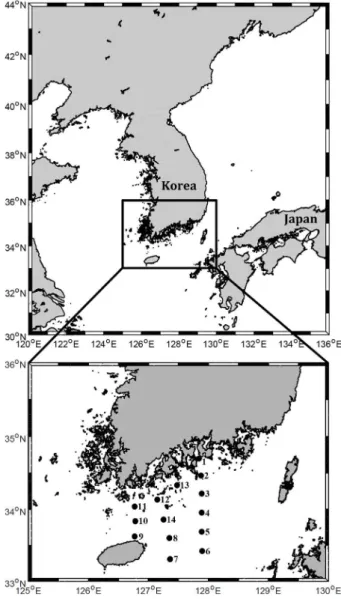
Fig. 1. Map showing the sampling stations in the southwestern
까지
14
개 정점에서
3
일간 연속적으로 수행하였다
(Fig.
1).
조사 해역의 수온과 염분은 수온
,
염분
,
수심 연속측정
장비
(CastAway-CTD, Sontek, USA)
를 사용하여 측정하였
다
.
부유 물질
(Suspended solids; SS)
은 측정에 앞서 실험실
에서
GF/F
여과지를 증류수로 세척한 후
,
건조기
(KS/VS-1202D4N, Vision scientific Co., Korea)
를 이용해
60°C
에서
24
시간 건조하였다
.
건조된 여과지는 정밀 저울
(CP-225D,
Sartorious, Germany)
로 건중량을 측정한 뒤
,
페트리 디쉬
에 밀봉하여 다음 단계를 준비하였다
.
현장에서 표층
30
cm
이내
500
mL
의 해수를 채수하여 준비된
GF/F
여과지
로 여과하고 냉동
(-20°C)
하여 실험실로 운반한 뒤
,
건조
기
(110°C)
에서
2
시간 건조하고 부유 물질의 건중량을 측
정하였다
. Chlorophyll
a
농도
(Chl-
a)
측정은 현장에서 채
수
(
표층
30
cm
이내
)
된 해수
500
mL
를
0.2
μm
박막여과지
(Membrane filter, Advantec, Japan)
로 여과
, 15
mL tube
에 넣
어 냉동보관
(-20°C)
하였다
.
실험실에서
90%
(v/v)
아세톤
10
mL
를 주입하여
24
시간 냉암소에서 색소를 추출한 후
에
3200
rpm
에서
12
분간 원심 분리시켜 상등액을 취해 형
광 광도계
(Optizen 2120UV, Mecasys Co., Korea)
를 사용하
여 측정하였다
(SCOR-UNESCO 1966).
식물플랑크톤 채
집은 채수된 해수
500
mL
를 루골 용액
(Lugol solution)
으로
최종 농도
2%
가 되도록 고정하였고
,
알루미늄 호일로 차
광 보관하였다
.
운반 후
,
자유 낙하방법으로 최종 농도
10
mL
가 되도록 농축한 후
,
시료
0.1
mL
를 마이크로피펫으로
Sedwick-Rafter
챔버에 취해 고배율 광학현미경
(ECLIPSE
80i, Nikon, Japan)
을 이용하여
200
~
400
X
하에서 돌말류와
와편모조류의 출현 세포수
(cells mL
-1)
에 의한 현존량을 파
악하였다
(Chihara and Murano 1997).
수표층의 부유플라스틱과 동물플랑크톤 채집을 위한 선
미 채집 방식은 선박 추진 장치인 스크류 프로펠러에서 발
생하는 충격파에 의하여 동물플랑크톤의 회피 현상으로
종 조성과 생물량 변동을 유발할 수 있다
(Sohn
et al. 2010).
이러한 단점을 보완하기 위해 선박 측면에서 뱃머리에 의
해 형성된 파의 영향을 받지 않도록 뉴스톤 네트
(David-Hempel neuston net, model 300, Hydro-Bios Co., Germany;
망목
300
μm)
를 멀리 설치하여
20
분간 평균
2.5
knots
의 속
도로 수평 채집하였다
(Fig. 2).
정량 분석을 위해 유량계
(model 438-115, Hydro-Bios Co., Germany)
를 뉴스톤 네
트 입구에 설치하여 여과 해수량을 측정하였다
.
채집된 시
료는 선상에서 해수를 제거한 후
99.5%
에틸 알코올로 고
정하여 실험실로 운반하였다
.
표면에 부유하는 미세플라
스틱은 복족류
,
십각류 유생 등 생물이 부착하게 되면 밀
도가 증가하여 저층에 가라앉으므로 표층에 떠있는 플라
스틱만을 계수하는 자유낙하방법은 적절하지 않을 수 있
다
(Collignon
et al. 2012).
따라서
,
분할 없이 광학현미경
(SMZ645, Nikon, Japan)
하에서 크기에 따라 부유플라스
틱을 미세플라스틱
(microplastic: 0.3
~
5.0
mm)
과 중형플라
스틱
(mesoplastic: 5.0
mm
초과
)
으로 분리
,
선별하고 페트
리 디쉬에 보관하였다
.
증류수와
GF/F
여과지를 사용하
여 여과
,
건조기
(60°C)
에서
24
시간 건조하고 정밀 저울로
건중량을 측정하였다
.
측정 후
,
광학현미경으로 여과지 위
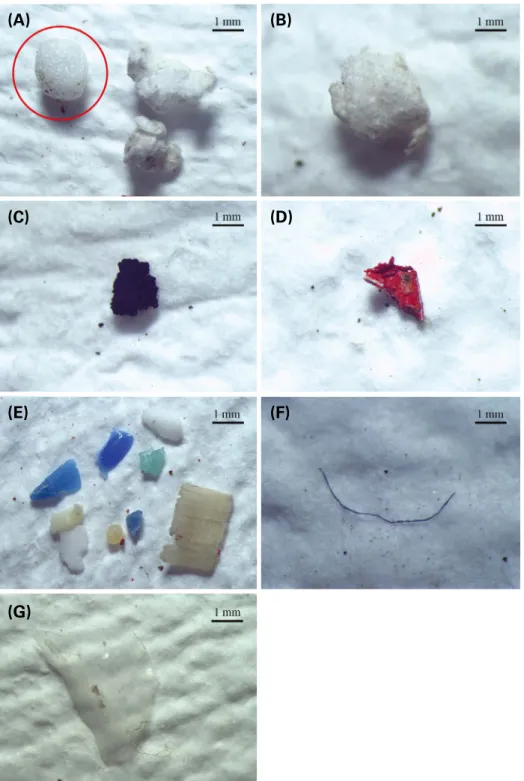
부유플라스틱을 섬유 조각
(fiber),
필름
(film),
하드 플라스
틱
(hard plastic),
페인트 조각
(paint particle),
스티로폼 파
편
(styrofoam fragment),
구형 스티로폼
(styrofoam sphere),
기타
(others)
로 구분
,
계수하였다
(Fig. 3).
부유플라스틱의
사진 촬영 및 길이 측정은 광학현미경
(SMZ745T, Nikon,
Fig. 3. Floating plastics appeared in the study area: (A) styrofoam sphere, (B) styrofoam fragment, (C), (D) Paint particles, (E) hard plastics, (F) fiber, and (G) film.
(A) (B)
(C) (D)
(E) (F)
Japan)
과 아이솔루션 프로그램
(version Lite, IMT i-Solution
Inc., Canada)
을 이용하였다
.
부유플라스틱 계수는 공기
중의 플라스틱 유입 방지를 위해 흄 후드
(CLD-101-05,
CHCLAB Co., Korea)
내에서 실시하였다
.
2. 동물플랑크톤
흄 후드에서 부유플라스틱 시료 처리 후
,
광학현미경을
이용하여 수표성 동물플랑크톤의 종 동정과 출현 개체수
를 파악하였다
.
종 동정을 위해 세밀한 관찰이 필요한 경우
,
형태 동정에 필요한 부속지를
70%
락토페놀
(Lactophenol
solution)
을 떨어뜨린 슬라이드 글라스 위에서 해부한 후
,
고배율 광학현미경
(ECLIPSE E200, Nikon, Japan)
으로 형태
를 관찰 종을 특정하였다
.
계수된 출현 개체수는 단위 체적
당 출현 개체수
(ind. m
-3)
로 환산하였다
.
3. 자료 분석
PRIMER
프로그램
(PRIMER-E version 6.1.6, New
Zea-land)
으로 환산된 동물플랑크톤 출현 개체수를 로그
(log
(x
+1))
지수로 변환하였고
, Bray-Curtis
유사도 지수를 근
거로 집괴 분석
(Clarke and Gorley 2006)
과
SIMPER
(Bray
and Curtis 1957)
분석을 실시하였다
.
동물플랑크톤과 환경
요인 간의 상관 관계를 설명하기 위해 중복 분석
(Redun-dancy analysis)
과 피어슨 상관 분석
(Pearson’s correlation
analysis)
을
R packages version 3.6.1 vegan
를 이용하여 실시
하였다
(Oksanen
et al. 2014).
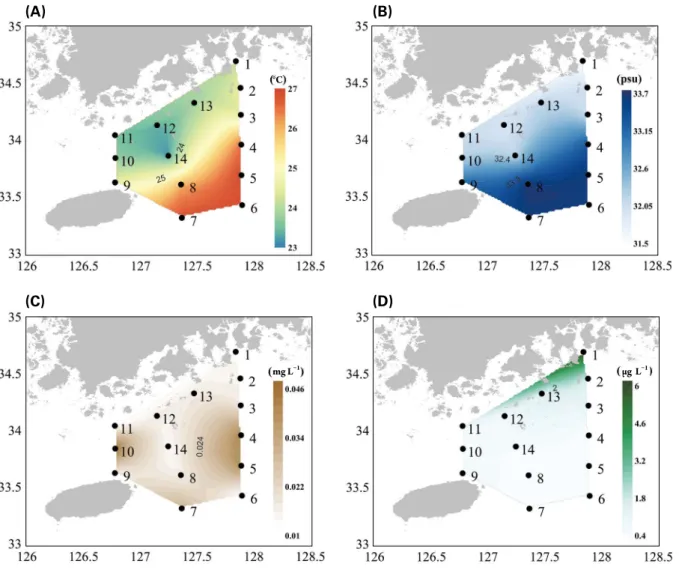
Fig. 4. Environmental factors in the sampling stations in September, 2017. (A) water temperature, (B) salinity, (C) suspended solids, and (D) chlorophyll a concentration.
(A) (B)
(C) (D)
°C결 과
1. 수온, 염분, 부유 물질 농도, Chl-a 농도,
식물플랑크톤 밀도
표층 수온과 염분은 각각
23.2
~
26.9°C와
31.50
~
33.69
의 범위로 나타났다
(Fig. 4A, B).
제주도 동쪽과 외해역
(Sts.
4
~
8)
에서 평균
26.7°C
로 높게 나타난 반면
,
나머지 정점
에서는 평균
23.9°C
로 남해 연안 인접 해역 및 거문도 주
변 해역에서 낮게 나타났다
.
표층 염분은 제주도 인근 해역
(St. 9),
제주도 동쪽 및 외해역
(Sts. 4
~
8)
에서 평균
33.51
로
나타났고 남해 연안 해역
(Sts. 1
~
3, 10
~
13)
과 거문도 남쪽
해역
(St. 14)
에서 평균
32.04
로
1.47
의 차이를 보였다
.
부유
물질은
2.85
~
12.10
mg L
-1의 범위로 제주 해협의
St. 10
에
서 가장 높았고 보길도 인근 해역
(St. 11)
에서 가장 낮았다
(Fig. 4C). Chl-
a
농도는
0.38
~
6.19
μg L
-1의 범위로 여수 해
만
(St. 1)
에서
6
μg L
-1이상으로 매우 높은 농도를 보였으며
(Fig. 4D),
그 외 정점에서는 평균
1.11
μg L
-1로 낮았다
.
식물
플랑크톤 중 돌말류의 밀도는
0.3
~
173.5
cells mL
-1의 범위
로 나타났고
,
와편모조류 밀도는
0.1
~
3.9
cells mL
-1의 범위
로 나타났다
(Table 1).
돌말류 밀도는 여수를 중심으로 높
게 나타났으며
,
외해역으로 갈수록 감소하는 양상을 보였
다
.
2. 부유플라스틱 분포 및 구성
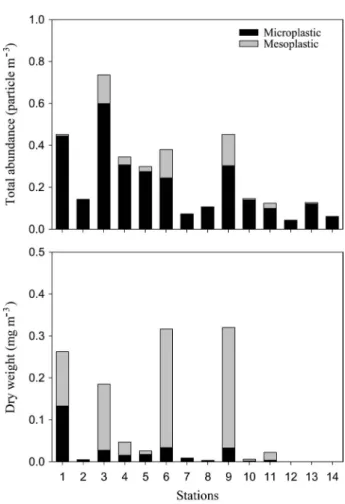
부유플라스틱 전체 입자수는
0.043
~
0.736
particle m
-3의
범위로 금오도 남쪽 해역
(St. 3)
에서 가장 높았고 거문도
북쪽 해역
(St. 12)
에서 가장 낮았다
(Fig. 5).
미세플라스틱
건중량은 제주도 동쪽 외해역
(St. 6)
에서
0.034
mg m
-3로 가
장 높았고 남해 연안 해역
(Sts. 12, 13)
과 거문도 남쪽 해역
(St. 14)
에서 평균
0.0003
mg m
-3로 가장 낮았다
.
중형플라
스틱의 건중량은 제주도 인근 해역
(St. 9)
에서
0.287
mg m
-3로 가장 높았으며
,
외나로도 인근 해역
(St. 13)
에서
0.0002
mg m
-3로 가장 낮았다
.
부유플라스틱의 구성은
Fig. 6
과 같
이 나타났다
.
전 해역에서 섬유 조각이 분포하였으며
,
일부
해역을 제외한 정점에서 미세플라스틱 크기의 페인트 조
각과 스티로폼 파편이 나타났다
.
중형플라스틱의 경우
,
제
주도
(St. 9)
와 보길도 인근 해역
(St. 11),
금오도 남쪽 해역
에서 제주도 동쪽 외해역
(Sts. 3
~
6)
까지 스티로폼 파편과
구형 스티로폼이
50%
이상 차지하였다
.
3. 동물플랑크톤 출현 양상과 환경요인과의 관계
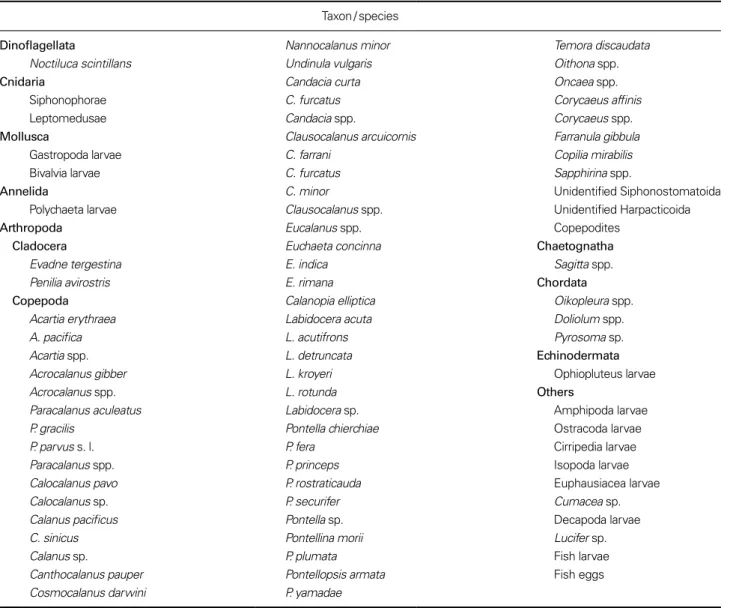
동물플랑크톤은 미동정된 분류군을 포함하여
81
개 분
Table 1. Density of phytoplankton(diatoms and dinoflagellates) at the sampling stations in September, 2017
Stations 1 2 3 4 5 6 7 8 9 10 11 12 13 14 Diatoms 173.5 15.1 11.5 0.3 1.1 0.3 0.6 2.4 1.3 1.0 2.2 1.3 2.2 0.9 Dinoflagellates 1.5 1.8 3.9 0.1 0.1 0.3 0.5 0.5 0.4 0.4 0.6 0.6 0.3 0.9 Total(cells mL−1) 175.0 16.9 15.4 0.4 1.2 0.6 1.1 2.9 1.7 1.4 2.8 1.9 2.5 1.8
Fig. 5. Total abundance and dry weight of micro- and
류군이었다
(Table 2).
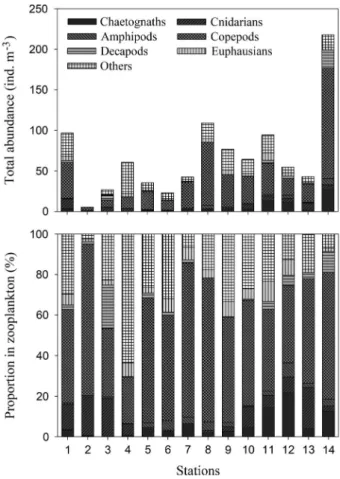
해역별 출현 개체수는
5.3
~
217.8
ind. m
-3의 범위였다
.
거문도 남쪽 해역
(St. 14)
에서 가장
높았고
,
금오도 인근 해역
(St. 2)
에서 가장 낮았다
(Fig. 7).
출현한 동물플랑크톤 가운데 요각류가 평균
52.5%
로 최
우점 분류군이었다
.
제주도 동쪽 및 외해역
(Sts. 5
~
8)
이
외의 정점에서는 해파리류가 출현하였으며
,
다른 정점에
비해
St. 4
에서 바다술통류와 미충류가 높은 점유율을 차
지하였다
.
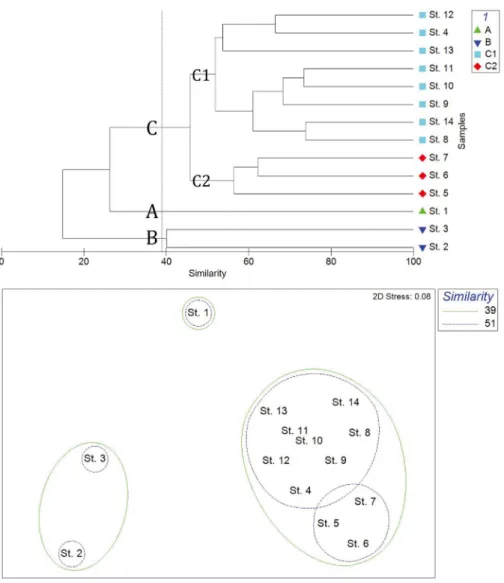
조사 해역별 동물플랑크톤 출현과 환경요인과의 관
계를 살펴보기 위해 대부분 종 동정이 이루어진 요각류
의 출현 개체수를 통해 얻은 집괴 분석 결과
(Fig. 8),
섬
진강 수의 영향을 받는
A
해역
(St. 1),
외해수와 만나 연
안전선을 형성하는
B
해역
(Sts. 2, 3)
그리고 제주난류와
쓰시마난류의 영향권인
C
해역으로 구분되었다
.
또한
C
해역은 제주난류의 영향을 강하게 받는
C1
해역
(Sts. 4,
8
~
14)
과 쓰시마난류의 직접적인 영향을 받는
C2
해역
(Sts. 5
~
7)
으로 구분하였다
. SIMPER
분석을 통해 각 해
역 구분에 영향을 미친 종을 살펴본 결과
(Table 3), B
해역
은
Pontella chierchiae
가
48.64%
로 가장 높은 기여율을 보였
고
,
Corycaeus spp.
가
18.36%,
Acartia erythraea
가
13.41%
의
기여율을 보였다
. C1
해역에서는
Canthocalanus pauper
가
19.99%
로 가장 높은 기여율을 보였으며
,
Paracalanus spp.
(12.99%),
P. gracilis
(11.89%),
Corycaeus spp.
(10.64%)
순
Fig. 6. Composition of micro- and meso-plastic at the sampling stations in September 2017.
Fig. 7. Variations in total abundance and the proportion of
으로 나타났다
. C2
해역에서
22.33%
로 가장 높은 기여율
을 보인 분류군은
Oncaea spp.
였으며
,
C. pauper
가
17.23%,
Clausocalanus furcatus
가
10.72%
로 나타났다
. SIMPER
분석
결과를 바탕으로 해역 구분에 영향을 미친 분류군을 식성
에 따라 입자식자
(Particle feeder copepods; PC)
와 육식자
(Carnivorous copepods; CC)
로 구분하고
,
그중
10%
이상의
기여도를 보인 주요 분류군을 대상으로 수온
(Temp.),
염
분
(Sali.),
부유 물질
(SS), Chlorophyll
a
농도
(Chl-
a),
돌말
류
(DT),
와편모조류
(DF),
미세플라스틱
(Microplastic),
중
형플라스틱
(Mesoplastic)
등 환경요인과의 상호 연관성을
파악하였다
.
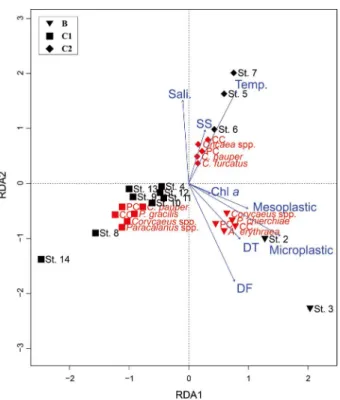
그 결과
A
해역을 제외한 모든 해역은 제
1
축
과
2
축 각각
5.907
과
4.786
의 고유값을 나타냈으며
,
누적
기여율은
82.7%
를 나타냈다
(Table 4). B
해역
(Sts. 2, 3)
에
출현한
Corycaeus spp., P. chierchiae, PC, CC, A. erythraea
는
Chl-
a
농도
, DT, DF, Microplastic, Mesoplastic
과 밀접한 양
의 방향성을 보였다
(Fig. 9). C2
해역
(Sts. 5
~
7)
에서는
CC,
Oncaea spp., PC, C. pauper, C. furcatus
는 수온
,
염분
, SS
와 양
의 방향성을 나타냈다
.
반면
, C1
해역
(Sts. 4, 8
~
14)
에서 출
현한 요각류는 수온
,
염분
, SS
와 음의 방향성을 보였다
.
유
의성 검정을 위한 상관 분석 결과
, B
해역
(
▼
)
에 출현한 요
각류는
DT, DF, Microplastic, Mesoplastic
과 약한 양의 관
계를 나타냈고
(
p
<0.05), C2
해역
(
◆
)
의 분류군들은 수온
,
염분
, SS
에 약한 양의 관계를 나타내었다
(
p
<0.05)
(Fig.
10).
Table 2. List of zooplankton occurring in the study areas
Taxon / species
Dinoflagellata Nannocalanus minor Temora discaudata Noctiluca scintillans Undinula vulgaris Oithona spp.
Cnidaria Candacia curta Oncaea spp.
Siphonophorae C. furcatus Corycaeus affinis
Leptomedusae Candacia spp. Corycaeus spp.
Mollusca Clausocalanus arcuicornis Farranula gibbula
Gastropoda larvae C. farrani Copilia mirabilis
Bivalvia larvae C. furcatus Sapphirina spp.
Annelida C. minor Unidentified Siphonostomatoida Polychaeta larvae Clausocalanus spp. Unidentified Harpacticoida Arthropoda Eucalanus spp. Copepodites
Cladocera Euchaeta concinna Chaetognatha
Evadne tergestina E. indica Sagitta spp. Penilia avirostris E. rimana Chordata Copepoda Calanopia elliptica Oikopleura spp.
Acartia erythraea Labidocera acuta Doliolum spp. A. pacifica L. acutifrons Pyrosoma sp. Acartia spp. L. detruncata Echinodermata
Acrocalanus gibber L. kroyeri Ophiopluteus larvae
Acrocalanus spp. L. rotunda Others
Paracalanus aculeatus Labidocera sp. Amphipoda larvae
P. gracilis Pontella chierchiae Ostracoda larvae
P. parvus s. l. P. fera Cirripedia larvae
Paracalanus spp. P. princeps Isopoda larvae
Calocalanus pavo P. rostraticauda Euphausiacea larvae
Calocalanus sp. P. securifer Cumacea sp. Calanus pacificus Pontella sp. Decapoda larvae
C. sinicus Pontellina morii Lucifer sp. Calanus sp. P. plumata Fish larvae
Canthocalanus pauper Pontellopsis armata Fish eggs
고 찰
Lie and Cho
(2016)
는 남해 서부 해역이 여름에 동중국
해에서 중국 연안을 따라 남하하는 중국 연안수
(Chinese
coastal water)
와 제주난류
(Jeju warm current)
가 혼합되어
제주 해협을 통과하는 수괴가 존재할 수 있음을 주장하였
다
.
본 연구에서 여름
(9
월
)
에 출현한 수표성 동물플랑크톤
,
특히 요각류 종을 대상으로 집괴분석을 실시한 결과 조
사 해역은 크게 여수 연안
(A
해역
),
난류수 영향 해역
(C
해
역
)
그리고 이들의 중간 수역
(B
해역
)
으로 구분되었다
.
난
류수 영향 해역은 제주난류의 영향을 받는 해역
(C1
해역
)
과 쓰시마난류의 영향을 직접적으로 받는 해역
(C2
해역
)
으
로 세분되었다
(Fig. 8). B
해역에서는
P. chierchiae, Corycaeus
spp.,
A. erythraea
가 높은 기여율을 보였다
. C1
해역에서는
C.
pauper, Paracalanus spp., P. gracilis, Corycaeus spp.
가
, C2
해역
에서는
Oncaea spp., C. pauper, C. furcatus
가 주요종으로 출
현하였다
.
이 중
P. chierchiae
와
C. pauper, P. gracilis, Oncaea
spp.,
C. furcatus
는 쓰시마난류 및 쿠로시오 해류의 유입을
지시하는 지표종으로 알려져 있다
(Hsieh
et al. 2004; Jeong
et al. 2008).
특히
,
P. chierchiae
가 여수 해만에 우점하여 출
현한 것은 시기적으로 쓰시마난류의 세력 확장으로 인한
출현 증가로 보이며
,
이는 선행연구와 비슷하게 나타났다
(Moon
et al. 2010; Jeong et al. 2014).
Fig. 8. Dendrogram and representative groups with more than 39% similarity by cluster analysis based on the abundance of copepod in
한편
, B
해역에서 높은 기여율을 보인
A. erythraea
는 여수
내만에서 여름에 높은 출현 개체수를 보이는 종으로 알려
져 있다
(Moon
et al. 2010).
따라서 강내만성종으로 알려진
A. erythraea
의
B
해역까지 출현 분포의 확장은 여름철의 장
마와 태풍으로 인한 섬진강 수 유입 증가와 밀접한 관계가
있을 수 있다
.
이러한 결과는 우리나라 여름 장마와 태풍에
따른 섬진강 수의 유입 증가가
B
해역의 동물플랑크톤 군집
구조에 까지 영향을 미칠 수 있음을 시사하고 있다
.
또한
,
연안에 우점하는
Corycaeus affinis
와 다른
Corycaeus spp.
가
B
와
C1
해역에서 출현하였다
. Seo
et al.
(2018)
은
C.
affinis
가
봄과 여름철 남해 연안과 제주 연안에서만 출현하며
,
또 다
른 종인
Corycaeus sp.
가 봄과 여름 동해 연안과 제주 연안
해역에서만 출현한다고 보고하였다
.
본 조사의
B
와
C1
해
역에서 출현한
Corycaeus spp.
또한 이들 종들과는 형태적으
로 달랐다
.
이러한 사실은
Corycaeus
속의 종들이 수괴지표
종으로 중요한 역할을 할 수 있음을 보여준다
.
해역별 우점 요각류를 식성에 따라
2
개 그룹으로 구분하
고 중복 분석과 상관 분석한 결과
B
해역에 출현한 주요 종
들은 식물플랑크톤
,
부유플라스틱과 약한 양의 상관 관계
를 보였다
(
p
<0.05). C2
해역에서 출현한 종들은 수온
,
염
분
,
부유 물질과 약한 양의 관계를 나타냈다
(
p
<0.05).
이러
한 결과는 수표성 동물플랑크톤의 출현 양상이 부유플라
스틱의 분포에 부분적으로 영향을 받을 수 있음을 시사한
다
.
Table 3. Results of similarity percentages procedure(SIMPER) analysis for dominant copepods and their feeding habits in the four areas
Group Species Contribution(%) Feeding habits References A Less than 2 samples in group
B
Pontella chierchiae 48.64 Carnivorous Ohtsuka and Onbé(1991)
Corycaeus spp. 18.36 Carnivorous Gophen and Harris(1981)
Acartia erythraea 13.41 Particle feeder Sheng et al.(2010)
Acrocalanus spp. 9.76 Particle feeder Tseng et al.(2008)
C C1
Canthocalanus pauper 19.99 Particle feeder Hu et al.(2014)
Paracalanus spp. 12.99 Particle feeder Paffenhöfer(1984)
Paracalanus gracilis 11.89 Particle feeder
-Corycaeus spp. 10.64 Carnivorous
-Paracalanus parvus s. l. 9.11 Particle feeder
-Oncaea spp. 8.58 Carnivorous Go et al.(1998)
Acartia pacifica 7.68 Carnivorous
-Clausocalanus furcatus 3.68 Particle feeder Uttieri et al.(2008)
Paracalanus aculeatus 3.01 Particle feeder
-Temora discaudata 2.93 Carnivorous Tseng et al.(2008)
C2
Oncaea spp. 22.33 Carnivorous
-Canthocalanus pauper 17.23 Particle feeder
-Clausocalanus furcatus 10.72 Particle feeder
-Corycaeus spp. 7.83 Carnivorous
-Paracalanus gracilis 7.11 Particle feeder
-Pontellina morii 4.87 Carnivorous Ohtsuka and Onbé(1991)
Labidocera detruncata 4.41 Carnivorous Fleminger(1975)
Paracalanus spp. 4.02 Particle feeder
-Paracalanus aculeatus 3.65 Particle feeder
-Farranula(corycaeus) gibbula 2.38 Carnivorous Dessier and Donguy(1985)
Euchaeta concinna 2.28 Carnivorous Yen(1985)
Nannocalanus minor 2.14 Particle feeder Santhanam et al.(2015)
Eucalanus spp. 1.80 Particle feeder Tester and Turner(1988)
한편
,
섭식 형태로 알아본
P. chierchiae
와
Corycaeus
속 요
각류의 종들은 육식자로 먹이를 움켜쥐고 섭식하는 특징
을 가지고 있으며
(Gophen and Harris 1981; Ohtsuka and
Onbé 1991),
A. erythraea
와
Acrocalanus
속의 종들은 전형적
인 입자 식자로 수중에 부유하는 작은 먹이를 섭식하는 특
징을 가지고 있다
(Tseng
et al. 2008; Sheng et al. 2010). Sun
et al.
(2017)
은 남중국해에서 출현한 요각류
,
화살벌레류
,
해파리류
,
새우류
,
어류 유생 등 다섯 분류군의 미세플라스
틱 섭취를 보고하였으며 또한
,
서해에 출현한 다양한 동물
플랑크톤 분류군의 장 내와 해수 내 존재하는 미세플라스
틱 현존량을 비교하였다
(Sun
et al. 2018).
한편
, Kang
et al.
(2018)
은 먹이가 많은 연안에서 동물플랑크톤의 미세플라
스틱 섭식이 중요하지 않음을 시사하였다
.
제한적인 먹이
조건의 실험이 아닌 현장의 부유플라스틱 입자수는 식물
플랑크톤의 현존량보다 현저히 적었으며
,
동물플랑크톤은
mouth parts
의 크기를 고려하여 선택적으로 먹이를 섭취하
기 때문에
,
유의한 결과가 나타났을지라도 입 크기보다 큰
플라스틱을 먹이로 활용하기 어려울 것이라 판단된다
.
그
럼에도 불구하고 봄철 제주도 인근 해역
(St. 9)
에서 출현한
치어류의 위 내용물 분석 결과 페인트 조각과 섬유 조각이
관찰되었으며
(Fig. 11A)
(
미발표
),
여름 제주도 동쪽 해역
Fig. 9. Redundancy analysis(RDA) ordination diagrams related
to environmental factors(blue arrows), stations, and copepods in September 2017. Abbreviations: PC(particle feeder copepods), CC(carnivorous copepods), Sali.(salinity), SS(suspended solids), Temp.(water temperature), Chl -a(chlorophyll a concentration), DT(diatoms), DF(dinoflagellates), microplastic, mesoplastic. The symbols were divided according to the sea areas.
Fig. 10. Results of Pearson’s correlation analysis(p<0.05) for the relationship between copepods and environmental factors by sea areas(B area, ▼; C1 area, ■; C2 area, ◆). Abbreviations: PC(particle feeder copepods), CC(carnivorous copepods), Sali. (salinity), SS(suspended solids), Temp.(water temperature), Chl-a (chlorophyll a concentration), DT(diatoms), DF(dinoflagellates), microplastic, mesoplastic.
Table 4. Summary of redundancy analysis(RDA) for the
relation-ship between copepods and environmental factors
Importance of components RDA1 RDA2 Eigenvalue 5.907 4.786 Proportion Explained 0.457 0.370 Cumulative Proportion 0.457 0.827
(St. 7)
에서는 육식자로 알려져 있는 화살벌레류의 소화관
에서 섬유 조각이 관찰되었다
(Fig. 11B).
이는 채집과정에
서 발생하는
cod end effect
에 의한 것일 수 있다
.
결론적으로
,
우리나라 제주도를 향해 동쪽으로 이동하
는 양쯔강 희석수는 매년 여름 강한 경년 변동성이 있기 때
문에 확장 범위를 달리하는 것으로 알려져 있다
(Park
et al.
2017).
본 연구에서는 제주난류와 쓰시마난류의 세력 확장
으로 인하여 난수성 및 외양성 종이 여수 연안에서 출현하
였다
.
연구 해역 내 양쯔강 희석수의 유입과 그에 따른 영
향은 제한된 자료만으로는 판단하기 어려우므로 차후 서
해 남단 및 제주도 인근 해역에 대한 해류 특성을 파악하고
정확한 분석을 위해 연구 해역을 확장해야 할 것으로 여겨
진다
.
적 요
여수와 제주도 사이 해역에 출현한 수표성 동물플랑크
톤의 군집 분포와 환경요인 간의 관계를 파악하기 위해
2017
년
9
월 총
14
개 정점에서 뉴스톤 네트를 이용하여 선
박 측면에서 예인 및 채집하였다
.
동물플랑크톤은 총
81
개
분류군으로 요각류가 최우점하였다
.
동물플랑크톤 출현 개
Fig. 11. Photos of microplastics in the stomach contents of fish larvae and Sagitta sp.: (A) Fish larvae randomly sorted from St. 9 in May
2017(unpublished study); (B) Sagitta sp. collected from St. 7 in September 2017.
(A)
체수를 기반으로 연안수의 영향을 받는 해역
,
연안수와 외
해수가 만나는 해역
,
외해수의 직접적 영향을 받는 해역으
로 구분되었다
.
본 연구에서 해역별 우점 요각류
,
식성에 따
른 요각류를
2
개 그룹으로 구분하고 군집에 미치는 환경요
인을 분석한 결과 수온과 염분
,
식물플랑크톤
,
부유플라스
틱과 유의미하였다
(
p
<0.05).
추가로 연구 해역에 출현한
치어 및 화살벌레류의 위 내용물 분석을 통해 미세플라스
틱 섭식을 확인하였다
.
낮은 영양단계에서 섭취한 플라스
틱이 먹이사슬을 타고 올라가 높은 영양단계로 전달된 것
으로 보인다
.
결과적으로 우리나라 남해 서부 해역에 출현
하는 동물플랑크톤 군집 특성을 볼 때 여름철 확장 범위를
달리하는 섬진강 수
,
제주난류
,
쓰시마난류의 영향을 받아
군집 분포가 달라지는 것으로 판단된다
.
사 사
현장조사에 큰 도움을 주신 전남대학교 동백호 승조원
들께 깊은 감사를 드립니다
. Chl-
a
농도 분석 장비를 사용
할 수 있게 해주신 전남대학교 해양융합과학과 윤양호 교
수님
,
물리적 환경요인에 대한 조언을 해주신 추효상 교수
님께도 감사의 말씀을 전합니다
.
본 연구는
2017
년 전남대 연구비
(
대학회계
)
및
2020
년
해양수산부 재원으로 해양수산과학기술진흥원의 지원을
받아 수행된 연구
(ICT
기반 수산자원관리 수산전문인력양
성
)
입니다
.
R
EFE
R
ENCES
Bray JR and JT Curtis. 1957. An ordination of the upland forest communities of southern Wisconsin. Ecol. Monogr. 27:325-349.
Brodeur RD. 1989. Neustonic feeding by juvenile salmonids in coastal waters of the Northeast Pacific. Can. J. Zool. 67:1995-2007.
Chihara M and M Murano. 1997. An Illustrated Guide to Marine Plankton in Japan. Tokai University Press. Tokyo.
Cho YK and K Kim. 1994. Characteristics and origin of the cold water in the south sea of Korea in summer. J. Korean Soc. Oceanogr. 29:414-421.
Clarke K and RN Gorley. 2006. PRIMER V6: user manual/tutorial. PRIMER-E. Plymouth, UK.
Cole M, PK Lindeque, E Fileman, J Clark, C Lewis, C Halsband and TS Galloway. 2016. Microplastics alter the properties and sinking rates of zooplankton faecal pellets. Environ. Sci. Tech-nol. 50:3239-3246.
Collignon A, JH Hecq, F Glagani, P Voisin, F Collard and A Goffart. 2012. Neustonic microplastic and zooplankton in the North Western Mediterranean Sea. Mar. Pollut. Bull. 64:861-864. Cózar A, F Echevarría, JI González-Gordillo, X Irigoien, B
Úbe-da, S Hernández-León, ÁT Palma, S Navarro, J García-de-Lomas, A Ruiz, ML Fernández-de-Puelles and CM Duarte. 2014. Plastic debris in the open ocean. Proc. Natl. Acad. Sci. USA 111:10239-10244.
Davenport J and EIS Rees. 1993. Observations on neuston and floating weed patches in the Irish Sea. Estuar. Coast. Shelf Sci. 36:395-411.
Dessier A and JR Donguy. 1985. Planktonic copepods and envi-ronmental properties of the eastern equatorial Pacific: sea-sonal and spatial variations. Deep Sea Res. Part I-Oceanogr. Res. Pap. 32:1117-1133.
Fleminger A. 1975. Geographical distribution and morphological divergence in american coastal-zone planktonic copepods of the genus Labidocera. Estuar. Res. 1:392-419.
Go Y, B Oh and M Terazaki. 1998. Feeding behavior of the poecil-ostomatoid copepods Oncaea spp. on chaetognaths. J. Mar. Syst. 15:475-482.
Gophen M and RP Harris. 1981. Visual predation by a marine cy-clopoid copepod, Corycaeus anglicus. J. Mar. Biol. Assoc. U. K. 61:391-399.
Ha SY, SW Kang, MO Park, YN Kim, SH Kang and KH Shin. 2010. Photoinduction of UV-absorbing compounds and photopro-tective pigment in Phaeocystis pouchetii and Porosira
glacial-is by UV exposure. Ocean Polar Res. 32:397-399.
Holdway P and L Maddock. 1983. Neustonic distributions. Mar. Biol. 77:207-214.
Hsieh CH, TS Chiu and CT Shih. 2004. Copepod diversity and composition as indicators of intrusion of the Kuroshio Branch Current into the Northern Taiwan Strait in Spring 2000. Zool. Stud. 43:393-403.
Hu S, Z Guo, T Li, EJ Carpenter, S Liu and S Lin. 2014. Detecting
in situ copepod diet diversity using molecular technique:
de-velopment of a copepod/symbiotic ciliate-excluding eukary-ote-inclusive PCR protocol. PLoS One 9:e103528.
Jang MC, SH Baek, PG Jang, WJ Lee and KS Shin. 2012. Pat-terns of zooplankton distribution as related to water masses in the Korea Strait during winter and summer. Ocean Polar Res. 34:37-51.
Jeong HG, HL Suh, YH Yoon and HY Soh. 2008. Redescription of
Pontella species(Calanoida, Pontellidae) from Korean waters, with notes on their spatio-temporal distribution. Ocean Sci. J.
43:209-222.
Jeong HG, HL Suh, W Lee and HY Soh. 2014. Seasonal variation of the neustonic zooplankton community in southern waters of Korea. Ocean Sci. J. 49:167-181.
Kang HS, MH Seo, YS Yang, EO Park, YH Yoon, D Kim, HG Jeong and HY Soh. 2018. Zooplankton and neustonic microplastics in the surface layer of Yeosu coastal areas. Korean J. Environ. Biol. 36:11-20.
Kingsford MJ and JH Choat. 1986. Influence of surface slicks on the distribution and onshore movements of small fish. Mar. Biol. 91:161-171.
Leech DM and CE Williamson. 2000. Is tolerance to UV radiation in zooplankton related to body size, taxon, or lake transparen-cy? Ecol. Appl. 10:1530-1540.
Li J, D Yang, L Li, K Jabeen and H Shi. 2015. Microplastics in commercial bivalves from China. Environ. Pollut. 207:190-195.
Lie HJ and CH Cho. 2016. Seasonal circulation patterns of the Yellow and East China Seas derived from satellite-tracked drifter trajectories and hydrographic observations. Prog. Oceanogr. 146:121-141.
Lima YDS and MJ Chretiennot-Dinet. 1984. Measurements of biomass and activity of neustonic microorganisms. Estuar. Coast. Shelf Sci. 19:167-180.
Marshall SM, AG Nicholls and AP Orr. 1935. On the biology of
Calanus finmarchicus. Part VI. Oxygen consumption in
rela-tion to environmental condirela-tions. J. Mar. Biol. Assoc. U. K. 20:1-27.
Moon SY, HJ Oh and HY Soh. 2010. Seasonal variation of zoo-plankton communities in the southern coastal waters of Korea. Ocean Polar Res. 32:411-426.
Na JY, SK Han and DK Cho. 1990. A study on sea water and ocean current in the sea adjacent to Korea peninsula - Ex-pansion of coastal waters and its effect on temperature vari-ations in the South Sea of Korea. Korean J. Fish. Aquat. Sci. 23:267-279.
Ohtsuka S and T Onbé. 1991. Relationship between mouthpart structures and in situ feeding habits of species of the family Pontellidae(Copepoda: Calanoida). Mar. Biol. 111:213-225. Oksanen J, FG Blanchet, R Kindt, P Legendre, RB O’Hara, GL
Simpson, P Solymos, MHH Stevens and H Wagner. 2014. Vegan: Community Ecology Package. R package Version 2.2-0. http://CRAN.Rproject.org/package=vegan.
Padmavati G and SC Goswami. 1996. Zooplankton distribution in neuston and water column along west coast of India from Goa to Gujarat. Indian J. Mar. Sci. 25:85-90.
Paffenhöfer GA. 1984. Does Paracalanus feed with a leaky sieve? Limnol. Oceanogr. 29:155-160.
Park C, CR Lee and JC Kim. 1998. Zooplankton community in the front zone of the east sea(the sea of Japan), Korea: 2. Relationship between abundance distribution and seawater temperature. J. Korean Fish. Soc. 31:749-759.
Park KA, JE Park, BJ Choi, SH Lee, HR Shin, SR Lee, DS Byun, B Kang and EL Lee. 2017. Schematic maps of ocean currents in the Yellow Sea and the East China Sea for science textbooks based on scientific knowledge from oceanic measurements. J. Korean Soc. Oceanogr. 22:151-171.
Santhanam P, K Jothiraj, N Jeyaraj, S Jeyanthi, AS Devi and S Ananth. 2015. Effect of monoalgal diet on the growth, sur-vival and egg production in Nannocalanus minor(Copepoda: Calanoida). Indian J. Mar. Sci. 44:1579-1584.
SCOR-UNESCO. 1966. Determination of photosynthetic pig-ments. UNESCO Monogr. Oceanogr. Methodol. 1:11-18. Seo MH, SY Choi, EO Park, D Jeong and HY Soh. 2018. Species
diversity of planktonic copepods and distribution characteris-tics of its major species in coastal waters of Korea. Korean J. Environ. Biol. 36:525-537.
Sheng L, L Tao, H Hui, G Zhi-Ling, H Liang-Min and WX Wang. 2010. Feeding efficiency of a marine copepod Acartia
eryth-raea on eight different algal diets. Sheng Tai. Xue Bao.
30:22-26.
Smith SL and J Vidal. 1986. Variations in the distribution, abun-dance, and development of copepods in the southeastern Bering Sea in 1980 and 1981. Cont. Shelf Res. 5:215-239. Sohn MH, BH Park, YS Choi, SJ Lee, YS Kang and YS Kang. 2010.
Swimming behavior study of the zooplankton(Copepod
Cala-nus sinicus) by using a holographic particle tracking
velocim-etry technique. J. KIMST 13:941-949.
Sun X, Q Li, M Zhu, J Liang, S Zheng and Y Zhao. 2017. Ingestion of microplastics by natural zooplankton groups in the north-ern South China Sea. Mar. Pollut. Bull. 115:217-224.
Sun X, J Liang, M Zhu, Y Zhao and B Zhang. 2018. Microplastics in seawater and zooplankton from the Yellow Sea. Environ. Pollut. 242:585-595.
Tester PA and JT Turner. 1988. Comparative carbon -specific ingestion rates of phytoplankton by Acartia tonsa,
Centro-pages velificatus and Eucalanus pileatus grazing on natural
phytoplankton assemblages in the plume of the Mississippi River(northern Gulf of Mexico continental shelf). Hydrobiolo-gia 167/168:211-217.
Tseng LC, R Kumar, HU Dahms, QC Chen and JS Hwang. 2008. Copepod gut contents, ingestion rates and feeding impact in relation to their size structure in the southeastern Taiwan Strait. Zool. Stud. 47:402-416.
Turner JT. 1984. Zooplankton feeding ecology: contents of fecal pellets of the copepods Acartia tonsa and Labidocera aestiva from continental shelf waters near the mouth of the
Missis-sippi River. Mar. Ecol. 5:265-282.
Turner JT. 2015. Zooplankton fecal pellets, marine snow, phy-todetritus and the ocean’s biological pump. Prog. Oceanogr. 130:205-248.
Uttieri M, GA Paffenhöfe and MG Mazzocchi. 2008. Prey capture in Clausocalanus furcatus(Copepoda: Calanoida). The role of swimming behaviour. Mar. Biol. 153:925-935.
Yen J. 1985. Selective predation by the carnivorous marine
copepod Euchaeta elongata: Laboratory measurements of predation rates verified by field observations of temporal and spatial feeding patterns. Limnol. Oceanogr. 30:577-597. Zagarese H, CE Williamson, M Mislivets and P Orr. 1994. The
vulnerability of Daphnia to UV-B radiation in the Northeast-ern United States. Adv. Limnol. 43:207-216.