Development of Automatic Ultrasonic Inspection System (SonicView)
Hyun-ju Yoo, Sung-nam Choi
KEPRI, Nuclear Power Lab., 103-16 munji-Dong, Yuseong-Gu, Daejeon, 305-380, Korea
1. Introduction
This paper describes the automatic ultrasonic inspection system (SonicView) that is under developing as a part of the project for development of automatic ultrasonic wave acquisition and analysis program. SonicView will be the user-friendly automatic ultrasonic inspection system through the benchmark of the automatic ultrasonic inspection system [1][2][3] commercialized and broadly used in NPP. Various image processing techniques will be adopted to detect the flaws in the component and piping welds in NPP. SonicView will enhance the integrity of nuclear power plant.
The object of this paper is to address the SonicVeiw which is developing for automatic ultrasonic inspection of welds in NPP.
2. System Description
The general specifications of SonicView are followed.
2.1 General Configuration of SonicView
The system architecture is designed to be modular, expandable, and aimed at embracing challenging ultrasonic examination techniques. The modularity and expandability are designed both in hardware and software. To replace or add new digital boards and software modules various methods are investigated.
Figure 1. General configuration for the SonicView architecture
2.2 Hardware Modules
A functional block diagram delineates the various modules in the hardware real-time section of the platform. SonicView platform is open-ended designed and not dedicated to a specific application of the ultrasonic examination.
Figure 2. Block diagram of hardware modules The hardware comprises both a real-time section for fast data transfer and a control section, devoted to programming, synchronizing, and calibrating for the platform hardware by the operative procedures. The fast data transfer in the real-time section devoted to transfer analog signal to digital data between the various processing modules (A/D board & UT Pulser/Receiver) and the PC. The control section is responsible for controlling and configuring each module in the real-time section. The hardware integration is obtained through the A/D board which is capable of achieving the required fast data transfer to the PC memory. SonicView hardwares are followed:
z A/D Board: converting digital signal to analog signal or analog signal to digital signal from UT Pulser/Receiver's control and output signals. z UT Pulser/Receiver: sending impulse signal to
probe, generating ultrasonic waves and converting digital signal for acquire signal.
z Probe: sending and receiving from ultrasonic wave of material (Welding in pipe of NPP) z Motion Controller: controlling Motor controller
of scanner.
z Amplifier : amplifying the electric signal. z Encoder: measuring the turning amount of motor
for correct position grasping of scanner with most AC Servo Motor, is combined model
PC
Scanner
Probe Motor/Encoder
A/D Board Motion Controller
UT Pulser / Receiver Amplifier
Transactions of the Korean Nuclear Society Autumn Meeting Busan, Korea, October 27-28, 2005
2.3 Software Modules
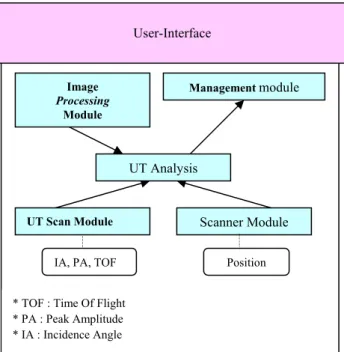
The software architecture can be imagined as a shell that encompasses the platform hardware. The user, through the interface, can control all modules (hardware / software processing and system information) through the software configuration panels. Users can easily coordinate the processing sequence and examination procedure through the user interface software. The software module is developed by C++ language and run under the Windows XP operation environment. SonicView is designed to satisfy the requirements of ASME Boiler & Pressure Vessel Section XI.
Figure 3. Block diagram of Software Modules SonicView software modules are followed:
z UT Scan module: generating and acquiring of ultrasonic signal
z Scanner module: controlling scanner
z UT Analysis module: analyzing ultrasonic signal z Image Processing module: ultrasonic signal image
processing
z Management module: managing ultrasonic data z UI(User Interface) module : user interface
3. Conclusion
This paper describes SonicView that is under developing as a part of the project for development of automatic ultrasonic inspection wave acquisition and evaluation program.
SonicView is designed to be modular and expandable for embracing challenging ultrasonic examination techniques. And state-of-the-art image processing techniques will be adopted to detect the flaws in the component and piping welds in NPP.
SonicView is ensured by ASME Code sec. XI, App. VIII, Performance Demonstration in Korea to be applicable in the nuclear power plants.
Improvement of SonicView will be maintain continuously for extending other automatic ultrasonic inspection field of Nuclear Power Plant like CRDM examination etc.
REFERENCES
[1] INTRASPECTTM Ultrasonic and Eddy Current Inspection
System Operations Manual, version 6.10
[2] MICROPLUS II POD Communication Protocol Specification, Version3, Veritec.
[3]Microplus2 Operational and Software Licwnce manual, Version 3, Veritec.
[4] Marco Scabia, “Hardware and Software platform for Real-Time Processing and Visualization of Echographic Radiorequency Signals”, IEE Transcation on ultrasonic, and Frequency control, Vol. 49, No.10, Oct , 2002.
[5] Jonathan J. Kaufman*a3b, Gangming Luo', and Robert S. Siffertb, ULTRASOUND SIMULATION FOR 3D-AXISYMMETRIC MODELS, IEEE Ultrasonic Symposium, pp.2066-2068, 2003.
Management module
UT Scan Module Scanner Module
UT Analysis Image
Processing
Module
IA, PA, TOF Position
* TOF : Time Of Flight * PA : Peak Amplitude * IA : Incidence Angle