© Korean Powder Metallurgy Institute 918 -1. Introduction
Powder metallurgy has lately attracted attention by reasons of both a proper parts-making process with complicated shape and close tolerance and the flexibility of alloy design. Thus it has been applied as an effective parts producing process for automobile and industrial machinery. But several shapes such as thread, traverse hold and undercuts cannot be formed without post machining operation. Furthermore the demands for parts with highly precise dimensions and functionally complicated shape are getting higher as time goes by so that the machining operation, as a post treatment of conventional P/M processes, is indispensable for meeting the customer’s requirements.
In general it is well known that the machinability of sintered parts is low by some causes like residual porosity and hard inclusion. It has been considered useful to add a machining aid to improve machinability without detrimental effects on mechanical properties. Many additives have been considered such as S, Bi, Te, MoS2, MnS and BN but only MnS has resulted in outstanding performance. [1] In actual uses, MnS presents the problems of extreme sensitivity to reaction with moisture and thermal decomposition during sintering. So, for resolve the problem of MnS, FeS was fabricated using the mechanical alloying method, [2-4] it offered the solid lubricant additive in sintered steel.
Recently, the novel synthesis process was occurred by combustion reaction during mechanical alloying method
called the MCP(Mechano-Chemical Process), its process is very simple and can easily fabricate the metal sulfide (MS). It is high cost-effective and environmental. This paper proposed the manufacturing process of various kinds of metal sulfide powder by MCP and their applications.
2. Applications of metal sulfides (1) Machinability enhancing agency (MnS)
The powder metallurgy materials were lowers the machinability by remaining pore than the ingot/forging. In other to solve this problem, MnS powder was added in parts of the iron alloy sintering materials. It is not only machinability also good for the mechanical properties. And, Added MnS in sintering material doesn’t decrease the physical characteristics, is reporting.
MnS powder was made by atomizing process using spray after melting, basically. But, the mechano-chemical process by combustion reactant heat during mechanical alloying can do without melting process, because MnS and xMnS powders were produced by the mechanical energy and the subsequent thermodynamic reactions. For improving sintering and mechanical properties of MnS, the transition elements of Cu, Fe and Mo were substituted 2~10wt% for Mn in the formula of MnS to produce xMnS powders. Fig.1 shows the effect of 0.5 wt% MnS and xMnS (x = 6 wt%) additions on cutting force with turning time elapsed. In case of xMnS(x =
2006 POWDER METALLURGY World Congress
C11-04-1 *Invited
Properties and Application of Metal Sulfide Powder
Dong-Kyu Park1,a, Sung-yeal Bae2,b, In-shup Ahn2,c, Kwang-Chul Jung1,d,e 1
Advanced Material Research Center, Kaya AMA Inc.
1010-1, Baekrok-Ri, Habuk-Myun, Yangsan-Si, Gyeongnam, 660-758, Korea;
2
Gyeong Sang National University
900, Gawza-Dong, Jinju-Si, Gyungnam, 660-701, Korea
a
[email protected], [email protected], [email protected], [email protected] Abstract
Metal sulfide powders such as MnS, MoS2 and FeS are simply used to the machinery processing improvement agent and solid
lubricant in powder metallurgy industrial. And then, metal sulfide powders have received relatively little attention from powder metallurgy. Recently, the portable machine is one of the important interfaces between human or human and electronic machine. With the increase of the intelligent activity, the social and industrial demands for information display device and power source are increasing. The transition metal sulfide materials (FeS, ZnS) have received considerable
attention due to the large variety of its electric, optical and magnetic properties. Among the metal sulfide, FeS2is appealing
superior material for applications in Li-2nd battery because of high capacity. ZnS is also a famous phosphor material with
various luminescence properties, such as photoluminescence (PL) and electroluminescence (EL). So generally used in the fields of display, sensors and laser. Metal sulfide materials, therefore, are provided for most widely application in all industries. In recent years, material researchers have become increasingly interested in studying with synthesis of metal sulfide.
© Korean Powder Metallurgy Institute 919 -0 100 200 300 xMnS(x=Fe) MnS C-MnS xMnS(x=Fe) Num b e r o f bor e s ( d ri lle d h o le s ) No-add
Mo) addition, cutting forces had the lowest values with machining time elapsed. This result revealed that xMnS(x = Mo) was quite useful additive but xMnS(x = Cu) was less effective one to enhance machinability. Especially, xMnS(x = Mo) addition gives nearly twice longer tool life than any other sulfides additions, it showed in Fig. 2. This significant improvement in machinability showed due to maintaining the stability under any practical environments and lubricating the tool more effectively.
In this study, low-density sintered metal filters were fabricated by sintering after die pressing method. Density, pore shape and permeability and mechanical strength of the filters were investigated with the variation of compressive pressure and sintering conditions.
5 10 15 20 25 30 35 40 45 50 0 50 100 150 200 250 Cut tin g force (N ) Time (min) No-add MnS C-MnS xMnS(x=Cu) xMnS(x=Fe) xMnS(x=Mo) Fig. 1. Effect of 0.5 wt% MnS and xMnS Mns and xMns (x = 6wt%) additions on cutting force with mac- hining time increasing.
Fig. 2. Effect of 0.5 wt% MnS and xMnS (x = 6wt%) additions on tool life
(2) Solid lubricant (MoS2, FeS, WS2, Cu2S)
As a solid lubricant, graphite and MoS2 are materials of
great interest, and moreover, WS2, BN (hexagonal), mica,
borax, AgS, CdI, PbI are used occasionally.
These solid lubricants are even more stable than liquid lubricants and those have thermo-stability. Graphite is not oxidized under 350℃ in the air, is stable over 1000℃ in vacuum or inactivity gas atmosphere. MoS2 is in general use
in abundance because it is also stable under 350℃ in the air and is stable until 600℃ in inactivity gas atmosphere.
But, MoS2 has demerits that it has low purity and has
lubricant property lower than graphite. Though MoS has good lubricant property, lubricant property is increased considerably when a little quantity of other sulfides; SnS is added to MoS. These solid lubricants are known that S of sulfide assists lubricant property in that it is sulfide.
Therefore, WS2, FeS, SnS, CrS and MnS containing S as
lubricants are coming into notice. There is CuS2 as similar
materials. It is possible for CuS2 to substitute MoS2. And it
is revealed in recent research that there is possible to substitute MoS2 in case of conventional powder metallurgy
product; oilless bearing. Its results showed in Fig. 3. (3) Photo luminescence
For conveying information, the portable machine is one of the important interfaces between human and human or electronic machine. With the increase of the intelligent
activity, the social and industrial demands for information display devices and power source are increasing.
0 5000 10000 15000 20000 0 5 10 15 20 25 30 35 KAB23 0.5% Cu2S 1.0% Cu2S 1.5% Cu2S 2.0% Cu2S 3.0% MoS2 Te m p e ratu re (℃ ) Time (sec)
Fig. 3. Changed of sintered materials during the bearing test for 1 hour powders.
Fig. 4. Luminescence spectra of mechanically alloyed ZnS for various times.
ZnS is also a famous phosphor material with various luminescence properties such as photo luminescence (PL), electro luminescence (EL) and so generally used in the field of displays, sensor and lasers. The fluorescence materials were divided on the sulfide and oxidized substance.
Among them, ZnS was great in the high brightness, electrically properties, high quality of emitting light efficiency and safety in high temperature. The sulfidation substance is doped by rare earth metal of Eu3+ and transition
metal of Cu2+ and Mn2+ has a various visible color.
Commonly, ZnS was synthesized using evaporating method and the liquid transformation method; it has the inclusions of the very complex manufacturing process. And the pollution was created with cleaning water and remaining matter in the making is causing to the environmental problem. But, a case of the ZnS powder fabricated by mechanical alloying, it will be able to solve the problem of the solution treatment method.
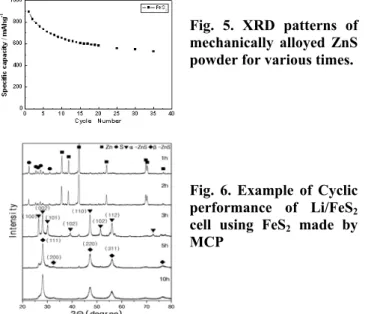
Fig. 5 shows the XRD patterns of mechanically alloyed ZnS powder for various times. As the time increasing during the mechanical alloying, α-ZnS(cubic) phase was formed after 3 hours, and β-ZnS(hexagonal) phase was formed after 5 hours, the mean particle size was decreased, as-received powders for 3hours were observed about 0.6-2um size, it was lower than commercial ZnS powder(mean particle size was about 6um). Also, as the controlled input energy with various times of mechanical alloying, α-ZnS and β-ZnS were selectively fabricated in them, respectively. [5]
(4) Activating iron sulfide using Li-2nd battery
Rechargeable lithium batteries have been developed for portable power applications such as electric vehicles, mobile machine, cellular phone and laptop computer because of their high specific energies in the range 100-150Wh/kg (and theoretical specific energies in the range 425-890Wh/kg).
Generally, iron sulfide is used to activating substance in Li-2nd battery. It was remained in the naturally pyrite has
low cost and a very environmental impact, but its disadvantages has low purity and difficult changes of phase because of fixed composition. Hence, experimental value of Li-battery using the pyrite was lower than theoretical
© Korean Powder Metallurgy Institute 920 -capacity. Recently, for the resolving this problem, the results using the FeS and FeSx synthesized by various
manufacture were aplenty reported from researchers. In them, the FeS2 doped with transition metal is improving the capacity of Li-battery. Further, FeS2 powders of single
phase made by mechanical alloying increases in specific energy have been limited by the extent of lithium intercalation into transition metal oxides, resulting in capacities in the range 100-150mAh/g of active material. A battery based on the Li/FeS2 redox couple has, in contrast,
theoretical specific energy of 894Wh/kg of the active material and a theoretical specific energy of 1270Wh/Kg, showed in Fig. 6.
Fig. 5. XRD patterns of mechanically alloyed ZnS powder for various times.
Fig. 6. Example of Cyclic performance of Li/FeS2
cell using FeS2 made by
MCP
3. Summary
Basically, the MnS and MoS2 powder were purposed
with the machinability controlled agent and solid lubricant in part of powder metallurgy. Metal sulfide (MS) was synthesized by combustion reaction that has many advantages such as high purity, high performance and easy fabrication of single phase and/or inter-metallic compounds. Moreover, it is investigating about the various application possibility of electric and electron materials.
Acknowledgement
This work was supported by grant No. RTI04-01-03 from the Regional Technology Innovation Program of the Ministry of Commerce, Industry and Energy (MOCIE).
4. Reference
1. M. Tokita, J. Soc. Powder Technol., Jpn. 30 (1993), p.790 2. Z. Jiang, R. K. Larsen, R. Lin, S. Mørup, I. Chorkendorff,
K. Nielsen, K. Hansen and K. West, J. of solid state chemistry, Vol.138(1998), pp-114-125.
3. Methods of fabricated Metal sulfide ; Korea Patent, 0363521
4. P. P. Chin, J. Ding, J. B. Yi,B.H. Liu, J. of alloys and compounds, Vol. 390 (2005), p. 255-260.
5. I. S. Ahn, W. H. Jung, S. Y. Bea, T. K. Sung, D. K. Park, Journal of KPMI, Vol. 12, No. 4, 2005 [6] D. K. Park, K. C. Jung, H. Y. Lee, Proceeding of Euro PM2004, Vienna, Austria, Vol. 4, 755-762, 2004