Impact of IgM Antibodies on Cross-Protection against
Pneumococcal Serogroups 6 and 19 after Immunization with
7-Valent Pneumococcal Conjugate Vaccine in Children
Although it is well known that pneumococcal conjugate vaccines provide cross-protection against some vaccine-related serotypes, these mechanisms are still unclear. This study was performed to investigate the role of cross-protective IgM antibodies against vaccine-related serotypes 6A, 6C, and 19A induced in children aged 12-23 months after
immunization with 7-valent pneumococcal conjugate vaccine (PCV7). We obtained serum samples from 18 Korean children aged 12-23 months after a PCV7 booster immunization. The serum IgG and IgM concentrations of serotypes 6B and 19F were measured by enzyme-linked immunosorbent assay (ELISA) in serum. The opsonic indices (OIs) against vaccine serotypes 6B and 19F and vaccine-related serotypes 6A, 6C, and 19A were determined by an opsonophagocytic killing assay (OPA) in IgM-depleted and control serum. Both IgG and IgM antibodies in ELISA and opsonic indices in OPA against serotypes 6B and 19F were demonstrated in the immune serum. IgM depletion decreased the OIs against vaccine serotypes 6B (geometric means of OIs (GMIs) of 3,009 vs. 1,396, 38% reduction) and 19F (1,117 vs. 750, 36% reduction). In addition, IgM depletion markedly decreased the OIs against vaccine-related serotypes 6A (GMIs of 961 vs. 329, 70% reduction), 6C (432 vs. 185, 72% reduction), and 19A (301 vs. 166, 58% reduction). The booster immunization PCV7 induced protective antibodies in the form of both IgG and IgM isotypes. IgM antibodies contributed to eliciting cross-protection against vaccine-related serotypes as well as against vaccine serotypes.
Keywords: Streptococcus pneumoniae; Heptavalent Pneumococcal Conjugate Vaccine; Pneumococcal Polysaccharide Type 6; Pneumococcal Polysaccharide Type 19;
Immunoglobulin M Hye-Kyung Cho,1,2 In Ho Park,1
Robert L. Burton,3 and Kyung-Hyo Kim1,4 1Center for Vaccine Evaluation and Study, Medical
Research Institute, Ewha Womans University School of Medicine, Seoul, Korea; 2Department of
Pediatrics, Graduate School of Medicine, Gachon University, Incheon, Korea; 3Departments of
Pathology and Microbiology, University of Alabama at Birmingham, Birmingham, AL, USA; 4Department
of Pediatrics, Ewha Womans University School of Medicine, Seoul, Korea
Received: 11 November 2015 Accepted: 16 March 2016 Address for Correspondence: Kyung-Hyo Kim, MD
Center for Vaccine Evaluation and Study, Medical Research Institute, Department of Pediatrics, Ewha Womans University School of Medicine, 1071 Anyangcheon-ro, Yangcheon-gu, Seoul 07985, Korea
E-mail: [email protected]
Funding: This study was funded by an RP-Grant 2013 of Ewha
Womans University to IHP and KHK and by the Ministry of Food and Drug Safety (11172MFDS360) to KHK. For the remaining authors, none were declared.
http://dx.doi.org/10.3346/jkms.2016.31.6.950 • J Korean Med Sci 2016; 31: 950-956
INTRODUCTION
Streptococcus pneumoniae is an important pathogen that causes morbidity and mortality in children in the first years of life, caus-ing clinical syndromes varycaus-ing from mucosal disease (sinusitis and otitis media) to invasive pneumococcal diseases (IPD; e.g., sepsis and meningitis) (1). To prevent pneumococcal infections in young children, the 7-valent pneumococcal conjugate
vac-cine (PCV7, PrevenarTM, Pfizer Inc, Philadelphia, PA, USA), which
includes serotypes 4, 6B, 9V, 14, 18C, 19F, and 23F, was licensed in the USA in 2000 and has been recommended for inclusion in national immunization programs for young children (2). Fol-lowing the introduction of PCV7 overall IPD rates among chil-dren aged < 5 years in USA were reduced by 77% compared with the prevaccine era (3).
Pneumococcal conjugate vaccines provide serotype-specific protection against vaccine serotypes (VTs) and some vaccine-related serotypes (VRTs) of S. pneumoniae (4,5). There have been some reports of enhanced cross-reactivity according to
the number of vaccinations (6,7). In children under 24 months of age, 3 primary doses of immunizations with PCV7 elicited immune responses for serotypes 6B and 6D, and a booster dose enhanced cross-reactive immune responses against serotypes 6A, 6C, and 6D (6). In addition, while the cross-reactive immune response against serotype 19A appeared in only a small propor-tion of subjects after a primary series of 3 doses, it was ampli-fied after the booster vaccination (8,9).
Although antigen-specific serum IgG antibodies have been used as a surrogate marker demonstrating vaccine-induced protection against many diseases, IgM is the first antibody pro-duced in a humoral immune response because it can be express-ed without isotype switching. IgM mostly exists as a pentamer whose ten antigen binding sites can bind simultaneously to mul-tivalent antigens such as bacterial capsular polysaccharides (PSs). This structure results in high avidity despite its relatively low affinity. Moreover, IgM can be particularly effective at com-plement activation (10). Indeed, studies with human monoclo-nal antibodies have shown that IgM antibodies are more
effi-ORIGINAL ARTICLE
Cho H-K, et al. • Impact of IgM on Cross-Protection by PCV7 in Children cient for opsonophagocytic killing of bacteria than IgG antibod-ies (11,12).
Previous studies have demonstrated the role of serotype-spe-cific IgM antibodies on the immunogenicity of the pneumococ-cal vaccine in adults and children (13,14). IgM antibodies could be involved in protection against VRTs, but the role of cross-protective IgM antibodies has not been investigated previously (6,8). Therefore, we aimed to investigate the impact of IgM on cross-protection against serotypes 6A, 6C, and 19A in children after booster immunization of PCV7.
MATERIALS AND METHODS
Subjects
Serum samples were obtained one to three months after the last vaccination from 18 healthy children aged 12 to 23 months immunized with PCV7 at 2, 4, and 6 months and after 12 months of age. All serum samples were stored frozen at -70°C until anal-ysis. Written informed consent was obtained from parents or legal guardians following a detailed explanation of the study.
Enzyme-linked immunosorbent assay (ELISA)
The IgG antibody concentrations against serotypes 6B and 19F were measured by the third-generation pneumococcal antibody ELISA posted on a website (http://www.vaccine.uab.edu), but the ELISA was modified for measuring IgM antibody concen-trations as previously described (13). The ELISA was performed at the Center for Vaccine Evaluation and Study, Ewha Medical Research Institute at Ewha Womans University.
Opsonophagocytic killing assay (OPA)
The opsonic activities of the serum samples for two vaccine se-rotypes (6B and 19F) and three vaccine-related sese-rotypes (VRTs; 6A, 6C, and 19A) were evaluated by OPA, as previously describ-ed (15-17). The opsonic index (OI) was defindescrib-ed as the serum di-lution that killed 50% of bacteria and was determined by linear interpolation. In this study, all serum samples were diluted 40-fold before the assay due to limited amounts of serum. Because all serum samples were diluted 4-fold during the assay, the lim-it of detection was 160. A detailed protocol is posted online (http: //www.vaccine.uab.edu).
Depletion of IgM from immune serum by affinity chromatography
To remove IgM antibody from immune serum, the serum sam-ples were mixed with agarose beads conjugated with anti-hu-man IgM antibody (Sigma-Aldrich, St. Louis, MO, USA) and in-cubated for 2 hours at RT. Unconjugated agarose beads were used as a control. The mixtures were applied to Bio-Rad chro-matography spin columns (Bio-Rad Laboratories, Inc., Hercu-les, CA, USA). The columns were centrifuged at 2,000 r.p.m. for
1 minute at 4°C, and the eluted fraction was collected. The effi-ciency of depletion was monitored using the pneumococcal antibody ELISA. The optical density was measured at 405 nm to determine the concentration of anti-pneumococcal PS (anti-PnPS) IgM antibody in the 1:1,000 diluted absorbed serum (13).
Statistical analysis
The geometric means of OIs (GMIs) against serotypes 6B, 19F, 6A, 6C, and 19A in IgM-depleted immune serum and control serum samples were analyzed by IBM SPSS Statistics 21 (IBM Corporation, Armonk, NY, USA). Comparisons of anti-PnPS IgG and IgM concentrations and OIs between IgM-depleted se-rum and control sese-rum were performed with a Wilcoxon signed-rank test, and P values < 0.05 were considered statistically sig-nificant. Values below the limit of detection were substituted with the half of the limit of detection. The interquartile range (IQR) of OIs between IgM-depleted serum and control serum was estimated, except in samples showing an OI lower than the detection limit of the OPA.
Ethics statement
The present study protocol was reviewed and approved by the institutional review board of CHA Gangnam Medical Center (IRB No. 06-25). Informed consent was submitted by the par-ents or guardians.
RESULTS
Effects of IgM depletion on opsophagocytic activities against serotypes 6B and 19F
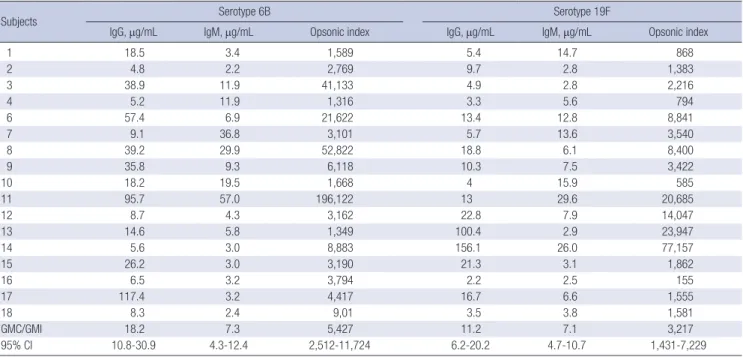
Anti-PnPS IgG and IgM antibody concentrations and OIs for serotypes 6B and 19F are displayed in Table 1. In Fig. 1, the OI for each serum is plotted against its respective anti-PnPS IgG and IgM antibody concentration.
To investigate the role of anti-PnPS IgM antibodies in the op-sonic capacity of the immune serum, IgM was removed by af-finity chromatography from immune serum and the depleted immune serum were tested by OPA for serotypes 6B and 19F. IgG and IgM antibody concentrations for serotypes 6B and 19F in IgM-depleted immune serum and control serum were deter-mined by ELISA to determine the efficiency of depletion. Affin-ity chromatography resulted in minimal loss of IgG antibodies for serotypes 6B and 19F, but removed a significant proportion of IgM antibodies for the same serotypes (Fig. 2). When the op-sonophagocytic activities were determined by OPA in IgM-de-pleted immune serum and control serum, geometric mean op-sonic indices (GMIs) decreased from 3,009 (95% CI: 1,001-9,042) in control serum to 1,396 (95% CI: 520-3,749) in IgM-depleted serum for serotype 6B. Each immune serum showed a 38% (me-dian, interquartile range [IQR] 26%-67%) reduction of OIs against serotype 6B by IgM depletion. For serotype 19F, GMIs decreased
Cho H-K, et al. • Impact of IgM on Cross-Protection by PCV7 in Children
from 1,117 (95% CI: 364-3,436) in control serum to 750 (95% CI: 285-1,973) in IgM-depleted serum. Each immune serum showed a 36% (median, IQR 0%-51%) reduction of OIs against serotype 19F by IgM depletion (Fig. 3).
Effects of anti-PnPS 6B and 19F IgM antibodies on cross-protective activities for serotypes 6A, 6C, and 19A
To investigate the contribution of anti-PnPS IgM antibodies to cross-protective activities for VRTs in the immune serum, we measured the OIs of IgM depleted immune serum and control serum against serotypes 6A, 6C, and 19A.
The GMIs against serotype 6A were 961 (95% CI: 294-3,143) in control serum and 329 (95% CI: 121-891) in IgM-depleted se-rum, representing a 3-fold decrease in GMIs and a 70%
(medi-an, IQR 64%-87%) decrease in OIs in each immune serum. The GMIs against serotype 6C were 432 (95% CI: 149-1,247) in con-trol serum and 185 (95% CI: 77-441) in IgM-depleted serum, representing a 2-fold decrease in GMIs and a 72% (median, IQR 54%-83%) decrease in OIs in each immune serum. The GMIs against serotype 19A were 301 (95% CI: 132-688) in control se-rum and 166 (95% CI: 82-337) in IgM-depleted sese-rum, repre-senting a 2-fold decrease in GMIs and a 58% (median, IQR 46%-68%) decrease in OIs in each immune serum (Fig. 3).
DISCUSSION
This study demonstrates that the PCV7 booster elicits protec-tive antibodies in the form of IgG and IgM, and that IgM anti-Table 1. IgG and IgM antibody concentrations and opsonic indices against serotypes 6B and 19F in children after booster immunization with PCV7
Subjects Serotype 6B Serotype 19F
IgG, μg/mL IgM, μg/mL Opsonic index IgG, μg/mL IgM, μg/mL Opsonic index
1 18.5 3.4 1,589 5.4 14.7 868 2 4.8 2.2 2,769 9.7 2.8 1,383 3 38.9 11.9 41,133 4.9 2.8 2,216 4 5.2 11.9 1,316 3.3 5.6 794 6 57.4 6.9 21,622 13.4 12.8 8,841 7 9.1 36.8 3,101 5.7 13.6 3,540 8 39.2 29.9 52,822 18.8 6.1 8,400 9 35.8 9.3 6,118 10.3 7.5 3,422 10 18.2 19.5 1,668 4 15.9 585 11 95.7 57.0 196,122 13 29.6 20,685 12 8.7 4.3 3,162 22.8 7.9 14,047 13 14.6 5.8 1,349 100.4 2.9 23,947 14 5.6 3.0 8,883 156.1 26.0 77,157 15 26.2 3.0 3,190 21.3 3.1 1,862 16 6.5 3.2 3,794 2.2 2.5 155 17 117.4 3.2 4,417 16.7 6.6 1,555 18 8.3 2.4 9,01 3.5 3.8 1,581 GMC/GMI 18.2 7.3 5,427 11.2 7.1 3,217 95% CI 10.8-30.9 4.3-12.4 2,512-11,724 6.2-20.2 4.7-10.7 1,431-7,229
PCV7, 7-valent pneumococcal conjugate vaccine; GMC, geometric mean concentration; GMI, geometric mean index; CI, confidence interval.
Fig. 1
(A)
(B)
10 100 1,000 10,000 100,000 1,000,000 0.1 1.0 10.0 100.0 1,000.0 Opsonic index (OI)IgG or IgM (ug/mL)
IgG-6B IgM-6B 10 100 1,000 10,000 100,000 1,000,000 0.1 1.0 10.0 100.0 1,000.0 Opsonic index (OI)
IgG or IgM (ug/mL)
IgG-19F IgM-19F
0.35 0.35
160 160
Opsonic index (OI)
IgG or IgM (μg/mL) 0.1 0.35 1.0 10.0 100.0 1,000.0 1,000,000 100,000 10,000 1,000 100 10 160 IgG-6B IgM-6B
Fig. 1
(A)
(B)
10 100 1,000 10,000 100,000 1,000,000 0.1 1.0 10.0 100.0 1,000.0 Opsonic index (OI)IgG or IgM (ug/mL)
IgG-6B IgM-6B 10 100 1,000 10,000 100,000 1,000,000 0.1 1.0 10.0 100.0 1,000.0 Opsonic index (OI)
IgG or IgM (ug/mL)
IgG-19F IgM-19F
0.35 0.35
160 160
Opsonic index (OI)
IgG or IgM (μg/mL) 0.1 0.35 1.0 10.0 100.0 1,000.0 1,000,000 100,000 10,000 1,000 100 10 IgG-19F IgM-19F A B
Fig. 1. Distribution of the opsonic indices and serotype-specific IgG or IgM concentrations. (A) serotype 6B, (B) serotype 19F.
Cho H-K, et al. • Impact of IgM on Cross-Protection by PCV7 in Children
bodies contribute to cross-functional opsonophagocytic activi-ties against VRTs 6A, 6C, and 19A. Previous studies reported that the booster immunization of PCV7 for children aged 12-23 months induces cross-protection against serotypes 6A, 6C, and 19A (6,8). However, the serological properties of cross-protec-tive antibodies against these VRTs obtained from PCV7 immu-nization were not investigated. This study is the first attempt to study the role of IgM antibody in cross-protection against VRT pneumococci. IgM antibodies are predominantly elicited in a T cell-independent immune response by PS antigens that are not processed and presented by MHC molecules. Because PS anti-gens do not activate follicular B cells but directly activate ma-ture B cells without T cell help, they do not undergo affinity mat-uration and Ig class switching. Consequently, they elicit
pre-dominantly low-affinity IgM antibodies and fail to develop im-munological memory (10). Nevertheless, some studies showed roles for IgM in opsonic activity and immune memory by en-hancing avidity and ability to trigger the complement system, and by generating T-cell dependent IgM memory B cells (18,19). Although conjugate vaccines mainly produce IgG through a T-cell dependent immune response, all subjects in this study obtained high concentrations of IgG and IgM antibodies and good functional immune responses to serotypes 6B and 19F af-ter the boosaf-ter immunization of PCV7. In addition, opsonic ac-tivities against serotypes 6B and 19F in each subject were relat-ed to the existence of IgM. This is consistent with previous re-ports about the role of IgM in the immunogenicity of the pneu-mococcal vaccine. A recent study in adults showed that PPV23 Fig. 2. Comparison of the changes in IgG and IgM concentrations in response to vaccine serotypes in PCV7 immune serum after IgM depletion. (A) anti-PnPS 6B IgG and IgM concentrations in control serum and IgM-depleted serum, (B) anti-PnPS 19F IgG and IgM concentrations in control serum and IgM-depleted serum.
0 1 2 3 4
Control IgM depletion
Ab lev
el
(OD
405
)
Control IgM depletion
Fig. 2
(B)
Anti-PnPS 19F IgG Anti-PnPS 19F IgM
1 2 3 4 5 6 7 8 9 10 11 12 13 14 15 16 17 18 0 1 2 3 4
Control IgM depletion
Ab lev
el
(OD
405
)
Control IgM depletion
Anti-PnPS 6B IgG Anti-PnPS 6B IgM
Fig. 2
(A)
Ab level (OD
405
)
Anti-PnPS 6B IgG Anti-PnPS 6B IgM
Control IgM depletion Control IgM depletion 4 3 2 1 0 A 0 1 2 3 4
Control IgM depletion
Ab lev
el
(OD
405
)
Control IgM depletion
Fig. 2
(B)
Anti-PnPS 19F IgG Anti-PnPS 19F IgM
Ab level (OD
405
)
Anti-PnPS 19F IgG Anti-PnPS 19F IgM Control IgM depletion Control IgM depletion 4 3 2 1 0 B
Cho H-K, et al. • Impact of IgM on Cross-Protection by PCV7 in Children
is less effective for older adults than for young adults, mainly due to low serotype-specific IgM antibody levels in older adults (13). In another toddler study, the correlation between IgM an-tibody concentrations and opsonic activities was stronger than that of IgG antibodies after a single dose of PCV9 vaccination. In that study, OPAs against serotype 14 remained in pooled se-rum samples after IgG depletion and was assumed to relate with the concentration of anti-PnPS 14-specific IgM antibody (14). This study attempted to investigate the relationship between IgM antibody and OPA against VRTs using IgM depletion. IgM depletion led to a marked decrease in the opsonic capacities against serotypes 6A, 6C, and 19A without considerable chang-es in IgG concentrations of immune serum. Thchang-ese rchang-esults show that IgM antibodies influence functional opsonophagocytic
ac-tivities against VRTs, such as serotypes 6A, 6C, and 19A. Because some IgM antibodies are not only protective against bacterial infections but also bind many unrelated antigens, such as single-stranded DNA, thyroglobulin, and β-galactosidase, such IgM antibodies are called polyreactive or natural antibod-ies (20). However, high opsonic IgM antibodantibod-ies in immune se-rum after PPV23 vaccination in the elderly are not reduced by the existence of single-stranded DNA, thyroglobulin, and β-gala-ctosidase. In addition, opsonic activities against VRTs were to-tally inhibited in IgM-depleted immune serum and control se-rum mixed with free 6B or 19F polysaccharide antigen (data not shown). Therefore, IgM antibodies specific for VTs seem to be also reactive with VRTs, rather than polyreactive.
There have been some reports on the possible role of IgM in Fig. 3. Reduction of opsonic indices to vaccine serotypes and vaccine-related serotypes in PCV7 immune serum after IgM depletion. (A) Opsonic indices against serotypes 6B, 6A, and 6C in control serum and IgM-depleted serum. (B) Opsonic indices against serotypes 19F and 19A in control serum and IgM-depleted serum.
10 100 1,000 10,000 100,000 1,000,000
Control IgM depletion
Opsonic index
(OI)
Control IgM depletion Control IgM depletion
Fig. 3
(A)
Serotype 6B Serotype 6A Serotype 6C
Opsonic index (OI)
Serotype 6B Serotype 6A Serotype 6C
Control IgM depletion Control IgM depletion Control IgM depletion 1,000,000 100,000 10,000 1,000 100 10 A 10 100 1,000 10,000 100,000
Control IgM depletion
Opsonic index
(OI)
Control IgM depletion
Fig. 3
(B)
Serotype 19F Serotype 19A
1 2 3 4 5 6 7 8 9 10 11 12 13 14 15 16 17 18 10 100 1,000 10,000 100,000
Control IgM depletion
Opsonic index
(OI)
Control IgM depletion
Fig. 3
(B)
Serotype 19F Serotype 19A
Opsonic index (OI)
Serotype 19F Serotype 19A
Control IgM depletion Control IgM depletion 100,000 10,000 1,000 100 10 B
Cho H-K, et al. • Impact of IgM on Cross-Protection by PCV7 in Children protection against other pathogens. Functional antibody activi-ties induced by Haemophilus influenzae type b conjugate vac-cine were related to both anti-PRP IgM and IgG concentrations (21). In regard to the Salmonella typhi vaccine, repeated anti-gen exposure with S. typhi porins could promote the anti-generation of protective IgM antibodies (22). IgM antibodies induced by meningococcal polysaccharide vaccine could contribute to func-tional antibody activities against group C meningococcus, de-spite its small quantity (23).
It has been noted that the correlations between opsonophago-cytic activities and IgG concentrations were lower for VRTs than for VTs (9,24). This study demonstrated substantial roles of IgM in cross-protection against VRTs as well as in opsonic capacity against VTs. Considering these data, evaluation of functional immune response using the OPA would be more desirable than an ELISA measuring only IgG antibodies, especially for evalua-tion of immunogenicity to VRTs (21).
Compared to studies in infants from the USA, Europe, or Tai-wan, Korean infants had higher post-vaccination antibody titers to all serotypes in PCV7 (25). In addition, Korean children had higher post-vaccination opsonic indices than children in other countries against all serotypes in PCV7 and two VRTs (serotype 6A and 6C) (unpublished data). Higher immunogenicity in Ko-rean children could develop due to a difference in IgM antibody responses among ethnic groups.
This study suggests that IgM antibodies contribute to the func-tional antibody response against VRTs as well as VTs in young children. However, this study was a small study performed on a limited sample size based on the immune responses to PCV7, and there were no post-primary vaccination immune serum available. In addition, new conjugate vaccines containing more serotypes and different carrier proteins were recently developed, and some conjugate vaccines were approved for adults (26-28). Further studies are needed for more subjects including children and adults, as well as for different vaccine formulations. More-over, studies in different populations or ethnic groups will pro-vide better information for understanding immune response by pneumococcal vaccine.
In conclusion, the booster immunization PCV7 induced pro-tective antibodies in the form of both IgG and IgM isotypes, and elicited cross-protection against serotypes 6A, 6C, and 19A among Korean children. IgM antibodies induced by PCV7 contribute to opsonization of serotypes 6A, 6C, and 19A.
ACKNOWLEDGMENT
We thank the study participants who provided the samples and Soo Young Lim, who helped us with our laboratory work. We are also grateful to Dr. Moon H. Nahm for his critical review of this manuscript. The University of Alabama at Birmingham (UAB) owns intellectual property rights on the various reagents used
for pneumococcal vaccine studies. DISCLOSURE
The authors have no potential conflicts of interest to disclose. AUTHOR CONTRIBUTION
Conception and design of study: Park IH, Kim KH. Acquisition of data: Park IH. Analysis and interpretation of data and draft-ing of the manuscript: Cho HK. Critical revision of the manu-script: Burton RL. Approved the final version of the manumanu-script: all authors.
ORCID
Hye-Kyung Cho http://orcid.org/0000-0003-0990-1350 In Ho Park http://orcid.org/0000-0003-2190-5469 Kyung-Hyo Kim http://orcid.org/0000-0002-0333-6808 REFERENCES
1. Lee JH, Cho HK, Kim KH, Kim CH, Kim DS, Kim KN, Cha SH, Oh SH, Hur JK, Kang JH, et al. Etiology of invasive bacterial infections in immuno-competent children in Korea (1996-2005): a retrospective multicenter study. J Korean Med Sci 2011; 26: 174-83.
2. World Health Organization. Pneumococcal conjugate vaccine for child-hood immunization--WHO position paper. Wkly Epidemiol Rec 2007; 82: 93-104.
3. Centers for Disease Control and Prevention (CDC). Invasive pneumo-coccal disease in children 5 years after conjugate vaccine introduction--eight states, 1998-2005. MMWR Morb Mortal Wkly Rep 2008; 57: 144-8. 4. Hsu KK, Shea KM, Stevenson AE, Pelton SI; Massachusetts Department
of Public Health. Changing serotypes causing childhood invasive pneu-mococcal disease: Massachusetts, 2001-2007. Pediatr Infect Dis J 2010; 29: 289-93.
5. Väkeväinen M, Eklund C, Eskola J, Käyhty H. Cross-reactivity of antibod-ies to type 6B and 6A polysaccharides of Streptococcus pneumoniae, evok-ed by pneumococcal conjugate vaccines, in infants. J Infect Dis 2001; 184: 789-93.
6. Lee H, Cha JH, Nahm MH, Burton RL, Kim KH. The 7-valent pneumococ-cal conjugate vaccine elicits cross-functional opsonophagocytic killing responses to Streptococcus pneumoniae serotype 6D in children. BMC Infect Dis 2013; 13: 474.
7. Hausdorff WP, Hoet B, Schuerman L. Do pneumococcal conjugate vac-cines provide any cross-protection against serotype 19A? BMC Pediatr 2010; 10: 4.
8. Lee HJ, Park SE, Kim KH. Immune response to 19A serotype after immu-nization of 19F containing pneumococcal conjugate vaccine in Korean children aged 12-23 months. Korean J Pediatr 2011; 54: 163-8.
9. Lee H, Nahm MH, Burton R, Kim KH. Immune response in infants to the heptavalent pneumococcal conjugate vaccine against vaccine-related serotypes 6A and 19A. Clin Vaccine Immunol 2009; 16: 376-81.
Cho H-K, et al. • Impact of IgM on Cross-Protection by PCV7 in Children 10. Janeway CA, Travers P, Walport M, Shlomchik MJ. The humoral immune
response. In: Janeway CA. Travers P, Walport M, Shlomchik MJ, editors. Immunobiology: the Immune System in Health and Disease. 6th ed. New York, NY: Garland Science, 2005, p367-408.
11. Pollack M, Koles NL, Preston MJ, Brown BJ, Pier GB. Functional proper-ties of isotype-switched immunoglobulin M (IgM) and IgG monoclonal antibodies to Pseudomonas aeruginosa lipopolysaccharide. Infect Im-mun 1995; 63: 4481-8.
12. Raff HV, Bradley C, Brady W, Donaldson K, Lipsich L, Maloney G, Shu-ford W, Walls M, Ward P, Wolff E, et al. Comparison of functional activi-ties between IgG1 and IgM class-switched human monoclonal antibod-ies reactive with group B streptococci or Escherichia coli K1. J Infect Dis 1991; 163: 346-54.
13. Park S, Nahm MH. Older adults have a low capacity to opsonize pneu-mococci due to low IgM antibody response to pneumococcal vaccina-tions. Infect Immun 2011; 79: 314-20.
14. Simell B, Nurkka A, Ekström N, Givon-Lavi N, Käyhty H, Dagan R. Serum IgM antibodies contribute to high levels of opsonophagocytic activities in toddlers immunized with a single dose of the 9-valent pneumococcal conjugate vaccine. Clin Vaccine Immunol 2012; 19: 1618-23.
15. Burton RL, Nahm MH. Development and validation of a fourfold multi-plexed opsonization assay (MOPA4) for pneumococcal antibodies. Clin Vaccine Immunol 2006; 13: 1004-9.
16. Wang D, Burton RL, Nahm MH, Soong SJ. A four-parameter logistic mod-el for estimating titers of functional multiplexed pneumococcal opsono-phagocytic killing assay. J Biopharm Stat 2008; 18: 307-25.
17. Romero-Steiner S, Frasch CE, Carlone G, Fleck RA, Goldblatt D, Nahm MH. Use of opsonophagocytosis for serological evaluation of pneumo-coccal vaccines. Clin Vaccine Immunol 2006; 13: 165-9.
18. Shyur SD, Raff HV, Bohnsack JF, Kelsey DK, Hill HR. Comparison of the opsonic and complement triggering activity of human monoclonal IgG1 and IgM antibody against group B streptococci. J Immunol 1992; 148: 1879-84.
19. Shi Y, Yamazaki T, Okubo Y, Uehara Y, Sugane K, Agematsu K. Regulation of aged humoral immune defense against pneumococcal bacteria by IgM memory B cell. J Immunol 2005; 175: 3262-7.
20. Notkins AL. Polyreactivity of antibody molecules. Trends Immunol 2004;
25: 174-9.
21. Dentinger CM, Hennessy TW, Bulkow LR, Reasonover AL, Romero-Stein-er S, HoldRomero-Stein-er PF, de Leon PG, Carlone GM, Parks DJ, Parkinson AJ, et al. Immunogenicity and reactogenicity to Haemophilus influenzae type B (Hib) conjugate vaccine among rural Alaska adults. Hum Vaccin 2006; 2: 24-8.
22. Perez-Shibayama C, Gil-Cruz C, Pastelin-Palacios R, Cervantes-Barragan L, Hisaki E, Chai Q, Onder L, Scandella E, Regen T, Waisman A, et al. IFN-γ-producing CD4+ T cells promote generation of protective germinal cen-ter-derived IgM+ B cell memory against Salmonella Typhi. J Immunol 2014; 192: 5192-200.
23. Tsai TF, Borrow R, Gnehm HE, Vaudaux B, Heininger U, Desgrandchamps D, Aebi C, Balmer P, Pedersen RD, Fritzell B, et al. Early appearance of bactericidal antibodies after polysaccharide challenge of toddlers primed with a group C meningococcal conjugate vaccine: what is its role in the maintenance of protection? Clin Vaccine Immunol 2006; 13: 854-61. 24. Yu X, Gray B, Chang S, Ward JI, Edwards KM, Nahm MH. Immunity to
cross-reactive serotypes induced by pneumococcal conjugate vaccines in infants. J Infect Dis 1999; 180: 1569-76.
25. Kim NH, Lee J, Lee SJ, Lee H, Kim KH, Park SE, Lee HJ. Immunogenicity and safety of pneumococcal 7-valent conjugate vaccine (diphtheria CRM197 protein conjugate; PrevenarTM) in Korean infants: differences that are found in Asian children. Vaccine 2007; 25: 7858-65.
26. Centers for Disease Control and Prevention (CDC). Use of 13-valent pneu-mococcal conjugate vaccine and 23-valent pneupneu-mococcal polysaccha-ride vaccine for adults with immunocompromising conditions: recom-mendations of the Advisory Committee on Immunization Practices (ACIP). MMWR Morb Mortal Wkly Rep 2012; 61: 816-9.
27. Centers for Disease Control and Prevention (CDC). Licensure of a 13-va-lent pneumococcal conjugate vaccine (PCV13) and recommendations for use among children - Advisory Committee on Immunization Practic-es (ACIP), 2010. MMWR Morb Mortal Wkly Rep 2010; 59: 258-61. 28. Silfverdal SA, Hogh B, Bergsaker MR, Skerlikova H, Lommel P, Borys D,
Schuerman L. Immunogenicity of a 2-dose priming and booster vaccina-tion with the 10-valent pneumococcal nontypeable Haemophilus influ-enzae protein D conjugate vaccine. Pediatr Infect Dis J 2009; 28: e276-82.