Department of Internal Medicine,
1Kangbuk Samsung Hospital,
Sungkyunkwan University School of Medicine, Seoul; 2Hanyang
University Guri Hospital, Guri;
3Konyang University College of
Medicine, Daejeon; 4Kyung Hee
University School of Medicine, Seoul; 5Dankook University College
of Medicine, Cheonan; 6Dongguk
University College of Medicine, Gyeongju; 7Inje University College of
Medicine, Busan; 8Soonchunhyang
University College of Medicine, Asan;
9Ewha Womans University School
of Medicine, Seoul; 10Jeju National
University College of Medicine, Jeju; 11Hallym University College of
Medicine, Chuncheon; 12Samsung
Medical Center, Sungkyunkwan University School of Medicine, Seoul, Korea Received : August 31, 2014 Revised : November 10, 2014 Accepted : September 1, 2015 Correspondence to Dong Il Park, M.D.
Department of Internal Medicine, Kangbuk Samsung Hospital, Sungkyunkwan University School of Medicine, 29 Saemunan-ro, Jongno-gu, Seoul 03181, Korea Tel: +82-2-2001-2059
Fax: +82-2-2001-2049
E-mail: [email protected]
Background/Aims: The aim of this study was to compare the clinical features and outcomes of ulcerative colitis (UC) according to the age of onset in Korea.
Methods: A total of 1,141 patients who were diagnosed with UC between July 1987 and November 2013 at 11 tertiary hospitals were enrolled. The baseline disease characteristic and disease state at onset, treatment during the disease course were retrospectively reviewed among patients with young-onset (YO, < 20 years) and adult-onset (AO, ≥ 20 years). Severe outcome was defined as use of intrave-nous (IV) steroids, infliximab, immunosuppressant, or UC-related operation.
Results: There were 55 YO patients (mean age, 17.8 ± 2.4) and 1,086 AO patients (mean age, 43.0 ± 13.6). High Mayo scores (7.7 ± 3.0 vs. 5.6 ± 2.7, p = 0.000), exten-sive UC (52.7% vs. 25.8%, p = 0.000) and IV steroid (41.8% vs. 18.0%, p = 0.000), immunosuppressant (47.3% vs. 26.9%, p = 0.002), and infliximab (20.0% vs. 7.2%,
p = 0.001) use were more frequent in the YO than in the AO group. According to
multivariate analysis, severe outcomes were related to YO disease (hazard ratio [HR], 2.18; 95% confidence interval [CI], 1.27 to 3.71), body mass index < 23 kg/m2 (HR, 1.46; 95% CI, 1.07 to 2.00), severe (HR, 2.29; 95% CI, 1.36 to 3.38), and moder-ate (HR, 2.48; 95% CI, 1.67 to 3.67) disease, extensive UC (HR, 2.90; 95% CI, 1.79 to 4.69), UC-related admission (HR, 63.89; 95% CI, 20.41 to 200.02), and oral steroid use (HR, 0.51; 95% CI, 0.39 to 0.67).
Conclusions: UC with YO presented with more advanced clinical features at onset and more severe outcomes than the AO. YO cases require careful manage-ment and intense treatmanage-ment strategies.
Keywords: Colitis, ulcerative; Young-onset; Clinical feature; Outcome
Comparing the clinical outcomes of young-onset
and adult-onset ulcerative colitis: a multi-center
Korean Association for the Study for Intestinal
Diseases study
Ji Yeon Kim1, Dong Il Park1, Dong Soo Han2, Kyu-Chan Huh3, Chang Kyun Lee4, Jeong Eun Shin5, Jae Hak Kim6, You Sun Kim7, Yunho Jung8, Sung-Ae Jung9, Hyun Joo Song10, Hyun Joo Jang11,
Young-Ho Kim12, and Sung No Hong12
Korean J Intern Med 2017;32:69-78 https://doi.org/10.3904/kjim.2014.262
INTRODUCTION
Ulcerative colitis (UC) is a chronic and relapsing inflam-matory disease of the colon and rectum that affects con-tinuously. Although its exact etiology remains unknown, UC is thought to arise from an interaction between genet-ic and environmental factors. Given its chrongenet-ic and re-lapsing nature, UC can seriously impact quality of life [1].
The worldwide incidence of UC varies greatly accord-ing to geographic location. The prevalence ranges be-tween 0.5 and 24.5 per 100,000 persons [2]. The annual incidence of UC in Asia is lower than that in Western regions [3,4]. However, the incidence of UC has in-creased in Asian countries secondary to the westerniza-tion of lifestyle and diagnostic modalities [5,6], especially among the younger age patients [7]. Due to these chang-es, UC is expected to become an increasing a clinical burden in Asia.
UC has bimodal peaks for incidence. There is a small peak in incidence around the age of 20 years and a sec-ond larger peak around the age of 60 years [8]. Recently, it was recognized that clinical characteristics and dis-ease outcomes differ according to the age of diagnosis. However, these studies have shown conflicting results. Some studies have found that early-onset UC produce a more severe phenotype [9] and requires more frequent operation than does late-onset UC [10]. Additionally, a larger proportion of patients with pediatric-onset UC require immunosuppressive and biologic agents com-pared to those with adult-onset (AO) disease [11]. In con-trast, late-onset UC is related to refractoriness to thera-py [12] and aggressive development of colorectal cancer [13]. Another study reported that age at diagnosis had no effect on prognosis [14].
In Korea, the clinical differences and effects related to age of onset in patients with UC have not been well established. A previous study reported that certain clin-ical features and disease extent more severe when UC is diagnosed at a younger age, as compared to when it is diagnosed later in life. However, the disease course and prognosis may not differ from those of their older counterparts [15]. Given this background, the aim of the present study was to compare the clinical features and disease outcomes of UC according to the age of onset in Korea.
METHODS
Study population
This is a multi-center, retrospective cohort study. Kore-an patients who were diagnosed with UC between July 1987 and November 2013 at one of 11 tertiary hospitals were identified. All patients were diagnosed and treat-ed by inflammatory bowel disease (IBD) specialists who are members of the Korean Association for the Study for Intestinal Diseases. The diagnosis of UC was based on accepted clinical, endoscopic, and histological findings [16]. Patients with the following conditions were exclud-ed: incomplete medical records or diagnosis of other type of colitis including Crohn disease (CD), Behcet’s disease, or infectious colitis. The study population was classified into two groups according to the age of onset. Patients who were diagnosed before the age of 20 years were defined as the young-onset (YO) group and those diagnosed at or after the age of 20 years were assigned to the AO group. This study was approved by the Institu-tional Review Board of each participating hospital.
Data collection and clinical outcomes
The baseline patient characteristics and clinical infor-mation were collected retrospectively from the medi-cal records of each participating hospital. The baseline characteristics included age at diagnosis, gender, body mass index (BMI), family history of IBD, smoking status, and follow-up duration. The disease state at diagnosis, including the Mayo score and the extent of disease, was also evaluated. The Mayo score is a 13-scale index (0 to 12) that represents disease activity including stool fre-quency, rectal bleeding, endoscopic findings, and a phy-sician’s overall assessment [17]. The disease activity at diagnosis was measured using the Mayo score. A Mayo score of 3 to 5 was considered mild disease, 6 to 10 was moderate disease and 11 to 12 was severe disease. The ex-tent of disease was determined by endoscopic findings and was categorized into three groups using the Mon-treal classification [18]. A lesion extending from the anal verge to the rectosigmoid junction was defined as ulcer-ative proctitis, disease to the distal part of the splenic flexure was defined as left-sided colitis and disease that extended beyond the splenic flexure was defined as ex-tensive colitis. Each patients’ treatment during disease course were assessed according to the history of
UC-re-lated admission and operation and, prior use of oral ste-roids, intravenous (IV) steste-roids, immunosuppressants, or infliximab. A history of oral steroid use was limited to independent cases of IV steroid use. Severe outcomes were defined by the use of IV steroids, infliximab, im-munosuppressants or UC-related operation.
Statistical analysis
SPSS version 18.0 (SPSS Inc., Chicago, IL, USA) was used for all statistical analyses. The chi-square test or Fisher exact test was used for the analysis of categorical vari-ables, such as gender, smoking status, disease activity at diagnosis, extent of disease, UC-related admission, UC-related operation, and medication use. Continuous variables including age, BMI, duration of follow-up, and Mayo score were analyzed using Student t test. Ka-plan-Meier survival analysis was performed to identi-fy factors associated with outcomes, and the log-rank test was used to evaluate any significant differences ac-cording to each factor. Multivariate analysis using Cox proportional hazard regression was used to determine independent predictive factors, and these results were estimated using hazard ratios (HRs) and 95% confi-dence intervals (CIs). In multivariate analysis, baseline characteristics at diagnosis were analyzed without treat-ment-related factors in order to evaluate factors affect-ing outcomes. The factors associated with treatment were analyzed using all variables. Results were consid-ered statistically significant when p values were < 0.05.
RESULTS
Clinical characteristics and outcomes of the study population
A total of 1,141 patients with UC were included in the present study. The baseline patient characteristics are described in Table 1. The mean age at diagnosis was 41.8 ± 14.3 years and the mean duration of follow-up was 7.1 ± 4.2 years. Overall, 645 patients (56.5%) were male. Most patients were diagnosed with mild disease activ-ity (52.3%) and ulcerative proctitis (43.9%). Furthermore, 41.4% of patients were hospitalized for UC treatment and 5.5% underwent operation. The 43.2% of patients used oral steroid independently for treatment of UC.
Comparison by age of onset
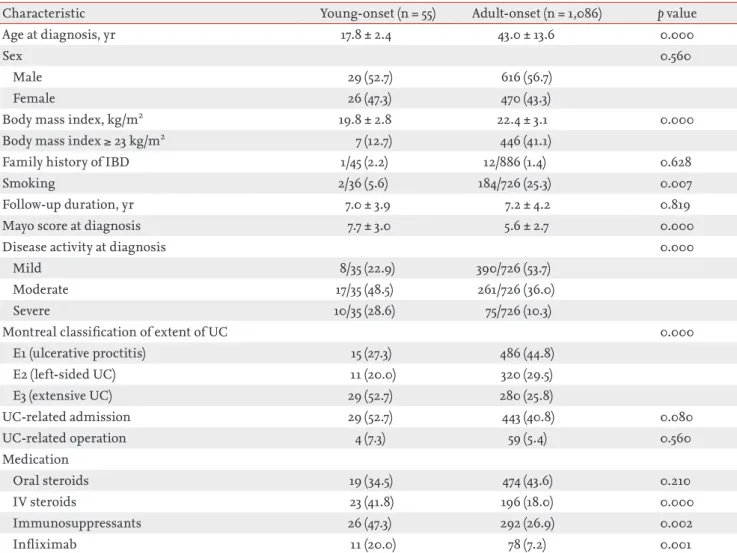
A total of 55 patients (4.8%) were diagnosed with YO disease and 1,086 patients (95.2%) had AO disease. The mean age at diagnosis was 17.8 ± 2.4 years in the YO group and 43.0 ± 13.6 years in the AO group. The mean BMI was significantly lower in the YO group than it was in the AO group (19.8 ± 2.8 kg/m2 vs.22.4 ± 3.1 kg/m2,p = 0.000). Patients in the YO group smoked less frequently than those in the AO group (5.6% vs. 25.3%, p = 0.007). At the time of diagnosis, the YO group presented with a higher mean Mayo score than did the AO group (7.7 ± 3.0 vs. 5.6 ± 2.7, p = 0.000). Severe disease activity and
Table 1. Baseline patient characteristics
Characteristic with UC (n = 1,141)Total patients
Age at diagnosis, yr 41.8 ± 14.3
Sex
Male 645 (56.5)
Female 496 (43.5)
Body mass index, kg/m2 22.3 ± 3.1
Family history of IBD 13/918 (1.4)
Smoking 186/762 (24.4)
Follow-up duration, yr 7.1 ± 4.2
Mayo score at diagnosis 5.7 ± 2.8
Disease activity at diagnosis
Mild 398/761 (52.3) Moderate 278/761 (36.5) Severe 85/761 (11.2) Montreal classification of extent of UC E1 (ulcerative proctitis) 501 (43.9) E2 (left-sided UC) 331 (29.0) E3 (extensive UC) 309 (27.1) UC-related admission 472 (41.4) UC-related operation 63 (5.5) Medication Oral steroids 493 (43.2) IV steroids 219 (19.2) Immunosuppressants 318 (27.9) Infliximab 89 (7.8)
Values are presented as mean ± SD or number (%). Patients with missing values were not included in analysis. Data are expressed as raw numbers with proportions.
UC, ulcerative colitis; IBD, inflammatory bowel disease; IV, intravenous.
extensive UC at diagnosis were more frequent in the YO group than they were in the AO group (28.6% vs. 10.3%, p = 0.000; 52.7% vs. 25.8%, p = 0.000, respectively) (Table 2).
During follow-up, there were no significant differenc-es in UC-related admission or operation, or use of oral steroids between the two groups. However, IV steroids, immunosuppressants and infliximab were used more frequently in the YO group than they were in the AO group (41.8% vs. 18.0%, p = 0.000; 47.3% vs. 26.9%, p = 0.002; 20.0% vs. 7.2%, p = 0.001, respectively) (Table 2).
Risk factors associated with severe outcomes
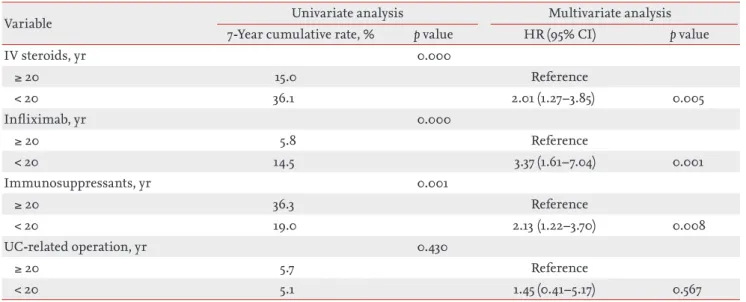
Patients were more likely to require IV steroids if they were diagnosed before the age of 20 years (HR, 2.01; 95%
CI, 1.27 to 3.85; p = 0.005). Use of infliximab (HR, 3.37; 95% CI, 1.61 to 7.04; p = 0.001) and immunosuppressant (HR, 2.13; 95% CI, 1.22 to 3.70; p = 0.008) were also more in-creased in the YO group. However, there was no rela-tionship between UC-related operation and the age at diagnosis (Table 3). The results of univariate and mul-tivariate analyses of the risk factors associated with IV steroids, infliximab and immunosuppressants use and UC-related operation are described in Supplementary Tables 1-5.
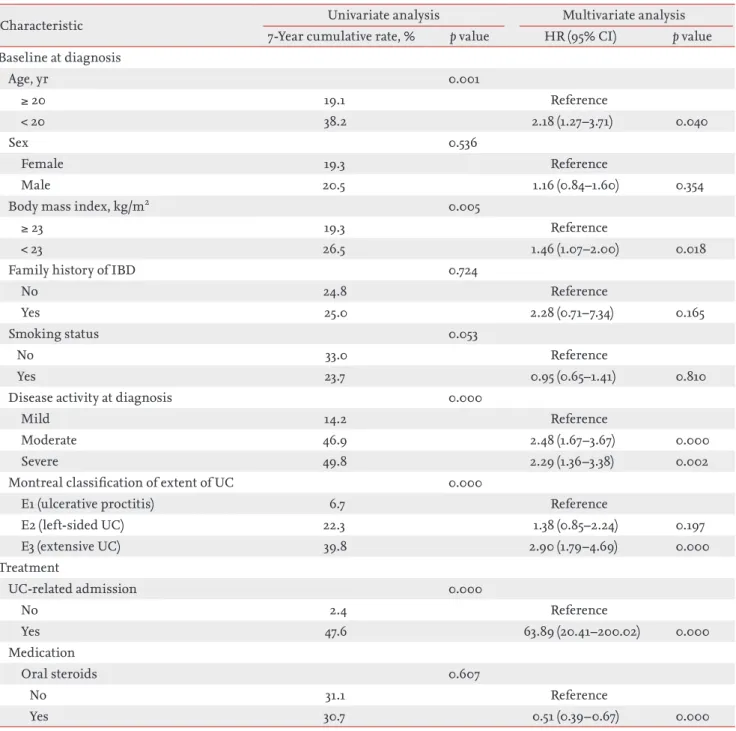
Table 4 and Fig. 1 describe the risk factors for severe outcomes. For the baseline characteristics at diagno-sis, multivariate analysis identified that YO disease was significantly associated with increased risk of
se-Table 2. Baseline characteristics and outcomes by age of onset in ulcerative colitis patients
Characteristic Young-onset (n = 55) Adult-onset (n = 1,086) p value
Age at diagnosis, yr 17.8 ± 2.4 43.0 ± 13.6 0.000
Sex 0.560
Male 29 (52.7) 616 (56.7)
Female 26 (47.3) 470 (43.3)
Body mass index, kg/m2 19.8 ± 2.8 22.4 ± 3.1 0.000
Body mass index ≥ 23 kg/m2 7 (12.7) 446 (41.1)
Family history of IBD 1/45 (2.2) 12/886 (1.4) 0.628
Smoking 2/36 (5.6) 184/726 (25.3) 0.007
Follow-up duration, yr 7.0 ± 3.9 7.2 ± 4.2 0.819
Mayo score at diagnosis 7.7 ± 3.0 5.6 ± 2.7 0.000
Disease activity at diagnosis 0.000
Mild 8/35 (22.9) 390/726 (53.7)
Moderate 17/35 (48.5) 261/726 (36.0)
Severe 10/35 (28.6) 75/726 (10.3)
Montreal classification of extent of UC 0.000
E1 (ulcerative proctitis) 15 (27.3) 486 (44.8) E2 (left-sided UC) 11 (20.0) 320 (29.5) E3 (extensive UC) 29 (52.7) 280 (25.8) UC-related admission 29 (52.7) 443 (40.8) 0.080 UC-related operation 4 (7.3) 59 (5.4) 0.560 Medication Oral steroids 19 (34.5) 474 (43.6) 0.210 IV steroids 23 (41.8) 196 (18.0) 0.000 Immunosuppressants 26 (47.3) 292 (26.9) 0.002 Infliximab 11 (20.0) 78 (7.2) 0.001
Values are presented as mean ± SD or number (%). Patients with missing values were not included. Data are expressed as raw numbers with proportions.
vere outcomes (HR, 2.18; 95% CI, 1.27 to 3.71; p = 0.040). In addition, BMI < 23 kg/m2 (HR, 1.46; 95% CI, 1.07 to 2.00; p = 0.018), moderate (HR, 2.48; 95% CI, 1.67 to 3.67;
p = 0.000), and severe (HR, 2.29; 95% CI, 1.36 to 3.38; p
= 0.002) disease activity at diagnosis, and extensive UC (HR, 2.90; 95% CI, 1.79 to 4.69; p = 0.000) were also relat-ed to increasrelat-ed risk of severe outcomes. During treat-ment, a history of UC-related admission (HR, 63.89; 95% CI, 20.41 to 200.02; p = 0.000) was related to severe outcomes. In contrast, previous use of oral steroids (HR, 0.51; 95% CI, 0.39 to 0.67; p = 0.000) decreased the risk of severe outcomes.
DISCUSSION
It is important to understand the clinical features and outcomes of UC with regard to the age of onset, because it may influence the proper treatment strategy to be used in clinical practice. The present study was the first large, multi-center and long-term study that analyzes the effects of age at disease onset. Our results suggest that age of onset is an important factor with regard to the clinical course of UC and, in particular, that clinical features and outcomes were more severe in UC patients with YO disease.
In the present study, we found that patients with YO disease had advanced clinical features at the time of
di-agnosis. Upon diagnosis, approximately 30% of YO pa-tients had severe disease activity and more than 50% had extensive UC. In contrast, 50% of the patients in the AO group were initially diagnosed with mild disease activ-ity and proctitis. The risk of IV steroid, infliximab and immunosuppressants use was also higher in the YO pa-tients than it was in the AO papa-tients. A previous study reported that patients younger than 17 years of age at di-agnosis had more extensive disease and aggressive clin-ical course, including steroid use than do those diag-nosed after the age of 17 [9]. Previous population-based cohort studies have demonstrated that the number of relapses decreased with increasing age of onset [19]. In addition, a younger age at diagnosis has been found to be an independent predictor of earlier relapse, with an HR increase of 0.4 per decade [20]. Patients with late on-set disease also have better responses to therapy and are more likely to experience steroid-free clinical remission 1 year after diagnosis than are patients with YO disease [21]. Overall, the results of the present study are consis-tent with those in the previous studies.
However, other reports have claimed that an older age of onset is related to poor outcomes in UC. A previous cross-sectional study found that patients 65 years and older were hospitalized more frequently and had higher in-hospital mortality and medical costs than did those diagnosed at a younger age [22]. However, this study was conducted using information from the Nationwide
Table 3. Associations between age of ulcerative colitis onset and severe outcomes
Variable Univariate analysis Multivariate analysis
7-Year cumulative rate, % p value HR (95% CI) p value
IV steroids, yr 0.000 ≥ 20 15.0 Reference < 20 36.1 2.01 (1.27–3.85) 0.005 Infliximab, yr 0.000 ≥ 20 5.8 Reference < 20 14.5 3.37 (1.61–7.04) 0.001 Immunosuppressants, yr 0.001 ≥ 20 36.3 Reference < 20 19.0 2.13 (1.22–3.70) 0.008 UC-related operation, yr 0.430 ≥ 20 5.7 Reference < 20 5.1 1.45 (0.41–5.17) 0.567
Inpatient Samples; therefore, it is possible that their findings resulted from analysis of elderly patients with many comorbidities, and a secondary diagnosis of IBD. Similar results were seen in another population-based cohort study demonstrating that patients over the age of 50 at the time of diagnosis had increased mortality within the first two years of diagnosis than did those
diagnosed at a younger age [23]. There were also more comorbidities reported in elderly patients, which were primarily attributed to their postoperative complica-tions. Similarly, more severe outcomes and higher mor-tality in elderly UC patients observed in previous studies may not reflect UC itself.
It is controversial how the age of UC onset influences
Table 4. Risk factors of severe outcomes of ulcerative colitis patients
Characteristic Univariate analysis Multivariate analysis
7-Year cumulative rate, % p value HR (95% CI) p value
Baseline at diagnosis Age, yr 0.001 ≥ 20 19.1 Reference < 20 38.2 2.18 (1.27–3.71) 0.040 Sex 0.536 Female 19.3 Reference Male 20.5 1.16 (0.84–1.60) 0.354
Body mass index, kg/m2 0.005
≥ 23 19.3 Reference
< 23 26.5 1.46 (1.07–2.00) 0.018
Family history of IBD 0.724
No 24.8 Reference
Yes 25.0 2.28 (0.71–7.34) 0.165
Smoking status 0.053
No 33.0 Reference
Yes 23.7 0.95 (0.65–1.41) 0.810
Disease activity at diagnosis 0.000
Mild 14.2 Reference
Moderate 46.9 2.48 (1.67–3.67) 0.000
Severe 49.8 2.29 (1.36–3.38) 0.002
Montreal classification of extent of UC 0.000
E1 (ulcerative proctitis) 6.7 Reference
E2 (left-sided UC) 22.3 1.38 (0.85–2.24) 0.197 E3 (extensive UC) 39.8 2.90 (1.79–4.69) 0.000 Treatment UC-related admission 0.000 No 2.4 Reference Yes 47.6 63.89 (20.41–200.02) 0.000 Medication Oral steroids 0.607 No 31.1 Reference Yes 30.7 0.51 (0.39–0.67) 0.000
the need for UC-related operation. Studies from West-ern countries have reported cumulative colectomy rates of 20% at 5 years and 25% at 10 years [24]. The rate of UC-related operation are lower in Asian patients than they are in Western patients, with a rate of 5.9% at 5 years and 10% of 10 years [25]. One Western study showed that the age of onset was younger in patients who had un-dergone previous operation [26]. The actuarial risk of colectomy in that study was 7.5% at 5 years and 10.4% at 10 years, higher than those of our study. Previous stud-ies have suggested that the risk of operation does not differ by age of onset, with a previous study showing a higher proportion of steroid use in younger patients [27], although the other results were similar to ours. In our study, the UC-related operation rate was not signifi-cantly different between the two groups. This finding may reflect the fact that a top-down strategy including biologic agents was more frequently used in YO pa-tients than in AO papa-tients because of their more severe disease state upon diagnosis. Operation becomes nec-essary in UC when patients are medically refractory, or develop complications or colitic cancer. In the present study, extensive colitis at diagnosis was associated with an increased the risk of UC-related operation. Extensive
inflammation may result in the development of compli-cations and colitic cancer.
The reasons behind the severe clinical features at di-agnosis and the severe outcomes in UC with YO are not clear. It is possible that YO patients are simply detected earlier because they present with more severe symptoms than do older patients. In patients with mild features and a relatively narrow extent, disease may not be rec-ognized early and therefore, in these patients it is di-agnosed later, when symptoms arise. A previous study suggested that the pathophysiologic mechanisms of YO and AO disease differ [28]. It has also been reported that YO was a poor prognostic factor for several autoimmune diseases, including systemic lupus erythematosus and type 1 diabetes mellitus [29], and that genetic factors are more highly associated with YO disease than they are with AO disease [30]. Mild disease UC with proctitis in AO patients may result from a weak immunologic reac-tion. Similar results have been observed in other immu-nologic diseases [31].
A previous report also demonstrated that treatment responses were better in UC patients with a BMI < 25 kg/m2 and in CD patients with a BMI > 25 kg/m2 than they are in larger patients [32]. However, the relationship between UC and BMI has not been clearly established. Alterations in fat and muscle may affect bone health, muscle performance, quality of life, and overall morbid-ity. However, BMI does not accurately reflect body com-position [33]. Interestingly, BMI < 23 kg/m2 increased the risk of severe outcomes in the present study. The BMI in the YO group was lower than in the AO group in this study, which is consistent with the pattern observed in the general population by age. BMI reflects the nutri-tional status, which might be worse in patients with se-vere disease. Smoking, which has been shown to have a well-established protective effect against UC [19], was more common in the AO group than in the YO group. However, it did not affect disease outcomes in the pres-ent study. This finding may be related to the fact that most YO patients were minors, in whom smoking is prohibited. The association between smoking and UC does not appear to be very clear, as several other stud-ies have argued that smoking does not have a protective effect against UC [34,35]. We also considered the finding that BMI and smoking increased with age. Further eval-uation is needed to establish conclusive findings. 0.8
0.6
0.4
0.2
0
Cumulative risk of severe outcomes
Months after diagenosis of UC
p = 0.040 Young-onset UC
Adult-onset UC
0 50 100 150 200 250
Figure 1. The cumulative risk of severe outcomes was higher in young-onset patients than it was in adult-onset patients (p = 0.040). UC, ulcerative colitis.
This study has several limitations. There were only 55 YO patients (4.8%) because data were collected from the Department of Internal Medicine’s medical records. In addition, the mean age of YO patients was also relatively high, and pediatric UC patients were not included. De-spite the small number of patients; however, there were significant differences in the severity of clinical features and outcomes between the two groups in the present study. Relapse rate is an important factor that affects dis-ease course and severe outcomes in UC. Unfortunately, the relapse rate could not be determined in the pres-ent study. In addition, the results of outcomes analysis using patient history including UC-related admission and steroid use during follow-up after diagnosis of UC were limited because of inconsistent reference points. Further study is needed to confirm the associations and trends observed here.
UC is a relapsing and remitting disease, currently with no cure. The purpose of treatment UC is to maintain re-mission and prevent complications. Long-standing mu-cosal inflammation can lead to complications and colitic cancer. Patients with YO UC suffer from the disease for a longer period of time than do AO patients. It is pos-sible that severe outcomes including operation may be higher in YO patients compared to in AO patients with a prolonged follow-up. Intensive care and uninterrupted follow-up are especially important for YO patients.
In conclusion, the present study revealed that age of disease onset has a major influence on UC. Patients with YO UC present with more advanced clinical features at diagnosis and experience more severe outcomes than do those with AO disease. Therefore, these results sug-gest that careful management and an intense treatment strategy are necessary for YO patients.
Conflict of interest
No potential conflict of interest relevant to this article was reported.
Acknowledgments
This work was funded by a grant of the Korean Health Technology R&D Project, Ministry of Health and Wel-fare, Republic of Korea (A120176; DSH).
REFERENCES
1. Irvine EJ. Quality of life of patients with ulcerative colitis: past, present, and future. Inflamm Bowel Dis 2008;14:554-565.
2. Cosnes J, Gower-Rousseau C, Seksik P, Cortot A. Epide-miology and natural history of inflammatory bowel dis-eases. Gastroenterology 2011;140:1785-1794.
3. Molodecky NA, Soon IS, Rabi DM, et al. Increasing inci-dence and prevalence of the inflammatory bowel diseases with time, based on systematic review. Gastroenterology 2012;142:46-54.e2.
4. Ng SC, Tang W, Ching JY, et al. Incidence and phenotype of inflammatory bowel disease based on results from the Asia-pacific Crohn’s and colitis epidemiology study. Gas-troenterology 2013;145:158-165.e2.
5. Yang DH, Yang SK. Trends in the incidence of ulcerative colitis in Korea. Korean J Med 2009;76:637-642.
6. Lok KH, Hung HG, Ng CH, et al. Epidemiology and clin-ical characteristics of ulcerative colitis in Chinese popu-lation: experience from a single center in Hong Kong. J Gastroenterol Hepatol 2008;23:406-410.
7. Shin DH, Sinn DH, Kim YH, et al. Increasing incidence of inflammatory bowel disease among young men in Ko-rea between 2003 and 2008. Dig Dis Sci 2011;56:1154-1159. 8. Sonnenberg A. Age distribution of IBD hospitalization.
Inflamm Bowel Dis 2010;16:452-457.
9. Kalkan IH, Dagli U, Oztas E, Tunc B, Ulker A.
Compar-KEY MESSAGE
1. It has been previously reported that the age of onset affects the clinical features and course in patients with ulcerative colitis (UC).
2. The Mayo score was higher and there was more frequent extensive UC in young-onset (YO) dis-ease group than there was in the adult-onset (AO) group. There was also more frequent intrave-nous steroid, infliximab and immunosuppres-sant use in the YO group than in the AO group.
However, there were no differences between YO and AO disease with regard to UC-related ad-mission, operation or oral steroid use.
3. In Korea, compared to that of AO disease, YO UC presented with more advanced clinical features upon diagnosis, and more severe out-comes.
ison of demographic and clinical characteristics of pa-tients with early vs. adult vs. late onset ulcerative colitis. Eur J Intern Med 2013;24:273-277.
10. Leijonmarck CE, Persson PG, Hellers G. Factors affecting colectomy rate in ulcerative colitis: an epidemiologic study. Gut 1990;31:329-333.
11. Adamiak T, Walkiewicz-Jedrzejczak D, Fish D, et al. In-cidence, clinical characteristics, and natural history of pediatric IBD in Wisconsin: a population-based epidemi-ological study. Inflamm Bowel Dis 2013;19:1218-1223. 12. Zimmerman J, Gavish D, Rachmilewitz D. Early and late
onset ulcerative colitis: distinct clinical features. J Clin Gastroenterol 1985;7:492-498.
13. Brackmann S, Andersen SN, Aamodt G, et al. Relationship between clinical parameters and the colitis-colorectal cancer interval in a cohort of patients with colorectal can-cer in inflammatory bowel disease. Scand J Gastroenterol 2009;44:46-55.
14. Bresci G, Parisi G, Bertoni M, Capria A. Long-term maintenance treatment in ulcerative colitis: a 10-year fol-low-up. Dig Liver Dis 2002;34:419-423.
15. Lee JH, Cheon JH, Moon CM, et al. Do patients with ulcerative colitis diagnosed at a young age have more se-vere disease activity than patients diagnosed when older? Digestion 2010;81:237-243.
16. Lennard-Jones JE. Classification of inflammatory bowel disease. Scand J Gastroenterol Suppl 1989;170:2-6. 17. Schroeder KW, Tremaine WJ, Ilstrup DM. Coated oral
5-aminosalicylic acid therapy for mildly to moderately ac-tive ulceraac-tive colitis: a randomized study. N Engl J Med 1987;317:1625-1629.
18. Silverberg MS, Satsangi J, Ahmad T, et al. Toward an inte-grated clinical, molecular and serological classification of inflammatory bowel disease: report of a Working Party of the 2005 Montreal World Congress of Gastroenterology. Can J Gastroenterol 2005;19 Suppl A:5A-36A.
19. Hoie O, Wolters F, Riis L, et al. Ulcerative colitis: patient characteristics may predict 10-yr disease recurrence in a European-wide population-based cohort. Am J Gastroen-terol 2007;102:1692-1701.
20. Bitton A, Peppercorn MA, Antonioli DA, et al. Clinical, biological, and histologic parameters as predictors of relapse in ulcerative colitis. Gastroenterology 2001;120:13-20.
21. Ha CY, Newberry RD, Stone CD, Ciorba MA. Patients with late-adult-onset ulcerative colitis have better outcomes
than those with early onset disease. Clin Gastroenterol Hepatol 2010;8:682-687.e1.
22. Ananthakrishnan AN, McGinley EL, Binion DG. Inflam-matory bowel disease in the elderly is associated with worse outcomes: a national study of hospitalizations. In-flamm Bowel Dis 2009;15:182-189.
23. Winther KV, Jess T, Langholz E, Munkholm P, Binder V. Survival and cause-specific mortality in ulcerative colitis: follow-up of a population-based cohort in Copenhagen County. Gastroenterology 2003;125:1576-1582.
24. Prideaux L, Kamm MA, De Cruz PP, Chan FK, Ng SC. In-flammatory bowel disease in Asia: a systematic review. J Gastroenterol Hepatol 2012;27:1266-1280.
25. Hilmi I, Singh R, Ganesananthan S, et al. Demography and clinical course of ulcerative colitis in a multiracial Asian population: a nationwide study from Malaysia. J Dig Dis 2009;10:15-20.
26. Targownik LE, Singh H, Nugent Z, Bernstein CN. The epidemiology of colectomy in ulcerative colitis: results from a population-based cohort. Am J Gastroenterol 2012;107:1228-1235.
27. Aloi M, Lionetti P, Barabino A, et al. Phenotype and dis-ease course of early-onset pediatric inflammatory bowel disease. Inflamm Bowel Dis 2014;20:597-605.
28. Ekbom A, Helmick C, Zack M, Adami HO. Ulcerative proctitis in central Sweden 1965-1983: a population-based epidemiological study. Dig Dis Sci 1991;36:97-102.
29. Amador-Patarroyo MJ, Rodriguez-Rodriguez A, Montoya- Ortiz G. How does age at onset influence the outcome of autoimmune diseases? Autoimmune Dis 2012;2012:251730. 30. Grimm IS, Friedman LS. Inflammatory bowel disease in
the elderly. Gastroenterol Clin North Am 1990;19:361-389. 31. Deal CL, Meenan RF, Goldenberg DL, et al. The clinical
features of elderly-onset rheumatoid arthritis: a com-parison with younger-onset disease of similar duration. Arthritis Rheum 1985;28:987-994.
32. Holtmann MH, Krummenauer F, Claas C, et al. Signifi-cant differences between Crohn’s disease and ulcerative colitis regarding the impact of body mass index and ini-tial disease activity on responsiveness to azathioprine: re-sults from a European multicenter study in 1,176 patients. Dig Dis Sci 2010;55:1066-1078.
33. Bryant RV, Trott MJ, Bartholomeusz FD, Andrews JM. Systematic review: body composition in adults with inflammatory bowel disease. Aliment Pharmacol Ther 2013;38:213-225.
34. Romberg-Camps MJ, Dagnelie PC, Kester AD, et al. In-fluence of phenotype at diagnosis and of other potential prognostic factors on the course of inflammatory bowel disease. Am J Gastroenterol 2009;104:371-383.
35. Roth LS, Chande N, Ponich T, Roth ML, Gregor J. Predic-tors of disease severity in ulcerative colitis patients from Southwestern Ontario. World J Gastroenterol 2010;16:232-236.
Supplementary Table 1. Baseline characteristics and outcomes by age of onset in ulcerative colitis patients
Characteristic Age, yr p value
1–19 (n = 55) 20–39 (n = 492) 40–59 (n = 453) ≥ 60 (n = 141)
Age of diagnosis, yr 17.8 ± 2.4 30.9 ± 5.4a 48.7 ± 5.3a,b 67.0 ± 5.3a,b,c 0.000
Sex 0.938
Male 29 (52.7) 277 (56.3) 259 (57.2) 80 (56.7)
Female 26 (47.3) 215 (43.7) 194 (42.8) 61 (43.3)
Body mass index, kg/m2 19.8 ± 2.8 21.8 ± 3.0a 22.9 ± 3.1a,b 22.5 ± 3.3a,b 0.243
Family history of IBD 1/45 (2.2) 7/387 (1.8) 3/377 (0.8) 2/122 (1.6) 0.628
Smoking 2/36 (5.6) 68/317 (21.5)a 84/307 (27.4)a 32/102 (31.4)a,b 0.006
Follow-up duration, yr 7.0 ± 3.9 7.4 ± 4.2 7.1 ± 4.3 6.5 ± 3.9 0.624
Mayo score at diagnosis 7.7 ± 3.0 5.8 ± 2.7a 5.4 ± 2.7a 5.5 ± 2.6a 0.389
Disease activity at diagnosis 0.000
Mild (3–5) 8/35 (22.9) 157/327 (48.0)a 183/305 (60.0)a,b 50/94 (53.2)a Moderate (6–10) 17/35 (48.6) 132/327 (40.4) 91/305 (29.8)b 38/94 (40.4) Severe (11–12) 10/35 (28.6) 38/327 (11.6)a 31/305 (10.2)a 6/94 (6.4)a Montreal classification of extent of UC 0.000 E1 (ulcerative proctitis) 15 (27.3) 209 (42.5)a 210 (46.4)a 67 (47.5)a E2 (left-sided UC) 11 (20.0) 128 (26.0) 144 (31.8) 48 (34.0)
E3 (extensive UC) 29 (52.7) 155 (31.5)a 99 (21.9)a,b 26 (18.5)a,b
UC-related admission 29 (52.7) 192 (39.0) 186 (41.1) 65 (46.1) 0.147 UC-related operation 4 (7.3) 22 (4.5) 27 (6.0) 10 (7.1) 0.533 Medication Oral steroids 19 (34.5) 212 (43.1) 206 (45.5) 56 (39.7) 0.343 IV steroids 23 (41.8) 95 (19.3)a 70 (15.5)a 31 (22.0)a 0.000 Immunosuppressants 26 (47.3) 146 (29.7)a 111 (24.5)a 35 (24.8)a 0.003 Infliximab 11 (20.0) 40 (8.1)a 31 (6.8)a 7 (5.0)a 0.003 Severe outcomes 24 (43.6) 122 (24.8)a 97 (21.4)a 37 (26.2)a 0.004
Values are presented as mean ± SD or number (%).
IBD, inflammatory bowel disease; UC, ulcerative colitis; IV, intravenous. ap < 0.05 compared with the 1–19 group.
bp < 0.05 compared with the 20–39 group. cp < 0.05 compared with the 40–59 group.
Supplementary Table 2. Risk factors of intravenous steroid use in ulcerative colitis patients
Characteristic Univariate analysis Multivariate analysis
7-Year cumulative rate, % p value HR (95% CI) p value
Baseline at diagnosis Age, yr 0.000 ≥ 20 15.0 Reference < 20 36.1 2.01 (1.27–3.85) 0.005 Sex 0.834 Female 16.5 Reference Male 15.6 1.01 (0.71–1.42) 0.976
Body mass index, kg/m2 0.021
≥ 23 15.5 Reference
< 23 21.4 1.45 (1.03–2.04) 0.035
Family history of IBD 0.600
No 19.9 Reference
Yes 23.1 2.16 (0.67–7.00) 0.199
Smoking status 0.032
No 27.2 Reference
Yes 17.8 0.96 (0.62–1.48) 0.848
Disease activity at diagnosis 0.000
Mild 11.1 Reference
Moderate 39.7 2.48 (1.61–3.82) 0.000
Severe 35.3 1.78 (1.01–3.14) 0.048
Montreal classification of extent of UC 0.000
E1 (ulcerative proctitis) 4.9 Reference
E2 (left-sided UC) 16.8 1.44 (0.83–2.50) 0.200 E3 (extensive UC) 33.7 3.53 (2.06–6.04) 0.000 Treatment UC-related admission 0.000 No 0.8 Reference Yes 38.9 28.61 (8.95–91.50) 0.000 UC-related operation 0.000 No 14.5 Reference Yes 41.3 1.62 (0.95–2.75) 0.075 Medication Oral steroids 0.000 No 20.0 Reference Yes 11.1 0.26 (0.18–0.37) 0.000 Immunosuppressants 0.000 No 7.9 Reference Yes 48.7 2.40 (1.70–3.39) 0.000 Infliximab 0.000 No 13.1 Reference Yes 60.5 1.22 (0.81–1.84) 0.349
Supplementary Table 3. Risk factors of infliximab use in ulcerative colitis patients
Characteristic Univariate analysis Multivariate analysis
7-Year cumulative rate, % p value HR (95% CI) p value
Baseline at diagnosis Age, yr 0.000 ≥ 20 5.8 Reference < 20 14.5 3.37 (1.61–7.04) 0.001 Sex 0.070 Female 5.0 Reference Male 7.1 1.54 (0.86–2.74) 0.147
Body mass index, kg/m2 0.122
≥ 23 6.6 Reference
< 23 7.4 1.40 (0.78–2.53) 0.258
Family history of IBD 0.228
No 7.6 Reference
Yes 13.0 1.82 (0.42–7.96) 0.428
Smoking status 0.550
No 10.3 Reference
Yes 7.4 1.11 (0.54–2.19) 0.775
Disease activity at diagnosis 0.000
Mild 4.0 Reference
Moderate 17.5 3.00 (1.58–5.73) 0.001
Severe 13.7 2.52 (1.08–5.90) 0.034
Montreal classification of extent of UC 0.000
E1 (ulcerative proctitis) 2.0 Reference
E2 (left-sided UC) 9.8 1.43 (0.58–3.51) 0.437 E3 (extensive UC) 8.9 1.39 (0.54–3.56) 0.495 Treatment UC-related admission 0.000 No 2.0 Reference Yes 12.3 1.17 (0.48–2.89) 0.729 UC-related operation 0.124 No 6.5 Reference Yes 1.7 0.14 (0.02–1.02) 0.069 Medication Oral steroids 0.067 No 4.6 Reference Yes 8.0 1.49 (0.80–2.79) 0.210 IV steroids 0.000 No 2.8 Reference Yes 22.0 2.01 (1.09–3.69) 0.024 Immunosuppressants 0.000 No 0.6 Reference Yes 17.3 12.29 (4.70–32.11) 0.000
Supplementary Table 4. Risk factors of immunosuppressant use in ulcerative colitis patients
Characteristic Univariate analysis Multivariate analysis
7-Year cumulative rate, % p value HR (95% CI) p value
Baseline at diagnosis Age, yr 0.001 ≥ 20 36.3 Reference < 20 19.0 2.13 (1.22–3.70) 0.008 Sex 0.032 Female 16.7 Reference Male 22.1 0.78 (0.56–1.09) 0.150
Body mass index, kg/m2 0.024
≥ 23 19.5 Reference
< 23 23.6 1.27 (0.92–1.75) 0.140
Family history of IBD 0.751
No 24.0 Reference
Yes 9.3 0.50 (0.12–2.05) 0.333
Smoking status 0.434
No 28.3 Reference
Yes 26.1 1.15 (0.79–1.68) 0.478
Disease activity at diagnosis 0.000
Mild 15.3 Reference
Moderate 45.2 1,97 (1.34–2.90) 0.001
Severe 42.3 2.21 (1.30–3.76) 0.003
Montreal classification of extent of UC 0.000
E1 (ulcerative proctitis) 7.1 Reference
E2 (left-sided UC) 26.4 2.80 (1.66–4.72) 0.000 E3 (extensive UC) 34.1 3.23 (1.89–5.54) 0.000 Treatment UC-related admission 0.000 No 8.5 Reference Yes 36.3 0.98 (0.62–1.53) 0.915 UC-related operation 0.011 No 18.9 Reference Yes 34.2 1.16 (0.67–2.02) 0.591 Medication Oral steroids 0.000 No 1.1 Reference Yes 34.7 26.72 (6.71–114.58) 0.000 IV steroids 0.000 No 12.4 Reference Yes 56.6 1.49 (1.03–2.16) 0.036 Infliximab 0.000 No 16.1 Reference Yes 79.9 3.02 (2.11–4.30) 0.000
Supplementary Table 5. Risk factors of ulcerative colitis-related operation in ulcerative colitis patients
Characteristic Univariate analysis Multivariate analysis
7-Year cumulative rate, % p value HR (95% CI) p value
Baseline at diagnosis Age, yr 0.430 ≥ 20 5.7 Reference < 20 5.1 1.45 (0.41–5.17) 0.567 Sex 0.389 Female 4.8 Reference Male 3.0 0.59 (0.26–1.31) 0.192
Body mass index, kg/m2 0.642
≥ 23 4.1 Reference
< 23 4.7 0.97 (0.46–2.07) 0.937
Family history of IBD 0.453
No 4.5 Reference
Yes 0.0 -
-Smoking status 0.537
No 5.9 Reference
Yes 3.6 1.17 (0.42–3.27) 0.766
Disease activity at diagnosis 0.001
Mild 3.5 Reference
Moderate 4.6 1.14 (0.42–3.06) 0.796
Severe 13.1 2.24 (0.72–6.95) 0.163
Montreal classification of extent of UC 0.000
E1 (ulcerative proctitis) 2.0 Reference
E2 (left-sided UC) 2.4 0.70 (0.24–2.02) 0.507 E3 (extensive UC) 8.2 2.33 (1.01–5.40) 0.049 Treatment UC-related admission 0.000 No 0.7 Reference Yes 8.4 6.94 (1.50–32.21) 0.013 Medication Oral steroids No 3.0 0.029 Reference Yes 4.8 3.18 (1.46–6.80) 0.004 IV steroids 0.000 No 1.8 Reference Yes 12.8 2.62 (1.14–6.05) 0.024 Immunosuppressants 0.000 No 2.2 Reference Yes 6.6 0.83 (0.37–1.86) 0.645 Infliximab 0.246 No 4.0 Reference Yes 1.2 0.12 (0.02–0.89) 0.038