2011년도 추계학술발표회 논문요약집 대한방사선방어학회
196 _http://www.karp.or.kr
Monte Carlo modeling of uniform scanning beam
in proton therapy using GEANT4
Seyjoon Park1 ․ Dae-Hyun Kim1, 3 ․ Jungwook Shin2 ․ Se Byeong Lee1 1 Proton Therapy Center, National Cancer Center, Koyang, Korea
2 Department of Radiation Oncology, University of California, San Francisco, USA
3 Department of Biomedical Engineering, College of Medicine, The Catholic University of Korea, Korea
E-mail: [email protected]
Key words : proton therapy, Monte Carlo simulation, uniform scanning, magnet, Bragg peak
Introduction
Unique properties of proton therapy allow delivery of targeted radiation doses with a high degree of accuracy, enabling the proton beam to destroy cancel cells with less damage to healthy tissue. Conventional proton therapy use double scattering mode in which proton beam is passed through the fixed scatterer (FS) and second scatterer (SS) in order to yield a flat and broad profile. The designated spread-out Bragg peak (SOBP) is achieved by passing the proton beams through rotating modulation (RM) wheels made of materials of different thickness in different sections. Jungwook Shin developed GEANT4 based simulation software on double scattering mode of the IBA Proteus235 which was installed in the National Cancer Center in Korea (NCC).
Our proton facility is also equipped with uniform scanning (US) mode. The fundamental difference of this technology is using scanning magnets (SM) instead of second scatterer (SS) which was the key component to broaden the beam profile in the double scattering mode. Uniform scanning uses magnets to scan a broad beam across a treatment field. This method has advantages over the double scattering mode in minimizing the material that might shorten the beam range. Therefore, narrow and magnetically steered proton beam allows treatment of a larger tumor at deeper depth, and at the same time, achieve better radiation dose distribution in the patient, reducing unwanted secondary neutron radiation that extend far beyond the treatment field.
This poster introduces our simulation study from modeling of the uniform scanning (US) mode to the simulation result achieved through comparison with measured data.
Methods
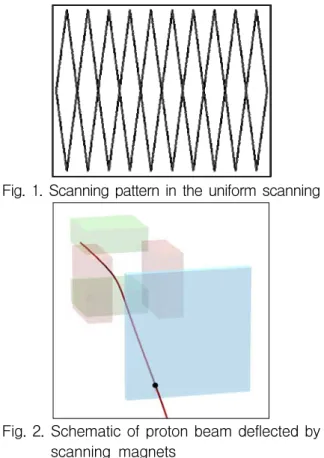
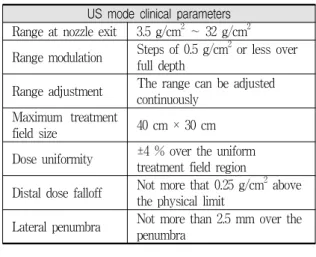
In the uniform scanning (US) mode the proton beam is typically scanned in a zigzag pattern in the x-y plane perpendicular to the beam direction as is shown in Fig. 1. When passing through two scanning magnets (SM), located along the central ray of proton beam downstream from the RM, Lorentz force leads to a bending of the proton’s trajectory. A schematic view of the magnetically steered proton beam is presented in Fig. 2. The clinical parameter values for uniform scanning of NCC proton therapy system are presented in the following table.
Fig. 1. Scanning pattern in the uniform scanning
Fig. 2. Schematic of proton beam deflected by scanning magnets
2011년도 추계학술발표회 논문요약집 대한방사선방어학회
제5분과(의료 및 생물)_ 197 Table 1. Specification of uniform scanning of
NCC nozzle
US mode clinical parameters Range at nozzle exit 3.5 g/cm2 ∼ 32 g/cm2 Range modulation Steps of 0.5 g/cm
2
or less over full depth
Range adjustment The range can be adjusted continuously
Maximum treatment
field size 40 cm × 30 cm
Dose uniformity ±4 % over the uniform treatment field region Distal dose falloff Not more that 0.25 g/cm
2
above the physical limit
Lateral penumbra Not more than 2.5 mm over the penumbra
Results
We first made a simple script to create a file in ASCII format which contains magnetic fields for drawing scanning pattern as shown in Fig. 1. A simulation was performed with these created magnetic fields in order to confirm the scanning pattern.
Meanwhile, ASCII file should be created as many as total number of pristine peak, since magnetic fields which correspond to the required field size are different at the depth of each pristine peak. All parameters, including magnetic fields, are stored in vector class while simulation. SOBP can be simulated by referring to these parameters and weight of each pristine peak.
Simulations were performed to compare Bragg peak with measured data. Fig. 3 shows three Bragg peaks simulated with range of 20, 22 and 24 cm/g2 respectively. Ranges are chosen for validation of U3 weight option. Simulation results showed good agreement with experimental results.
We also simulated SOBPs of U3 option with modulation width of 5 cm. These dose profiles were obtained with eight or nine weighted pristine peaks. Fig. 4 shows simulation results.
Fig. 3. Comparisons between the measurement and Monte Carlo dose profiles over the range which corresponds to U3 weight options.
Fig. 4. Monte Carlo simulation of SOBP for suboptions of U3
Conclusion
We have developed a GEANT4 Monte Carlo model of uniform scanning nozzle at Korea National Cancer Center. GEANT4 enabled us to build a complex simulation environment and to mimic the dynamic behavior of real irradiation of the beam delivery system. Especially magnetic field classes in the GEANT4 were used to simulate lateral steering of the proton beams. This model provided a good approximation of the actual beam steering process and produced agreement between measured and simulated data.
Acknowledgement
This study was fully supported by funds from research projects of the Korea National Cancer Center (nos. NCC-0910110-3).