© Korean Powder Metallurgy Institute 1205
-1. Introduction
High strength Cu alloys with good electrical conductivity at high temperatures can be achieved by dispersing fine particles such as oxides, carbides, nitrides and borides in the Cu matrix [1-6]. TiB2 is well known for its high melting
point, hardness and electrical conductivity [7]. Thus, TiB2
reinforced matrix composites were investigated in this study.
High-energy ball-milling is applied to produce fine and nanosized particles. Spark-plasma sintering (SPS) is a newly developed process that enables sintering of high quality materials in short periods possible by DC-pulse charging between powder particles with relatively high sintering pressure. SPS systems offer many advantages (e. g. rapid sintering, less sintering additives, uniform sintering, low running cost, and easy operation) over conventional systems [8].
In the present study, commercial TiB2 and copper
powders were ball-milled to obtain composite powders with improved TiB2 particles distribution by means of
ball-milling microstructure and properties of spark-plasma sintered Cu-TiB2 composites were investigated.
2. Experimental and Results
TiB2 (99.5 %, <45 ㎛) and copper (99.5 %, <45 ㎛)
powders were used as raw materials. To obtain the desired composite powders containing 2.5 wt% TiB2, powderswere
perepared by two methods. First, Cu powder was mixed
with the raw TiB2 powder in a turbular mixer at a speed of
75 rpm for 2 hours. Next, the Cu and TiB2 powders were
milled by high-energy ball-milling (AGO-2, planetary ball mill type) for 30 min and 60 min at 300 rpm. Balls and vials were made of stainless steel. The diameter of the balls was 2.77 mm and the powder to ball ratio was 1:20. The vials were then evacuated and subsequently filled with argon up to 0.3 MPa.
Spark Plasma Sintering (SPS) was performed using a SPS apparatus (Sumitomo Coal Mining Co.Ltd, AUJ-1611) under vacuum. A graphite mold of 15 mm in inner diameter was used. The applied SPS-pressure and SPS-temperature were 50 MPa and 650-750 , respectively. Holding time at ℃ the final temperature was 5 min. It should be noted that the effective temperature of the sample is usually 50 higher ℃ than the measured SPS-temperature.
X-ray diffraction patterns (XRD, Cu Kα, Rigaku, RAD-3C) were taken to conduct phase analyses of powders and compact. The particle size distribution was determined by a laser particles size analyzer (LPSA, Malvern, Mastersizer 2000). Then, a morphology observation and qualitative analysis (EDS) of powders were done by means of field emission-scanning electron microscopy (FE-SEM, JEOL, JSM-6500F). The relative density of the samples was measured by the Archimedes method and hardness (HRB)
values were measured by a Rockwell hardness tester. The electrical conductivity expressed in %IACS (International Annealed Copper Standard) was measured by a conductivity meter (Fischer, SIMASCOPE® SMP10). 2006 POWDER METALLURGY
World Congress
PC11-W-05
Production of Dispersion-strengthened Cu-TiB
2Alloys by Ball-milling
and Spark-plasma Sintering
Dae-Hwan Kwona, Jong-Won Kumb, Thuy Dang Nguyenc, Dina Dudinad, Pyuck-Pa Choie,
Ji-Soon Kimf and Young-Soon Kwong
Research Center for Machine Parts and Materials, School of Materials Science & Engineering Processing, University of Ulsan, San 29 Mugeo-dong, Nam-gu, Ulsan 680-749, Korea
a
[email protected], [email protected], [email protected], [email protected],
e
[email protected], [email protected], [email protected]
Abstract
Dispersion-strengthened copper with TiB2 was produced by ball-milling and spark plasma sintering (SPS).Ball-milling was performed at a rotation speed of 300rpm for 30 and 60min in Ar atmosphere by using a planetary ball mill (AGO-2). Spark-plasma sintering was carried out at 650℃ for 5min under vacuum after mechanical alloying. The hardness of the specimens sintered using powder ball milled for 60min at 300rpm increased from 16.0 to 61.8 HRB than that of specimen using powder mixed with a turbular mixer, while the electrical conductivity varied from 93.40% to 83.34%IACS. In the case of milled powder, hardness increased as milling time increased, while the electrical conductivity decreased. On the other hand, hardness decreased with increasing sintering temperature, but the electrical conductiviey increased slightly Keywords : ball-milling, Cu-TiB2 alloy, spark-plasma sintering
© Korean Powder Metallurgy Institute 1206 -Table. 1 Density, hardness and electrical conductivity of
sintered samples Ball-milling Sintering sample Speed (RPM) Time (min) Temp. ( )℃ Time (min) Relative density (%) Hardness (HRB) Electrical conductivity (%IACS) 1* - - 650 5 99.10 16.0 93.40 2 300 30 650 5 97.81 48.7 88.26 3 - 60 650 5 97.78 61.8 83.34 4 - 60 700 5 97.75 53.4 84.11 5 - 60 750 5 97.09 53.2 86.25
* Using powder mixed with a turbular mixer
Table. 1 shows the changes in the relative density, hardness and electrical conductivity of Cu–2.5wt.% TiB2
consolidated by the SPS process using powders ball milled for 30min and 60min at 300rpm at various temperatures ranging from 650 to 750°C. The relative density of all the samples could be obtaine over 97% of the theoretical density after the SPS.
Even though the hardness of the sintered samples using ball-milled powder increased more than that of sample sintered using powder mixed with a turbular mixer, the electrical conductivity still remained high.
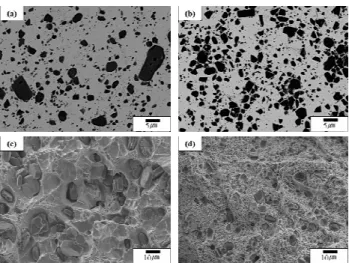
Fig. 1. SEM morphologies of cross-section and fracture surface of samples sintered for 5min at 650 by ℃ mixing ((a) and (c)) and ball milled powders ((b) and (c)).
Fig. 1 shows the SEM morphologies of cross-section and fracture surface of samples sintered for 5min at 650 . In ℃ the case of simple mixing, the large and small particles in the copper matrix were observed together (Fig. 1(a) and (c)). The shape and size of TiB2 paricles in sample sintered using
mixed powde with turbular mixer did not show any change (Fig. 1(c)). On the other hand, the size of TiB2 particles in
sample that was sintered using powder ball-milled for 60min at 300rpm decreased (Fig. 1(b) and (d)). Furthermore, the shape of TiB2 particles changed from flate and
hexagonal to angular (Fig. 1(d)). Physical impacts on powders induced by ball-milling cause fractured in TiB2
particles, consequently deforming their shape. Based on these observations, Partices are expected to become smaller with increasing of milling time
3. Summary
Dispersion-strengthened copper with TiB2 was produced
by ball-milling and spark plasma sintering. Hardness of specimens sintered using the ball-milled powder increased from 16.0 to 61.8 HRB than that of specimen using the
mixed powder, while the electrical conductivity changed from 93.40% to 83.34%IACS. For ball-milled powder, the hardness increased with increasing milling time, while the electrical conductivity decreased. On the other hand, hardness decreased with increaseing sintering temperature and the electrical conductivity increased slightly
4. Acknowledgements
This work was supported by the Research Center for Machine Parts and Materials Processing (ReMM) located at the University of Ulsan which is funded by the Ministry of Commerce, Industry and Energy (MOCIE).
5. References
1. A. Upadhyaya and G.S. Upadhyaya, Mater. Design, 16, 41 (1995).
2. Zhao, Z. Liu, R. Su, Y. Cao and G. Li, Journal of Materials Engineering, 10, 23 (1995).
3. Y. J. Kwon, M. Kobashi, T. Choh and N. Kanetake, J. Japan Inst. Metals, 65[4], 273 (2001).
4. Y.V. Baikalova and O.I. Lomovsky, Journal of Alloys and Compounds, 297, 87 (2000).
5. T. Maruyama and S. Onose, Journal of Nuclear Science and Technology, 36[4], 380(1999).
6. C. Biselli, D.G. Morris and N. Randall, Scripta Metall. Mater., 30, 1327 (1994).
7. G.V. Samsonov and B.A. KovenskayaIn, in Boron and Refractory Borides (ed. V.I. Matkovich), Springer-Verlag, New York, p. 19, 1977.