Review on Licensing Requirements for an Advanced Refueling Machine
Sang-Gyoon Chang, a Jeong-Ki Hwang,a In-Yong Kim,a Byeong-Taek Park,b a Mechanical System Engineering Department, Korea Power Engineering Company, Inc.Daejeon, Korea, [email protected]
b Nuclear Power Plant Business Group, Doosan Heavy Industries & Construction Co., Ltd. Changwon, Gyeongnam, Korea
1. Introduction
A review on licensing requirements for the design of an advanced refueling machine (ARM) is provided. The ARM is being developed to apply to the advanced power reactor (APR) 1400. Licensing requirements and advanced design features for the ARM should be established at the beginning of design process. Con-sequently, this paper describes technical design criteria and licensing requirements based on the regulatory documents and the industrial codes and standards for the ARM.
2. Design Criteria
The ARM is a crane structure for handling a fuel assembly between the reactor and the fuel transfer system (FTS) in nuclear power plant as shown in Fig. 1.
Fig. 1 Configuration of ARM
The ARM should be designed with a maximum safety, reliability and as low as reasonably achievable radiation exposures. Additionally, the operability and main-tainability during the design life of the ARM should be considered. All the design criteria such as licensing requirements and advanced design features for the ARM should be established at the beginning of design process.
The ARM is classified as Non Nuclear Safety [1] and should be designed and constructed with appropriate consideration of the intended services by using the applicable industry codes and standards. However, the ARM is classified as Seismic Category II [2], whose continued function is not required but whose failure could reduce the functioning of any plant safety feature to an unacceptable safety level. It should be designed
and constructed so that the safety shutdown earthquake (SSE) will not cause a failure.
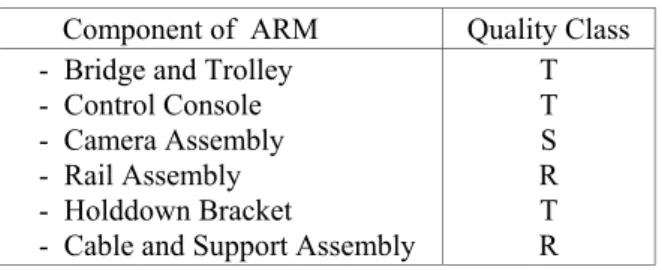
The ARM should be designed according to the Quality Class. The definition [2] of the Quality Class (Q, T, R, S) is as follows: 1) Q-class: Items or related services which perform safety-related functions during the normal operation and safe shutdown of the nuclear power plant, and whose failure could impact on the environment and public safety, 2) T-class: Items, portions of structures, systems or equipment or related services whose failure could reduce the functioning of any of the safety-related plant features (Q-class) to an unacceptable level, 3) R-class: Items, related services which are identified as reliability critical to achieve a high plant availability of the power generating function of the plant, 4) S-class: Non-safety-related items that are not quality class Q, T or R. The Quality Class for each component of the ARM is classified in Table 1.
Table 1. Quality Classification for ARM Component of ARM Quality Class - Bridge and Trolley
- Control Console - Camera Assembly - Rail Assembly - Holddown Bracket
- Cable and Support Assembly
T T S R T R 3. Licensing Requirements
Design goal for the ARM is to handle fuel assem-blies in a safe and reliable manner. The domestic act defined in [3] regulates for the technical criteria for a reactor, the related nuclear facilities and the location, structure, performance, operation and quality assurance of nuclear fuel periodic facilities. Acceptance criteria for the licensing of the ARM design is based on specific general design criteria [4], regulatory guidelines [5], and engineering codes and standards [1, 6]. In order to meet acceptance criteria for the ARM, the provisions for a protection from a physical fuel damage and a radio-logical protection, adequate cooling and a prevention of a criticality, and the operability and maintainability cited in the industrial codes and standards should be considered.
3.1 Protection from a fuel damage and a radiological material release
Transactions of the Korean Nuclear Society Autumn Meeting Busan, Korea, October 27-28, 2005
To prevent any damage to the fuel assemblies that pose a radiation hazard or an unintentional radiation exposure risk to personnel, mechanical and electrical safety devices shall be designed for the system of the ARM. Allowable stresses for components for the ARM involved in grappling and hoisting fuel assemblies shall be chosen to ensure that there will not be a structural failure of any part of the ARM that would result in a dropping or damaging of the fuel assemblies. Grapples and mechanical latches which carry a fuel assembly shall be designed such that an accidental opening is mechanically prevented.
Following interlock [1] shall be provided to prevent any damage to the fuel assemblies and to provide for a personnel safety as follows: 1) Underload and Overload interlock, 2) Up-Position and Down-Position interlock, 3) End-Travel for a physical limitation to a translation, 4) Up-Limit for a physical limitation to a hoisting, 5) Slow Zone interlock for a travel region, 6) Non-simultaneous Motion interlock against simultaneous hoisting and translation motions, 7) Grapple Release interlock, 8) Bridge and Trolley Travel interlock, 9) Slack Cable interlock actuated to prevent a further downward travel, 10) Translation Inhibit interlock, 11) Interfaced interlock between the ARM and the FTS to ensure a proper equipment positioning during fuel transfer operations.
3.2 Cooling, shielding and prevention of criticality All the fuel handling equipment shall be designed to prevent an accidental criticality during a fuel handling. In the event of an unexpected failure, the fuel assembly shall remain in a safe condition and location with an adequate cooling and shielding. The ARM shall be designed to ensure that a sub-criticality is maintained with the equipment fully loaded with fuel and the pool flooded with un-borated water. The component of the ARM shall be designed so that the operator will not be exposed to > 2.5 mrem/h from an irradiated fuel assembly elevated to the up position interlock with the pool at a normal operating water level.
3.3 Operability and maintainability
The ARM should be designed to operate in an efficient manner with a high degree of reliability. A high degree of efficiency can be achieved in the ARM by using simple, direct operations. Design life, radiation damage resistance, maintainability, and the ease of a decontamination shall be evaluated during the design of the components of the ARM and its equipment should be located in areas accessible for an operation, testing, inspection, and maintenance.
The parts and hardware of the ARM shall be standardized one by the industrial standards to permit an easy replacement of the parts between similar pieces
of equipment. Maximum use should be made of the standard commercially available parts and hard-ware. The design shall include features which facilitate a replacement operation. All the components which are normally submerged refueling water shall be removable and / or replaceable with ease without lowering the refueling pool water levels. All the control components of the ARM shall be located in removable modules with quick disconnects to permit a removal from the containment at the end of a refueling outage.
4. Conclusion
The design criteria and the licensing requirements for the ARM based on the regulatory documents and the industrial codes and standards are reviewed. At the beginning of design process for the ARM, the design requirements for a protection from physical fuel damage and a radiological protection, adequate cooling and a prevention of a criticality, and the operability and maintainability were established. These design require-ments will be applied to the ARM of the APR 1400.
REFERENCES
[1] ANSI/ANS-57.1, Design Requirements for Light Water Reactor Fuel Handling Systems, 1992 (Re-affirmed 1998).
[2] PSAR for SKN3&4.
[3] 과기부고시 제 2002-21 호, 원자로 시설의 안전
등급과 등급별 규격에 관한 규정.
[4] SRP 10 CFR 50, Appendix A, General Design Criterion (GDC) 2, 5, 61, 62.
[5] SRP 9.1.4, Light Load Handling System, 1996(Draft).
[6] KEPIC MCN (ASME NOG-1, Rules for Construction of Overhead and Gantry Cranes), 2000.