A Study on the Development and Evaluation of a Collaborative
Problem-Solving Learning Model for Nursing Students
Sowon Lee
1, *Boyoung Kim
21
Research Assistant, College of Nursing, Gyeongsang National University, Gyeongnam, South
Korea
*
2Associate Professor, College of Nursing, Institute of Health Sciences, Gyeongsang National
University, Gyeongnam, South Korea
[email protected]
1, [email protected]
2Abstract
This study developed and evaluated a learning model to improve collaborative problem-solving skills for nursing students taking physiology courses. This one-group pretest-posttest design used the jigsaw cooperative learning method on 30 nursing students from one local university. We analyzed the effect of a cooperative problem- solving learning model using SPSS 21.0 to compare changes in the students’ collaborative self-efficacy, problem-solving abilities, and team-member exchange. As a result, the participants showed significant increases in collaborative self-efficacy, problem-solving ability, and team-member exchange after experiencing cooperative problem- solving learning model. Therefore, we will help nursing students improve their communication skills by enhancing their collaborative self-efficacy and help them solve problems effectively in conflict situations.
Keywords: Collaborative Problem-Solving, Collaborative Self-Efficacy, Problem-Solving Abilities, Team-Member
Exchange
1. INTRODUCTION
Various problem-solving skills are required to solve the many problems we face daily [1]. Nurses communicate with various medical workers and patients in medical situations, so they also need problem-solving abilities to resolve issues when conflicts arise [2]. Although one of the goals of nursing education programs is to develop various core capabilities required by society, newly licensed nurses report that they lack essential communication skills needed as nurses or the effort to explore and develop themselves in medical sites [3]. Therefore, nursing students need to develop collaborative problem-solving skills via nursing education programs to perform their duties effectively in situations that require collaboration.
In this context, collaborative problem-solving is a student-centered teaching method that requires students to solve problems by sharing the understanding and effort required to achieve a solution, and is a teaching-learning strategy that can help develop communication skills, interpersonal relationships, and collaboration [4]. In particular, cooperative learning is an educational approach used in problem-solving learning to solve problems through cooperative and collaborative processes between members within small groups, and is distinguished from learning groups or small group learning approaches used in traditional learning processes [5]. In cooperative learning, the participants’ learning disposition, self-esteem, and self-efficacy have direct and indirect effects on the learning outcomes [6, 7]. Cooperative learning is also reported to improve communication, interpersonal, and solving skills [7-9]. Previous studies showed that problem-solving skills interact with collaborative self-efficacy and affect academic performance, and produce positive results in collaborative learning situations [10-12]. The jigsaw model of cooperative learning breaks assignments into (jigsaw) puzzle pieces that the group assembles to complete [13]. This cooperative learning
IJACT 21-3-23
Manuscript Received: February 17, 2021 / Revised: February 25, 2021 / Accepted: March 4, 2021 Corresponding Author: [email protected]
Tel: +82-55-772-8248, Fax: +82-55-772-8222
method enables each student of a ‘home’ group to focus on one area. These students become ‘experts’ in their assigned area by working and discussing with members from other groups assigned to the same focus area. These new groups are called ‘expert’ groups. The ‘experts’ then return to their ‘home’ group and share their expertise with the members [14].
Research on cooperative learning has been conducted in many fields on various groups, from elementary school students to university students [15-18]. However, most of the studies on nursing students focused on nursing practice, basic nursing, and communication [3, 13, 19]. Unlike other majors, nursing students often have a difficult time adapting due to the stress of memorizing a vast number of unfamiliar terms in anatomy and physiology [20]. In particular, basic major subjects require significant learning, and collaborative team activities affect the group’s task performance, which in turn determines the quality of team performance [21, 22]. Slow learners can be motivated or helped by highly-motivated students, while fast learners can establish their teaching skills by helping slow learners [21, 22]. The sharing of information or feedback with other members in the learning process is called team-member exchange, and cooperative learning is affected by the exchange of team members, which is the communication or interaction that helps the learners solve problems [2].
Therefore, this study investigated changes in the collaborative self-efficacy, problem-solving abilities, and team-member exchange of students who participated in a collaborative problem-solving learning model in a physiology course. The results of this study will become basic data for researching and developing learning models for basic major subjects in nursing education.
2. METHODOLOGY
2.1 Subjects
This is a one-group pretest-posttest experimental study comparing the effect of collaborative problem-solving learning model education on nursing students. A convenience sample of 30 second-year nursing students attending G-university in J-city were the subjects. Using the G*Power 3.1.7 program, this study required a minimum sample size of 28 subjects to verify the difference in pretest-posttest scores (significance level .05, power .80, effect size .5, so a total of 27 participants were chosen for the research.
2.2 Cooperative Problem-Solving Learning Process
In this study, the cooperative learning in physiology course is a collaborative problem-solving learning model based on the Jigsaw I method [23]. As a collaborative problem-solving learning, the jigsaw method is a teaching strategy that helps learners learn cooperation as group members share responsibility for each other's learning by using team member exchange to complete achievement goals. Jigsaw cooperative learning enables each student of a ‘home’ group to specialize in one task. These students meet with members from other groups who are assigned to the same task, and after mastering the material, return to their ‘home’ group and share what they have learned with their group members. Subsequently, this strategy helps to improve collaborative efficacy, and problem-solving skills in Figure 1.
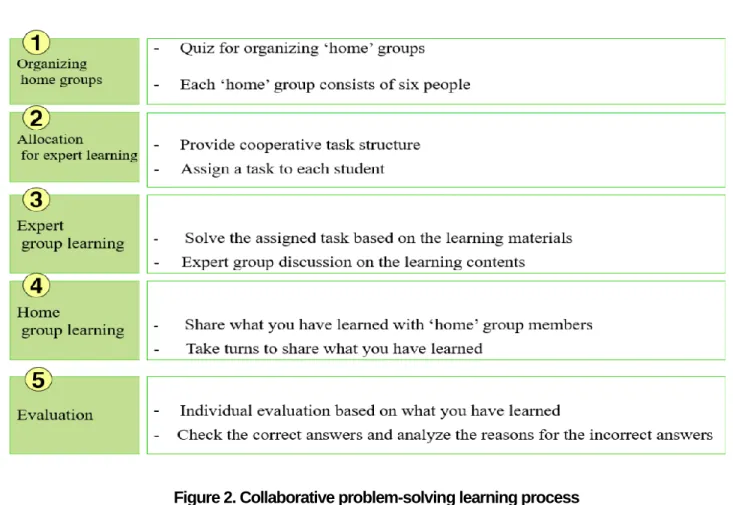
The learning process was implemented in 5 steps, as shown in Figure 2.
[Step 1] Organizing ‘home’ groups
Before forming the ‘home’ groups, the participants took a 20-question quiz to organize ‘home’ groups with similar learning levels. Based on the results, four members were assigned to each group, and the learning materials were distributed to each group.
[Step 2] Allocation for expert learning
Learning materials related to physiology were provided to each group, and the related sub-topics and ranges were divided and distributed to the students. The students were assigned to one topic, and the learning materials provided to each student were a part of the learning contents, which were organized to allow individuals to fill in the learning contents.
[Step 3] ‘Expert’ group learning
The students left their ‘home’ groups and joined other team members assigned to the same sub-topic to form ‘expert’ groups. The expert group engages in cooperative learning activities to solve problems related to what they have learned as well as the assigned tasks based on the learning materials, and what they have learned in advance. After exchanging knowledge in the ‘expert’ group, the students returned to their ‘home’ groups and prepared to teach what they had learned.
[Step 4] ‘Home’ group learning
After returning to their ‘home’ groups, the students shared what they learned in the expert group with their ‘home’ group members. During this process, each ‘expert’ explained what they have learned in their own words rather than simply reading the learning materials.
[Step 5] Evaluation
After the learning process in each ‘home’ group, all of the students performed tasks to reinforce their understanding of what they had learned. After completing the tasks individually, the instructor presented the answers, and if the answers were incorrect, the students discussed why they were incorrect.
2.3.1 Collaborative Self-Efficacy
Collaborative self-efficacy is the belief that an individual has the ability to collaborate and work with other learners to perform tasks well [24]. This study used the Korean version of ‘Self-Efficacy for Group Work Measure’ [25]. This tool consisted of 19 items on a 5-point scale, and the reliability of the tool was .93 [25]. The reliability in this study was .71.
2.3.2 Problem-Solving Ability
Problem-solving abilities refer to the intellectual and creative abilities to recognize the difference between a goal state and the current state, and quickly and effectively resolve the obstacles that cause this difference [26]. This study used the Personal Problem-Solving Inventory (PPSI) to measure problem-solving abilities [27]. This 40-item tool consists of three sub-factors: problem-solving confidence, approach-avoidance style, and personal control. Among them, this study only used 11 problem-solving confidence items and 16 approach-avoidance style items, excluding personal control factors. The reliability of each sub-factor was .859 for problem solving-confidence and .782 for approach-avoidance style. In this study, the reliability was .80 for problem solving-confidence and .78 for approach-avoidance style.
2.3.3 Team-Member Exchange
Team-member exchange shows how free a learner is to receive information, help, and exchange ideas and feedback with other members [22]. This study used a modified version which consists of 10 items on a 5-point scale [2]. The higher the score, the higher the degree of team-member exchange. The scale was .80 [2], and .78 in this study.
2.4 Data Collection
The data for this study was collected from March 4 to June 7 in 2019. The participants were fully informed of the study purpose and method. After explaining confidentiality and how the collected data will be managed, the survey was conducted only on the students who agreed to participate after obtaining written consent.
2.5 Data Analysis
This study used SPSS 21.0 to analyze the results. First, the subjects’ general characteristics were analyzed by numbers and percentages. Second, a paired t-test was used to compare changes in the subjects’ collaborative self-efficacy, problem-solving abilities, and team-member exchange. The significance level (α) was p<.05.
3. RESULTS
3.1 The Subjects’ General Characteristics
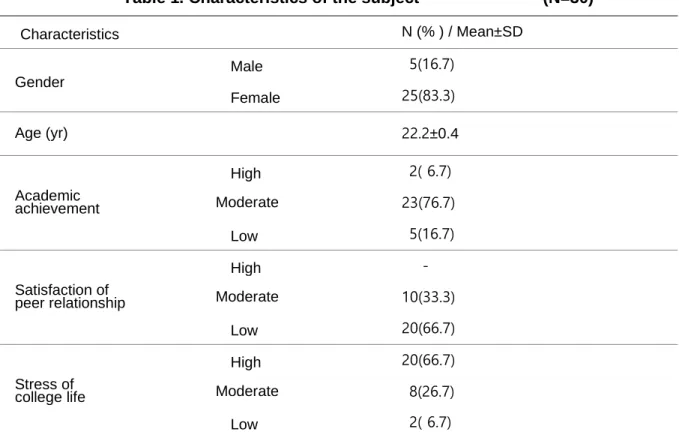
The majority of the subjects were female students (25, 83.3%). Twenty-tree students had average GPAs (76.7%), 2 had high GPAs (6.7%), and 5 had low GPAs (16.7%). In terms of peer satisfaction, 20 students were satisfied (66.7%), 10 were dissatisfied (21.7%). Twenty students had high levels of stress 66.7%), 8 had average levels of stress (26.7%), and 2 had low (6.7%) in Table 1.
Table 1. Characteristics of the subject (N=30)
Characteristics N (% ) / Mean±SD Gender Male 5(16.7) Female 25(83.3) Age (yr) 22.2±0.4 Academic achievement High 2( 6.7) Moderate 23(76.7) Low 5(16.7) Satisfaction of peer relationship High - Moderate 10(33.3) Low 20(66.7) Stress of college life High 20(66.7) Moderate 8(26.7) Low 2( 6.7)
3.2 The Effectiveness of Collaborative Problem-Solving Learning Model Education
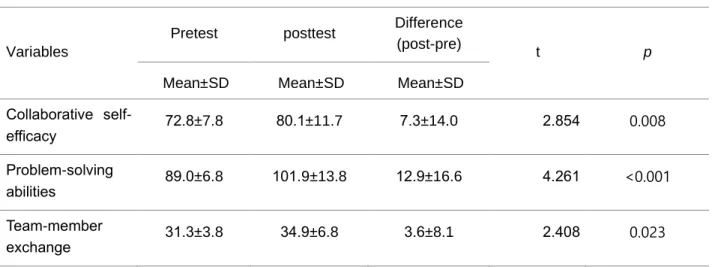
The nursing students who participated in collaborative problem-solving learning model education showed improved scores in collaborative self-efficacy (t=2.854, p=0.008), problem-solving abilities (t=4.261, p=<0.001), and team-member exchange (t=2.408, p=0.023) in Table 2.
Table 2. Effects of collaborative problem-solving learning model education
Variables
Pretest posttest Difference (post-pre)
t p
Mean±SD Mean±SD Mean±SD
Collaborative self-efficacy 72.8±7.8 80.1±11.7 7.3±14.0 2.854 0.008 Problem-solving abilities 89.0±6.8 101.9±13.8 12.9±16.6 4.261 <0.001 Team-member exchange 31.3±3.8 34.9±6.8 3.6±8.1 2.408 0.023
4. DISCUSSION
This study examined changes in the collaborative self-efficacy, problem-solving abilities, and team-member exchange of nursing students who participated in a collaborative problem-solving learning model education. As a result, all four variables showed positive changes after cooperative learning.
First, there was a significant difference in the subjects’ collaborative self-efficacy before and after participating in collaborative problem-solving learning model education. This means that the jigsaw cooperative learning technique had an effect on enhancing the students’ collaborative self-efficacy. Pescosolido [28] stated that the higher the collaborative self-efficacy, the more effort is made in cooperative tasks, and even if these tasks do not yield satisfying results, the participants tend to participate in achieving the group’s goal. Another study reported a positive correlation between collaborative self-efficacy and communication skills, and the higher the collaborative self-efficacy, the higher the communication skills [12]. In jigsaw cooperative learning, students frequently interact with other students, so communication with others becomes a significant factor. Through the process of discussing what they have learned in the ‘expert’ group and teaching what they have learned in the ‘home’ group, the students experience communicating with various learners and environments in the learning process. These experiences lead to improvements in the students’ communication skills to effectively convey their thoughts in situations where they have to perform tasks, which in turn lead to improved collaborative self-efficacy.
Second, there was a significant difference in the students’ problem-solving abilities after participating in collaborative solving learning model education. The students showed positive changes in problem-solving skills after participating in cooperative learning, which was consistent with previous studies. A study measuring problem-solving skills in cooperative learning situations showed increases in problem-solving skills and responsibility, in addition to positive effects on self-concept formation [30]. This is because the tasks assigned in jigsaw collaborative learning must be performed through discussion with other students and the students need to share what they learned with their ‘home’ group members like ‘Tutor’ who help other student [31]. In this study, the positive results of problem-solving abilities before and after cooperative learning are also considered to be in the same context.
Third, there was a significant difference in team-member exchange after participating in collaborative problem-solving learning model education. Team-member exchange increases when members communicate with each other, maintain interpersonal relationships, and help each other [22]. Therefore, the team-member exchange scores increased in the cooperative learning process because the interaction and communication between the students increased while sharing what they learned with ‘expert’ and ‘home’ group members. That is, there were active interactions between the ‘expert’ and ‘home’ groups to obtain positive results in the evaluation process during jigsaw collaborative learning. Other study also reported that team-member exchange improved, which motivated students to receive good grades [2]. That is, the exchange between students improved because the learning model of this study requires the students’ participation and because students’ interactions are affected by the evaluation.
the learning contents to the students, so they do not understand the whole or entire jigsaw puzzle when they engage in learning. In addition, there may be some free riders because the discussions in the ‘expert’ groups may be centered around active communicators. This may lead to a learning gap between groups because the ‘home’ group members of these free riders may not learn what they shared in the ‘expert’ group discussions. Finally, this study was only conducted on nursing students in one region, so there are difficulties in generalizing the results. Therefore, conducting further studies to investigate the relationship between the various variables that affect cooperation and learning among individual characteristics and inducing active student communication and participation will help evaluate the effectiveness of cooperative learning in nursing education.
5. CONCLUSION
This study identified that the students who participated in collaborative problem-solving learning model education increased their collaborative self-efficacy, problem-solving abilities, and team-member exchange. These results show that the integrated teaching method of jigsaw cooperative learning improves the collaborative problem-solving ability of nursing students, which is necessary for application to various courses to enhance the collaborative communication skills of nursing students. In conclusion, we have identified the application of jigsaw cooperative learning in collaborative problem-solving learning model education. It is a new way of learning, which is quite different from traditional learning method. Based on the findings, we believe that collaborative problem-solving learning would be acceptable and helpful to increase performance-approach goal for nursing students. However, we hope that this study only collected and analyzed the results of the students who agreed to participate, it is necessary to examine whether the change in collaborative self-efficacy, problem-solving abilities, and team-member exchange and whether the results are the characteristics of the group or the effect of the learning method.
CONFLICT OF INTEREST
The authors declared no conflict of interest.
REFERENCES
[1] M. J. Lee, “Communication Pattern and Problem-solving Ability of the Internet Game Addicts in College Students,” The Korea Contents Association (KOCON), Vol. 9, No. 11, pp. 108-119, November 2009. https://doi.org/10.5392/jkca.2009.9.11.108
[2] K. S. Jang, N. Y. Kim and H. Park, “Effects of an action learning based creative problem-solving course for nursing students,” The Journal of Korean Nursing Administration Academic Society, Vol. 20, No. 5, pp. 587-598, 2014. https://doi.org/10.11111/jkana.2014.20.5.587
[3] J. H. Park, “Effectiveness of Cooperative Learning on Nursing Students' Performance and Experience,” Journal of Korean Academic Soc Nursing Education. Vol. 16, No. 2, pp. 202-212, December 2010. https://doi.org/10.5977/jkasne.2010.16.2.202
[4] Y. M. Lee, T. J. Kim, J. I. Kim, and S. P. Jang, “The Effects of Task Types and Collaboration Procedures on Task Performance and Group Efficacy in Web-based Situational Learning Environment,” Educational Research Institute, College of Education, Ewha Womans University. Vol. 37, No. 3, pp. 47-75, December 2006.
[5] I. S. Park, “The Effects of Jigsaw cooperative learning model on communication competence of pre-service teachers,” The Journal of Learner-Centered Curriculum and Instruction (JLCCI), Vol. 19, No. 2, pp. 1009-1027. January 2019. http://dx.doi.org/10.22251/jlcci.2019.19.2.1009
[6] M. H. Kang, M. J. Kim, H. J, Kim, S. Y. Um, and H. Y. Jung, “Investing the Relationship among students ’collaboration performance, self-efficacy, interaction and achievement in the web-based collaborative learning,” Korean Journal of Educational Research, Vol. 48, No. 1, pp. 157-180, January 2010.
[7] J. W. You, “The Relationship among Self-efficacy for Group Work, Team Efficacy, Interaction, and Team Performance in Team Project-based Learning in a College Classroom,” The Journal of Learner-Centered Curriculum and Instruction (JLCCI), Vol. 14, No. 10, pp. 89-110, 2014.
Society for Curriculum Studies (KSCS), Vol. 25, No. 3, pp. 265-288, September 2007. https://doi.org/10.15708/kscs.25.3.200709.011
[9] Y. M. Lee, “An Investigation of the Factors Affecting on the Team Based Project Learning in Engineering College,” The Journal of Learner-Centered Curriculum and Instruction (JLCCI), Vol. 13, No. 6, pp. 351-375, December 2013.
[10] M. H. Jung, and K. S. Shin, “The effects of the project -based learning on improvement of creative thinking, creative disposition and problem solving of college students,” The Korean Journal of Educational Psychology, Vol. 13, No. 3, pp. 287-301, September 2004.
[11] D. H. Kim, “An Evaluation Study on the Planning and Implementing of Project Learning in Elementary School,” Korean Society for Curriculum Studies, Vol. 16, No. 2, pp. 297-327. October 1998.
[12] J. H. Park, and J. W. Ko, “Relationship between Collaborative Self-efficacy and Problem-solving Skills of University Students: Mediating Effect of Communication Skills,” Journal of Educational Innovation Research. 26(1), pp. 169-192. 2016. https://doi.org/10.21024/pnuedi.26.1.201604.169
[13] J. A. Kim, “Effect of Cooperative Learning Applying Jigsaw Model in Nursing Simulation Based Education,” Journal of Learner-Centered Curriculum and Instruction. Vol. 12, No. 4, pp. 49-69, December 2012.
[14] T. M. Duffy, and J. R. Kirkley, Learner-Centered Theory and Practice in Distance Education: Case from Higher Education. illustrated, Lawrence Erlbaum Associates. 2004.
[15] Y. M. Choi, “A Comparative Study on the Teaching-Learning Methods for Economic Education in Elementary School,” master’s Thesis, Seoul national University of Education, South Korea., 2010. [16] Y. L. Hwang, and Y. B. Park, “Effect of Jigsaw III Cooperative Learning on Science Achievement and
Learning Attitude of Middle School Female Students,” Journal of Science Education, Vol. 35, No. 1, pp. 91-101, June 2011. https://doi.org/10.21796/jse.2011.35.1.91
[17] B. G. Ahn, “The Effect of Cooperative Learning on Academic Achievement in Economic Instruction,” Korea Economic Education Association, Vol. 18, No. 1, pp. 69-89, June 2011.
[18] H. H. Yoo, and E. J. Kim, “Effects of Jigsaw Listening and Reading Tasks on Korean University Students' Speaking Abilities and Attitudes on English,” The Applied Linguistics Association of Korea (alak), Vol. 22, No. 1, pp. 237-275, March 2006.
[19] M. K. Kim, and H. W. Kim, “The Effects of Jigsaw Cooperation Learning on Communication Ability, Problem Solving Ability, Critical Thinking Disposition, Self-directed Learning Ability and Cooperation of Nursing Students,” The Journal of Korean Academic Society of Nursing Education Vol. 25, No. 4, pp. 508-516, November 2011. https://doi.org/10.5977/jkasne.2019.25.4.508
[20] B. N. Park, J. S. Park, and J. R. Lee, “Factor affecting adaptation to school life among nursing junior college freshmen,” Journal of the Korean Society of Health Information and Health Statistics, Vol 34, pp. 153-164, 2009.
[21] J. H. Kim, “Suggestion of practical jigsaw class model in social studies instruction,” Master ’s thesis, Kyungpook National University, South Korea., 2016.
[22] A. M. Seers, M. Petty, and J. F. Cashman, “Team-member exchange under team and traditional management: A naturally occurring quasi-experiment,” Group & Organization Management, Vol. 20, No. 1, pp. 18-38, March 1995. https://doi.org/10.1177/1059601195201003
[23] E. Aronson, “The jigsaw classroom: Building cooperation in the classroom,” Chicago: Scott Foresman and Company. 1997.
[24] S. B. Alavi, and J. McCormick, “The roles of perceived task interdependence and group members' interdependence in the development of collective efficacy in university student group contexts,” British Journal of Educational Psychology, Vol. 78, No. 3, pp. 375-393, 2008. https://doi.org/10.1348/000709907X240471
[25] S. Y. Kim, and M. H. Kang, “The relationship between self-efficacy for group work, perceived usefulness, flow, perceived interaction, and learning outcomes in team project-based learning with closed-type SNS,” The Journal of Educational Information and Media. Vol. 22, No. 1, pp. 85-110. March 2016. 10.15833/KAFEIAM.22.1.085
[26] S. J. Lee, Y. K. Chang, H. N. Lee, and K. Y. Park, “A Study on the Development of Life-Skills: Communication, Problem Solving, and Self-Directed Learning,” Korean Educational Development Institute, pp. 1-145, January 2003.
[27] P. P. Heppner, and C. H. Petersen, “The development and implications of a personal problem-solving inventory,” Journal of Counseling Psychology, Vol. 29, No. 1, pp. 66-75, January 1982.
10.1037/0022-0167.29.1.66
[28] A. T. Pescosolido, “Group Efficacy and Group Effectiveness: The Effects of group efficacy over time on group performance and development,” Small Group Research, Vol. 34, No. 1, pp. 20-42. February 2003. 10.1177/1046496402239576
[29] S. Y. Kwon, “The analysis of relationships among Learning style, preferences for Learning activities and Learning strategies in e-Learning environment,” Korean Association for Educational Information and media, Vol. 14, No. 4, pp. 141-171, 2008.
[30] A. V. Kotze, and L. Cooper, “Exploring the transformative potential of project-based learning in university adult education,” Studies in the Education of Adults, Vol. 32, No. 2, pp. 212-228, January 2016. https://doi.org/10.1080/02660830.2000.11661431
[31] E. Y. Choi, “The Role of Effective Tutors Recognized by Students who have Experienced Problem-Based Learning-Focused on Focus Group Interview,” The Journal of the Convergence on Culture Technology (JCCT), vol. 6, No. 4, pp. 469-476, 2020. http://dx.doi.org/10.17703/JCCT.2020.6.4.469