63
ISSN: 2288-2766 © 2021 KODISA & EABEA. http://eajbe.jams.or.kr
doi: http://dx.doi.org/10.20498/eajbe.2021.9.1.63
Issues in Real Estate Taxation and Rationalization of Property
Taxation: Lessons from Real Estate Regulation Policy in Korea
11Choongik CHOI
Professor, Department of Public Administration, Kangwon National University, Korea
E-mail: [email protected]
Received: November 09, 2020. Revised: January 15, 2021. Accepted: January 23, 2021.
Abstract
Purpose – This study examines the regressive estate taxation issues and seeks measures for the rationalization of property taxation. Although various discussions on the reorganization of property taxation have been made, discourses on how much property taxation burden is given to homeowners and on whether the increase of property taxation should be shifted to tenants have not been properly carried out.
Research design, data, and methodology – Therefore this study examined the property taxation issues and sought measures for the rationalization of property taxation based on homeowners’ social and economic characteristics. This study deals with discussions on the directions for rational real estate reorganization and what desirable real estate market stabilization polices are.
Result – This study investigates what issues and disputes the powerful real estate policies to ease overheat of the real estate market have caused and seeks directions to solve those.
Conclusion – The study results supports that the real estate taxation would be levied in proportion to the economic capacity of real estate owners to pay taxes. It implies that tax levy not only in conjunction with income, but also in combination with existing real estate assets would be considered to be desirable in terms of comprehensive tax justice.
Keywords: Issues in Real Estate Taxation, Rationalization of Property Taxation, Comprehensive Real Estate Tax, Property Tax, Jeonse Price
JEL Classification Code: O18, R31, R38, H20
ⓒ Copyright: The Author(s)
This is an Open Access article distributed under the terms of the Creative Commons Attribution Non-Commercial License (http://Creativecommons.org/licenses/by-nc/4.0/) which permits unrestricted noncommercial use, distribution, and reproduction in any medium, provided the original work is properly cited.
64
1. Introduction
Up to recently, various discussions have been made over the reformulation of property taxation system, but the discourse on how much the tax is economically burdened to homeowners and whether or not the increase in the tax will be passed on tenants has not been properly considered. Various real estate polices are presented frequently through the mass media. There was little discourse on how the real estate taxation could be rationalized in terms of real estate market. The key contents of real estate policy in the current Korea government are to increase taxes on the rich and cut taxes on the poor for social justice.
In the recent real estate policy of Korea government, the increase of real estate taxes has led to a shortage of jeonse, and makes the real estate market unstable with apartment prices rising nationwide. The real estate market has responded coldly or sensitively to rapidly changing government’s real estate policy. Frequent changes make real estate trading parties embarrassed. It is difficult to be well informed of and respond to those changes. Since the current government was launched, real estate polices emerged in every 50 days on average and the most measures were presented among the governments in history. To interpret this conversely, it proves that the real estate market has not been easily stabilized. Some analysis that the real estate prices rose more than any other governments has emerged.
The interest in real estate of Korean people who perceive it is the site of living and a major means for property expansion is huge. Since the Moon Jae-In government was launched in 2017, many measures for real estate market stabilization have been presented. A variety of regulations and policies to control the demand and supply of the real estate market have emerged. In the center of the supply policy, there has been new housing supply, and loan regulations and real estate taxation consolidation have been in the center of policies for demand. To prevent real estate speculation in Seoul Metropolitan Area, the regulations on mortgage loans and Jeonse (lease on a deposit basis) loans have been fortified and a new obligatory clause that the owners need to live for two years minimum to obtain the ownership of reconstruction apartment was enacted. Issues related to real estate have continuously occurred.
Among the policies for demand of real estate, the real estate tax system reorganization that may cause refusal to pay tax is the subject of a pressing interest to real estate owners. Above of all, although acquisition tax and registration tax are imposed upon once, the property taxation needs to be paid each year and so homeowners feel much higher burden. Disputes on rational property taxation reorganization become a hot topic. This study examines what direction for cooking down desirable real estate market should be through empirical discussions on the rationalization of property taxation.
Many measures to control the demand and supply of real estate market have been attempted. An assertion that price stabilization through increase in supply rather than excessive market intervention and price regulations is desirable draws support. New housing supply is in the center of supply policy, and loan regulations and real estate tax system consolidation are in the center of demand policy. Different opinions on whether the proposed policies can properly function to prevent speculative real estate trading and whether real consumers of real estate can stably trade real estate are presented. This study investigates what disputes and issues the government’s strong real estate policies to cool down overheated real estate market have, centered on property taxation.
2. Theoretical Background
Property taxation is an important tax system at central and local governments’ entire financial level as well as household finances, and it is a sort of wealth tax based on assets as taxation basis. The characteristics of property taxation can be divided into five: First, `property taxation is a tax imposed upon property as it is based on ownership of real estate, and the tax payer’s circumstances or situations are not considered in taxation. Second, although there are many cases that debts including loans in addition to own capital in buying real estate, no tax reduction is offered according to debts in the taxation process, as tax is imposed upon total real estate amount. Third, as property tax is nominally paying part of income that can be expected by owning real estate without erosion of the owned property, so the tax rate is not high; therefore part of income created from the property is paid without selling the property. Fourth, property taxation is classified as local tax, tax revenue can be easily secured, and it is stable for the long-term, and so local tax is suitable as local-specific tax revenue. Fifth property taxation is a tax whose burden is suitable for the determination principle according who gains, rather than burden through capability (National Assembly Budget Office, 2019).
65 When it comes to the literature review of empirical research on real estate taxation, Choi et al. (2020) analyzed the real estate tax burden by income class using the Public Finance Panel Survey data. The results explored the possibility of the incidence of real estate tax on the Jeonse tenants by employing a simple quasi-experimental design. It is found that Jeonse prices for the apartments, which are subject to the comprehensive real estate tax, are not higher than those for the apartments, which are not subject to the comprehensive tax. It implies that there is no evidence on the incidence of the tax on the Jeonse tenants, and the amount of tax levied is not enough to bring about the incidence. It is expected that the pattern of the incidence would turn to the different direction if the tax rates rise (Choi et al., 2020).
The history of real estate tax system is very long. Property taxation imposed on the ownership of land, building, housing started since the Three Kingdoms Period, and it was a main item of tax in the agrarian society. As industry developed, the importance of land tax fell, but its influence on housing, building, and industrial sites is still huge. The property taxation was consolidated in the early 1970s, in the late 1980s, and in the early and mid-2000s when real estate prices soared according to economic growth. The government adopted progressive tax rates for residential land in 1973 in terms of real estate price hike in the 1970s. Heavy taxes were applied to residential land, golf courses, vacant land, and corporation’s non-business land in 1974. Since the adoption of the property tax, it was used as a major policy means controlling real estate speculation in the economic growth process in the 1970s and 1980s, and the tax system was more consolidated. Although the government raised acquisition ax, registration tax, and transfer income tax to control speculation, it started to cement property taxation as the policy effect was not huge. Although steady taxation consolidation, including shift to taxation on real estate that was not taxed and the adoption of progressive tax rates for housing, was made, the real estate prices rose centered on land in the 1980s. The government adopted the property taxation for excessive land ownership in 1987, and newly enacted comprehensive land tax through revision of the Local Tax Act in 1990.
In 2005, a huge change occurred to the property taxation. In 2005, the urban planning tax was integrated into the property tax, and comprehensive land tax was dualized into property tax and comprehensive real estate tax, and the actualization of the declared value was adopted. In this way, property taxation including property tax was fortified. Among others, simplification of taxing through integration of buildings (existing property tax) and annexed land (existing comprehensive land tax) is worth noticing. Declared value actualization was attempted to raise the real estate declared value, which is the tax base, to the real transaction prices. To prevent rapid tax increase, the government adopted fair market price ratio of real estate, which is a standard of assessment reflection ratio system through which the standard of assessment is calculated by multiplying declared value by a certain ratio.
The government tried to raise the declared value reflection ratio step-by-step, but the property tax was not raised for a while after land and buildings were raised by 70% and housing by 60% in 2009 at the time of Lee Myung-Bak government. As for the comprehensive real estate tax, summing up taxation by household was decided as a violation of the constitution by the Constitutional Court in 2008, and tax rate was cut for real estate trading activation. Also, as taxation base amount was raised from KRW 600 million to KRW 900 million of one house per household in 2009, real estate taxation was eased more. As Moon Jae-In government was launched, they decided to raise fair market price ratio of the comprehensive real estate tax by 5% each year to consolidate property taxation, and so it is scheduled to increase to 85%, 90%, 95%, and 100% in 2019, 2020, 2021, and 2022, each. However property tax was still at 60%, and so different fair market price ratios of real estate are applied to property tax and comprehensive real estate tax.
In the integrating process of comprehensive land tax and property tax in 2005, as land and buildings are taxed through summing them up, the government simplified the standard of assessment bracket of housing and decreased tax rate to prevent rapid tax burden increase, and also lowered tax rates for the remaining building and golf courses. As one of the measures to cope with 2008 financial crisis and reinvigoration of the real estate market, the government additionally decreased housing property tax rate, and also lowered tax rate for golf courses in non-Seoul Metropolitan Area by half between 2008 and 2009 temporarily. In addition, the tax burden upper limit system to prevent tax burden increase was carried out in 2005. It was devised in order to prevent rapid property tax burden compared to the previous year, the system was newly established in the property tax and comprehensive real estate tax items in 2005. In early years of the system, 150% was uniformly applied to all tax items, but the standard of assessment increased due to summing up taxation of residential land and housing building was conducted in the past, so the standard of assessment rose and the actualization of declared value was made, which rapidly increased housing sector tax burden. Therefore the property tax upper limit was limited to housing worth KRW 600 million or lower based on 2006 and the tax rate fell to 105~110%, and it was declined to 130% even for housing worth over KRW 600 million. Unlike property tax, the comprehensive real estate tax was set not to go beyond a certain ratio of summing up value of previous year’s property tax and
66 comprehensive real estate tax. In 2005, it did not go beyond 150%, but it was expanded to 300% due to the system expansion. However it fell to 150% again from 2009 for invigoration of the rea estate market (National Assembly Budget Office, 2018).
3. Issues in Real Estate (Property) Taxation
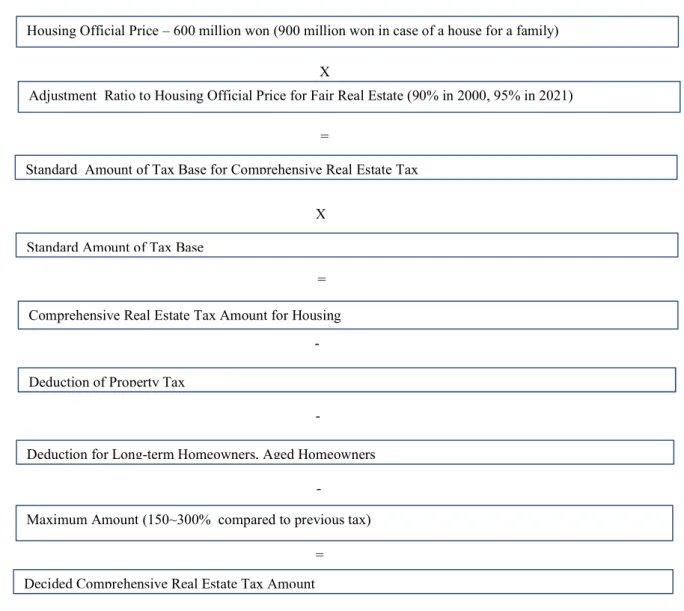
In August 2020, the revision of the tax legislation was decided in the Cabinet Meeting. Acquisition tax, property tax, comprehensive real estate tax, and transfer income tax were all raised, and the main details included the increase of multi-house owners’ comprehensive real estate tax rate and corporate acquisition tax rate. The reorganization of the comprehensive real estate tax in 2020 was consolidated targeting individuals and corporations, and it is worth noticing that individual’s maximum tax rate is applied as a single tax rate. That deduction of KRW 600 million applied to individuals was abolished and that tax burden upper limit applied to individuals disappear for corporations mean that long-term ownership is strongly regulated. The multi-house owners’ tax burden upper limit was raised up to 300% and this rate is applied if one owns three houses or more or two houses in the control area.
Housing Official Price – 600 million won (900 million won in case of a house for a family)
Adjustment Ratio to Housing Official Price for Fair Real Estate (90% in 2000, 95% in 2021)
Standard Amount of Tax Base for Comprehensive Real Estate Tax
Standard Amount of Tax Base
Comprehensive Real Estate Tax Amount for Housing
Deduction of Property Tax
Deduction for Long-term Homeowners, Aged Homeowners
Maximum Amount (150~300% compared to previous tax)
Decided Comprehensive Real Estate Tax Amount = X X = -=
67 Comprehensive real estate tax and property tax amounts are calculated by applying tax rate and tax credit to the standard of assessment calculated according to tax law based on declared value. Those taxes target real estate owners based on June 1 each year, and the property tax is imposed in July ~ September based on the declared value declared by the Land, Infrastructure and Transport and local governments and the comprehensive real estate tax is imposed in December.
In the revised tax law bill in 2020, what is the most remarkable is tax rate change. When looking at it, the tax rate of comprehensive real estate tax is rapidly increasing targeting multi-house owners. The tax rate increase of multi-house owners compared to one house owners is about 2 times higher, which means government’s strong intention to strongly regulate multi-house ownership for speculation. The actualization of declared value has a high possibility to increase tax burden. What is remarkable is that the tax credit rate and the upper limit of aggregate deductible rate of long-term ownership deduction of aged person having one house was raised from 70% to 80%, and thus the burden of end user’s one house possession was eased. As giving to one’s spouse for 10 years up to KRW 600 million is possible without gift tax, an increase of homeowners who want to give part of their real estate is line with the context.
A problem is that a possibility to pay more tax is high if declared value rises, although tax rate does not change as property tax or comprehensive real estate tax is paid based on the declared value. The reason is because the declared value may rise although housing price does not rise if declared value becomes similar to actual traded value through government’s actualization of the declared value. Consequently it means more tax can be paid, irrelevant of real estate prices. The reason why the reorganization of property taxation has huge effects on the consumers and suppliers is that a possibility of continuous rise of property tax or comprehensive real estate tax is high, although real estate prices are constant or drop. As the acquisition and trading taxes in addition to property taxation are sharply raised, the burden of the end users of real estate goes up. A concern co-exists in that the policy to control speculative forces may decline end user’s desire to buy property in addition to causing people’s resistance to pay tax.
4. Property Taxation Consolidation and Real Estate Tax Increase to Ease Inequality
Figure 2 show the percentage of real estate tax compared to GDP between OECD countries. It is easily found that the Korean real estate tax was 0.9% of nominal GDP in 2018, which stood at 17th among OECD countries (Figure 2). The real estate transaction tax ratio was 1.5%, which is high to be ranked top. This is more than three times higher than the mean ratio of OECD countries. As the structure is that real estate transaction tax is higher and property taxation is lower than OECD averages, an assertion to consolidate property taxation, ease transaction tax and rationalize the real estate tax system emerged. Although the purpose of the policy is rational, we will see whether the real estate market will respond to the purpose of the tax system reorganization.
Major developed countries use real estate taxation policy for market stabilization when housing prices soar, which is similar to the Korean real estate tax system rationalization. In the U.K., they raise acquisition tax rate and apply additional tax rate targeting multi-house owners using acquisition tax and transfer income tax to prevent housing price hike. In Singapore, they respond to housing price rise through tax rate increase by adopting additional acquisition tax at policy level and so real estate taxation is used for housing market stabilization. The property wealth tax in France adopted in 2018 targets only real estate except financial assets and movable assets from the existing wealth tax targets, and progressive tax rates are applied to individuals having net assets exceeding EUR 1.3 million (Korea Research Institute for Human Settlements, 2020).
In the U.K., acquisition tax rate increases according to taxation bracket, and additional tax rate is applied to multi-house owners, and tax rates are raised upon housing price rise in Singapore. The key to real estate tax policy of these countries is a rapid increase of tax rate according to taxation bracket, and this means that a system to impose more taxes to the group having higher capability to pay taxes. If it is adopted in Korea, a strong resistance to pay tax is predicted, but adequate publicness exists in that the nation retrieves part of the profits according to real estate value rise, as the standard of assessment increases, and it may contribute to the realization of tax justice. A method to discriminately apply tax rate scope to actual one house owners, multi-house owners, corporations, and foreigners can also be considered. Rather the taxes increased from wealthy class can ease tax burden for low income brackets so there can be a positive effect of income redistribution.
Property taxation (real estate tax) not only plays an important function composing finances of central and local governments, but affects individuals possessing real estate and potential consumers. It also functions as a socially important tax system connected to macro economy including construction and real estate industries. Therefore change in property taxation may diversely affect real estate market and other sectors socially and economically.
68 If property taxation level is suddenly raised to the level of major OECD countries, a hug resistance to pay tax throughout the society may occur. First, rapidly raised taxes compared to existing tax rate entails taxpayers’ resistance, and there is a concern that it may be linked with real estate market decline. A paradoxical phenomenon in which new real estate end users are burdened for the raised property taxation rather than those who purchased high real estate for speculation and then sold them may be accompanied. Second, huge macroeconomic ripple effects are predicted to be huge in various aspects including private spending, government expenditures, and GDP, as well as housing and land prices, and the reduction of disposable income of real estate owners can be caused, and the real estate prices may be declined due to the effect of taxation’s negative capitalization. However there will be no burden to people not possessing house and aggregate demand may increase due to the wealth redistribution effect deriving from the nature of progressive tax. So the economic rippled effects of property taxation change should be considered in diverse aspects.
Canada UK USA France Japan Australia Belgium Korea South Germany
OECD Average Percentage of Property Tax (Rank) 3.1 3.1 2.7 2.6 1.9 1.6 1.3 0.9 0.4 1.1 (1) (2) (3) (4) (8) (9) (12) (17) (27) Percentage of Transaction Tax (Rank) 0.3 0.8 0.1 0.8 0.3 1.3 1.1 1.5 0.4 0.4 (20) (6) (28) (7) (22) (2) (3) (1) (12) Total 3.4 3.9 2.8 3.4 2.2 3 2.3 2.4 0.8 1.5
Source: Revised from National Assembly Budget Office (2018)
Figure 2: Percentage of Real Estate Tax compared to GDP in OECD Countries
The key to real estate tax system reorganization should be choice and concentration to apply high tax rate by limiting it to corporations or high price homeowners for speculation, not targeting all homeowners. The current government’s real estate tax system reorganization is intensively carried out. The reason is that tax rate increase through tax law revision and the adjustment of fair market price ratio of real estate are simultaneously carried out. We need to take notice that resistance to pay tax like tax bomb, which was a disputable issue since the adoption of the comprehensive real estate tax, may emerge again. If real estate tax burden increases, the tax burden of high price homeowners will rise, and the people’s emotion will become negative. In addition to the heavy tax dispute of paying property tax and also comprehensive real estate tax, there can be a feeling that government excessively intervenes in private property. The process of letting people know about the rationalization and imperativeness of tax rate increase, and enhancement of their understanding and communication should be accompanied.
5. Conclusion
Real estate has been perceived as a means to increase property to many people. Although government’s real estate policy changes, the real estate value repeatedly rises if real estate owners endure for some period, and so real estate owners’ behaviors are not fundamentally changed. Although real estate can be used as goods with investment value in some sense, it seems to be derived from a concept of owning rather than using. For stable real estate taxation policy, it may be more desirable to increase taxes on real estate possession rather than heavy taxation on
69 real estate transactions. Despite resistance to pay tax for the short-term, tax rate increase will work as a burden to those who want to own real estate for the long-term, and so tax revenue will go up and real estate price will be stabilized.
Looking at homeowner households’ characteristics, their net assets and net debts all sharply rose compared to non-homeowners. The debt increase rate was higher than asset increase rate: Houseowner group’s net assets rose just 1.6% on average annually but debts rose 4.4% on average annually, which proves that rapid debt increase may become a burden to national economy. What is interesting is that households owning lower price houses do not intend to increase debts, but the 2~3 quintile groups (middle income bracket), increase debts. Also, even non-homeowners generate rental income, and 1.62% (74 out of 4,576 non-non-homeowners) of the non-non-homeowners has real estate rental income. When the number of owned homes increases, the fact that assets and debts simultaneously increase may weaken household’s financial soundness as home ownership may increase debts, and so a caution is needed. Because it is difficult to regard that asset quintile goes up, although income goes up, asset tax burden of those who have higher asset quintile can be high compared to income. This means that real estate-rich people may have smaller income and it can be a factor remarkably reduce household’s disposable income if property taxation increases. Meanwhile when looking at property tax by income quintile of homeowners, a regression by which the ratio of property tax to household income becomes lower is shown as household income quintile goes from 1 to 5. Therefore, the rationalization of tax system in terms of both assets and income should be carried out for the long-term.
Tax rates considering the tax paying ability of real estate owners is a key policy factor. There is a need to judge tax paying ability as comprehensively by integrating income and existing real estate assets with tax paying ability. Although progressive tax rates are valid from the Rawls’ theory of justice aspect, it has an aspect of violation of the constitution from the private property right control. Nonetheless, application of higher tax rates to high income earners or wealthy people can become a meaningful reason for tax justice, and the reason is because of an income redistribution effect. More tax revenue due to progressive tax rates can be connected to tax reduction of socially underprivileged class. Accordingly, rational systems and policies are necessary to make a social virtuous circle. Here, there is a reason that efforts to maximize income redistribution effect according to progressive rate application should be accompanied. It should be noted that a fair taxation system will be able to boost the economy, but on the other hand, excessive taxation can bring about tax resistance as well as shrinking economic activity.
References
Choi, C. S (2015). Relationship between housing prices and expected housing prices in the industry. The Journal of Distribution Science, 13(11), 39-46.
Choi, C. I., Kim, C. K., Kim, C. M., & Lee, D. K. (2020). Regressive real estate taxation and tax incidence on the jeonse costs, Journal of Korea Real Estate Appraisal, 19(3), 29-47.
Korea Research Institute for Human Settlements (2020). The changes of housing price and real estate taxation policy in OECD countries. KRIHS Policy Brief 758, 1-25.
National Assembly Budget Office (2019). Characteristics of home owners and rationalization of property taxation. Retrieved November 01, 2020, from https://korea.nabo.go.kr/
National Assembly Budget Office (2018). Issues and trends of real estate taxation. Retrieved November 01, 2020, from https://korea.nabo.go.kr/
Rho, S. Y. (2014). A study on the financial strength of households on house investment demand. Journal of Distribution Science, 12(4), 31-39.