†
To whom corresponding should be addressed. Tel : +82-02-961-9671 E-mail : [email protected]
Abstract
Currently, 3D printing technology is a new revolutionary additive manufacturing process that can be used for making three dimensional solid objects from digital films. In 2019, this 3D printing technology spreading vigorously in production parts (57%), bridge production (39%), tooling, fixtures, jigs (37%), repair, and maintenance (38%). The applications of 3D printing are expanding to the defense, aerospace, medical field, and automobile industry. The raw materials are playing a key role in 3D printing. Various additive materials such as plastics, polymers, resins, steel, and metals are used for 3D printing to create a variety of designs. The main advantage of the green cement for 3D printing is to enhance the mechanical properties, and durability to meet the high-quality material using in construction. There are several advantages with 3D printing is a limited waste generation, eco-friendly process, economy, 20 times faster, and less time-consuming. This research article reveals that the role of green cement as an additive material for 3D printing.
Key words : 3D printing, green cement, technology trends, applications, construction
1. Introduction
An additive manufacturing process called 3 Di-mensional Printing (3DP) is a more popular advan-ced technology in modern society. The 3D printing process consists of three steps i.e is modeling, prin-ting, and finishing. There are different methods of 3D printing shows in Figure 1.
The first technology is selective laser sintering (SLS), high power laser can be used and it scans the material like powders layer by layer. A liquid pho-topolymerization can be used for making a solid part of the second method Stereolithography (SL). A special plastic or metal wire is used as input material for the extrusion nozzle in the third method fused depo-sition modeling (FDM). The applications of 3D
prin-ting are two types i.e is rapid prototyping and per-sonal printing and it spreads to the various industries such as fashion & retail (Alyson Vanderploeg, 2017), food (Nachel, 2019), medical (Sunil Sharma, 2019) games & entertainment (Zhen Chen, 2017), defense & aerospace (Sunil C. Joshi, 2015) and automobile indu-stry (Megan R.Nichols, 2019).
The recent review (Shahrubudin, 2019) reported the detailed information of 3D printing technology, raw materials for 3D printing, and applications. They discussed the types of 3D typing (binder jetting, di-rected energy deposition), materials extrusion, pow-der bed fusion, sheet lamination, vat photopolymeri-zation. Materials such as metals, polymers, compo-sites, ceramics, smart materials, etc. Applications are the aerospace industry, automotive industry, food in-dustry, healthcare and medical inin-dustry, architecture, building, & construction industry, electric and elec-tronic industry, and fabric and fashion industry.
Figure. 1. Different methods of 3D printing
The application of cement composites for 3D prin-ting was investigated (Gregory J Gibbons, 2010) for the feasibility studies of Portland cements. Mohamad Izwan Saifudin Mohd Zainuri, 2020 was reviewed on using natural fiber with cement for 3D Concrete Printing. In this review, they discussed the types of raw materials such as coarse aggregates, fly ash, clay, and sand used for the printing. The main theme of this paper is to review the 3D printing trends and green cement for 3D printing.
2. The role of green cement and 3D printing
in the construction industry
2-1. Effect of CO2 emission reduction according to using green cement
Carbon dioxide from the cement industry world-wide accounts for about 5 percent of the total emi-ssions (Worrell et al., 2001). Cement is expected to increase demand and production annually, with global cement output rising from about 25.4 million tons as of 2006 to 368 million tons (low estimate) to 438 million tons (high estimate) by 2050 (Miller et al., 2018). Increased cement production also increases the use of fossil fuels needed to manufacture cement, thereby increasing CO2 generation at the same time.
Accordingly, the cement industry needs to reduce CO2 generation through the use of alternative fuels
or substitutes.
Calcination process occurs when calcium carbo-nate (CaCO3) and silicon dioxide SiO2 are combined
in furnace at 1,450 ℃, which results in the for-mation of the following products,
The cement manufacturing process is largely divided into three processes: raw material process, calcination process, and finishing process, and about 90% of greenhouse gas emissions are caused by combustion and decarbonate of fuel for calcination in the calcination process (Sánchez Jiménez et al., 2016). Currently, the cement industry induces a re-duction of the amount of limestone input to reduce carbon dioxide and the input of alternative materials using circulating resources. Also, it aims to reduce energy usage and CO2 generation by installing
high-efficiency equipment such as furnace burners and coolers, and by pursuing high efficiency such as crusher/separator.
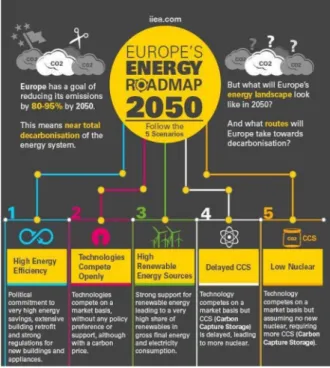
Europe's cement industry carries out various green-house gas reduction activities with the obligation to reduce the weight of high greenhouse gas emissions. Among such activities, the roadmap of the 2050 low carbon economy presents the technologies applicable to the cement industry for CO2 reduction and even
provides the potential CO2 reduction that can be
achieved by 2050. The road map presents various process technologies and possibilities to significan-tly reduce CO2 emissions in cement production and
presents a vision to reduce CO2 emissions by 32%
compared to 1990 using reduction means. It also mentions the potential for how much higher reduc-tion rates can be when carbon capture and storage (CCS) technology is applied. It is also expected that
Figure 2. Europe energy Road map scenarios 2050 (The above image was adopted from the reference IEA, W, 2009)
chlorine and heavy metal components, and removing them will complicate the process and increase the unit cost of manufacturing. Therefore, research is actively underway to introduce and utilize new technologies for pre-treatment of circulating resour-ces and re-treatment using existing plants for active utilization of circulating resources and energy con-servation. To reduce harmful substances, securing technologies to reduce heavy metal content through pre-treatment of circulating resources is essential.
In addition to the problems facing the cement industry, energy use, and carbon dioxide emissions, increasing waste generation is a major problem for countries around the world. This issue is of par-ticular importance in developing countries where major urbanization is underway. In many developing countries, domestic waste is discharged into sewage, buried, burned in an uncontrolled manner, dumped in improperly unsuitable places, or moved to landfill that does not meet the requirements for environ-mentally sound final disposal of waste. This treat-ment can lead to soil, water resources, and air pollution, which can continue to deteriorate the living environment and health of the adjacent popula-tion. Local governments and governments in many countries need to find safe and environmentally stable ways to deal with the growing number of Municipal Solid Waste (MSW) and sewage sludge. Therefore, the cement industry can save the raw material problem by mixing the ashes and clinkers from the joint treatment of waste.
2-2. The technology of 3D printing for the construction
Concrete 3D printing is a technology that replaces existing construction methods and utilizes Fused Deposition Modeling (FDM) technology that
extru-des concrete without form. The global 3D printing market is expected to be worth $ 6.1 billion in 2019. As the market share of the construction market using 3D printers is about 4%, the use of 3D printers in the construction sector is still low(Vieira Silva, 2019). However, an average annual growth rate of more than 15 percent is expected. NASA in the U.S. and Winsun in China are producing buil-dings through 3D printing and conducting concrete research to produce results in terms of leading tech-nology improvement and commercialization. In addi-tion, attempts to incorporate 3D printing into archi-tecture continue worldwide, including Britain, Japan, Germany, and Singapore. Research on building mate-rials for future construction is also being actively carried out. A research team from Wisconsin Uni-versity in the U.S. has developed a water-drainage concrete mix technology with 100 years of dura-bility. The concrete is made by adding non-woven fabric and polyvinyl alcohol and has high compre-ssion strength. In addition, the UC Berkeley Ronald Rael research team developed a fiber-reinforced cement complex in collaboration with Thailand's Siam Cement, while Renca Company of Dubai and Nanyang University of Technology of China worked together to develop cement materials with improved
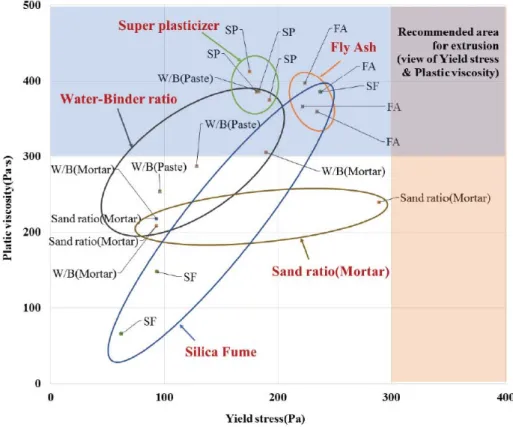
Figure 3. Yield stress and plastic viscosity distribution (The above image adopted from the reference Lee et al., 2018)
fluidity and excellent insulation properties using geopolymer cement. These developed architectural materials are expected to be useful for 3D printing in the future. This aggressive investment in 3D printing technology is leading to a growth driver that will lead the industry in the future. McKinsey & Company of the U.S. has pointed to 3D printing technology as one of the 12 industry-rocketing Dis-ruptive Technologies. It also estimated that the tech-nology would bring economic effects totaling $55 billion (Cohen et al., 2014). Contour Crafting, which is mainly used in the 3D printing process, molds extruded concrete into the desired shape.
3. Features and efficiency of future
construction industry applying 3D
printing
3-1. Research of construction materials applied to 3D printing
Various studies on 3D printing technology are underway for faster and more convenient architec-ture in the fuarchitec-ture. Of the many parts of 3d printing,
the material is the most important part because it is a practical component of shape. Lee et al., 2018 experimentally analyzed the effects of changes in the factors (Water-Binder Ratio(W/B), binder type, refinement ratio, superplasticizer image) that greatly affect the flow characteristics of concrete. As a result, they revealed that the increased W/B resulted in a decrease in viscosity, along with an increase in the Fly Ash (FA) ratio. Lee, Yoon Jung (2020) proposed a suitable concrete mix for 3D printing, and conducted extrusion and additive verification and surfactant adhesion performance experiments, and finally conducted a bending member experiment made of 3D concrete printing to compare and analyze structural performance and behavior with reinforced concrete members. The results of the analysis with computational fluid dynamics (CFD) revealed that the higher the viscosity and the lower the yield stress, the higher the yield stress, and the higher the curing speed, the better. Therefore, it was confirmed that a suitable mix for 3D concrete printing should have high viscosity and adequate yield stress. An analysis of these material properties will be a necessary consideration in developing
addition, there are measures to compensate for short-comings caused by the material properties of con-crete. One of the most representatives is the use of shrinkage reducer to regulate shrinkage. Since cons-truction through a 3d printer is carried out with external exposure, chances are high that shrinkage cracks will occur due to water loss inside and outside of the concrete. To solve this problem and improve the durability of 3D printed concrete, reduction of shrinkage of 3D printed concrete is essential. Lee et al. (2019) produced seven types of shrinkage reduc-tion samples to develop shrinkage reducreduc-tion agents for 3D printed concrete and evaluated their per-formance in a general concrete mix. In addition, the characteristics and performance of 3D printed concrete with shrinkage reduction agents were reviewed by selecting samples of shrinkage reduction agents and applying them to 3D printed concrete. As a result, the study revealed that the use of shrinkage reducer increases the compressive strength by more than 10% compared to conventional 3D printed concrete, and reduces the shrinkage by more than 36%.
3-2. The current of Construction Progress Management(CPM) Using 3D Printing The 3D printing technology applied to construc-tion differs greatly from the construcconstruc-tion techniques used in the past. The biggest difference is that 3D printing can be completed in a relatively short period compared to conventional construction methods. This indicates that a new concept for the construction stage of 3D printing and an accurate calculation of the construction period is needed. These studies will help in planning future construction projects through 3D printing. High-performance pumps are needed to facilitate material extrusion from 3D printing devi-ces. In this fabrication method, concrete shall pass
the situation limited to frame structure construction. The results showed that the construction period was reduced by about 46% compared to the existing construction techniques. Since the details of the pro-cess vary for construction purposes, it is expected that more accurate predictions will be possible if additional factors that need to be considered are applied to the calculation formula.
To complete a solid-structured building with 3d printing, the device characteristics of the device must be analyzed first and continued to the optimum process. One of the most representative factors to consider is the moving speed of the nozzle. This is because it has a direct relationship with the hard-ening speed of concrete. Park et al. (2019) conduc-ted a basic experimental study to determine the constructability of the 3D concrete structure accor-ding to the moving speed of nozzles, the revolutions per minute (RPM) of screw-in discharge buckets, and the aspect ratio reflecting wall length of the struc-tures using gantry-type 3D concrete printing equip-ment. In addition, each 3d printer has a key device characteristic to consider for each device. Com-pletion of the building can be achieved efficiently without wasting time and resources if each stage of the process is carried out sequentially, taking into account the structure, materials, and device charac-teristics of the target building.
Building technology through 3D printing is cited as the main technology to overcome the pandemic situation such as the Covid-19 worldwide. Further studies will improve the material properties of con-crete while simultaneously reducing carbon dioxide and treating waste. In addition, the use of 3D printers suitable for the intended structure will solve the global challenge of housing, as the performance development of 3D printer devices is taking place in
various device structures.
4. Conclusions
The role of green cement for 3D printing and the characteristics of 3D printing technology in the future construction industry were reviewed. In par-ticular, as described above, the role of green cement is expected to weight in the future in reducing CO2
emissions. In addition, in the future construction industry, it is expected that the development of 3D printing technology will apply a construction method differentiated from the traditional construction me-thods. I hope that this research, which examines the technologies of green cement and 3D printing, will become a cornerstone for the changing future con-struction history.
References
1. Vanderploeg, A., et al., 2017, The application of 3D printing technology in the fashion industry, International Journal of Fashion Design, Tech-nology and Education, Vol. 10, No. 2, pp. 170-179
2. Nachal, N., et al., 2019, Applications of 3D Printing in Food Processin,. Food Eng Rev, Vol. 11, pp. 123–141
3. Sharma, S., et al., 2019, Three-Dimensional Printing and its Future in Medical World, Journal of Medical Research and Innovation, Vol. 3, No. 1, e000141
4. Chen, Z., 2017, The Service-oriented Manu-facturing Mode based on 3D printing: A Case of Personalized Toy, Procedia Engineering, Vol. 174, pp. 1315–1322
5. Sunil C., et al., 2015, 3D printing in aerospace and its long-term sustainability, Virtual and Phy-sical Prototyping, Vol. 10, pp. 175-185
6. Nichols, M. R., 2019, How does the automotive
industry benefit from 3D metal printing?, Metal Powder Report, Vol. 74, No. 5, pp. 257-258 7. Shahrubudin, N., et al., 2019, An Overview on
3D Printing Technology: Technological, Materi-als, and applications, Procedia Manufacturing, Vol. 35, pp. 1286–1296
8. Gibbons, G. J., et al., 2010, 3D Printing of cement composites, Advances in Applied
Cera-mics, Vol. 109, No. 5, pp. 287-290
9. Saifudin, M. I.. et al., 2020, Emerging Natural Fiber-Reinforced Cement Materials and Techno-logy for 3D Concrete Printing: A Review, Inter-national journal of integrated engineering, Vol. 12, No. 3, pp. 161-177
10. Worrell, E., et al., 2001, Carbon dioxide emi-ssions from the global cement industry, Annual review of energy and the environment, Vol. 26, No. 1, pp. 303-329
11. Miller, S. A., et al., 2018, Carbon dioxide re-duction potential in the global cement industry by 2050, Cement and concrete research, Vol. 114, pp. 115-124
12. Sánchez-Jiménez, et al., 2016, Influence of ball milling on CaO crystal growth during limestone and dolomite calcination: effect on CO2 capture at calcium looping conditions, Crystal Growth & Design, Vol. 16, No. 12, pp. 7025-7036 13. IEA, W., 2009, Cement Technology Roadmap
2009–Carbon emissions reductions up to 2050, Paris, France, pp. 1-2
14. Vieira, S. D., 2019, New technologies to accele-rate additive manufacturing processes on an in-dustrial scale
15. Cohen, D., et al., 2014, 3-D printing takes shape, McKinsey Quarterly, Vol. 1, pp. 1-6
16. Lee, H., et al., 2018, Study on rheological pro-perties of mortar for the application of 3D printing method, Journal of the Korean Re-cycled Construction Resources Institute, Vol. 6, No. 1, pp. 16-24
17. Lee, Y. J., 2020, Material Characteristics of 3D Printing Concrete and Flexural Performance of Printed Members, University of Seoul, M.E. Di-ssertation(in Korean), pp. 67-68
18. Ahn, B. J., 2020, Compressive Strength Ex-periment of Lightweight Concrete Using Coarse Aggregate Produced by 3D Printing, Journal of the Korea Academia-Industrial cooperation Society, Vol. 21, No. 5, pp. 54-59
19. Lee, D. G., et al., 2019, Development of Shrin-kage Reducing Agent for 3D Printing Concrete, Journal of the Korea Academia-Industrial coo-peration Society, Vol. 20, No. 12, pp. 37-43 20. Park, H. J., et al., 2017, A Development of
Work Item and Duration Estimation Method for 3D Printing based Building, Journal of the Korea Academia-Industrial cooperation Society,