P2-44 / Y. -H. Ham
IMID 2009 DIGEST •
Abstract
In this article, we reported the results of etching poly-monochloro-para-xylylene (parylene-C) thin films using inductively coupled plasma and CF4/O2 gas mixture. The CF4 gas fraction increased up to the approximately 16 %, the polymer etch rate increased in the range of 277 – 373 nm/min. It confirmed that the etch rate of the parylene-C mainly depended on the O radical density in the plasma. Using a contact angle measurement, the contact angle increased with increasing the CF4 fraction. Moreover, the contact angle was highly related a CFx functional group on parylene films.
1. Introduction
Organic Thin Film Transistors (OTFTs) have been investigated for possible use in low-cost, large area, flexible electronic applications during many years.[1] Simultaneously, OTFT devices have been required to be scaled down.
Parylene-C (poly-monochloro-para-xylylene) is more suitable organic material for gate dielectric in OTFTs. A patterning process for the organic film is required in order to apply it to OTFTs. Specifically, the patterning of organic semiconductors is necessary for eliminating parasitic leakage, reducing cross talk in order to achieve high on/off ratios, and removing material from the optical path.[2] Patterning process of organic films has been widely carried out by O2
plasma. However, it is well known that an oxygen plasma can cause damage the semiconductor and dielectric layer due to the interaction between the oxygen radials and polymer resulting in the formation of several functional groups on the polymer surface.[3] These functional groups can rotate into the bulk of the material and move away from the polymer
surface.[4] As a result, functional groups lead to degradation of transistor performance. Hence, preventing the functional groups is essential to improve the OTFTs’ performance. Research in this field has been so far studied by many researching groups. However, various gas chemistries have not been widely examined to reduce the formation of the functional groups, even though the reaction of the polymer with the plasma-created species makes a large effect on the formation of the functional groups.
In this work, in order to obtain more information about the effect of CF4 gas addition to oxygen plasma,
we investigated the plasma treated surface of parylene-C films and the plasma characteristics in inductively coupled O2/CF4 mixing gas plasma.
2. Experimental
The 300-nm thick parylene-C films were deposited on Si (100) substrates by chemical vapor deposition. The wafers were then plasma-treated with a radio-frequency (RF) etching system.
Etching experiments were performed in a planar Inductively Coupled Plasma (ICP) reactor, which was
described detail in our previous work. [5] A
Quadrupole Mass Spectrometry (QMS) (HPR-30, Hiden Analytical) was performed in Residual Gas Analysis (RGA) mode, delivering data on the neutral species only. The etching conditions were: a total gas flow rate of 60 sccm; an operating pressure of 4 mTorr; an input ICP power of 300 W and; a bias power of 30 W. The gas mixing ratios were varied by adjusting the partial flow rate of the mixture components and were set in the range of 0 – 50 % CF4 in the CF4/O2 mixture. The
parylene-C film samples used in this study were 2 × 2
Study on the surface characteristics of parylene-C films in
inductively coupled O
2/CF
4gas plasma
Yong-hyun Ham
1, Kyu-Ha Baek
1, Kun-Sik Park
1, Hong-sik Shin
1,
Ho-jin Yun
1, Kwang-Ho Kwon
2, and Lee-Mi Do
11
Electronics and Telecommunications Research Institute (ETRI), 138 Gajeongdong, Yuseong-gu, Daejeon 305-700, Korea
Tel.:82-2-860-5776, E-mail: [email protected]
2
Dept. Control and Instrumentation Engineering, Korea University, Jochiwon-eup, Yeongi-gun, chungnam 339-700, Korea
P2-44 / Y. -H. Ham
• IMID 2009 DIGEST
cm2 in area. In order to determine the etch rate, the
etched depths of the parylene-C film were measured using a surface profiler (Alpha-step 500, Tencor). X-ray Photoelectron Spectra (XPS) were extracted using a VG Scientific ESCALAB 200R XPS system with Al (Kα) (1486.6 eV) radiation operating at 260 W. The binding energy was calibrated using C 1s peak at 284.5 eV. Static contact angles for water and diiodomethane were measured using a sessile drop method with a contact angle goniometer (SEO Phoenix 300) at room temperature.
3. Results and discussion
0 10 20 30 40 50 100 150 200 250 300 350 400 Parylene -Vdc CF4 fraction in O2/CF4(%) E tc h ra te (n m /m in ) 150 160 170 180 190 200 -d c bi as( V )
Fig. 1 Parylene-C etch rate and negative dc bias as
functions of the CF4 gas fraction in the
CF4/O2 plasma
Figure 1 shows the parylene-C etch rate and negative dc bias as a function of the CF4 gas fraction in the
CF4/O2 plasma. From Fig. 1, it can be seen that, as the
CF4 gas fraction increases up to the approximately
16 %, the polymer etch rate increases from 277 to 373 nm/min. 0 10 20 30 40 50 1.9x10⁻⁷ 2.0x10⁻⁷ 2.1x10⁻⁷ 2.2x10⁻⁷ 2.2x10⁻⁷ 2.3x10⁻⁷ O F CF4 fraction in O2/CF4(%) O par ti al pr e ssur e (T or r) 1.0x10⁻⁸ 2.0x10⁻⁸ 3.0x10⁻⁸ 4.0x10⁻⁸ 5.0x10⁻⁸ F par tia l pr essur e (T or r)
Fig. 2 O and F partial pressures as a function of the
CF4 gas fraction
As the CF4 fraction of over 16%, the etch rate of the
parylene-C rapidly decreases. However, the negative dc bias increases monotonically up to 50% of CF4
fraction and was -197 V in 50 % CF4 mixture.
Figure 2 shows the variation of partial pressure for each neutral species of O and F in the CF4/O2 plasmas
which were obtained by the QMS. From Fig. 2, we can observe that the change of O radical density shows a very similar trend as that of polymer etch rates in the CF4/O2 plasma. Accordingly, the polymer
etch rate is closely dependent on the O radical density in the CF4/O2 plasma. 0 10 20 30 40 50 0 20 40 60 80
as- recieved diiodomethane
Diiodomethane CF4 fraction in O2/CF4 (%) C o nt a c t an gl e (de gr e e ) DI water
as- recieved Di water
Fig. 3 Contact angles as a function of the CF4 gas
fraction
Figure 3 shows the contact angle and the surface energy with increasing CF4 fraction. In Fig. 3, we can
confirm that the contact angle increases with CF4
fraction. For D.I. water, the contact angle increases from 3.1 to 51.8o with CF
4 fraction in the range of 0 to
50%, respectively. At the same time, for diiodomethane solution, the contact angle increases from 21.9 to 65.3 o, respectively.
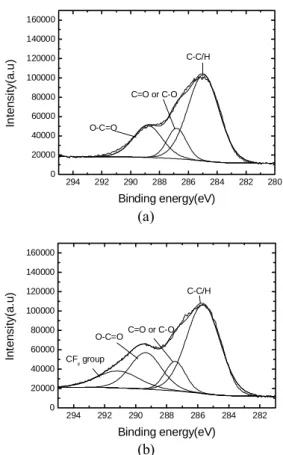
Figure 4 represents the deconvolution of C 1s spectrum. As shown in Fig. 4(a), we can observe that the carbon peak is composed of three different carbon
species in pure O2 plasma treatment. Each peak
basically corresponds to C-C/H, C=O (or C-O), and O-C=O bonds which are observed at 284.5, 286.3, and 288.2 eV, respectively. [6] At the O2/CF4 plasma, new
peak was observed at the binding energy of approximately 291 eV in Fig. 4(b). In generally, the fluorine atom was formed to CFx group on organic
materials. So, peak of 291 eV is surely related to CF4
gas addition to the O2 plasma which corresponds to
P2-44 / Y. -H. Ham IMID 2009 DIGEST • 294 292 290 288 286 284 282 280 0 20000 40000 60000 80000 100000 120000 140000 160000 In tensi ty( a.u ) Binding energy(eV) C-C/H C=O or C-O O-C=O (a) 294 292 290 288 286 284 282 0 20000 40000 60000 80000 100000 120000 140000 160000 Int ensi ty( a. u) Binding energy(eV) C-C/H C=O or C-O O-C=O CF x group (b)
Fig. 4 Deconvolution of a C 1s spectrum at
(a) pure-O2 and (b) 50% CF4 fraction
It is also known that the contact angle for CFx groups
is higher than that of the functional groups such as O-C=O and O-C=O (or C-O) bonds. Therefore, we can found that the formation of CFx functional group is
surely influenced to the contact angle in Fig. 3.
4. Summary
In this article, the results were obtained from the etch of poly-monochloro-para-xylylene (parylene-C) thin film, which was carried out in ICP etch system using CF4/O2 gas mixture. The effects of CF4 addition
to O2 plasma on etch rates were investigated. The CF4
gas fraction increased up to the approximately 16 %, the polymer etch rate increased in the range of 277 – 373 nm/sec. In contrast, the etch rate rapidly decreased with increasing the CF4 fraction over 16 %.
Based on the QMS data, it was confirmed that the etch rate of the parylene-C mainly depended on the O radical density in CF4/O2 plasma.
By a contact angle measurement, the contact angle increased with increasing the CF4 fraction. It is related
to the generation of a CFx functional group on
parylene film after CF4 addition in CF4/O2 plasma.
Acknowledgement
This research was supported by the Ministry of Knowledge Economic (Grant No.10031791) and convergence research program funded by Korea Research Council for Industrial Science and Technology.
5. References
1. M. E. Roberts, S. C. B. Mannsfeld, R. M. Stoltenberg, and Z. Bao, Org. Electronics. 10, 377 (2009).
2. I. Kyissis, C. D. Dimitrakopoulos, and S. J. Purushothaman, J. Vac. Sci. Technol. B. 20, 956 (2002).
3. C. M. Chan, T.M. Ko, and H. Hiraoka, Surf. Sci. Rep. 24, 1 (1996).
4. W. J. Brennan, W.J. Feast, H.S. Munro and S.A. Walker, Polymer. 32, 1527 (1991).
5. M. Kim, N.-K. Min, S. J. Yun, H. W. Lee, A. Efremov, and K.-H. Kwon, Microelectron. Eng. 85, 348 (2008). 6. D. A. Shutov, S.-Y. Kang, K.-H. Baek, K. S. Suh, and