빅 데이터를 이용한 임플란트에 대한 관심도 분석: 웹 기반 연구
공현준*
Hyun-Jun Kong*
Analysis of interest in implant using a big data: A web-based
study
Purpose: The purpose of this study was to analyze the level of interest that com-mon Internet users have in dental implant using a Google Trends, and to compare the level of interest with big data from National Health Insurance Service. Mate-rials and methods: Google Trends provides a relative search volume for search keywords, which is the average data that visualizes the frequency of searches for those keywords over a specific period of time. Implant was selected as the search keyword to evaluate changes in time flows of general Internet users’ interest from 2015 to 2019 with trend line and 6 month moving average. Relative search volume for implant was analyzed with the number of patients who received National Health Insurance coverage for implant. Interest in implant and conventional den-ture was compared and popular related search keywords were analyzed. Results: Relative search volume for implant has increased gradually and showed a signifi-cant positive correlation with the total number of patients (P<.01). Interest in im-plant was higher than denture for most of the time. Keywords related to imim-plant cost were most frequently observed in all years and related search on implant procedure was increasing. Conclusion: Within the limitations of this study, the public interest in dental implant was gradually increasing and specific areas of interest were changing. Web-based Google Trends data was also compared with traditional data and significant correlation was confirmed. (J Korean Acad Prost-hodont 2021;59:164-72)
Keywords
Big data; Dental implants; Dentures; Health information systems; Internet
Corresponding Author Hyun-Jun Kong
Department of Prosthodontics, College of Dentistry, Wonkwang University, 895 Muwang-ro, Iksan 54538, Republic of Korea +82 (0)63 859 2929 [email protected]
Article history Received August 28, 2020 / Last Revision October 6, 2020 / Accepted October 13, 2020
ORCID iDs
Hyun-Jun Kong
https://orcid.org/0000-0001-9331-3572
원광대학교 치과대학 치과보철학교실
Department of Prosthodontics, College of Dentistry, Wonkwang University, Iksan, Republic of Korea
© 2021 The Korean Academy of Prosthodontics
This is an Open Access article distributed under the terms of the Creative Commons Attribution Non-Commercial License (http://creativecommons.org/licenses/by-nc/4.0) which permits unrestricted non-commercial use, distribution, and reproduction in any medium, provided the original work is properly cited.
cc
Introduction
A major development in dentistry has been the successful use of osseointegrat-ed implants to replace the natural teeth. The use of dental implants for oral
reha-bilitation of edentulous patients has greatly expanded the range of dentistry, presenting various treatment options in complex cases in which functional rehabilitation was previously limited or insufficient.1 The long-term
suc-cess and predictability of dental implants have been well documented in both fixed and removable prostheses. In previous studies, dental implant showed high clinical success rates and patient satisfaction, regardless of the type of prosthesis.2-5
Also in Korea, National Health Insurance coverage for dental implant was first started in 2014, and the number of patients applied is gradually increasing. For this rea-son, as dental implant become popular, the public’s inter-est in implant is also growing rapidly.6 However, the
as-sessment of patient factors associated with implant was mostly limited to postoperative satisfaction or success rate.7,8 In general, preferences for various implant
pros-thetic methods have been studied, however, there is lack of research on the perception or interest that the general public has in the dental implant.9,10
As the technology of modern society develops, the Internet has become a major source of information in personal life.11 When people need information, they can
type search words into the Internet search engine and get the information easily and quickly. According to the announcement by the International Telecommunication Union in 2020, one-third of the world’s population now uses the Internet, and the number of users continues to increase.12 Especially in Korea, with the rapid
develop-ment of information and communication technology and the widespread of smartphones, the Internet is very common in everyday life.
Google (Google LLC, Mountain View, CA, USA) is the most popular search engine in the world and offering Google Trends, a big data site that allows users to check the frequency of keyword or term searches using the Google search engine.13 Google Trends is a useful tool to
show how search volumes for specific keywords change over time and how they differ depending on the region. In addition, Google Trends allows users to enter up to five
search keywords at a time, so users can compare trends between each keyword. Therefore, Google Trends based service could evaluate the responses to keywords in each region, including what keywords people are interested in, how the keywords have changed over time, and what related search terms they have.14
Also, medical information that can be used as a big data for health care could be downloaded conveniently and easily through the Healthcare Bigdata Hub system provided by Health Insurance Review and Assessment Service in Korea. The Healthcare Bigdata Hub system provides public data that could be analyzed by anyone, and ensures free utilization, including the use of prof-it-making purposes.
The health and medical sector has been considered as a representative area to utilize a big data, due to its high volume, diversity, and complexity. In previous studies, researchers discussed the potential use of Google Trends in healthcare and medicine, including the prediction of disease.15,16 However, perception of the availability and
importance of a big data in the field of dentistry has been low so far, and few specific researches have been con-ducted, especially in dental implantology.
Therefore, the purpose of this study was to analyze the level of interest that common Internet users have in den-tal implant and report the related search keywords using a Google Trends. Also, the study compared the level of interest with big data from National Health Insurance Service.
Materials and methods
This study did not require approval from the local in-stitutional review board because it used only publicly available data. A Google Trends provides data on Internet search patterns by analyzing some of all web searches on Google Search websites and other affiliated Google sites. Users or researchers are able to download analysis re-sults for searches to perform further studies. The portal calculated the proportion of searches for a user-specified
keyword among all searches performed by Google search engines. Then, it provides a relative search volume (RSV), which is the average data that visualizes the frequency of searches for those keywords over a specific period of time.17 Users can specify the geographical distinctions
according to city, state, or country for analysis. In addi-tion, users can choose the research period, ranging from January 2004 to the present, divided by months or days. Researchers are also able to specify up to five keywords at the same time and compare the RSV for a particular search keyword between geographic areas or over time. Furthermore, Google Trends allows users to select specif-ic topspecif-ic categories to limit the search.18
In this study, the settings for Google Trends are as fol-lows. First, the research period was set from 2015 to 2019 for five years. Next, the geographic area was set up as the Republic of Korea, and the topic category was health. Fi-nally, the web search mode was selected. Google Trends uses a relative search index that standardizes randomly collected search volumes. Since there would be some differences in each search, the average of RSV was used after entering the search keyword twice. In addition, the average value was obtained by searching in April and Oc-tober 2020, respectively.
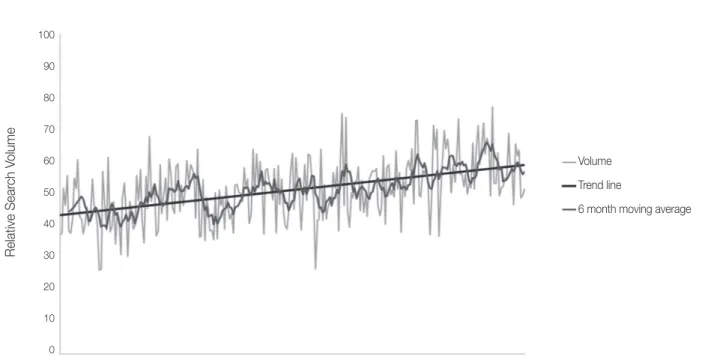
The word Implant in Korean was selected as the search keyword to evaluate changes in time flows of general Internet users’ interest from 2015 to 2019. Then, comma separated value data files for each month has been ex-tracted and visualized. In addition, linear trend lines and six-month simple moving averages were inserted using software (Excel 2010, Microsoft Corp., Redmond, WA,
USA) to evaluate time series variations.
Next, the number of patients who received the first stage of National Health Insurance coverage for implant was calculated on a monthly basis from January 2015 to July 2019 using the Healthcare Bigdata Hub system to compare the data values obtained from Google Trends with the actual number of claims for implant. Google Trends provides 4 to 5 days of data each month. There-fore, the mean of each data was set to the data values for the month. Pearson correlation analysis was performed on the RSV of the month and the total number of patients who received the National Health Insurance coverage for implant.
The interest in implants was compared with the con-ventional denture. The search keywords were Implant and Denture respectively, comparing RSV and setting a linear trend line. Pearson’s correlation analysis was con-ducted for RSV over a month to evaluate the relationship between implant and denture searches. Statistical analy-sis was performed with software (SPSS version 20.0, IBM Corp., Armonk, NY, USA) and statistical significance was set at P < .05.
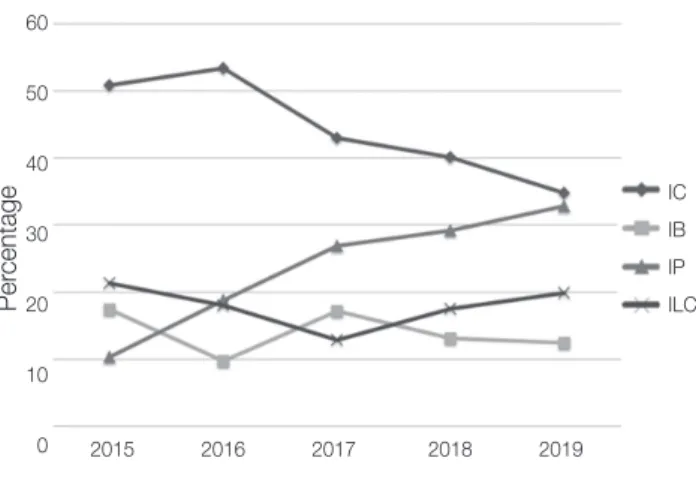
Google Trends presents popular related search terms for the keyword. Based on related search terms, research-ers could identify trends in what usresearch-ers who search im-plant also search for. From 2015 to 2019, after searching the implant for each year, related search terms were col-lected and the top 10 search terms were analyzed. Each search term was classified into four groups, and the RSV for each group was scaled and analyzed according to the year (Table 1).
Table 1. Related search keyword groups
Group Related search keyword
Implant cost (IC) Implant cost, implant price, molar implant price, implant insurance cost, Osstem implant price Implant brand (IB) Osstem implant, Dio implant, Implant company, Point implant
Implant procedure (IP) Implant procedure, implant denture, anterior implant, molar implant Implant longevity and complications (ILC) Implant longevity, implant complications, implant pain
Results
RSV for implant has increased gradually since 2015 to 2019, given the linear trend line and six month moving averages (Fig. 1). The maximum value of RSV was 77 and recorded on August 25, 2019. The minimum value was 26 and found on June 7, 2015. The average of RSV was 51.26 and the standard deviation was 9.69.
RSV of the month for implant and total number of patients who received the National Health Insurance coverage for implant has both shown a gradual increase over the year (Fig. 2). RSV of the month was the highest at 68.68 in March 2018. The total number of patients was the highest at 81061 in July 2018, with an increase in July every year.
For January 2015 to July 2019, Pearson correlation analysis was performed on the RSV of the month and the total number of patients. Pearson correlation coefficient was 0.521, indicating a statistically significant positive
correlation (Table 2).
The RSV and linear trend line for implant and denture were compared (Fig. 3). The average RSV of denture was 13.54 with a standard deviation of 4.66. The RSV of den-ture was the highest at 28.25 in May 8, 2016. It was 3.5 in August 16, 2015. The RSV for implant was higher for all dates. No significant change in linear trend line for den-ture was observed, and a certain level was maintained regardless of year. Pearson correlation analysis was also performed on the RSV for implant and denture, with no statistical significance (Table 3).
The percentage of RSV for each related search key-word group is as follows (Fig. 4). Group Implant cost (IC) showed the highest value for all years. Groups IC decreased from 50.89% in 2015 to 34.81% in 2019, and Group Implant procedure (IP) increased from 10.36% to 32.80%. Group Implant brand (IB) and Implant longevity and complications (ILC) were approximately 10 to 20%.
Relative Sear ch V olume 100 90 80 70 60 50 40 30 20 10 0 2015/1/4 2015/7/4 2016/1/4 2016/7/4 2017/1/4 2017/7/4 2018/1/4 2018/7/4 2019/1/4 2019/7/4 Volume Trend line
6 month moving average
Table 3. Pearson correlation analysis for implant and denture
Correlations
Implant Denture
Implant Pearson Correlation 1 .112 Sig. (2-tailed) .072 N 261 261 Denture Pearson Correlation .112 1
Sig. (2-tailed) .072
N 261 261
Table 2. Pearson correlation analysis for relative search
volume of the month and the total number of patients
Correlations
Relative
search volumeTotal number of patients
Relative search Pearson Correlation 1 .521* volume Sig. (2-tailed) .000
N 56 56 Total number Pearson Correlation .521* 1 of patients Sig. (2-tailed) .000
N 56 56
*: Correlation is significant at the 0.01 level.
2015/1 2015/7 2016/1 2016/7 2017/1 2017/7 2018/1 2018/7 2019/1 2019/7
Relative Sear
ch V
olume of the month
80 70 60 50 40 30 20 10 0 90000 80000 70000 60000 50000 40000 30000 20000 10000 0 Google Trends Patients
Total number of patients
Fig. 2. Relative search volume of the month and the total number of patients.
Relative Sear ch V olume 100 90 80 70 60 50 40 30 20 10 0 Implant Denture 2015/1/4 2015/7/4 2016/1/4 2016/7/4 2017/1/4 2017/7/4 2018/1/4 2018/7/4 2019/1/4 2019/7/4
Discussion
The present study analyzed the level of interest in implant using Google Trends and compared the level of interest with big data from National Health Insurance Service. Health and medical big data has been collected from both the public and private sectors, and data with significant scale and diversity is being built, especially based on the use of high levels of information and com-munication technology. A common method to get the data needed for epidemiological research is to examine and classify the accumulated clinical data one by one, which requires a lot of time and manpower. An Internet data based approach has presented new possibilities for solving complex problems that have been difficult to deal with conventional research methods. Recently, The Na-tional Academy of Medicine approved the use of Internet data in health care research. Internet data is easily acces-sible to anyone, and as time goes by, data is accumulated and organized.
As a result of the RSV analysis, interest in implant showed a gradual increase, which could be seen through the linear trend line and 6 month moving average. As reported in previous study, this is attributed to the
expan-sion of insurance coverage for implant, improved public awareness of implant, and increased accessibility.19 Also,
considering the trend, public interest in implant is ex-pected to increase further in future. However, currently, the information available from web searches related to implant is limited, most of which are dental advertise-ments and promotional articles. Therefore, efforts by cli-nicians or dental associations will be required to ensure that the general public can obtain quality information about implant on the Internet.
In this study, there is a limitation that the number of implant patients cannot be accurately collected, given that the Healthcare Bigdata Hub system only provides patients who received the National Health Insurance cov-erage for implants. However, with the increasing use in the insurance coverage for implant, the overall trend of implant patients could be predicted. Since the standard of National Health Insurance coverage for implant is July of each year depending on age, the number of insurance application increased greatly in July every year. The Pear-son correlation coefficient between the RSV and the total number of patients was 0.521, which could be considered to show a modest or moderate positive correlation.20 As
reported by previous study, these results suggest that the RSV can be used similarly to predict public demand and interest for implant.21 Several studies have compared
Google Trends with traditional reliable data sets and reported moderate to strong strengths of association, which means that Google Trends data can be used to ana-lyze health-related phenomena.22,23
In partially or fully edentulous patients, conventional denture has been the main choice of treatment for cen-turies. Compared to conventional denture, implant-sup-ported prosthesis offer superior results for esthetics, phonetics, function, and comfort for the patients.24 Also,
implant assisted or supported denture shows improved satisfaction and success rate.25 According to the
analy-sis of public interest in implant and denture, interest in implant was higher than denture, regardless of year. In addition, the level of interest in denture has not changed
Per centage 60 50 40 30 20 10 0 2015 2016 2017 2018 2019
Fig. 4. The percentage of relative search volume for each related search keyword group. IC: implant cost, IB: implant brand, IP: implant procedure, ILC: implant longevity and complications.
IC IB IP ILC
significantly over time. These results could have been affected by the relatively young age group of Internet users. Nevertheless, as a treatment option for edentulous patients, it could be assumed that the public interest in implant is increasing, and that the gap between denture is widening over time. The significant increase in interest in implant treatment in recent years has been attributed to a change in perception of implant and an increase in the number of qualified providers.26
According to the RSV analysis, the most frequent re-lated search keyword for implant was implant cost in all years. As reported previously, cost and associated factors are one of the most relevant reasons for choosing or rejecting treatments for both fully and partially eden-tulous patients.27,28 Also, treatment fees have a greater
impact on utilization than on demand.29 The frequency
of searches for implant procedure increased in 2019 com-pared to 2015. This means that as implant become more popular, interest in the surgical or prosthetic procedure of implant is gradually increasing. Therefore, these as-pects should be considered in consultation with patients or in the choice of treatment options.
However, the major limitation of Google Trends study is the lack of accurate information about how Google gen-erates search data and its algorithms. It is also difficult to assess the change in the interface and functionality of Google Trends over time, which may lead to variation in the search results and, therefore, changes in research results. Google Trends searches, even under the same conditions and points in time, also result in some dif-ferences each time they are analyzed. Therefore, a large number of searches should be performed to obtain the average value. Data reliability could be insufficient in this study because only four searches were made under the same conditions. Also, since Google ranks third in terms of Internet search engine market share in Korea, Google’s search results cannot accurately represent the interest of the general public in Korea. In addition, all searches are calculated on Google Trends, such as searching for social issues and specific academic information. Cook et al.30
suggested that Internet search study may work well on keywords with less media exposure because media re-ports affect search trends which can increase non-patient searches that do not reflect actual activity. Further stud-ies are needed to evaluate the validity of Google Trends for surveillance in prosthetic dentistry and how big data will be used as valuable research data. In the future, a big data on the Internet, including a Google Trends, will be appropriately selected and interpreted, making it a major data resource for prosthetic dentistry.
Conclusion
The present study confirmed that the public interest in dental implant was gradually increasing and specific areas of interest were changing. It also compared web-based Google Trends data with conventional data, and there was a significant correlation.
References
1. Steigenga JT, al-Shammari KF, Nociti FH, Misch CE, Wang HL. Dental implant design and its relation-ship to long-term implant success. Implant Dent 2003;12:306-17.
2. Adell R, Lekholm U, Rockler B, Brånemark PI. A 15-year study of osseointegrated implants in the treat-ment of the edentulous jaw. Int J Oral Surg 1981;10:387-416.
3. van Steenberghe D, Lekholm U, Bolender C, Folmer T, Henry P, Herrmann I, Higuchi K, Laney W, Lin-den U, Astrand P. Applicability of osseointegrated oral implants in the rehabilitation of partial eden-tulism: a prospective multicenter study on 558 fix-tures. Int J Oral Maxillofac Implants 1990;5:272-81. 4. Buser D, Weber HP, Bragger U, Balsiger C. Tissue
in-tegration of one-stage ITI implants: 3-year results of a longitudinal study with Hollow-Cylinder and Hol-low-Screw implants. Int J Oral Maxillofac Implants 1991;6:405-12.
5. Adell R, Eriksson B, Lekholm U, Brånemark PI, Jemt T. Long-term follow-up study of osseointegrated im-plants in the treatment of totally edentulous jaws. Int J Oral Maxillofac Implants 1990;5:347-59.
6. Ryu JI, Jeon JE. Utilization rate of dental implant for elderly in National Health Insurance in Korea. J Ko-rean Dent Assoc 2019;57:496-503.
7. Pjetursson BE, Karoussis I, Bürgin W, Brägger U, Lang NP. Patients’ satisfaction following implant therapy. A 10-year prospective cohort study. Clin Oral Implants Res 2005;16:185-93.
8. Schropp L, Isidor F, Kostopoulos L, Wenzel A. Pa-tient experience of, and satisfaction with, de-layed-immediate vs. delayed single-tooth implant placement. Clin Oral Implants Res 2004;15:498-503. 9. Feine JS, Awad MA, Lund JP. The impact of patient
preference on the design and interpretation of clini-cal trials. Commun Dent Oral Epidemiol 1998;26:70-4.
10. Esfandiari S, Lund JP, Penrod JR, Savard A, Thoma-son JM, Feine JS. Implant overdentures for edentu-lous elders: study of patient preference. Gerodontol-ogy 2009;26:3-10.
11. Lee JY, Lee JH, Park YH, A design and implementa-tion of the management system for number of key-word searching results using Google searching en-gine. J Korean Inst Inf Commun Eng 2016;20:880-6. 12. Cha YS, Hwang SM, Yang PJ. Achilles tendon
inju-ry and seasonal variation: An analysis using Google Trends. Korean J Sports Med 2019;37:155-61.
13. Nghiem le TP, Papworth SK, Lim FK, Carrasco LR. Analysis of the capacity of Google trends to measure interest in conservation topics and the role of on-line news. PLoS One 2016;11:e0152802.
14. Cervellin G, Comelli I, Lippi G. Is Google Trends a reliable tool for digital epidemiology? Insights from different clinical settings. J Epidemiol Glob Health 2017;7:185-9.
15. Carneiro HA, Mylonakis E. Google trends: a web-based tool for real-time surveillance of disease
out-breaks. Clin Infect Dis 2009;49:1557-64.
16. Dugas AF, Hsieh YH, Levin SR, Pines JM, Mareiniss DP, Mohareb A, Gaydos CA, Perl TM, Rothman RE. Google Flu Trends: correlation with emergency de-partment influenza rates and crowding metrics. Clin Infect Dis 2012;54:463-9.
17. Choi HY, Varian H. Predicting the present with Goo-gle Trends. Econ Rec 2012;88:2-9.
18. Nuti SV, Wayda B, Ranasinghe I, Wang S, Dreyer RP, Chen SI, Murugiah K. The use of google trends in health care research: a systematic review. PLoS One 2014;9:e109583.
19. Lee K, Dam C, Huh J, Park KM, Kim SY, Park W. Dis-tribution of medical status and medications in el-derly patients treated with dental implant surgery covered by national healthcare insurance in Korea. J Dent Anesth Pain Med 2017;17:113-9.
20. Taylor R. Interpretation of the correlation coeffi-cient: A basic review. J Diagnostic Med Sonography 1990;6:35-9.
21. Motosko C, Zakhem G, Ho R, Saadeh P, Hazen A. Us-ing Google to trend patient interest in botulinum toxin and hyaluronic acid fillers. J Drugs Dermatol 2018;17:1245-6.
22. Jena AB, Karaca-Mandic P, Weaver L, Seabury SA. Predicting new diagnoses of HIV infection using in-ternet search engine data. Clin Infect Dis 2013;56: 1352-3.
23. Samaras L, García-Barriocanal E, Sicilia MA. Syn-dromic surveillance models using Web data: the case of scarlet fever in the UK. Inform Health Soc Care 2012;37:106-24.
24. Att W, Stappert C. Implant therapy to improve quali-ty of life. Quintessence International 2003;34:573-81. 25. Mijiritsky E, Ormianer Z, Klinger A, Mardinger O.
Use of dental implants to improve unfavorable re-movable partial denture design. Compend Contin Educ Dent 2005;26:744-6, 748, 750.
26. Leles CR, Ferreira NP, Vieira AH, Campos AC, Sil-va ET. Factors influencing edentulous patients’
pref-erences for prosthodontic treatment. J Oral Rehabil 2011;38:333-9.
27. Walton JN, MacEntee MI. Choosing or refusing oral implants: a prospective study of edentulous volun-teers for a clinical trial. Int J Prosthodont 2005;18: 483-8.
28. Leles CR, Martins RR, Silva ET, Nunes MF. Discrimi-nant analysis of patients’ reasons for choosing or re-fusing treatments for partial edentulism. J Oral
Re-habil 2009;36:909-15.
29. Narby B, Kronström M, Söderfeldt B, Palmqvist S. Prosthodontics and the patient. Part 2: Need becom-ing demand, demand becombecom-ing utilization. Int J Prosthodont 2007;20:183-9.
30. Cook AR, Chen MI, Pin Lin RT. Internet search lim-itations and pandemic influenza, Singapore. Emerg Infect Dis 2010;16:1647-9.