© 2015 Korean Breast Cancer Society. All rights reserved. http://ejbc.kr | pISSN 1738-6756
INTRODUCTION
Breast cancer is a heterogeneous disease. Molecular subtyp-ing based on the hormone receptor (HR) and human epider-mal growth factor receptor 2 (HER2) statuses is very impor-tant to determine a treatment strategy for breast cancer. Mo-lecular-targeted therapy has improved patient survival in the adjuvant setting. For patients with HR-positive breast cancer, use of tamoxifen for 5 years can reduce the annual recurrence rate by approximately half and the breast cancer mortality by
a third [1]. Aromatase inhibitors, which are commonly used for postmenopausal patients with HR-positive disease, im-prove the disease-free survival in this population [2]. In com-bination with chemotherapy, adjuvant HER2-targeted therapy with either concomitant or sequential trastuzumab signifi-cantly improves the disease-free survival and overall survival of patients with HER2-positive breast cancer [3-5]. However, triple-negative breast cancer (TNBC) remains a challenging problem for both clinicians and investigators. TNBC, charac-terized by the absence of the estrogen receptor (ER), the pro-gesterone receptor (PR), and HER2, represents approximately 10% to 20% of breast cancer cases [6]. It is associated with poor survival even in patients with stage I breast cancer [7]. Owing to the absence of targeted therapeutic agents, conven-tional chemotherapy remains the main treatment for TNBC.
Adjuvant chemotherapy is a well-established and effective treatment for the management of breast cancer, even in
ER-Evaluation of the Survival Benefit of Different Chemotherapy Regimens in
Patients with T1-2N0 Triple-Negative Breast Cancer
Hyun-Ah Kim, Min-Ki Seong, Eun-kyu Kim1, Eunyoung Kang1, Seho Park2, Min Hee Hur3, Byung Joo Song4,
Woo Chul Noh, Korea Breast Cancer Society
Department of Surgery, Korea Cancer Center Hospital, Korea Institute of Radiological & Medical Sciences, Seoul; 1Department of Surgery, Seoul National
University Bundang Hospital, Seongnam; 2Department of Surgery, Yonsei University College of Medicine, Seoul; 3Department of Surgery, Cheil General
Hospital and Women’s Healthcare Center, Dankook University College of Medicine, Seoul; 4Department of Surgery, Seoul St. Mary’s Hospital, The Catholic
University of Korea College of Medicine, Seoul, Korea
ORIGINAL ARTICLE
Purpose: This study aimed to evaluate the survival benefit of dif-ferent adjuvant chemotherapy regimens in patients with T1-2N0 triple-negative breast cancer. Methods: Of 67,321 patients who were registered in the Korean Breast Cancer Society nationwide database between January 1999 and December 2008, 4,033 patients with T1-2N0 triple-negative breast cancer were includ-ed. The overall survival of patients who did not receive adjuvant chemotherapy was compared with those treated with adjuvant anthracycline and cyclophosphamide (AC), 5-fluorouracil, anthracy cline, and cyclophosphamide (FAC), or cyclophospha-mide, metho trexate, and 5-fluorouracil (CMF). Results: The me-dian follow-up was 52.5 months. Chemotherapy was used in 87.4% of patients; it was used more commonly in patients with T2 tumors, those who were younger, had a higher histologic grade, and who showed lymphovascular invasion. The 5-year cumulative overall survival rate was 95.4%. Younger age,
breast-conserving surgery, and adjuvant chemotherapy were significantly associated with improved overall survival. The 5-year cumulative overall survival rate of patients who did not receive adjuvant chemotherapy and those treated with AC, FAC, and CMF were 92.5%, 95.9%, 95.3%, and 95.9%, respectively. On multivariate analysis, the administration of any adjuvant che-motherapy regimen was significantly associated with improved overall survival (p=0.038). No significant difference in survival benefit was observed among the three different treatment groups. Conclusion: A standard adjuvant chemotherapy regimen with the least drug-related toxicity might be a reasonable treat-ment for patients with T1-2N0 triple-negative breast cancer.
Key Words: Adjuvant chemotherapy, Lymph nodes, Survival, Triple negative breast neoplasms
Correspondence to: Woo Chul Noh
Department of Surgery, Korea Cancer Center Hospital, Korea Institute of Radiological and Medical Sciences, 75 Nowon-ro, Nowon-gu, Seoul 01812, Korea
Tel: +82-2-970-1221, Fax: +82-2-970-1221 E-mail: [email protected]
Received: January 21, 2015 Accepted: July 16, 2015
positive cases [8]. Nevertheless, the toxicity and high cost of chemotherapy are potential obstacles of use, for both physi-cians and patients. To avoid overtreatment with chemother-apy, studies to identify patients who may benefit from adjuvant chemotherapy are currently underway. Although there are promising results with gene expression profiling, these studies have not yet been shown to help select patients with node-negative TNBC who could be good candidates for adjuvant chemotherapy [9]. In addition, there is no universally accept-ed standard adjuvant chemotherapy regimen for the treat-ment of TNBC because of a lack of reliable evidence in sup-port of a particular regimen. The use of platinum-based che-motherapy, epidermal growth factor receptor targeted-agents, and other novel agents in the adjuvant treatment of TNBC are still under investigation [10]. Standard adjuvant chemother-apy regimens such as the classic cyclophosphamide, metho-trexate, and 5-fluorouracil (CMF), anthracycline-containing, and taxane-containing regimens are currently accepted as reasonable choices in routine practice for patients with TNBC [10]. Nonetheless, controversy still exists about choosing an adjuvant chemotherapy regimen with an acceptable level of adverse toxicity for a low-risk population such as patients with relatively small node-negative tumors.
As there are currently no available evidence-based preferred regimens for TNBC, selection of chemotherapy is commonly based on pathologic parameters such as the nodal status and
tumor size. According to most clinical guidelines, all patients with node-positive disease and/or tumors >1 cm should be considered for adjuvant chemotherapy regardless of the mo-lecular subtype [11]. Despite this recommendation, there is no universally accepted protocol to aid in the selection of ad-juvant chemotherapy regimens for patients with node-nega-tive TNBC.
The purpose of our study was to evaluate the influence of different systemic adjuvant chemotherapy regimens on the survival of patients with T1-2 node-negative TNBC enrolled from the Korean Breast Cancer Society (KBCS) nationwide database.
METHODS
Data sourcePatients with newly diagnosed invasive ductal or lobular, T1-2 node-negative TNBC between January 1999 and December 2008 were identified from the KBCS database. The KBCS database has prospectively collected nationwide breast cancer data since 1996. It includes information about patient sex; age at diagnosis; cancer stage according to the sixth American Joint Committee on Cancer classification; type of surgical procedure; histologic findings; ER, PR, HER2, and other bio-logical marker status; adjuvant treatment; and other miscella-neous data. Patient survival data were provided by the Death
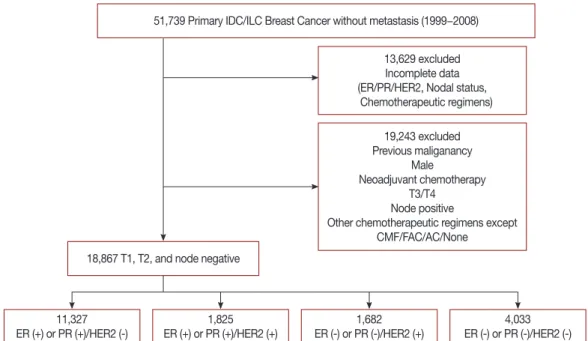
Figure 1. Study design.
IDC=invasive ductal carcinoma; ILC=invasive lobular carcinoma; ER=estrogen receptor; PR=progesterone receptor; HER2=human epidermal growth factor receptor 2; CMF=cyclophosphamide, methotrexate, and 5-fluorouracil; FAC=5-fluorouracil, anthracycline, and cyclophosphamide; AC=anthracycline and cyclophosphamide.
51,739 Primary IDC/ILC Breast Cancer without metastasis (1999−2008)
18,867 T1, T2, and node negative
13,629 excluded Incomplete data (ER/PR/HER2, Nodal status, Chemotherapeutic regimens) 19,243 excluded Previous maliganancy Male Neoadjuvant chemotherapy T3/T4 Node positive
Other chemotherapeutic regimens except CMF/FAC/AC/None 11,327 ER (+) or PR (+)/HER2 (-) 1,825 ER (+) or PR (+)/HER2 (+) 1,682 ER (-) or PR (-)/HER2 (+) 4,033 ER (-) or PR (-)/HER2 (-)
Certification of the Korean National Statistical Office and the Korean Central Cancer Registry of the Ministry of Health and Welfare [12]. One hundred fourteen institutes participate in this KBCS database project. Detailed information on the KBCS database has been provided previously [12,13]. ER and PR status was defined as positive or negative according to the standard method of each institution. HER2 positivity was de-fined as a 3+ score on immunohistochemical analysis and/or gene amplification observed with fluorescence in situ hybrid-ization. Each physician prospectively registered information regarding the ER, PR, and HER2 status in the KBCS database, according to institutional standards. This retrospective study was approved by the Institutional Review Board of the Korea Cancer Center hospital (K-1305-002-017).
Between January 1999 and December 2008, 51,739 patients with newly diagnosed invasive ductal or lobular breast cancers were registered in the KBCS database. We excluded patients with incomplete information regarding the ER, PR, and HER2 statuses; lymph node metastasis; and adjuvant chemo-therapy regimens. Male patients and patients with other pre-vious malignancies, lymph node metastasis, or who under-went treatment with adjuvant chemotherapy regimens other than CMF, anthracycline and cyclophosphamide (AC), or 5-fluorouracil, anthracycline, and cyclophosphamide (FAC) were also excluded. A score of 0–1+ on immunohistochemi-cal analysis or a negative result after fluorescent in situ hybrid-ization confirmed the TNBC ER-, PR-, and HER2-negative statuses. Of these patients, 4,033 patients with TNBC were in-cluded in this analysis (Figure 1). The last date of follow-up for survival was December 31, 2009. The primary endpoint of this study was death caused by any reason. As the KBCS data-base only provides patients’ survival information, analysis of disease recurrence could not be performed.
Statistical analysis
Data analysis was performed with SPSS version 14.0 (SPSS Inc., Chicago, USA). The chi-square test was used to assess differences in values between the groups. Survival rates were estimated by using the Kaplan-Meier method, and compared with the log-rank test. Multivariate analyses were performed with the linear logistic regression model and the Cox propor-tional hazards model. Statistical significance was accepted as
p-values of <0.05.
RESULTS
Patient characteristicsAmong 51,739 patients with newly diagnosed invasive duc-tal or lobular breast cancer in the KBCS database, the data
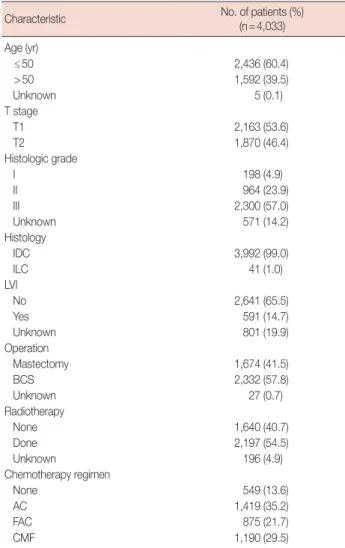
from 18,867 patients were available for this analysis. Of these patients, 21.4% (4,033/18,867) were classified as having T1-2N0 TNBC (Figure 1). The mean age at diagnosis was 48.5
±10.8 years (range, 21–91 years). Most of the tumors were T1 (53.6%) and had a high histological grade (grade 3; 57.0%). Lymphovascular invasion was observed in 591 patients (14.7%). Breast-conserving surgery (BCS) was performed in 57.8% of the patients (Table 1).
Application of adjuvant chemotherapy
Overall, 3,781 patients (86.4%) were treated with adjuvant chemotherapy. AC was the most commonly administered chemotherapy regimen with 1,419 patients (35.2%) receiving this treatment. CMF was administered to 1,190 patients (29.5%). FAC was used as an adjuvant treatment for 875
pa-Table 1. Patients characteristics
Characteristic No. of patients (%)(n=4,033) Age (yr) ≤50 2,436 (60.4) >50 1,592 (39.5) Unknown 5 (0.1) T stage T1 2,163 (53.6) T2 1,870 (46.4) Histologic grade I 198 (4.9) II 964 (23.9) III 2,300 (57.0) Unknown 571 (14.2) Histology IDC 3,992 (99.0) ILC 41 (1.0) LVI No 2,641 (65.5) Yes 591 (14.7) Unknown 801 (19.9) Operation Mastectomy 1,674 (41.5) BCS 2,332 (57.8) Unknown 27 (0.7) Radiotherapy None 1,640 (40.7) Done 2,197 (54.5) Unknown 196 (4.9) Chemotherapy regimen None 549 (13.6) AC 1,419 (35.2) FAC 875 (21.7) CMF 1,190 (29.5)
IDC =invasive ductal carcinoma; ILC =invasive lobular carcinoma; LVI = lymphovascular invasion; BCS=breast-conserving surgery; AC=anthracyclin and cyclophosphamide; FAC=5-fluorouracil, anthracyclin, and cyclophospha-mide; CMF=cyclophosphamide, methotrexate, and 5-fluorouracil.
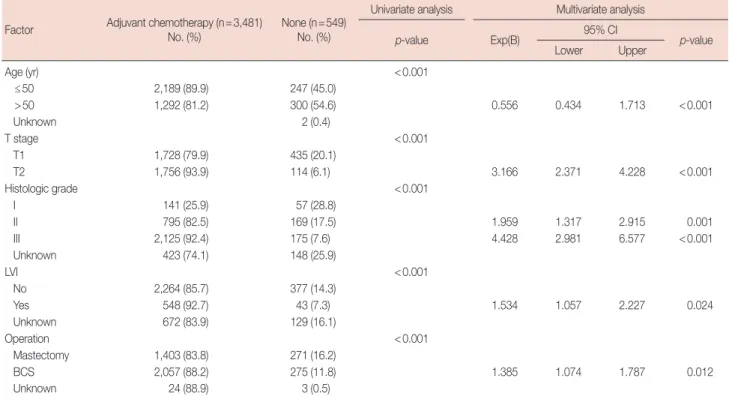
tients (21.7%) (Table 1). Chemotherapy was administered to 91.3% (879/963), 88.9% (1,310/1,473), 87.5% (911/1,029), 78.3% (346/442), and 38.0% (46/121) of patients aged ≤40, 41–50, 51–60, 61–70, and >71 years, respectively. Adjuvant chemotherapy was more frequently used in patients aged ≤50 years, and in patients who had larger tumors (T2), high histol-ogic grade tumors, tumors showing lymphovascular invasion, and who were treated with BCS (Table 2). In a multivariate model, values significantly predictive of adjuvant chemother-apy use included younger age, T2 tumor, high histologic grade, lymphovascular invasion, and BCS (Table 2).
The AC and FAC regimens were more commonly used for patients with high-risk characteristics such as younger age, larger tumor size, higher histologic grade tumors, and the presence of lymphovascular invasion. In contrast, the CMF regimen was more frequently used in patients aged >50 years, and in patients with smaller tumors (T1), lower histologic grade tumors, and no lymphovascular invasion (Table 3).
Overall survival
After a median follow-up of 52.5 months, there were 150 deaths, including 11 unrelated deaths, 69 breast cancer-related deaths, and 70 deaths due to unknown reasons. Of the 11 un-related deaths, heart problems were the cause of death in only one patient; the patient was 65 years at diagnosis, was not
Table 2. Factors associated with use of adjuvant chemotherapy Factor Adjuvant chemotherapy (n=3,481) No. (%) None (n=549) No. (%)
Univariate analysis Multivariate analysis
p-value Exp(B) 95% CI p-value
Lower Upper Age (yr) <0.001 ≤50 2,189 (89.9) 247 (45.0) >50 1,292 (81.2) 300 (54.6) 0.556 0.434 1.713 <0.001 Unknown 2 (0.4) T stage <0.001 T1 1,728 (79.9) 435 (20.1) T2 1,756 (93.9) 114 (6.1) 3.166 2.371 4.228 <0.001 Histologic grade <0.001 I 141 (25.9) 57 (28.8) II 795 (82.5) 169 (17.5) 1.959 1.317 2.915 0.001 III 2,125 (92.4) 175 (7.6) 4.428 2.981 6.577 <0.001 Unknown 423 (74.1) 148 (25.9) LVI <0.001 No 2,264 (85.7) 377 (14.3) Yes 548 (92.7) 43 (7.3) 1.534 1.057 2.227 0.024 Unknown 672 (83.9) 129 (16.1) Operation <0.001 Mastectomy 1,403 (83.8) 271 (16.2) BCS 2,057 (88.2) 275 (11.8) 1.385 1.074 1.787 0.012 Unknown 24 (88.9) 3 (0.5)
CI=confidence interval; LVI=lymphovascular invasion; BCS=breast-conserving surgery.
Table 3. Clinicopathologic characteristics according to adjuvant che-motherapy regimens Characteristic AC (n=1,419) No. (%) FAC (n=875) No. (%) CMF (n=1,190) No. (%) None (n=549) No. (%) p-value Age (yr) <0.001 ≤50 915 (64.5) 587 (67.1) 687 (57.7) 247 (45.0) >50 501 (35.3) 288 (32.9) 503 (42.3) 300 (54.6) Unknown 3 (0.2) 2 (0.4) T stage <0.001 T1 707 (49.8) 379 (43.3) 642 (53.9) 435 (79.2) T2 712 (50.2) 496 (56.7) 548 (46.1) 114 (20.8) Histologic grade <0.001 I 44 (3.1) 13 (1.5) 84 (7.1) 57 (10.4) II 372 (26.2) 102 (11.7) 321 (27.0) 169 (30.8) III 883 (62.2) 669 (76.5) 573 (48.2) 175 (31.9) Unknown 120 (8.5) 91 (10.4) 212 (17.8) 148 (27.0) LVI <0.001 No 1,085 (76.5) 434 (49.6) 745 (62.6) 377 (68.7) Yes 172 (12.1) 235 (26.9) 141 (11.8) 43 (7.8) Unknown 162 (11.4) 206 (23.5) 304 (25.5) 129 (23.5) Operation <0.001 Mastectomy 544 (38.3) 251 (28.7) 608 (51.1) 271 (49.4) BCS 870 (61.3) 616 (70.4) 571 (48.0) 275 (50.1) Unknown 5 (0.4) 8 (0.9) 11 (0.9) 3 (0.5)
AC=anthracyclin and cyclophosphamide; FAC=5-fluorouracil, anthracyclin, and cyclophosphamide; CMF=cyclophosphamide, methotrexate, and 5-fluo-rouracil; LVI=lymphovascular invasion; BCS=breast-conserving surgery.
treated with adjuvant chemotherapy, and died 6 years after the operation. The 5-year overall survival rate was 95.4% (Figure 2). Age >50 years, mastectomy, and no adjuvant chemother-apy were associated with a significantly increased risk of death on univariate analysis (Table 4). Compared to the T1 stage, T2 showed a greater risk of death but this result did not reach sta-tistical significance (p=0.058).
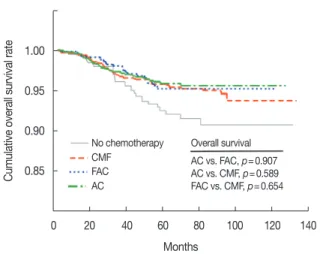
Compared to no adjuvant chemotherapy, adjuvant chemo-therapy with any regimen had a beneficial effect on overall
survival (Table 4). The beneficial effect of adjuvant chemo-therapy was retained after adjustment for age, T stage, and surgical procedures (Table 5). When compared with patients who did not receive adjuvant chemotherapy, the hazard ratio of death was 0.524 (95% confidence interval [CI], 0.325–0.846;
p=0.008) in the AC group, 0.516 (95% CI, 0.292–0.912; p=0.023) in the FAC group, and 0.567 (95% CI, 0.357–0.900,
Figure 2. Overall survival of all patients. 1.00 0.95 0.90 0.85 0 20 40 60 80 100 120 140 Months
Cumulative overall survival rate
Table 4. Univariate analysis of overall survival in all patients
Factor of patientsNo. Death OS rate (%)5-Year p-value
Age (yr) 0.009 ≤50 2,436 77 95.9 >50 1,592 73 94.6 T stage 0.058 T1 2,163 63 96.1 T2 1,870 87 94.6 Histologic grade I 198 5 97.0 II 964 41 95.0 0.287 III 2,300 89 95.0 0.332 LVI 0.254 No 2,641 82 95.9 Yes 591 24 95.2 Operation 0.012 Mastectomy 1,674 85 94.4 BCS 2,332 63 96.3 Chemotherapy regimen None 549 31 92.5 AC 1,419 45 95.9 0.013 FAC 875 23 95.3 0.034 CMF 1,190 51 95.9 0.039
OS=overall survival; LVI=lymphovascular invasion; BCS=breast-conserving surgery; AC=anthracyclin-cyclophosphamide; FAC=5-fluorouracil-anthracy-clin-cyclophosphamide; CMF=cyclophosphamide-methotrexate-5-fluorouracil.
Table 5. Multivariate analysis of overall survival in all patients
Factor Hazard ratio 95% CI p-value
Age (yr) 0.065 ≤50 1 >50 1.366 0.981–1.903 T stage 0.003 T1 1 T2 1.702 1.205–2.406 Operation 0.110 Mastectomy 1 BCS 0.758 0.540–1.065 Chemotherapy regimen 0.038 None 1 AC 0.524 0.325–0.846 0.008 FAC 0.516 0.292–0.912 0.023 CMF 0.567 0.357–0.900 0.016
CI=confidence interval; BCS=breast-conserving surgery; AC=anthracyclin and cyclophosphamide; FAC=5-fluorouraci, anthracyclin, and cyclophospha-mide; CMF=cyclophosphamide, methotrexate, and 5-fluorouracil.
Table 6. Univariate analysis of overall survival in patients treated by ad-juvant chemotherapy
Factor of patientsNo. Death OS rate (%)5-Year p-value
Age (yr) 0.379 ≤50 2,189 72 95.8 >50 1,292 47 95.8 T stage 0.022 T1 1,728 46 96.5 T2 1,756 73 95.1 Histologic grade I 141 5 96.2 II 795 31 95.7 0.756 III 2,125 72 95.7 0.898 LVI 0.302 No 2,264 68 96.1 Yes 548 21 95.3 Operation 0.071 Mastectomy 1,403 62 95.1 BCS 2,081 57 96.4 Chemotherapy regimen AC 1,419 45 95.9 FAC 875 23 95.3 0.907 CMF 1,190 51 95.9 0.589
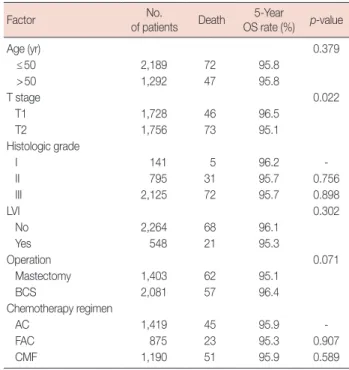
OS=overall survival; LVI=lymphovascular invasion; BCS=breast-conserving surgery; AC=anthracyclin-cyclophosphamide; FAC=5-fluorouracil-anthracy-clin-cyclophosphamide; CMF=cyclophosphamide-methotrexate-5-fluorouracil.
p=0.016) in the CMF group.
There was no significant difference in patient survival rates between the chemotherapy regimens employed (AC vs. FAC,
p=0.907; AC vs. CMF, p=0.589; FAC vs. CMF, p=0.654)
(Table 6, Figure 3). The multivariate analysis of overall surviv-al in patients treated with adjuvant chemotherapy showed no difference in the survival benefit between the adjuvant che-motherapy regimens (Table 7).
DISCUSSION
In our study, adjuvant chemotherapy was administered to 86.4% of patients with T1-2N0 TNBC in South Korea, and it significantly improved the overall survival in this retrospec-tive cohort. No difference in patient survival was observed be-tween the various adjuvant chemotherapy regimens used. An advantage of this study is that it only included patients with node-negative TNBC from a large nationwide cohort. There are only a few studies examining adjuvant chemotherapy for node-negative breast cancer because this group has a better prognosis. In addition, most of these studies have focused on patients with ER-negative breast cancer, resulting in study co-horts with a mixture of ER–/HER2+ and TNBC patients. In this era of HER2-targeted therapy, the inclusion of a HER2 overexpression group in this analysis could cause confusion about the effects of chemotherapy on survival.
According to our analysis, the use of adjuvant chemother-apy was associated with an improved overall survival rate,
which is in agreement with a previous large retrospective analysis [14]. The International Breast Cancer Study Group conducted a retrospective study to evaluate the efficacy of CMF for each molecular subtype in patients with node nega-tive disease enrolled in two randomized clinical trials [14]. A significant reduction in the hazard ratio for chemotherapy versus no chemotherapy was observed for the TNBC subtype (hazard ratio, 0.46; 95% CI, 0.29–0.73) [14].
The efficacy of CMF, AC, and FAC was similar in our study. This result corresponds with the findings of the National Sur-gical Adjuvant Breast and Bowel Project (NSABP) B-23, which was designed to determine whether AC was compara-ble or superior to CMF when used to treat patients with node-negative ER-node-negative breast cancer. They demonstrated no statistically significant differences in the outcomes of AC-treated patients and CMF-AC-treated patients during 8 years of follow-up [15,16]. A retrospective study analyzed the respon-siveness of different breast cancer subtypes to specific chemo-therapy regimens in the MA5 adjuvant trial [17]. There were no significant differences in the disease-free survival (hazard ratio, 1.1; 95% CI, 0.6–2.1) and overall survival (hazard ratio, 1.3; 95% CI, 0.7–2.5) between cyclophosphamide-epirubicin-5-fluorouracil and CMF in basal-like tumors. Together with the findings of our study, these results suggest that any of these regimens (CMF, AC, or FAC) is a reasonable therapeutic choice in terms of efficacy.
When there is no difference in the efficacy between differ-ent treatmdiffer-ents, drug-related toxicities should be considered when selecting the optimal treatment regimen. The classic CMF regimen has been a standard treatment for a long time, and the safety of this regimen is well known [18,19]. Compar-isons of drug compliance and toxicity between doxorubicin-cyclophosphamide and CMF were performed in the NSABP B-23 study. The toxicity of four courses of AC therapy was similar to that of classic CMF [16]. In contrast, FAC treatment significantly induced more episodes of emesis, mucositis,
alo-Table 7. Multivariate analysis of overall survival in patients treated by adjuvant chemotherapy
Factor Hazard ratio 95% CI p-value
T stage T1 1 T2 1.155 1.098–2.238 0.021 Chemotherapy regimen AC 1 FAC 0.942 0.570–1.558 0.816 CMF 1.129 0.754–1.690 0.556
CI=confidence interval; AC=anthracyclin and cyclophosphamide; FAC=5-fluorouracil, anthracyclin, and cyclophosphamide; CMF=cyclophosphamide, methotrexate, and 5-fluorouracil.
Figure 3. Overall survival according to the chemotherapy regimen used. The receiving adjuvant chemotherapy showed beneficial effect on over-all survival compared with not receiving adjuvant chemotherapy. There was no significant difference in the survival rates between the chemo-therapy regimens employed.
CMF=cyclophosphamide, methotrexate, and 5-fluorouracil; FAC=5-fluorouracil, anthracycline, and cyclophosphamide; AC=anthracycline and cyclophosphamide. 1.00 0.95 0.90 0.85 0 20 40 60 80 100 120 140 Months
Cumulative overall survival rate
No chemotherapy CMF FAC AC Overall survival AC vs. FAC, p=0.907 AC vs. CMF, p=0.589 FAC vs. CMF, p=0.654
pecia, and cardiotoxicity compared with CMF [20,21]. Ex-tending the AC chemotherapy regimen from four to six cycles increased toxicity, including cardiotoxicity, without survival improvement [22]. As the results of our study showed that the efficacy of FAC was not different from either that of AC or CMF, these latter treatments with less adverse toxicity may be considered a better choice for the low-risk group of patients in our study, and particularly for older patients.
Cardiotoxicity is an important issue when studies of adju-vant anthracycline-containing chemotherapy are conducted. Anthracycline-induced cardiotoxicity could not be assessed in our study because 46.7% of deaths were caused by unknown reasons. Only one death was known to result from a heart-re-lated problem.
Although many drugs such as platinum-based drugs, tax-anes, bevacizumab, epidermal growth factor receptor-targeted agents, and poly adenosine diphosphate ribose polymerase inhibitors are being investigated as potential therapeutic agents for TNBC, there is no generally accepted adjuvant regi-men for TNBC [10]. Most clinical trials to test these novel agents are conducted in high-risk patients; therefore, it would take a long time to consider the results and adapt these drugs to adjuvant regimens that could be used in routine clinical practice for low-risk patients. Until then, physicians and pa-tients have to choose one of the conventional chemotherapies. This study has some limitations. Firstly, regimens using anes were excluded from the analysis. In Korea, the use of tax-anes in the adjuvant setting for node-negative breast cancer is not supported by the National Health Insurance Service. Only 78 patients with T1-2 node-negative TNBC received adjuvant treatment with AC followed by taxane or anthracycline-tax-ane. There are limited data on the adjuvant use of taxanes in patients with node-negative breast cancer, which remains controversial [22-25]. Therefore, we excluded these patients as well as a small number treated with different regimens con-taining agents less frequently used in this population, such as oral 5-fluorouracil, vinorelbine, capecitabine, and gem-citabine. Secondly, TNBC was classified by data that was col-lected at each institute since 1999. The KBCS database recom-mends the results of ER, PR, or HER2 examinations should be classified according to each institute’s guideline and has no specific pathological validation program. Therefore, we as-sume that part of data would not match with the American Society of Clinical Oncology/College of American Pathol-ogists guideline for HER2, which was written in 2007. In add-ition, the exact dose, cycles, and routes of administration of adjuvant chemotherapy were not provided by the KBCS data-base. We analyzed the survival data based on only the chemo-therapy regimen. Lastly, patients with T1a/b tumors were
in-cluded in the analysis, and the merit of adjuvant chemother-apy in these patients is debatable. Administration of adjuvant chemotherapy was not associated with a significantly higher recurrence rate in T1a/bN0 HER2-positive breast cancer or TNBC [26-28]. We incorporated this group of patients be-cause the KBCS database has only limited data on T stage subclassifications, even though the inclusion of this popula-tion might dilute the results of the analysis.
In conclusion, currently used standard adjuvant chemo-therapy regimens improved the overall survival in patients with T1/2 node-negative TNBC. There was no significant dif-ference in the survival of patients administered CMF, AC, or FAC regimens. In the future, randomized prospective studies should lead to the development of new adjuvant treatment modalities for low-risk patients with TNBC. Currently, the se-lection of standard chemotherapy regimens with fewer drug-related adverse toxicities may be the most reasonable choice.
CONFLICT OF INTEREST
The authors declare that they have no competing interests.
REFERENCES
1. Early Breast Cancer Trialists’ Collaborative Group (EBCTCG). Effects of chemotherapy and hormonal therapy for early breast cancer on re-currence and 15-year survival: an overview of the randomised trials. Lancet 2005;365:1687-717.
2. Cuzick J, Sestak I, Baum M, Buzdar A, Howell A, Dowsett M, et al. Ef-fect of anastrozole and tamoxifen as adjuvant treatment for early-stage breast cancer: 10-year analysis of the ATAC trial. Lancet Oncol 2010;11: 1135-41.
3. Perez EA, Romond EH, Suman VJ, Jeong JH, Davidson NE, Geyer CE Jr, et al. Four-year follow-up of trastuzumab plus adjuvant chemothera-py for operable human epidermal growth factor receptor 2-positive breast cancer: joint analysis of data from NCCTG N9831 and NSABP B-31. J Clin Oncol 2011;29:3366-73.
4. Slamon D, Eiermann W, Robert N, Pienkowski T, Martin M, Press M, et al. Adjuvant trastuzumab in HER2-positive breast cancer. N Engl J Med 2011;365:1273-83.
5. Goldhirsch A, Gelber RD, Piccart-Gebhart MJ, de Azambuja E, Procter M, Suter TM, et al. 2 Years versus 1 year of adjuvant trastuzumab for HER2-positive breast cancer (HERA): an open-label, randomised con-trolled trial. Lancet 2013;382:1021-8.
6. Carey L, Winer E, Viale G, Cameron D, Gianni L. Triple-negative breast cancer: disease entity or title of convenience? Nat Rev Clin Oncol 2010; 7:683-92.
7. Kim JE, Ahn HJ, Ahn JH, Yoon DH, Kim SB, Jung KH, et al. Impact of triple-negative breast cancer phenotype on prognosis in patients with stage I breast cancer. J Breast Cancer 2012;15:197-202.
8. Early Breast Cancer Trialists’ Collaborative Group (EBCTCG), Peto R, Davies C, Godwin J, Gray R, Pan HC, et al. Comparisons between
dif-ferent polychemotherapy regimens for early breast cancer: meta-analy-ses of long-term outcome among 100,000 women in 123 randomised trials. Lancet 2012;379:432-44.
9. Kittaneh M, Montero AJ, Glück S. Molecular profiling for breast cancer: a comprehensive review. Biomark Cancer 2013;5:61-70.
10. Joensuu H, Gligorov J. Adjuvant treatments for triple-negative breast cancers. Ann Oncol 2012;23 Suppl 6:vi40-5.
11. Hernandez-Aya LF, Gonzalez-Angulo AM. Adjuvant systemic thera-pies in breast cancer. Surg Clin North Am 2013;93:473-91.
12. Kim HA, Kim EK, Kim MS, Yu JH, Lee MR, Lee HK, et al. Association of human epidermal growth factor receptor 2 with radiotherapy resis-tance in patients with T1N0M0 breast cancer. J Breast Cancer 2013;16: 266-73.
13. Ahn SH, Son BH, Kim SW, Kim SI, Jeong J, Ko SS, et al. Poor outcome of hormone receptor-positive breast cancer at very young age is due to tamoxifen resistance: nationwide survival data in Korea: a report from the Korean Breast Cancer Society. J Clin Oncol 2007;25:2360-8. 14. Colleoni M, Cole BF, Viale G, Regan MM, Price KN, Maiorano E, et al.
Classical cyclophosphamide, methotrexate, and fluorouracil chemo-therapy is more effective in triple-negative, node-negative breast cancer: results from two randomized trials of adjuvant chemoendocrine thera-py for node-negative breast cancer. J Clin Oncol 2010;28:2966-73. 15. Fisher B, Jeong JH, Anderson S, Wolmark N. Treatment of axillary
lymph node-negative, estrogen receptor-negative breast cancer: updat-ed findings from National Surgical Adjuvant Breast and Bowel Project clinical trials. J Natl Cancer Inst 2004;96:1823-31.
16. Fisher B, Anderson S, Tan-Chiu E, Wolmark N, Wickerham DL, Fisher ER, et al. Tamoxifen and chemotherapy for axillary node-negative, es-trogen receptor-negative breast cancer: findings from National Surgical Adjuvant Breast and Bowel Project B-23. J Clin Oncol 2001;19:931-42. 17. Cheang MC, Voduc KD, Tu D, Jiang S, Leung S, Chia SK, et al.
Respon-siveness of intrinsic subtypes to adjuvant anthracycline substitution in the NCIC.CTG MA.5 randomized trial. Clin Cancer Res 2012;18: 2402-12.
18. Goldhirsch A, Coates AS, Colleoni M, Castiglione-Gertsch M, Gelber RD. Adjuvant chemoendocrine therapy in postmenopausal breast can-cer: cyclophosphamide, methotrexate, and fluorouracil dose and sched-ule may make a difference. International Breast Cancer Study Group. J Clin Oncol 1998;16:1358-62.
19. Colleoni M, Price KN, Castiglione-Gertsch M, Gelber RD, Coates AS, Goldhirsch A. Mortality during adjuvant treatment of early breast
can-cer with cyclophosphamide, methotrexate, and fluorouracil. Interna-tional Breast Cancer Study Group. Lancet 1999;354:130-1.
20. Martin M, Villar A, Sole-Calvo A, Gonzalez R, Massuti B, Lizon J, et al. Doxorubicin in combination with fluorouracil and cyclophosphamide (i.v. FAC regimen, day 1, 21) versus methotrexate in combination with fluorouracil and cyclophosphamide (i.v. CMF regimen, day 1, 21) as adjuvant chemotherapy for operable breast cancer: a study by the GEI-CAM group. Ann Oncol 2003;14:833-42.
21. Hutchins LF, Green SJ, Ravdin PM, Lew D, Martino S, Abeloff M, et al. Randomized, controlled trial of cyclophosphamide, methotrexate, and fluorouracil versus cyclophosphamide, doxorubicin, and fluorouracil with and without tamoxifen for high-risk, node-negative breast cancer: treatment results of Intergroup Protocol INT-0102. J Clin Oncol 2005; 23:8313-21.
22. Shulman LN, Cirrincione CT, Berry DA, Becker HP, Perez EA, O’Regan R, et al. Six cycles of doxorubicin and cyclophosphamide or paclitaxel are not superior to four cycles as adjuvant chemotherapy for breast can-cer in women with zero to three positive axillary nodes: Cancan-cer and Leukemia Group B 40101. J Clin Oncol 2012;30:4071-6.
23. Martín M, Ruiz A, Ruiz Borrego M, Barnadas A, González S, Calvo L, et al. Fluorouracil, doxorubicin, and cyclophosphamide (FAC) versus FAC followed by weekly paclitaxel as adjuvant therapy for high-risk, node-negative breast cancer: results from the GEICAM/2003-02 study. J Clin Oncol 2013;31:2593-9.
24. Ozdemir N, Aksoy S, Zengin N, Altundag K. Taxanes in the adjuvant treatment of node-negative breast cancer patients. J BUON 2012;17:27-32.
25. Lagha A, Chraiet N, Labidi S, Krimi S, Ayadi M, Gligorov J, et al. Impact of taxanes in the adjuvant setting of node-negative breast cancers. Bull Cancer 2013;100:465-71.
26. Migdady Y, Sakr BJ, Sikov WM, Olszewski AJ. Adjuvant chemotherapy in T1a/bN0 HER2-positive or triple-negative breast cancers: applica-tion and outcomes. Breast 2013;22:793-8.
27. Olszewski AJ, Migdady Y, Boolbol SK, Klein P, Boachie-Adjei K, Sakr BJ, et al. Effects of adjuvant chemotherapy in HER2-positive or triple-negative pT1ab breast cancers: a multi-institutional retrospective study. Breast Cancer Res Treat 2013;138:215-23.
28. Ho AY, Gupta G, King TA, Perez CA, Patil SM, Rogers KH, et al. Favor-able prognosis in patients with T1a/T1bN0 triple-negative breast can-cers treated with multimodality therapy. Cancer 2012;118:4944-52.