Research Article
Identifying Potentially Avoidable Emergency Department Visits
of Long-Term Care Hospital Residents in Korea: A Multicenter
Retrospective Cohort Study
Keon Kim,
1Dong Hoon Lee
,
2Ho Young Yune,
3Jung Hee Wee
,
4Duk Ho Kim,
5Eui Chung Kim
,
6Jee Yong Lim,
7and Seung Pil Choi
41Department of Emergency Medicine, Ewha Womans University Hospital, Seoul 07985, Republic of Korea 2Department of Emergency Medicine, College of Medicine, Chung-Ang University, Seoul 06973, Republic of Korea 3Department of Emergency Medicine, Hallym University Dongtan Sacred Heart Hospital, Hwaseong-si,
Gyeonggi-do 18450, Republic of Korea
4Department of Emergency Medicine, College of Medicine, Yeouido St. Mary's Hospital, The Catholic University of Korea, Seoul 07345, Republic of Korea
5Department of Emergency Medicine, Eulji University, Seoul 01830, Republic of Korea
6Department of Emergency Medicine, CHA University School of Medicine, Seongnam-si 13496, Republic of Korea 7Department of Emergency Medicine, Seoul St. Mary’s Hospital, Seoul 065691, Republic of Korea
Correspondence should be addressed to Dong Hoon Lee; [email protected]
Received 12 November 2018; Revised 15 May 2019; Accepted 30 May 2019; Published 19 June 2019 Academic Editor: Shahrzad Bazargan-Hejazi
Copyright © 2019 Keon Kim et al. This is an open access article distributed under the Creative Commons Attribution License, which permits unrestricted use, distribution, and reproduction in any medium, provided the original work is properly cited. The aims of this study were to investigate the reasons of transfers from long-term care hospitals (LTCHs) to emergency departments (EDs) of university hospitals in geriatric patients and to categorize the avoidable causes of these transfers. This retrospective multicenter study involved patients aged 65 years and older who were transferred from LTCHs to 5 EDs of university hospitals located in the metropolitan area of South Korea between January 2017 and December 2017. The expert panel reviewed and categorized the reason of transfers as avoidable or not. Moreover, we also investigated the number of patients with do-not-resuscitate (DNR) documents and the date these DNR documents were written. A total of 255,543 patients visited 5 EDs during the study period. Of these, 1,131 patients were from LTCHs. The number of potentially avoidable transfers was 168/1,131 (14.9%). The most common reason of avoidable transfers was noncritical diagnoses that could be assessed and managed in LTCHs (57.1%). There were 162 patients with DNR orders; of these, 12 had approved the DNR order before transfer. In conclusion, in Korea, potentially avoidable transfers could be reduced by managing noncritical diseases in LTCH and preparing advance care directives, including DNR orders, during admission to LTCH.
1. Introduction
In Korea, the number of the elderly population is rapidly increasing because of prolonged life expectancy and low birth rate. According to the Statistics Korea database, the rate of the elderly aged 65 years and older has increased from 10.2% in 2008 to 13.8% in 2017, and it is expected to become 37.8% by 2050 [1]. With increasing age, the medical demand also increases in this population. The rate of total medical expenses in the elderly aged 65 years and older is steadily
increasing from 31.6% in 2010 to 36.8% in 2015. Addition-ally, the number of long-term care hospitals (LTCHs) has increased consistently from 714 in 2009 to 1,516 in 2017 [2]. An LTCH in Korea is a medical institution where doctors and nurses are stationed and where patients requiring long-term hospitalization and treatment due to senile diseases are mainly hospitalized. The elderly patients’ total healthcare costs in LTCH are covered by the National Health Insurance (NHI) in Korea. According to the National Health Insurance Expenditure Trends Report by the National Health Insurance
Volume 2019, Article ID 7041607, 7 pages https://doi.org/10.1155/2019/7041607
Review and Assessment Service [3], the total healthcare costs increased by 6.4% in 2015 compared to those in 2014, and one of the major causes was increased LTCH admission of the elderly patients. There are also nursing homes for elderly in Korea. A nursing home is a welfare facility that cares for rather than treats the elderly, whereas an LTCH is a “hospital” where patients can be treated or rehabilitated. Therefore, caregivers in nursing homes assist elderly patients in their daily activities, such as cooking, doing laundry, and physical activities such as excretion and bathing, especially those having difficulty in mobility due to senile diseases, such as dementia and stroke. Additionally, LTCHs have full-time working physicians, who are absent in nursing homes, and an outside physician visits twice a month [4].
LTCHs in Korea basically provide simple conservative treatments because of conflicting payment systems and lack of professional personnel and suitable facilities [5, 6]. There-fore, although LTCHs are medical institutions, practically only simple medical interventions, such as maintenance of existing medication and empirical medical treatment for newly occurring complications, can be performed in an LTCH. It is reasonable that patients in LTCHs are transferred to tertiary university hospitals when they have unstable vital signs or acquire new diseases or when their existing diseases worsen. These patients are assessed and treated in the emergency department (ED). However, some patients from LTCH are transferred unnecessarily to tertiary hospitals.
Unnecessary transfers can cause physical, mental, and economic distress to patients. Such transfers can also waste the limited medical resources of university hospitals and add to ED overcrowding in tertiary university hospitals. Therefore, there is a need to consider the potentially avoidable transfers from LTCHs. However, in Korea, there is a paucity of the data on patients who are transferred from an LTCH to the ED of tertiary university hospitals [7–11]. These studies showed the overall characteristics of geriatric patients transferred from LTCHs, but they did not consider the appro-priateness of transfers. Thus, this study aimed to estimate the rate of potentially avoidable transfers from LTCHs to EDs of university hospitals in Korea and to categorize the causes of these transfers.
2. Methods
2.1. Study Setting and Participants. This multicenter,
retro-spective cohort study investigated all ED visits of LTCH patients aged 65 years and older between January 2017 and December 2017 in 5 tertiary university hospitals located in the metropolitan area of South Korea. The bed capacity of the enrolled hospitals was 620, 830, 850, 890, and 1,000 beds. Moreover, the number of patients visiting the ED of these hospitals annually ranges from 40,000 to 70,000.
2.2. Data Sources
2.2.1. National Emergency Department Information System.
Data of patients who visited EDs between January 2017 and December 2017 were extracted from the National Emergency
Department Information System (NEDIS) of Korea, which is a nationwide government system that has been in operation since 2003 and collects data from more than 150 Korean emergency centers.
We analyzed the following variables provided by the NEDIS: patient demographic information (age, sex), triage acuity (Korean Triage and Acuity Scale [KTAS]), main reasons for ED visit (medical or nonmedical cause), primary diagnosis in the ED, and disposition at the ED (returned to an LTCH, admitted to transferred hospital, admitted to another hospital, left before treatment completed, deceased). The KTAS is a Korean triage system that categorizes patients by severity from 1 to 5, with 1 being the highest.
2.2.2. Electronic Medical Record Review. After extracting
the patients’ data in the NEDIS database, we reviewed the patients’ electronic medical review (EMR) to determine the patients’ detailed diagnosis in the ED and the reason for transfers. We also assessed other variables, such as the following: causes of LTCH admission, whether the patients were transferred from an LTCH, whether they signed the do-not-resuscitate (DNR) order, and the point in time when the decision of DNR was taken.
2.3. Outcome Measurements. The primary outcome was the
number of avoidable transfers. To develop the available tools that identify avoidable transfers, we (1) developed a con-ceptual framework, (2) developed the criteria of potentially avoidable transfers, (3) recruited and trained expert panels who then performed chart reviews, and (4) analyzed the appropriateness of transfers.
The secondary outcome was the number of patients who have already signed or provided informed consent for the DNR order while still in the LTCHs, and the number of patients who signed the DNR form at the ED or after ED admission. Patients who have already signed the DNR order can experience natural death in an LTCH if their condition deteriorates while undergoing conservative treatments. These data were obtained by the panel through a chart review.
2.3.1. Conceptual Framework and Development of the Criteria of Potentially Avoidable Transfers. We developed our
con-ceptual framework and the criteria of potentially avoidable transfers based on the medical literature. We reviewed several previous studies [12–19] and analyzed the appropriateness of transfers. Additionally, from a number of available tools that identify avoidable transfer criteria, we selected the tool developed by Morphet et al. [19], who validated this tool that is relevant to the Australian health context. We modified and developed the criteria considering the current status of LTCHs in Korea, specifically when it comes to human and equipment resources, procedure availability, quality of evaluation, and acute illness treatment. As a result, the criteria for potentially avoidable transfers were divided into the following five categories: (1) presence of noncritical diagnoses that could be assessed and treated in an LTCH, such as cel-lulitis or urinary tract infection (UTI), provided that patients have no signs of systemic toxicity and have no uncontrolled
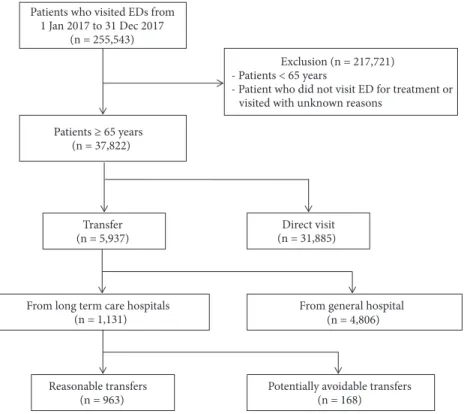
Patients who visited EDs from 1 Jan 2017 to 31 Dec 2017 (n = 255,543) Patients ≥ 65 years (n = 37,822) Transfer (n = 5,937) Direct visit (n = 31,885)
From long term care hospitals (n = 1,131)
From general hospital (n = 4,806)
Reasonable transfers (n = 963)
Exclusion (n = 217,721) - Patients < 65 years
- Patient who did not visit ED for treatment or visited with unknown reasons
Potentially avoidable transfers (n = 168)
Figure 1: The flowchart of the study population. ED: emergency department.
comorbidities and the condition can usually be managed with oral antimicrobials; (2) family member/members who refused further evaluation and treatment in the ED; (3) already-known advance care directives (including DNR); (4) simple procedure such as replacement of urinary catheter because of failure of insertion in an LTCH; and (5) minor traumas not requiring ED assessment, such as abrasions, bruises, skin lesions not requiring sutures, and minor burns covering only a small area of skin.
2.3.2. Expert Panel Reviewer Recruitment. We recruited an
expert panel composed of three board-certified emergency medicine physicians, who have more than 10 years of expe-rience, to review the patients’ EMR. The panel reviewed previous studies and made a consensus about the criteria for potentially avoidable transfers. On the basis of the results on the patients’ EMR, the panel decided on whether the transfer from an LTCH to the ED could be avoidable or not.
2.4. Statistical Analysis. All statistical analyses were
per-formed using IBM SPSS version 23.0 (IBM Corp., Armonk, NY, USA). We entered descriptive statistics for the numbers and percentages of the study population. The chi-squared test was used to compare the categorical variables between groups. Statistical significance was set at p-value less than 0.05.
2.5. Ethics Statement. This study was approved by the
institu-tional review boards of each hospital, and the need for patient informed consent was waived.
3. Results
A total of 255,543 patients presented to the 5 EDs in 2017. Of these, 37,822 (14.8%) patients were aged 65 years and older. The number of patients transferred from LTCHs to EDs was 1,131, which represents 3.0% of all ED patients aged 65 years and older. Of these, 168 (14.9%) patients were categorized as the potentially avoidable transfer group, whereas 963 (85.1%) patients were categorized as the reasonable transfer group (Figure 1).
3.1. General Characteristics of LTCH Patients Transferred to the ED of University Hospitals. The baseline characteristics
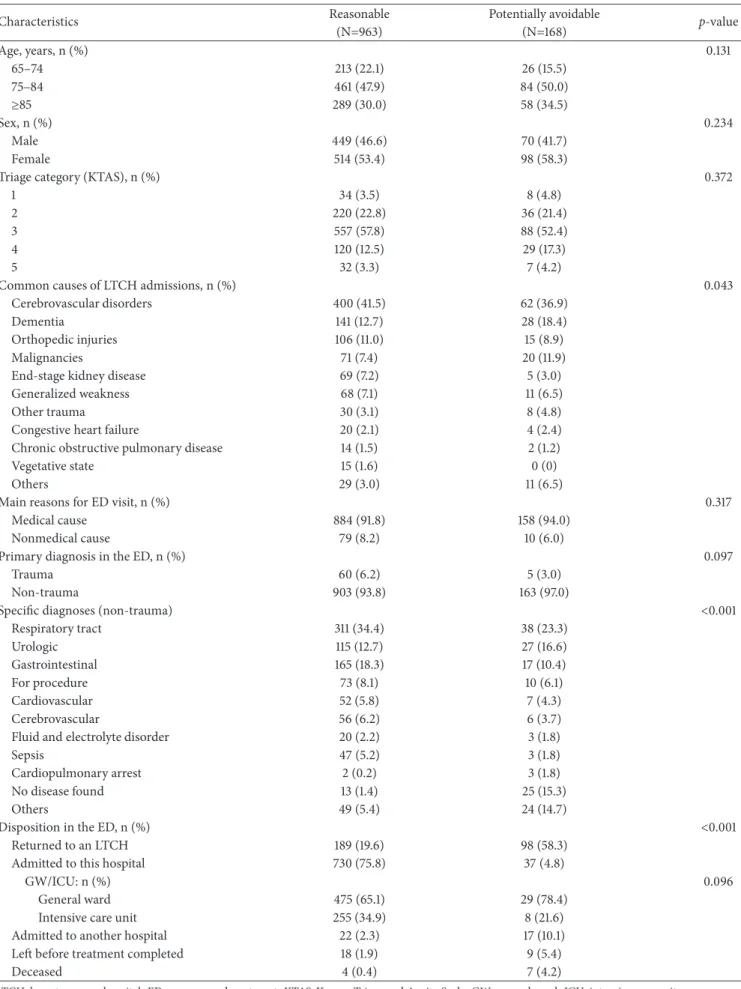
of the study population are shown in Table 1. Age, sex, triage acuity, main reasons for ED visits (medical or nonmedical), primary diagnosis in the ED (trauma or nontrauma), and frequency of admission to the general ward or intensive care unit were not statistically different between the rea-sonable and potentially avoidable transfer groups (Table 1). The reasons of LTCH patient admissions were different between the potentially avoidable and reasonable transfer groups (p=0.043). Cerebrovascular disorder and dementia were the most common causes in both groups, which were followed by orthopedic injuries, malignancies, and end-stage kidney disease in the reasonable transfer group and malignancies, orthopedic injuries, and generalized weakness in the potentially avoidable transfer group. After transferring to the ED, the primary diagnoses (nontrauma) were different between the two groups. The potentially avoidable transfer group was more frequently coded as no disease found (15.3% vs. 1.4%, p<0.001).
Table 1: General characteristics of the study population transferred from LTCHs to EDs.
Characteristics Reasonable Potentially avoidable p-value
(N=963) (N=168) Age, years, n (%) 0.131 65–74 213 (22.1) 26 (15.5) 75–84 461 (47.9) 84 (50.0) ≥85 289 (30.0) 58 (34.5) Sex, n (%) 0.234 Male 449 (46.6) 70 (41.7) Female 514 (53.4) 98 (58.3)
Triage category (KTAS), n (%) 0.372
1 34 (3.5) 8 (4.8)
2 220 (22.8) 36 (21.4)
3 557 (57.8) 88 (52.4)
4 120 (12.5) 29 (17.3)
5 32 (3.3) 7 (4.2)
Common causes of LTCH admissions, n (%) 0.043
Cerebrovascular disorders 400 (41.5) 62 (36.9)
Dementia 141 (12.7) 28 (18.4)
Orthopedic injuries 106 (11.0) 15 (8.9)
Malignancies 71 (7.4) 20 (11.9)
End-stage kidney disease 69 (7.2) 5 (3.0)
Generalized weakness 68 (7.1) 11 (6.5)
Other trauma 30 (3.1) 8 (4.8)
Congestive heart failure 20 (2.1) 4 (2.4)
Chronic obstructive pulmonary disease 14 (1.5) 2 (1.2)
Vegetative state 15 (1.6) 0 (0)
Others 29 (3.0) 11 (6.5)
Main reasons for ED visit, n (%) 0.317
Medical cause 884 (91.8) 158 (94.0)
Nonmedical cause 79 (8.2) 10 (6.0)
Primary diagnosis in the ED, n (%) 0.097
Trauma 60 (6.2) 5 (3.0)
Non-trauma 903 (93.8) 163 (97.0)
Specific diagnoses (non-trauma) <0.001
Respiratory tract 311 (34.4) 38 (23.3) Urologic 115 (12.7) 27 (16.6) Gastrointestinal 165 (18.3) 17 (10.4) For procedure 73 (8.1) 10 (6.1) Cardiovascular 52 (5.8) 7 (4.3) Cerebrovascular 56 (6.2) 6 (3.7)
Fluid and electrolyte disorder 20 (2.2) 3 (1.8)
Sepsis 47 (5.2) 3 (1.8)
Cardiopulmonary arrest 2 (0.2) 3 (1.8)
No disease found 13 (1.4) 25 (15.3)
Others 49 (5.4) 24 (14.7)
Disposition in the ED, n (%) <0.001
Returned to an LTCH 189 (19.6) 98 (58.3)
Admitted to this hospital 730 (75.8) 37 (4.8)
GW/ICU: n (%) 0.096
General ward 475 (65.1) 29 (78.4)
Intensive care unit 255 (34.9) 8 (21.6)
Admitted to another hospital 22 (2.3) 17 (10.1)
Left before treatment completed 18 (1.9) 9 (5.4)
Deceased 4 (0.4) 7 (4.2)
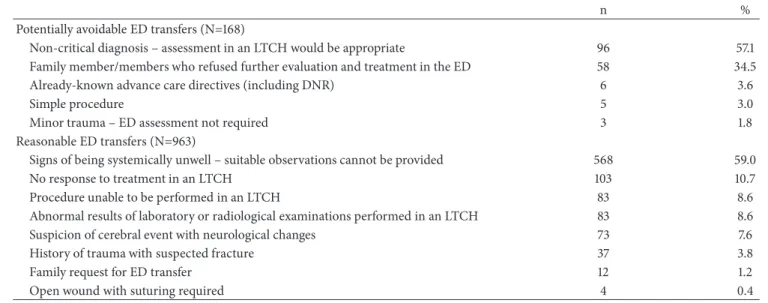
Table 2: Potentially avoidable reasons for ED transfer.
n %
Potentially avoidable ED transfers (N=168)
Non-critical diagnosis – assessment in an LTCH would be appropriate 96 57.1
Family member/members who refused further evaluation and treatment in the ED 58 34.5
Already-known advance care directives (including DNR) 6 3.6
Simple procedure 5 3.0
Minor trauma – ED assessment not required 3 1.8
Reasonable ED transfers (N=963)
Signs of being systemically unwell – suitable observations cannot be provided 568 59.0
No response to treatment in an LTCH 103 10.7
Procedure unable to be performed in an LTCH 83 8.6
Abnormal results of laboratory or radiological examinations performed in an LTCH 83 8.6
Suspicion of cerebral event with neurological changes 73 7.6
History of trauma with suspected fracture 37 3.8
Family request for ED transfer 12 1.2
Open wound with suturing required 4 0.4
ED: emergency department, LTCH: long-term care hospital, DNR: do-not-resuscitate.
Regarding their disposition in the ED, 98 (58.3%) and 189 (19.6%) patients of the potentially avoidable and reasonable transfer groups, respectively, returned to their LTCH without hospital admission (p<0.001). In contrast, the rate of patients who were admitted to university hospitals was much higher in the reasonable transfer group (75.3% vs. 4.8%, p<0.001) than in the potentially avoidable group. There was no significant difference in the percentage of admission to the general ward or intensive care unit between the 2 groups (p = 0.096).
3.2. Potentially Avoidable Reasons for ED Transfer. Of the 168
potentially avoidable transfers, the most common reasons were the following: noncritical diagnoses that could be assessed and treated in an LTCH (96/168, 57.1%), family member/members who refused further evaluation and treat-ment in the ED (58/168, 34.5%), already-known advance care directives (including DNR) (6/168, 3.6%), simple procedures that could be performed in an LTCH (5/168, 3.0%), and minor traumas not requiring ED assessment (3/168, 1.8%, Table 2). Regarding the noncritical diagnosis, there were cases of urinary tract infection (28 patients), nonspecified diagnosis (23 patients), upper respiratory infection (22 patients), gas-trointestinal problems including gastritis or enterocolitis (8 patients), cellulitis (5 patients), herpes zoster (3 patients), arthritis (2 patients), epistaxis (2 patients), conjunctivitis (2 patients), and hypoglycemia (1 patient).
3.3. Number of Patients with Do-Not-Resuscitate (DNR) Order according to the Location Where Informed Consent for DNR Was Obtained. DNR orders were found in 162 (14.3%)
patients aged 65 years and older who were transferred from an LTCH to the ED (Table 3). In the reasonable transfer group, 6 (3.7%), 20 (12.3%), and 87 (53.7%) patients signed the DNR order in the LTCH, ED, and ward or intensive care unit, respectively, whereas in the potentially avoidable transfer group, 6 (3.7%), 36 (22.2%), and 7 (4.3%) patients
Table 3: Locations where informed consent for DNR was obtained.
Location Reasonable Potentially avoidable
(n=113) (n=49)
LTCH 6 (3.7) 6 (3.7)
ED 20 (12.3) 36 (22.2)
Ward or ICU 87 (53.7) 7 (4.3)
DNR: do-not-resuscitate, LTCH: long-term care hospital, ED: emergency
department, ICU: intensive care unit.
signed the DNR order in the LTCH, ED, and ward or intensive care unit, respectively.
4. Discussion
In this study, the rate (14.9%) of transfers from an LTCH to the ED of a university hospital in patients aged 65 years and older was potentially avoidable. However, this rate is lower than that in the previous studies [12, 17, 19, 20], which reported that 31%–53% of all ED transfers from care homes are avoidable. Codde et al. [12] and Morphet et al. [19] included the transfer for simple suturing of soft tissue injury during office hours and insertion of failed urinary catheter despite repeated attempts or replacement of gastrostomy as potentially avoidable transfers, which was contrary to the results in our study. In this study, we did not categorize these reasons as potentially avoidable transfers in consideration of the LTCH situation in Korea. Therefore, the frequency of avoidable transfers in our study was significantly low compared to previous studies.
In Korea, LTCHs have difficulty in performing such procedures, including simple sutures, because of the current system in these institutions. The most frequently mentioned difficulty by LTCH personnel was that they could barely provide high-quality medical services since the fixed-sum medical fee per day payment system was implemented in
2008. A previous nationwide survey including 104 chief executive officers from LTCHs revealed problems of this fee system [21]. Another Korean study also reported that some LTCHs regularly sent patients to other hospitals and took a medicine from that hospital to reduce the medical expenses, even when patients paid their medical fee in LTCH [22]. This payment system applies the fixed cost of hospitalization per day depending on the disease and functional condition of inpatients. In this system, LTCHs are forced to minimize the number of their healthcare personnel and downgrade the management efforts and medications.
Several studies investigated the service quality and prob-lem of LTCHs. The level of medical service quality was higher in LTCHs with a lower patient: nurse ratio and a lower turnover rate of nursing personnel [23]. Low turnover was an important factor in providing quality healthcare management, which was likely due to the provision of more consistent treatments and effective communications [24, 25]. However, the mandatory number of healthcare personnel required in LTCH is lower than that in the general hospitals in Korea. For a general hospital, 1 doctor per 20 hospitalized patients and 1 nursing staff (nurse, nurse assistant) per 2.5 patients are needed, whereas for LTCHs, 1 doctor per 40 patients and 1 nursing staff per 6 patients are required. Thus, increased manpower within LTCHs could be one of the solutions to prevent potentially avoidable transfers of LTCH patients.
In this study, the most common reason for the potentially avoidable transfers was noncritical diagnoses that could be assessed and treated in an LTCH, which accounted for 96/168 (57.1%) of avoidable transfers and 96/1131 (8.5%) of the total transfers from LTCHs in patients aged 65 years and older (Table 2). These noncritical diagnoses included the following: simple urinary tract infections without fever and with stable vital signs requiring only oral antibiotic therapy, cellulitis requiring only oral antibiotics and conservative treatment with mild localized symptoms, and epistaxis requiring only an application of nasal packing. These conditions could be empirically managed by simple medication treatment without specific evaluation. Therefore, if physicians in an LTCH could manage these noncritical diseases, the number of potentially avoidable transfers might be reduced.
DNR orders were found in 162 of the 1131 patients transferred from LTCHs to the EDs, but only 12 patients signed the DNR order at the LTCH before transfer (Table 3). More patients provided informed consent for DNR order at the ED than at the LTCH. In Korea, the law ‘act on hospice and palliative care and decisions on life-sustaining treatment for patients at the end’ was implemented in August 2017 [26]. Before this law was implemented, patients usually make advance care directives including DNR in the ED after the transfer, which is consistent with the result of this study. Therefore, a clear communication about care plans is needed between the physicians and patients in LTCHs at the time of LTCH admission. Another reason of avoidable transfer was represented by the refusal to treatment by the family at ED (Table 2). This problem also could be resolved by the clear communication about advance care directives between LTCH physicians and patients or their families.
Preventing potentially avoidable transfer is related to reduced overcrowding of the ED and its adverse effects. Given that elderly patients tend to have cognitive impairment, they are at risk of falling, depression, functional decline, and sensory disturbance, and they are also prone to being prescribed with multiple medications [27, 28]. These char-acteristics complicate the evaluation and treatment of the elderly in the ED, requiring complex and lengthy clinical evaluations. Therefore, the potentially avoidable transfers of the elderly patients may be one of the causes of ED overcrowding. Furthermore, some studies have identified the effect of high occupancy and access block in the ED as causes of adverse patient outcomes, high mortality rates (20%–30%), increased risk of errors, prolonged inpatient length of stay, delayed critical care time, and hospital readmission [29, 30].
Our study has some limitations. First, a major limita-tion of this study was its retrospective design. Given that researchers retrospectively reviewed the EMR, there was an inevitable risk of bias. Second, although this was a multicenter study, only 5 EDs of the university hospitals around the metropolitan area of Korea and 75 LTCHs were analyzed. Therefore, this could not reflect the characteristics of the rural area and could have affected the generalizability of the results. Third, the opinion of an “expert panel” was subjective, and the expert panel consisted of only emergency physi-cians. Finally, this study included patients who were trans-ferred from LTCHs to EDs, but not patients from nursing homes. For these reasons, our results should be interpreted cautiously.
5. Conclusions
This study showed that the rate of potentially avoidable transfers from LTCHs to EDs of university hospitals was 14.9% in Korea. These avoidable transfers could be reduced by managing noncritical diseases and preparing advance care directives, including DNR order, during LTCH admission. Additionally, increasing the healthcare provider-patient ratio at LTCHs and off-loading some provider responsibility could be solutions at the policy and infrastructure level.
Data Availability
The data used to support the findings of this study are available from the corresponding author upon request.
Disclosure
This study is based on a master’s thesis by Dr. Keon Kim (the-sis advisor: Prof. Dong Hoon Lee) and has been presented as an abstract at “18th International Conference on Emergency Medicine 2019, Seoul, Korea.”
Conflicts of Interest
All authors declare that there are no conflicts of interest regarding the publication of this article.
Acknowledgments
This research was supported by the Chung-Ang University Research Grants in 2018. We thank all members of the Korean Society of Geriatric Emergency Medicine for their assistance in providing the data for this study.
References
[1] Population Projections and Summary indicators (Korea), “Statistics Korea,” 2018, http://kosis.kr/statHtml/statHtml. do?orgId=101&tblId=DT 1BPA003&conn path=I2.
[2] National Health Insurance Statistics, “National health
insurance corporation,” 2018, http://kosis.kr/statHtml/statHtml .do?orgId=354&tblId=DT MIRE01&conn path=I2. [3] National Health Insurance Expenditure Trends Report,
“National health insurance review and assessment service,” 2016, http://www.hira.or.kr.
[4] Welfare of older persons act, 2017.
[5] H. Song, “Long-term care hospital systems in developed coun-tries and the implications for Korea,” Journal of the Korean
Geriatrics Society, vol. 16, p. 114, 2012.
[6] E. Lee and J. C. Lee, “Problems and improvements of long-term care hospitals in aged society Asia pacific,” Journal of Health Law
and Ethics, vol. 10, no. 1, 2016.
[7] D. H. Kim, K. S. Han, J. S. Park et al., “Analysis of emergency department patients transferred from geriatric hospitals: case series descriptive study,” Journal of the Korean Society of
Emer-gency Medicine, vol. 22, no. 5, pp. 531–535, 2011.
[8] J. W. Park, H. I. Park, M. B. Shim et al., “Analysis of factors affecting length of hospital stay in geriatric patients transferred from long-term care hospitals,” Journal of the Korean Society of
Emergency Medicine, vol. 26, no. 2, pp. 165–171, 2015.
[9] M. W. Park, K. H. Park, J. Cho et al., “Characteristics of geriatric trauma patients transferred from long-term care hospitals: a propensity score matched analysis,” Journal of the Korean
Society of Emergency Medicine, vol. 25, no. 3, pp. 312–317, 2014.
[10] E. M. Ham, H. B. Kim, C. H. Pyo et al., “Analysis of epidemi-ologic characteristics between patients visited from residential aged care facilities and elderly patients visited from home admitted to the emergency department with disease,” Journal
of The Korean Society of Emergency Medicine, vol. 28, no. 1, pp.
87–96, 2017.
[11] K. W. Kim and S. N. Jang, “Who comes to the emergency room with an infection from a long-term care hospital? a retrospective study based on a medical record review,” Asian
Nursing Research, vol. 12, no. 4, pp. 293–298, 2018.
[12] J. Codde, J. Frankel, G. Arendts, and P. Babich, “Quantification of the proportion of transfers from residential aged care facilities to the emergency department that could be avoided through improved primary care services,” Australasian Journal
on Ageing, vol. 29, no. 4, pp. 167–171, 2010.
[13] J. G. Ouslander and K. Maslow, “Geriatrics and the triple aim: Defining preventable hospitalizations in the long-term care population,” Journal of the American Geriatrics Society, vol. 60, no. 12, pp. 2313–2318, 2012.
[14] J. G. Ouslander, G. Lamb, M. Perloe et al., “Potentially avoidable hospitalizations of nursing home residents: frequency, causes, and costs,” Journal of the American Geriatrics Society, vol. 58, no. 4, pp. 627–635, 2010.
[15] U. Hwang, M. N. Shah, J. H. Han, C. R. Carpenter, A. L. Siu, and J. G. Adams, “Transforming emergency care for older adults,”
Health Affairs, vol. 32, no. 12, pp. 2116–2121, 2013.
[16] J. G. Ouslander, J. F. Schnelle, and J. Han, “Is This really an emergency? reducing potentially preventable emergency department visits among nursing home residents,” Journal of the
American Medical Directors Association, vol. 16, no. 5, pp. 354–
357, 2015.
[17] R. E. Burke, S. P. Rooks, C. Levy, R. Schwartz, and A. A. Ginde, “Identifying potentially preventable emergency department visits by nursing home residents in the United States,” Journal
of the American Medical Directors Association, vol. 16, no. 5, pp.
395–399, 2015.
[18] S. Conroy, C. H. Nickel, A. B. J´onsd´ottir et al., “The development of a European curriculum in geriatric emergency medicine,”
European Geriatric Medicine, vol. 7, no. 4, pp. 315–321, 2016.
[19] J. Morphet, K. Innes, D. L. Griffiths, K. Crawford, and A. Williams, “Resident transfers from aged care facilities to emer-gency departments: can they be avoided?” Emeremer-gency Medicine
Australasia, vol. 27, no. 5, pp. 412–418, 2015.
[20] L. Carter, J. Skinner, and S. Robinson, “Patients from care homes who attend the emergency department: could they be managed differently,” Emergency Medicine Journal, vol. 26, no. 4, pp. 259– 262, 2009.
[21] Y. B. Kim, “A study on evaluation and improvement of long-term care hospitals for changing long-long-term care hospital fee system,” The Korean Journal of Health Service Management, vol. 5, no. 2, pp. 105–117, 2011.
[22] K. H. Ok, “A study on medical fee system of the convalescent hospital - focused on the case of patient group adjustment,” The
Korean Society of Law and Medicine, vol. 18, no. 2, pp. 195–218,
2017.
[23] M. Sohn and M. Choi, “Factors related to healthcare service quality in long-term care hospitals in South Korea: a mixed-methods study,” Osong Public Health and Research Perspectives, vol. 8, no. 5, pp. 332–341, 2017.
[24] J. H. Shin and T. K. Hyun, “Nurse staffing and quality of care of nursing home residents in Korea,” Journal of Nursing
Scholarship, vol. 47, no. 6, pp. 555–564, 2015.
[25] R. A. Kieft, B. B. De Brouwer, A. L. Francke, and D. M. Delnoij, “How nurses and their work environment affect patient experiences of the quality of care: a qualitative study,” BMC
Health Services Research, vol. 14, article 249, 2014.
[26] “Act on hospice and palliative care and decisions on life-sustaining treatment for patients at the end of life,” 2016. [27] F. Aminzadeh and W. B. Dalziel, “Older adults in the emergency
department: a systematic review of patterns of use, adverse out-comes, and effectiveness of interventions,” Annals of Emergency
Medicine, vol. 39, no. 3, pp. 238–247, 2002.
[28] U. Hwang and R. S. Morrison, “The geriatric emergency department,” Journal of the American Geriatrics Society, vol. 55, no. 11, pp. 1873–1876, 2007.
[29] P. C. Sprivulis, J.-A. Da Silva, I. G. Jacobs, A. R. L. Frazer, and G. A. Jelinek, “The association between hospital overcrowding and mortality among patients admitted via Western Australian emergency departments,” Medical Journal of Australia, vol. 184, no. 5, pp. 208–212, 2006.
[30] R. Forero, S. McCarthy, and K. Hillman, “Access block and emergency department overcrowding,” Critical Care, vol. 15, no. 2, article 216, 2011.
Stem Cells
International
Hindawi www.hindawi.com Volume 2018 Hindawi www.hindawi.com Volume 2018 INFLAMMATIONEndocrinology
International Journal ofHindawi www.hindawi.com Volume 2018 Hindawi www.hindawi.com Volume 2018
Disease Markers
Hindawi www.hindawi.com Volume 2018 BioMed Research InternationalOncology
Journal of Hindawi www.hindawi.com Volume 2013 Hindawi www.hindawi.com Volume 2018Oxidative Medicine and Cellular Longevity
Hindawi
www.hindawi.com Volume 2018
PPAR Research
Hindawi Publishing Corporation
http://www.hindawi.com Volume 2013 Hindawi www.hindawi.com
The Scientific
World Journal
Volume 2018 Immunology Research Hindawi www.hindawi.com Volume 2018 Journal ofObesity
Journal of Hindawi www.hindawi.com Volume 2018 Hindawi www.hindawi.com Volume 2018 Computational and Mathematical Methods in Medicine Hindawi www.hindawi.com Volume 2018Behavioural
Neurology
Ophthalmology
Journal of Hindawi www.hindawi.com Volume 2018Diabetes Research
Journal ofHindawi
www.hindawi.com Volume 2018
Hindawi
www.hindawi.com Volume 2018 Research and Treatment
AIDS
Hindawi
www.hindawi.com Volume 2018
Gastroenterology Research and Practice
Hindawi www.hindawi.com Volume 2018