저작자표시 2.0 대한민국 이용자는 아래의 조건을 따르는 경우에 한하여 자유롭게 l 이 저작물을 복제, 배포, 전송, 전시, 공연 및 방송할 수 있습니다. l 이차적 저작물을 작성할 수 있습니다. l 이 저작물을 영리 목적으로 이용할 수 있습니다. 다음과 같은 조건을 따라야 합니다: l 귀하는, 이 저작물의 재이용이나 배포의 경우, 이 저작물에 적용된 이용허락조건 을 명확하게 나타내어야 합니다. l 저작권자로부터 별도의 허가를 받으면 이러한 조건들은 적용되지 않습니다. 저작권법에 따른 이용자의 권리는 위의 내용에 의하여 영향을 받지 않습니다. 이것은 이용허락규약(Legal Code)을 이해하기 쉽게 요약한 것입니다. Disclaimer 저작자표시. 귀하는 원저작자를 표시하여야 합니다.
A Thesis for the Degree of Master of Science
Characterization of Korean sweet potato starches:
physicochemical, pasting, and digestion properties
한국산 11 품종 고구마 전분의 이화학 · 호화 및
소화 특성 연구
February, 2013
Baek, Hye Rim
Interdisciplinary Program for
Agricultural Biotechnology Graduate School Seoul National University
농학석사학위논문
Characterization of Korean sweet potato starches:
physicochemical, pasting, and digestion properties
한국산 11 품종 고구마 전분의 이화학 · 호화 및
소화 특성 연구
지도교수 문 태 화 이 논문을 석사학위 논문으로 제출함 2013년 2월 서울대학교 대학원 협동과정 농업생물공학 백 혜 림 백 혜 림의 석사학위 논문을 인준함 2013년 2월 위 원 장 유 상 렬 인 부위원장 문 태 화 인 위 원 이 기 원 인2
A Thesis for the Degree of Master of Science
Characterization of Korean sweet potato starches:
physicochemical, pasting, and digestion properties
by
Baek, Hye Rim
Advisor: Tae Wha Moon, Professor
Submitted in Partial Fulfillment of the Requirement for the Degree of Master of Science
February, 2013
Interdisciplinary Program for
Agricultural Biotechnology Graduate School Seoul National University
I
ABSTRACT
Physicochemical, pasting, and digestion properties of Korean sweet potato starches were investigated. Sweet potato starch granules were
oval, round, polygonal, spherical, and bell-shaped and of 10.2-15.3µm
in mean particle diameter. The average particle size of Jeongmi was the highest, while Daeyumi was the lowest. Amylose content of the sweet potato starches varied from 12.3 to 17.4%. Jeongmi showed the highest
values for Mw (14.6ⅹ107g/mol), whereas Daeyumi had the lowest (7.2
ⅹ107g/mol). A similar chain length distribution of amylopectin was
found in 11 sweet potato starches. The portion of B3 (DP≥37) correlated
(r=0.66, p<0.01) with the amount of leached amylose. Thermal
properties of DSC showed the high values of To, Tp, and Tc in
Shinyulmi and Jeongmi, but a relatively low value in Daeyumi. All
sweet potato starches exhibited a characteristic Ca-type diffraction
pattern. Different patterns were revealed among the swelling factors of sweet potato starches depending on temperature. The contents of rapidly digestible starch (RDS), slowly digestible starch (SDS) and resistant starch (RS) in sweet potato starches ranged from 9.6 to 17.4%,
II
31.4 to 45.6%, 35.7 to 62.8%, respectively. Shinyulmi and Happymi had the highest SDS, and Jeongmi had the highest RS. According to the Rapid visco analyzer (RVA) viscosity profiles, differences were observed in pasting parameters such as pasting temperature, peak viscosity, final viscosity and breakdown. Happymi showed the highest breakdown, and lowest final viscosity, setback, pasting time, and pasting temperature.
Keywords: sweet potato starch, digestibility, slowly digestible starch,
resistant starch, pasting properties
III
CONTENTS
Abstract ··· I Contents ··· III List of figures ··· V List of tables ··· VI Introduction ··· 1Materials and Methods ··· 4
1. Materials ··· 4
2. Methods ··· 4
2-1. Starch isolation ··· 4
2-2. Granular shape and size distribution ··· 5
2-3. Damaged starch content ··· 5
2-4. Amylose content ··· 6
2-5. Branched chain length distribution ··· 6
2-6. Determination of molecular weight distribution by high-performance size-exclusion chromatography (HPSEC) – multi-angle laser-light scattering (MALLS) –refractive index (RI) system ··· 7
2-7. X-ray diffraction patterns and relative crystallinity ··· 8
IV
2-9. Swelling factor ··· 9
2-10. Close packing and amylose leaching ··· 10
2-11. Pasting properties ··· 11
2-12. Starch digestibility ··· 11
2-13. Statistical analysis ··· 13
Results and Discussion ··· 14
1. Morphological characteristics of sweet potato starch granules ··· 14
2. Damaged starch ··· 23
3. Amylose content ··· 25
4. Branched chain length distribution of amylopectin and amylose leaching (AML) ··· 27
5. Molecular weight distributions determined by HPSEC-MALLS-RI ··· 31
6. X-ray diffraction pattern and crystallinity ··· 34
7. Thermal properties ··· 38 8. Swelling factor ··· 41 9. Digestibility ··· 47 10. Pasting properties ··· 50 Conclusion ··· 54 References ··· 56 국문초록 ··· 64
V
LIST OF FIGURES
Fig. 1. Light micrographs of sweet potato starches ··· 19
Fig. 2. Particle size distributions of sweet potato starches ··· 21
Fig. 3. X-ray diffractogram of sweet potato starch ··· 36
VI
LIST OF TABLES
Table 1. Granule size of the sweet potato starches determined by particle size
distribution ··· 22
Table 2. Damaged starch content of sweet potato starch ··· 24
Table 3. Amylose content of sweet potato starches ··· 26
Table 4. Branched chain length distributions of sweet potato starches ··· 29
Table 5. Amounts of amylose leaching (AML) and close packing concentrations (C*) of sweet potato starches ··· 30
Table 6. Molecular characteristics of sweet potato starches ··· 33
Table 7. Relative crystallinity of sweet potato starches ··· 37
Table 8. Gelatinization parameters of sweet potato starches ··· 40
Table 9. Swelling factor of sweet potato starches ··· 43
Table 10. Relative amounts of RDS, SDS, and RS in sweet potato starches ··· 49
Table 11. Pasting properties of sweet potato starches from different cultivars ··· 52
Table 12. Correlation coefficients between the physicochemical, digestion, pasting properties of sweet potato starches··· 53
1
INTRODUCTION
Sweet potato (Ipomoea batatas Lam) is one of the most important root crops in the world with more than 133 million tonnes produced worldwide annually (Waramboi et al., 2011). It is a staple food for globally millions of people and the seventh most abundant crop after wheat, rice, maize, potato, barley and cassava (Bovell-Benjamin, 2007). Furthermore, these days, its role has dramatically changed from a staple food to a health food. Sweet potato is used as powder, snack, sweet jelly, drink, starch, ethanol, food coloring, and so on (Palomar et al., 1981; Suzuki, 1978; Wanjekeche & Keya, 1995). Its starch is processed into an ingredient in bread, cakes, noodles and confectioneries. In recent years, new sweet potatoes have been developed by Bioenergy Crop Research Center, National Institute of Crop Science (NICS), Rural Development Administration (RDA) of Korean government for the purpose of producing colored sweet potato and high starch yield types.
At present time, especially colored sweet potato (orange, purple) is very popular in Korea due to its sweet taste, appearance, and flavor compared
with normal, yellow-fleshed sweet potato. Although nutritional aspects of
orange-fleshed sweet potato have been reported including β-carotene (Teow et al., 2007), physicochemical properties of its starch are rarely reported.
2
Starch has been known as the major storage polysaccharide of plants and is deposited in partially crystalline granules varying in morphology and molecular structure between and within plant species (Blazek and Copeland, 2008). Starch basically contains two types of biomacromolecules; amylose and amylopectin.
Nutritionally, starch is generally classified into rapidly digestible starch (RDS), slowly digestible starch (SDS), and resistant starch (RS) depending
on the rate of digestion (Englyst et al., 1992).It has been shown that the RDS
fraction compares well with glycemic index purported to increase the likelihood impact diabetes/pre-diabetes, cardiovascular disease indices, and
obesity (Ludwig, 2000). SDS is the starch fraction which is digested
completely, but its digestion rate is very slow compared to RDS. The physiological effects of SDS are useful in weight loss program for prolonged satiety and also helpful in diabetes. Moreover, SDS can provide a longer, more consistent source of systemic glucose (Lehmann and Robin, 2007). RS is , in general, clssasfied as dietary fiber and is fermented to produce a high level of butyrate that is beneficial to colonic health. Sajilata et al. (2006) stated that RS can prevent colonic cancer, have hypoglycemic and hypocholesterolemic effects, inhibit fat accumulation, and increase
absorption of minerals. In the present study, the 13 sweet potato cultivars
3
Thus, the variability among cultivars indicates genetic differences in sweet potato cultivars that affect physicochemical and digestion properties. Physicochemical and structural characteristics of starch vary among different
varieties of the same botanical sources (Afoakwa, 2011).
With respect to Korean sweet potato, detailed studies on the physicochemical properties of either the starch or flour are conspicuously scarce. Moreover, there is a lack of adequate information on relationship between starch digestibility and its structural properties among different Korean sweet potato cultivars. Therefore, the aims of this study were to characterize the physicochemical, pasting, and digestion properties of sweet potato starches from 11 Korean cultivars in addition to Japanese Gold sweet potato and Pumpkin sweet potato; and to analyze the correlations among and between these properties.
4
MATERIALS AND METHODS
1. Materials
Korean native sweet potato cultivars, Gunmi, Gunpungmi, Daeyumi, Matnami, Borami, Shinyulmi, Jeonmi, Jeongmi, Hayanmi, Happymi, Heathymi, Pumpkin sweet potato, and Gold sweet potato were obtained from Mokpo Experiment Station, National Institute of Crop Science, Rural Development Administration of Korean government in Korea. Pancreatin (P-7545, activity 8×USP/g) was purchased from Sigma Chemical (St. Louis, MO, USA), amyloglucosidase (AMG 300L, activity 300 AGU/mL) from Novozymes (Bagsvaerd, Denmark), and isoamylase from Megazyme (Bray, Ireland).
2. Methods
2-1. Starch isolation
Sweet potatoes were washed and peeled. Immediately after peeling, they were sliced into 0.2mm thick pieces using a food slicer (Sungkwang Metal Co. Ltd., Seoul, Korea). Then, the sweet potatoes were soaked in distilled water and ground into small pieces using a blender (CR-481W, Samsung,
5
Seoul, Korea). The pieces were passed through 100-mesh sieves, and the suspension was collected in a plastic container. After a solid layer of starch settled down, the supernatant was decanted, and the starch layer was dissolved in distilled water. This process was repeated until the supernatant became transparent. Finally, the suspended solution was centrifuged at 6,000 ×g for 15min. Then, the starch was dried at 40℃ in a drying oven and passed though a 100-mesh sieve.
2-2. Granular shape and size distribution
The granule morphology of sweet potato starches were observed using a CSB-HP3 light microscope (Samwon Scientific, Seoul, Korea) equipped with a polarizer. A small amount of starch was dispersed well in glycerol to prevent the movement of starch granules, and mounted onto a microscope slide with a cover slip. Images were captured using a digital camera (E8400, Nikon, Tokyo, Japan) and transferred to a computer. The particle size
distribution of sweet potato starches was investigated using an AccusizerTM
780 particle sizing & counting analyzer (Particle Sizing Systems, Port Richey, FL, USA)
6
Damaged starch contents of the isolated sweet potato starches were analyzed with a starch damage assay kit (Megazyme International Ireland Ltd.).
2-4. Amylose content
Absolute amylose contents of the sweet potato starches were determined
with an amylose/amylopectin assay kit (Megazyme International Ireland Ltd.) based on the concanavalin A method (Gibson et al., 1997).
2-5. Branched chain length distribution
The amylopectin branched chain length distribution of starch sample was investigated after debranching the starch with isoamylase. Starch (15 mg) was dispersed in 90% DMSO (3 mL) and boiled for 15 min. To precipitate the starch, ethanol (15 mL) was added to starch suspension. The suspension was centrifuged at 10,000 ×g for 10 min twice. Distilled water (1.5 mL) was added to the precipitated starch and boiled for 10 min. After that, 1.5 mL of 50 mM sodium acetate buffer (pH 4.3) and 30 µL of isoamylase (Megazyme), which specifically hydrolyzes α-1,6-glycosidic linkages, were added to the suspension. The mixture was incubated in a water bath at 45°C and 50 rpm for 2 hr. After the reaction, samples were boiled for 10 min to stop enzyme reaction. Debranched samples were filtered through a 0.45-µm membrane
7
filter and analyzed using high-performance size-exclusion chromatography on a Carbo-pack PA1 anion exchange column (250 × 4 mm; Dionex, Sunnyvale, CA, USA) with a pulsed amperometric detector (Dionex). After equilibrating the column with 150 mM NaOH, the sample was eluted with various gradients of 600 mM sodium acetate in 150 mM NaOH at a flow rate of 1 mL/min. The gradients of sodium acetate used were as follows: linear gradients from 0 to 20% for 0 to 5 min, from 20 to 45% for 6 to 30 min, from 46% to 55% for 31 to 60 min, from 56 to 60% for 61 to 80 min, from 61 to 65% for 81 to 90 min, from 66 to 80% for 91 to 95 min, and from 81 to 100% for 96 to 100 min. The values of the degree of polymerization (DP) from 1 to 7 were designated using a mixture of maltooligosaccharides (DP 1-7, Sigma Chemical).
2-6. Determination of molecular weight distribution by high-performance size-exclusion chromatography (HPSEC) – multi-angle laser-light scattering (MALLS) –refractive index (RI) system
Molecular masses of sweet potato starches were determined using HPSEC-MALLS-RI system. Starch (25 mg) was dispersed in 90% DMSO (5mL) and boiled for 15 min. The solution was mixed with ethanol (25mL) to precipitate starch and centrifuged at 10,000×g for 10 min. For washing, the pellet was dispersed in ethanol (30mL) again, and then centrifuged at
8
10,000×g for 10 min. This procedure was repeated three times. Then, the
sample was dried completely by cold wind using a drier. Afterwards, 100
mM NaNO3 (5mL) containing 0.02% NaN3 was added to the pellet, and
boiled for 15 min. This solution was autoclaved for 15 min and subsequently filtered through a 5.0 µm filter (Millipore) and injected into a HPSEC-MALLS-RI system.
The HPSEC-MALLS-RI system consisted of a model PU-2080 Plus (Jasco, Tokyo, Japan) with a 200 µL injector loop, a degasser (NO-OX Vacuum Station, Alltech, Deerfield, IL, USA), a differential refractive index detector (Opti-Lab, Wyatt Technology, Santa Barbara, CA, USA), and Shodex OH-Pak 804 and 806 columns (Showa Denko, Tokyo, Japan). Aqueous 100 mM
NaNO3 solution containing 0.02% NaN3 was used as the mobile phase, and it
was filtered through 0.22 µm filters (Millipore) and degassed before use. The flow rate was 0.4 mL/min and the experimental data collected from the DAWN DSP/OptiLab system were processed with ASTRA software (Version 4.09.07., Wyatt Technology).
2-7. X-ray diffraction patterns and relative crystallinity
X-ray diffraction analysis was performed using a powder X-ray diffractometer (Model New D8 advance, Bruker, Karlsruhe, Germany) analyzing at 40 kV and 40 mA. Starch sample scan was performed through
9
2θ range from 3° to 30° with a 0.02°step size and a count time of 2 sec. The area was calculated using the software developed by the instrument manufacturer (EVA, 2.0). The crystallinity was determined using the equation below.
Relative crystallinity (%) =
100
2-8. Measurement of thermal properties
The thermal properties of sweet potato starches were determined using a differential scanning calorimeter (Diamond DSC, Perking-Elmer Inc., Waltham, MA, USA). Starch (10 mg) was weighed in a hermetic aluminum pan (Seiko, Tokyo, Japan), and 40 µL of distilled water was added. The sample pans were sealed and kept at room temperature overnight for equilibrium. DSC scan was made as the sample was heated from 30 to 130°C at a scan rate of 5°C/min. As a reference, an empty pan was used.
2-9. Swelling factor
Swelling factor of starch was determined according to the method of Tester and Morrison (1990). Starch (100 mg) was suspended in 5 mL of distilled water and incubated in a water bath at 50, 60, 70, and 80°C for 30 min. After cooling the sample on ice, 0.5 mL of blue dextran solution (5
10
mg/mL) was added. The solution was centrifuged at 3,000 ×g for 15 min, and the absorbance of the supernatant was measured at 620 nm. Swelling factor (SF) was calculated as follows:
S R S A A A w SF =1+7,700× − w : sample weight (mg)
As : absorbance of the supernatant
AR : absorbance of reference (without starch)
2-10. Close packing and amylose leaching
Close packing (C*) and amylose leaching were determined by the method of Eerlingen (2007) with slight modification. Starch suspension (0.25% dry matter) was heated for 15 min in a water bath at 80°C. After cooling on ice for 5 min, the starch sample was centrifuged at 2,400 ⅹg for 15 min. The supernatant was transferred to other tube with a pipette for the measurement of amylose content (Gilber and Spragg 1964). The sediment was weighed and close packing concentration (C*) was calculated as follows:
eight sediment w 100 matter) (dry ght starch wei (%) * = × C
11
For the determination of amylose content, supernatant (1.0 mL) was taken into a 50.0 mL tube. After adding 0.1 M NaOH (0.5 mL), the sample was boiled for 3 min and immediately cooled on ice. Following neutralization with 0.1 M HCl (0.5 mL), 20.0 mL of potassium hydrogen tartrate solution (5.0 g/L) and distilled water (27.5 mL) were added. Then, 0.5 mL of an
iodine solution (200.0 mg I2 and 2.0 g KI/100 mL) was added. After
thorough mixing, the solution was placed at room temperature for 20 min. The absorbance of the solutions was measured at 680 nm. Pure potato amylose was used for the calibration curve.
2-11. Pasting properties
Pasting properties of starch suspensions were measured with a Rapid Visco Analyzer (RVA-4, Newport Scientific Pty, Ltd., Warriewood, Australia). Each potato starch (2g) was added to 25mL of distilled water. The starch suspension was equilibrated at 50°C for 1 min, heated from 50 to 95°C at a rate of 12°C/min, held at 95°C for 2.5 min, cooled to 50°C at the same rate, and held at 50°C for 2 min. The paddle speed was 960 rpm for the first 10 sec, then 160 rpm for the remainder of the experiment.
2-12. Starch digestibility
12
and Thompson (2001) with slight modification. To prepare enzyme solution, pancreatin (2g) was dissolved in 24 mL of distilled water and stirred for 10 min. It was centrifuged at 1,500 ×g for 10 min, and 20 mL of the supernatant was transferred into a beaker containing 3.6 mL of distilled water and 0.4 mL of amyloglucosidase. The enzyme solution was stored in a shaking incubator at 37°C for at least 10 min prior to use.
Each starch sample (30 mg) was weighed and placed in a 2 mL-microtube with a glass bead. After adding 0.75 mL of sodium acetate buffer (pH 5.2), the tube was stored in a shaking incubator at 37°C for 10 min. After storage, prepared enzyme solution (0.75 mL) was added to each tube and all samples were incubated in a shaking incubator with a shaking speed of 240 rpm at 37°C. The reaction was stopped at 10 min and 240 min by boiling for at least 10 min. The hydrolyzed glucose content in the supernatant obtained after centrifugation (5,000 ×g, 5 min) was measured using a GOP-POD kit (BCS Corp., Anyang, Korea).
Starch fractions were classified based on the rate of hydrolysis. Rapidly digestible starch (RDS) fraction was measured by the value of glucose after enzyme reaction for 10 min. Slowly digestible starch (SDS) fraction was defined as the amount digested between 10 min and 240 min of hydrolysis. The undigested fraction after 240 min was determined as resistant starch (RS) fraction.
13 2-13. Statistical analysis
Experiments were performed in triplicate, and mean values and standard deviations were reported except X-ray diffraction. Analysis of variance (ANOVA) was conducted and the mean separations done by the Duncan’s multiple range text (p<0.05). All the statistical analyses described above were conducted using SPSS for Windows 12.0 software (SPSS Inc., Chicago, IL, USA). Pearson correlation coefficients (r) for the relationships between various starch properties were calculated.
14
RESULTS AND DISCUSSION
1. Morphological characteristics of sweet potato starch granules
The granular structure of sweet potato starch was studied using polarized light microscopy (Fig. 1). Under polarized light, the retention of granule crystallinity was observed by birefringence (Maltese cross). The birefringence of starch under polarized light indicates a radial orientation of the crystallites composed of polymer chains, such as amylose and amylopectin (Gallant et al., 1997).
Starch granules from different botanical origins differ in morphology (Hoover, 2001). Especially, granules of tuber and root starches are oval, although round, spherical, polygonal, and irregular shaped granules also exist (Hoover, 2001). Light microscopy exhibited that all of the sweet potato starches had oval, round, spherical, polygonal, irregular, and bell-shaped granules and there was few pore on the surface of starch granules. Although various shapes of granules were observed in each sample, there were no clear
differences in the granules from 13 types of sweet potato starches. Though
some damaged granules, possibly from starch isolation, were observed, most granules were intact, with no obvious surface pores.
15
maize but are smaller than that of potato (Dreher and Berry, 1983). Particle size, including size distribution, is one of the characteristics that most markedly affect the functional properties of starch granules (Rasper, 1971). Starch composition, gelatinization and pasting properties, enzyme susceptibility, crystallinity, swelling, and solubility are all affected by granule size. According to Goering and Dehhas (1972), smaller granules have higher solubility and water absorption capacity than relatively large granules. Also, the smaller the particle size, the more digested was starch, presumably due to an increase in relative surface area (Mahasukhonthachat
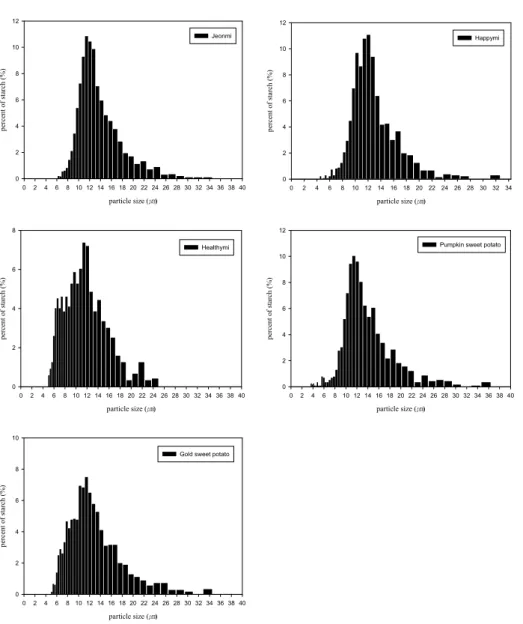
et al., 2010). Fig. 2 illustrates the size distributions of the native starch
granules from different sweet potato cultivars. The sweet potato starches of different cultivars consisted of mixed populations of small and medium granules with a diameter range of 3.7-37.5 µm. Pumpkin sweet potato starch showed the widest granule distribution (3.7-35.5 µm), while Healthymi showed the narrowest range (5.1-22.4 µm). Sweet potato starch granules displayed average size from 10.2 to 15.3 µm. Among them, Jeongmi starch had the largest average granule diameter, followed by Gunmi starch. On the other hand, Borami had the smallest average granule diameter.
The variation in shape and size of starch granules may be due to the biological origin (Svegmark and Hermansson, 1993). The morphology of starch granules depends on the biochemistry of the amyloplast or chloroplast
16
a-1) Gun b-1) Gun c-1) Dae d-1) Ma e-1) Bor nmi (ⅹ40) npungmi (ⅹ eyumi (ⅹ40 atnami (ⅹ40 rami (ⅹ40) 40) ) ) 17 a-2) b-2 c-2) d-2) e-2 ) Gunmi (ⅹ 2) Gunpungm ) Daeyumi ( ) Matnami ( 2) Borami (ⅹ 40, polarized mi (ⅹ40, pol ⅹ40, polariz ⅹ40, polariz ⅹ40, polarize d) arized) zed) zed) ed)
f-1) Shin g-1) Jeo h-1) Jeo i-1) Hay j-1) Hap nyulmi (ⅹ40 nmi (ⅹ40) ngmi (ⅹ40) yanmi (ⅹ40) ppymi (ⅹ40) 0) ) ) ) 18 f-2 g-2 h-2 i-2 j-2 2) Shinyulmi 2) Jeonmi (ⅹ 2) Jeongmi ( ) Hayanmi ( 2) Happymi ( (ⅹ40, polar ⅹ40, polarize ⅹ40, polariz ⅹ40, polariz (ⅹ40, polari rized) ed) zed) zed) zed)
k-1) Hea l-1) Pum m-1) Go Fig. 1. L althymi (ⅹ4 mpkin sweet p
old sweet pot
Light micro 40) potato (ⅹ40 tato (ⅹ40) ographs of s 19 k-2) 0) l-2) P m-2) weet potato Healthymi ( Pumpkin swe Gold sweet o starches ⅹ40, polariz eet potato (ⅹ potato (ⅹ40 zed) ⅹ40, polarize 0, polarized) ed)
20 particle size (㎛) 0 2 4 6 8 10 12 14 16 18 20 22 24 26 28 30 32 34 36 per cent of s ta rch ( % ) 0 2 4 6 8 10 Gunmi particle size (㎛) 0 2 4 6 8 10 12 14 16 18 20 22 24 26 28 30 32 34 36 38 40 per cent of s ta rch ( % ) 0 2 4 6 8 10 Gunpungmi particle size (㎛) 0 2 4 6 8 10 12 14 16 18 20 22 24 26 28 30 32 34 36 38 40 per ce nt of star ch (% ) 0 2 4 6 8 10 Daeyumi particle size (㎛) 0 2 4 6 8 10 12 14 16 18 20 22 24 26 28 30 32 34 36 38 40 pe rc en t of s tar ch (% ) 0 2 4 6 8 10 Matnami particle size (㎛) 0 2 4 6 8 10 12 14 16 18 20 22 24 26 28 30 32 34 36 38 40 per ce nt of star ch (% ) 0 2 4 6 8 10 Borami particle size (㎛) 0 2 4 6 8 10 12 14 16 18 20 22 24 26 28 30 32 34 36 38 40 pe rc en t o f s tar ch (% ) 0 2 4 6 8 10 Shinyulmi particle size (㎛) 0 2 4 6 8 10 12 14 16 18 20 22 24 26 28 30 32 34 36 38 40 per ce nt of star ch (% ) 0 2 4 6 8 10 12 Jeonmi particle size (㎛) 0 2 4 6 8 10 12 14 16 18 20 22 24 26 28 30 32 34 36 38 40 pe rc en t o f s tar ch (% ) 0 2 4 6 8 10 12 Jeongmi
21 particle size (㎛) 0 2 4 6 8 10 12 14 16 18 20 22 24 26 28 30 32 34 36 38 40 pe rce nt of s ta rch (% ) 0 2 4 6 8 10 12 Jeonmi particle size (㎛) 0 2 4 6 8 10 12 14 16 18 20 22 24 26 28 30 32 34 pe rc en t o f s tar ch (% ) 0 2 4 6 8 10 12 Happymi particle size (㎛) 0 2 4 6 8 10 12 14 16 18 20 22 24 26 28 30 32 34 36 38 40 pe rc en t o f s tar ch (% ) 0 2 4 6 8 Healthymi particle size (㎛) 0 2 4 6 8 10 12 14 16 18 20 22 24 26 28 30 32 34 36 38 40 pe rc en t o f s tar ch (% ) 0 2 4 6 8 10 12
Pumpkin sweet potato
particle size (㎛) 0 2 4 6 8 10 12 14 16 18 20 22 24 26 28 30 32 34 36 38 40 pe rc en t o f s tar ch (% ) 0 2 4 6 8 10
Gold sweet potato
22
Ta
ble 1. Granule size of the sweet po
tato s
tar
ches determ
ined by particle size distribution
Sam ples Size rang e ( µ m ) Mean diam eter ( µ m ) Mode ( µ m ) A verage size ( µ m) Gun m i 6.3 – 33.7 20.0 15.0 15.1 b Gunpungm i 3.7 – 31.9 17.8 1 1.4 12.7 cd Daeyum i 3.7 – 31.9 17.8 10.3 10.3 e Matnam i 3.7 – 31.9 17.8 10.3 10.5 e Boram i 4.1 – 31.9 18.9 10.3 10.2 e Shinyulm i 6.3 – 35.5 20.9 10.8 13.1 c Jeonm i 6.3 – 33.7 20.0 1 1.4 13.1 c Jeongm i 8.3 – 37.5 22.9 12.1 15.3 a Hayan m i 5.4 – 35.5 20.5 12.1 13.4 c Happym i 4.6 – 31.9 18.2 12.1 12.3 cd Healthym i 5.1 – 24.4 14.7 11.4 10.8 e Pum
pkin sweet potato
3.7
– 35.5
19.6 11.4
13.0
c
Gold sweet potato
5.1
– 33.7
19.3 11.4
11.7
23 2. Damaged starch
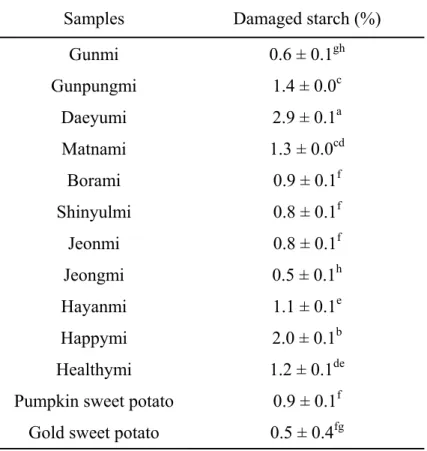
The content of damaged starch is an important quality index parameter in starchy food products. Excessive starch damage is detrimental, because it results in undesirable rheological-functional properties and unacceptable food (Evers and Stevens, 1985). Furthermore, damaged starch granules imbibe more water and are more susceptible to amylolysis. Granular integrity of starch can be affected by the mechanical action of the starch isolation process thus producing what is called damaged starch (Hoseney, 1994). Table 2 presents the contents of damaged starch of sweet potato starches. The damaged starch content of sweet potato starches was in the range of 0.5 to 2.9%. Although each sweet potato starch was produced by going through the isolation process, damaged starch content was rather small amount.
24
Table 2. Damaged starch content of sweet potato starches
Samples Damaged starch (%)
Gunmi 0.6 ± 0.1gh Gunpungmi 1.4 ± 0.0c Daeyumi 2.9 ± 0.1a Matnami 1.3 ± 0.0cd Borami 0.9 ± 0.1f Shinyulmi 0.8 ± 0.1f Jeonmi 0.8 ± 0.1f Jeongmi 0.5 ± 0.1h Hayanmi 1.1 ± 0.1e Happymi 2.0 ± 0.1b Healthymi 1.2 ± 0.1de
Pumpkin sweet potato 0.9 ± 0.1f
25 3. Amylose content
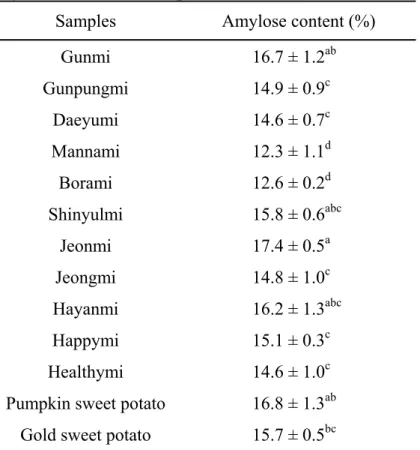
The amylose content of starch affects gelatinization and retrogradation properties, swelling power, and enzymatic susceptibility of starches (Gérard et al., 2001; Lindeboom et al., 2004). Therefore, it is important that the amylose content be quantified for food processing and product quality. There are some differences in the amylose content reported by different authors, which are related to the different analytical methods used and the age and variety of the plants. According to Shen and Sterling (1981), sweet potato starch has an amylose content of 13.4-22.5% depending on the variety, whereas values from 20 to 30% of amylose were reported by Waramboi et al. (2011). Starches that contain amylopectin with long branch chains cause overestimation of the amylose content when it is determined by the blue value method, because long chains of amylopectin also can form a helical complex with iodine. Therefore, absolute amylose contents of most of the starches studied were lower than their apparent amylose contents (Jane et al., 1999). In this study, the absolute amylose content of sweet potato starches ranged from 12.3 to 17.4%. Although there were no significant differences between amylose content of sweet potato starches, Jeonmi and Matnami showed the highest (17.4%) and lowest (12.3%) amylose content respectively.
26
Table 3. Amylose content of sweet potato starches
Samples Amylose content (%)
Gunmi 16.7 ± 1.2ab Gunpungmi 14.9 ± 0.9c Daeyumi 14.6 ± 0.7c Mannami 12.3 ± 1.1d Borami 12.6 ± 0.2d Shinyulmi 15.8 ± 0.6abc Jeonmi 17.4 ± 0.5a Jeongmi 14.8 ± 1.0c Hayanmi 16.2 ± 1.3abc Happymi 15.1 ± 0.3c Healthymi 14.6 ± 1.0c
Pumpkin sweet potato 16.8 ± 1.3ab
27
4. Branched chain length distribution of amylopectin and amylose leaching (AML)
One of the important properties of starch is its ability to swell and leach soluble materials while heated above its gelatinization temperature and this determines its specific functional property when utilized in food products (Noranizan et al., 2010). Starch swelling is viewed as a property of amylopectin (Gomand et al., 2010).
Table 4 represents the relative percent of total peak area with degree of polymerization (DP). Branch chain length distributions of all samples totally
debranched by isoamylase were analyzed using HPASEC-PAD.Chain-length
distributions were divided into four fractions as follows; A, B1, B2, and B3
chains have the chain length of DP 6-12, 13-24, 25-26, and ≥37, respectively (Hanashiro et al., 1996).
At low temperatures, mainly amylose leaching occurs, while molecules of higher molecular weight leach at increasing heating temperatures (Eliasson and Gudmundsson, 1996; Tester and Morrison, 1990). Low values for amylose leaching (AML) indicate that only a fraction of amylose leaches out (Zobel, 1988).
In this study, the portion of B3 (DP≥37) correlated (r=0.66, p<0.01) with the
amount of leached amylose. Gunmi and Hayanmi had a large portion of B3
28
samples (6.5, and 6.2%, respectively). It was possibly due to the reason that amylopectin might be resistant to leaching when it had a high portion of long branch chain, and thus amylose could be relatively leached well.
The close packing concentration (C*) is the concentration where the swollen granules fill up the available space in the starch suspension. C* is an important parameter to understand starch behavior in applications and depends on temperature (Gomand et al., 2010).
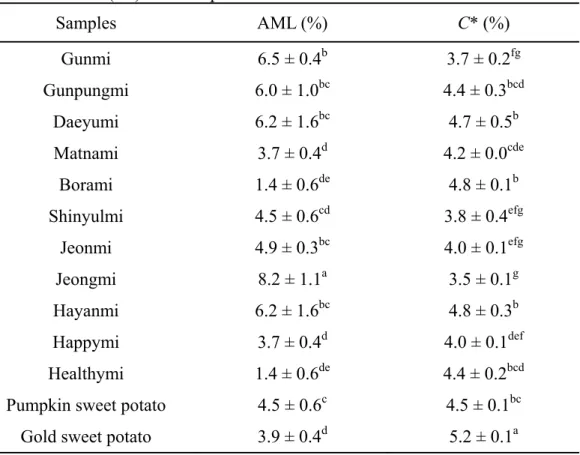
Table 5 presents AML and C*of sweet potato starches. AML varied
between 1.4 and 8.3 % in the sweet potato starches. Among them, AML of
29
Ta
ble 4. Branched chain length dist
ributions of sweet potato starch es Sa m ples Percent distribution (%) DP 6-12 DP 13-24 DP 25-36 DP ≥37 Gunm i 39.3 ± 0.3 ef 36.9 ± 0.6 e 10.1 ± 0.6 a 4.1 ± 0.1 a Gunpungm i 41.8 ± 1.0 b 37.8 ± 0.1 d 10.0 ± 0.2 a 3.5 ± 0.2 b Daeyum i 41.5 ± 0.5 bc 37.8 ± 0.1 d 9.2 ± 0.2 d 3.5 ± 0.2 b Matnam i 41.5 ± 0.2 bc 39.1 ± 0.2 b 9.4 ± 0.1 cd 2.9 ± 0.1 cd Boram i 40.1 ± 0.6 de 40.0 ± 0.4 a 9.6 ± 0.1 bc 3.0 ± 0.3 c Shinyulm i 44.7 ± 0.3 a 35.9 ± 0.2 f 7.0 ± 0.2 f 2.9 ± 0.2 cd Jeonm i 40.5 ± 0.5 d 39.0 ± 0.1 b 9.9 ± 0.1 ab 3.6 ± 0.1 b Jeongm i 39.9 ± 0.3 de 40.4 ± 0.2 a 10.1 ± 0.2 a 3.8 ± 0.1 b Hayanm i 38.8 ± 0.1 f 39.0 ± 0.2 b 10.1 ± 0.2 a 4.1 ± 0.1 a Happym i 40.4 ± 0.2 d 40.1 ± 0.1 a 9.1 ± 0.2 d 2.3 ± 0.2 e Healthym i 40.3 ± 0.6 d 40.2 ± 0.2 a 8.5 ± 0.1 e 2.7 ± 0.2 d Pum
pkin sweet potato
42.2 ± 0.2 b 37.5 ± 0.2 d 9.6 ± 0.1 bc 3.5 ± 0.2 b
Gold sweet potato
40.8 ± 0.7 cd 38.4 ± 0.1 c 10.2 ± 0.3 a 3.8 ± 0.3 b
30
Table 5. Amounts of amylose leaching (AML) and close packing concentrations (C*) of sweet potato starches
Samples AML (%) C* (%) Gunmi 6.5 ± 0.4b 3.7 ± 0.2fg Gunpungmi 6.0 ± 1.0bc 4.4 ± 0.3bcd Daeyumi 6.2 ± 1.6bc 4.7 ± 0.5b Matnami 3.7 ± 0.4d 4.2 ± 0.0cde Borami 1.4 ± 0.6de 4.8 ± 0.1b Shinyulmi 4.5 ± 0.6cd 3.8 ± 0.4efg Jeonmi 4.9 ± 0.3bc 4.0 ± 0.1efg Jeongmi 8.2 ± 1.1a 3.5 ± 0.1g Hayanmi 6.2 ± 1.6bc 4.8 ± 0.3b Happymi 3.7 ± 0.4d 4.0 ± 0.1def Healthymi 1.4 ± 0.6de 4.4 ± 0.2bcd
Pumpkin sweet potato 4.5 ± 0.6c 4.5 ± 0.1bc
31
5. Molecular weight distributions determined by HPSEC-MALLS-RI
Molecular characteristics of sweet potato starches were analyzed using absolute weight-average molecular weight and z-average radius of gyration (Rg). The structural data obtained by HPSEC-MALLS-RI system using DMSO as a dissolution solvent are shown in Table 6. Significant differences were observed in molecular weight of amylopectin among sweet potato starches. In this study, the number average molecular weight (Mn) and the weight average molecular weight (Mw) of sweet potato starches correlated with RS content (r=0.415, 0.577, p<0.01, respectively). Jeongmi had high
Mw (14.6ⅹ107g/mol) and RS (62.8%) content, while Daeyumi had the
lowest value of Mw (7.2ⅹ107g/mol) and RS (42.4%) among Korean sweet
poato starches.
Jeongmi with the highest value of Mw of amylopectin showed a high Rg (223.4 nm), and Borami having the greatest Rg (291.6 nm) displayed a rather
high Mw (13.3ⅹ107g/mol). Similar realationship between Mw of
amylpectin and Rg has been reported earlier for pigeon pea and barely starches (Sandhu and Lim, 2008; You and Izydorczyk, 2002).
Interestingly, there was a negative correlation (r=-0.498, p<0.01) between Rg and amylose leaching. As Rg value indicates the volume occupied by the molecule in a solution, the branched chain-length and branching pattern of
32
the amylopectin molecule are expected to affect the Rg in the solution (Yoo and Jane, 2002). Patindol et al. (2007) suggested that smaller Rg of amylopectin might be less capable of interacting with each other and amylose. Therefore, amylose could less likely leach out when amylopectin had a high Rg.
In general, polydispersity values (Mw/Mn) of sweet potato starches had the range from 1.2 to 1.8 except for Borami. Polydispersity of Borami was
higher than 2, and it might be caused by other materials except starch.Lower
polydispersity implies a more homogenous distribution of amylopectin molecules, while higher value means a more heterogenous distribution of amylopectin (Patindol et al., 2007).
33
Ta
ble 6. Mo
lecular characteris
tics of
sweet potato starch
es Sa m ples Mn ( ⅹ 10 7 g/mol) Mw (ⅹ 10 7 g/ mol ) Rg (T sakama et al.) Polydispersity (Mw/Mn) Gunm i 6.6 ± 0.7 cde 9.4 ± 0.8 de fg 206.7 ± 10.1 cd 1.4 ± 0.1 de Gunpungm i 5.5 ± 0.3 e 8.0 ± 0.8 fg 192.8 ± 8.1 de 1.5 ± 0.1 cd e Daeyum i 5.7 ± 1.0 e 7.2 ± 1.8 g 169.5 ± 12.4 e 1.2 ± 0.1 e Matnam i 7.8 ± 0.4 bc d 12.6 ± 0.4 ab c 236.2 ± 4.5 bc 1.6 ± 0.1 bc d Boram i 6.3 ± 1.1 de 13.3 ± 0.1 ab 291.6 ± 27.3 a 2.1 ± 0.1 a Shinyulm i 8.1 ± 1.3 abc 10.8 ± 2.5 bc d 214.3 ± 27.1 bc d 1.3 ± 0.2 de Jeonm i 9.6 ± 1.1 a 13.1 ± 1.5 ab c 221.1 ± 9.2 bc d 1.4 ± 0.0 de Jeongm i 8.1 ± 1.0 abc 14.6 ± 1.6 a 223.4 ± 16.6 bc d 1.8 ± 0.4 b Hayanm i 5.6 ± 0.3 e 9.9 ± 1.4 de f 213.3 ± 12.3 bc d 1.8 ± 0.2 bc Happym i 7.3 ± 0.2 bc d 10.7 ± 1.3 cd e 205.0 ± 24.5 cd 1.5 ± 0.2 cd e Healthym i 8.6 ± 0.9 ab 13.9 ± 1.6 a 233.3 ± 27.9 bc 1.6 ± 0.1 bc d Pum
pkin sweet potato
8.5 ± 0.9 ab 12.9 ± 0.2 ab c 241.4 ± 27.9 b 1.5 ± 0.2 cd e
Gold sweet potato
5.3 ± 0.9 e 8.3 ± 0.5 ef g 218.5 ± 7.7 bc d 1.6 ± 0.2 bc d
34
6. X-ray diffraction pattern and crystallinity
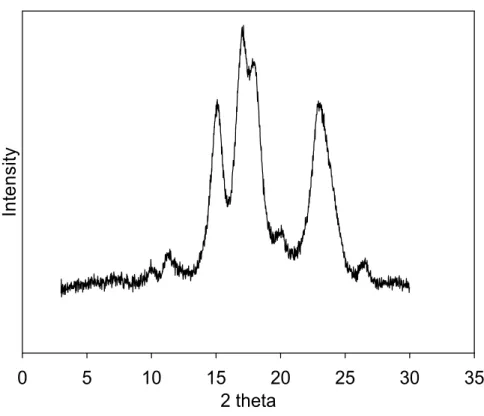
The crystalline nature of a starch granule can be defined by the position of the X-ray diffraction peaks (Zobel, 2006). Hizukuri (1969) demonstrated that mixtures of A- and B- type starches produced an intermediate pattern, C-type. As expected, all sweet potato starches exhibited C-type diffraction pattern with three distinct intensities; 17.2°, 18.1° and 23.1° 2θ angles (Fig. 3). Not only Korean sweet potato cultivars but also Gold sweet potato and Pumpkin sweet potato starches showed the same X-ray diffraction. Hizukuri,
subclassified C-type as Ca-, Cb-, and Cc-type on the basis of their
resemblance to either A-type, B-type, or a type between A and B, respectively. A type pattern displays main peaks at 2θ = 15.0°, 17.0°, 17.9°, and 23° (Hanashiro et al., 1996). According to this, all sweet potato starches
used in the current study were of Ca type. Despite the similarity in X-ray
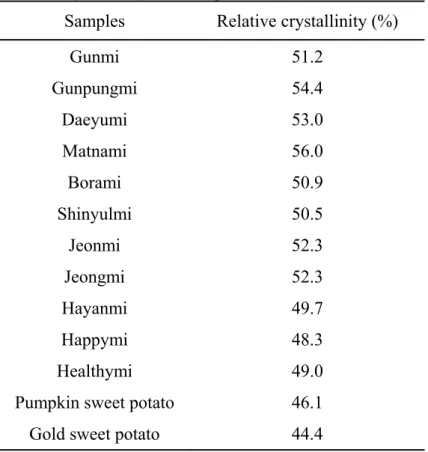
diffraction pattern, significant differences were observed in the relative crystallinity among sweet potato starches. The degree of relative crystallinity of Matnami was estimated to be 56.0% compared with 44.4% for Gold sweet potato starch.
Abdel-Aal et al. (2002) reported that relative crystallinity of starch could be influenced by amylopectin content. However, there were no significant differences between amylose contents of sweet potato starches, and relative
35
36 2 theta 0 5 10 15 20 25 30 35 In tensi ty
Fig. 3. X-ray diffractogram of sweet potato starch; Gunmi It represents X-ray diffractograms of all sweet potato starches.
37
Table 7. Relative crystallinity of sweet potato starches
Samples Relative crystallinity (%)
Gunmi 51.2 Gunpungmi 54.4 Daeyumi 53.0 Matnami 56.0 Borami 50.9 Shinyulmi 50.5 Jeonmi 52.3 Jeongmi 52.3 Hayanmi 49.7 Happymi 48.3 Healthymi 49.0
Pumpkin sweet potato 46.1
38 7. Thermal properties
DSC was used to study starch gelatinization which involves disruption of the native structure of starch granules. Gelatinization is the loss of macromolecular organization within the starch granules in the presence of heat and water. The differences in gelatinization temperature can be attributed to the differences in size, form and distribution of starch fractions within the granule (Kaur et al., 2010).
The results of DSC analysis of the sweet potato starches are presented in
Table 8. Shinyulmi and Jeongmi showed high To, Tp, and Tc, whereas the
lowest values were observed for Gold sweet potato starch. Gelatinization temperatures can be affected by amylose content (Demeke et al., 1999; Jane et al., 1999; Stevenson et al., 2006). As mentioned in “Amylose content” section, amylose contents of 13 sweet potato starches were not significantly different, suggesting that the differences in gelatinization temperature among starches were not caused by different amylose content. Gelatinization occurs initially in the amorphous regions of the granule, because hydrogen bonding is weakened in these areas (Singh et al., 2003). It involves melting and uncoiling of the outer chains of amylopectin that are packed together as double helices in clusters (Sandhu and Lim, 2008). ∆H is mainly due to the melting of imperfect amylopectin-based crystals, with potential contributions
39
from crystal-packing and helix-melting enthalpies (Lopez‐Rubio et al., 2008). The lower transition temperatures and higher ∆H of Borami and Healthymi starches (22.7, and 19.9 J/g, respectively) suggested the disruption of double helices (in amorphous and crystalline regions) during gelatinization was more pronounced in other starches.
In addition, as discussed in detail later “Digestibility” section, gelatinization temperatures (To, Tp, and Tc) were shown to have positive correlations with
40
Ta
ble 8. Gelatinization param
ete
rs of sweet potato starch
es 1) To , T p , and Tc
indicate the onset, peak, and conclusion tem
peratu res of g elatinization , respectively . 2) Tc -To
denotes the tem
perature range of gelatinization. ∆ H ind icates the g elatinization enthalpy . Sa m ples T o (°C) 1) T p (°C) Tc (°C) Tc -To (°C) 2) ∆ H (J/g) Gunm i 64.8 ± 0.2 d 70.2 ± 0.1 gh 73.9 ± 0.4 g 9.1 ± 0.5 g 17.7 ± 1.8 c Gunpungm i 66.9 ± 0.4 bc 71.8 ± 0.1 ef 76.8 ± 1.1 e 9.9 ± 0.7 fg 13.9 ± 1.5 e Daeyum i 63.8 ± 0.1 e 71.7 ± 0.0 f 80.3 ± 0.0 b 16.4 ± 0.1 a 12.1 ± 0.2 f Matnam i 67.4 ± 0.5 b 73.0 ± 0.4 bc 78.6 ± 1.2 d 11 .2 ± 1.4 e 15.2 ± 0.9 d Boram i 66.4 ± 0.0 c 72.7 ± 0.0 cd 76.5 ± 0.0 e 10.1 ± 0.0 fg 22.7 ± 0.2 a Shinyulm i 70.6 ± 0.0 a 75.0 ± 0.0 a 80.0 ± 0.0 bc 9.4 ± 0.0 g 9.3 ± 0.1 g Jeonm i 64.7 ± 0.1 d 72.6 ± 1.5 cd e 79.4 ± 0.0 cd 14.7 ± 0.1 b 16.4 ± 0.0 d Jeongm i 67.2 ± 0.0 b 73.6 ± 0.0 b 82.0 ± 0.0 a 14.7 ± 0.0 b 15.9 ± 0.1 d Hayanm i 62.0 ± 0.5 g 69.8 ± 0.1 h 75.5 ± 0.4 f 13.5 ± 0.9 c 16.2 ± 0.2 d Happym i 62.8 ± 0.1 f 70.4 ± 0.0 gh 75.3 ± 0.0 f 12.5 ± 0.1 cd 17.9 ± 0.2 c Healthym i 64.6 ± 0.7 d 72.0 ± 0.1 de f 76.9 ± 0.3 e 12.3 ± 0.7 d 19.9 ± 0.1 b Pum
pkin sweet potato
65.0 ± 0.0 d 70.8 ± 0.4 g 75.0 ± 0.5 f 10.1 ± 0.5 fg 17.8 ± 0.3 c
Gold sweet potato
62.3 ± 0.2 g 68.9 ± 0.3 i 73.0 ± 0.6 g 10.8 ± 0.8 ef 16.4 ± 0.9 d
41 8. Swelling factor (SF)
The starch molecules are held together by hydrogen bonding in the form of crystalline bundles, which are called micelles (Oladebeye et al., 2009). The strength and character of the micelle network within the granule is the major factor controlling the swelling behavior of starch. Therefore, swelling power patterns of starches have been used to provide evidence for associative binding force within the granules (Leach et al., 1959).
It has been reported that amylose acts both as diluent and inhibitor of swelling, especially in the presence of lipids which can form insoluble complexes with some of the amylose during swelling and gelatinization (Tester and Karkalas, 1996; Zeleznak and Hoseney, 1987). As expected, swelling factor for all sweet potato starches increased with increasing temperature. Swelling factor values rapidly increased at 60-70°C or 70-80°C depending on the sample. The swelling factor of Gunmi had a considerable change between 60°C and 70°C, whereas that of Daeyumi sharply increased between 70°C and 80°C. Interestingly, in case of Pumpkin sweet potato starch, it was shown that swelling at the temperature range of 50-60°C dramatically changed. The swelling factor at 80°C obtained in Hayanmi was the lowest, while the highest value was shown in case of Healthymi. These observed differences of swelling factor depending on the temperature and
42
sample type were caused by many factors. Factors like amylose-amylopectin ratio, chain length and molecular weight distribution, degree/length of branching and conformation also decide the swelling and solubility (Moorthy, 1994). There is a possible relationship between swelling volumes and cooking quality (Moorthy, 1994).
Srichuwong et al. (2005) mentioned that swelling ability contributes to important characteristics, such as pasting and rheological properties, of most starchy food products. The loss of free water and restricted flow of water due to enormously swollen granules occupying more space contribute to the increased viscosity of the starch heating system.
It is known that more highly swollen granules lead to a reduction in starch paste rigidity (Eliasson, 2007). Carnali and Zhou (1996) found that the rigidity of granules influences the rheology of pastes/gel in proportion to the temperature at which the starch has been pasted.
43
Ta
ble 9. Swelling factor
of sweet potato starches
Sa m ples 50°C 60°C 70°C 80°C Gunm i 2.3 ± 0.2 cd 4.2 ± 0.6 bc 13.2 ± 0.4 ab 15.0 ± 1.1 ab Gunpungm i 1.8 ± 0.4 d 3.7 ± 0.9 cd e 6.3 ± 0.4 g 13.0 ± 0.3 cd Daeyum i 4.0 ± 0.4 ab 5.0 ± 0.7 b 8.7 ± 0.2 e 15.7 ± 0.2 a Matnam i 2.3 ± 1.1 cd 2.7 ± 0.5 e 8.5 ± 0.7 e 16.3 ± 0.8 a Boram i 3.7 ± 0.1 b 4.5 ± 0.7 bc 8.7 ± 0.6 e 12.7 ± 0.4 cd e Shinyulm i 3.1 ± 0.6 c 3.3 ± 0.3 de 11 .6 ± 0.1 c 13.4 ± 0.8 cd Jeonm i 4.6 ± 0.3 a 6.3 ± 0.6 a 10.8 ± 0.3 c 13.7 ± 0.6 bc Jeongm i 2.4 ± 0.3 cd 3.4 ± 0.4 de 9.7 ± 0.3 d 12.4 ± 0.6 cd e Hayanm i 2.5 ± 0.3 cd 3.3 ± 0.5 de 9.2 ± 0.5 de 11 .8 ± 0.9 de f Happym i 2.7 ± 0.1 c 3.9 ± 0.4 c 7.2 ± 0.8 f 11 .4 ± 0.4 ef Healthym i 2.6 ± 0.6 cd 3.6 ± 0.4 cd e 12.7 ± 0.8 b 15.8 ± 0.9 a Pum
pkin sweet potato
3.7 ± 0.3 ab 6.1 ± 0.3 a 9.9 ± 0.4 d 10.3 ± 0.3 f
Gold sweet potato
3.7 ± 0.3 b 6.0 ± 0.7 a 13.7 ± 0.1 a 15.4 ± 0.7 a
44 Gunmi temperature (oC) 45 50 55 60 65 70 75 80 85 Swell ing fa cto r 0 2 4 6 8 10 12 14 16 18 Gunpungmi temperature (oC) 45 50 55 60 65 70 75 80 85 Swell ing fa cto r 0 2 4 6 8 10 12 14 16 18 Daeyumi temperature (oC) 45 50 55 60 65 70 75 80 85 S w ell ing fa cto r 0 2 4 6 8 10 12 14 16 18 Matnami temperature (oC) 45 50 55 60 65 70 75 80 85 Swe ll ing fa ct or 0 2 4 6 8 10 12 14 16 18 Borami temperature (oC) 45 50 55 60 65 70 75 80 85 Sw el lin g f ac tor 0 2 4 6 8 10 12 14 16 18 Shinyulmi temperature (oC) 45 50 55 60 65 70 75 80 85 S w ell ing fa cto r 0 2 4 6 8 10 12 14 16 18
45 Jeonmi temperature(oC) 45 50 55 60 65 70 75 80 85 S w ell ing fa cto r 0 2 4 6 8 10 12 14 16 18 Jeongmi temperature (oC) 45 50 55 60 65 70 75 80 85 Swell ing f acto r 0 2 4 6 8 10 12 14 16 18 Hayanmi temperature (oC) 45 50 55 60 65 70 75 80 85 Sw el ling fa ct or 0 2 4 6 8 10 12 14 16 Happymi temperature (oC) 45 50 55 60 65 70 75 80 85 Swe llin g fac tor 0 2 4 6 8 10 12 14 16 18 Healthymi temperature (oC) 45 50 55 60 65 70 75 80 85 Sw elli ng f ac to r 0 2 4 6 8 10 12 14 16 18
Pumpkin sweet potato
temperature (oC) 45 50 55 60 65 70 75 80 85 Swe lli ng fa ct or 0 2 4 6 8 10 12 14 16 18
46
Gold sweet potato
temperature (oC) 45 50 55 60 65 70 75 80 85 Sw ell ing fac to r 0 2 4 6 8 10 12 14 16 18
47 9. Digestibility
The in vitro digestibilities of sweet potato starches are in Table 10. In the present study, all sweet potato starches showed lower RDS in comparison to their SDS content which offers the advantage of a slow increase of postprandial blood glucose levels (Lehmann and Robin, 2007).
The SDS content, which is generally the most desirable form of dietary starch, followed the order: Gold sweet potao >Pumpkin sweet potato > Shinyulmi, Happymi > Gunpungmi > Jeonmi > Gunmi > Daeyumi > Borami > Hayanmi > Matnami > Healthymi > Jeungmi. It ranged from 30.9 to 53.0%, the highest being found in Gold sweet potato starch and lowest in
Jeongmi starch. In particular, Gold sweet potato starch showed the highest
contents of SDS, while Shinyulmi and Happymi had relatively high content of SDS among the Korean sweet potato starches. It might be related to the result that the SDS content was negatively correlated to Mw of amylopectin (r=-0.53, p<0.01). A similar inverse relationship between Mw of starch and digestibility had previously been reported in different legume starches (Sandhu and Lim, 2008). However, digestibility of native starches has been attributed to the interplay of many factors, including the botanical source (Goñi et al., 1997; Jenkins et al., 1984), physicochemical properties (Panlasigui et al., 1991), particle size (Snow and O'Dea, 1981),
48
amylose/amylopectin ratio (Goddard et al., 1984), and the presence of lipid-amylose complexes (Goddard et al., 1984; Guraya et al., 1997). Although Jeongmi had the lowest SDS, it had the highest content of RS (62.8%) fraction. In this study, a positive correlation was observed between average size of granules and SDS+RS content (r=0.50, p<0.01). This entails that particle size is one of the important factors affecting the digestibility of starch. In addition, damaged starch content positively correlated (r=0.65, p<0.01) with rapidly digestible starch (RDS), and it showed that the extent of the damage in starch could affect the starch digestibility. Therefore, it was considered that these results might be affected to the highest RS content of Jeongmi starch.
49
Table 10. Relative amounts of RDS, SDS, and RS in sweet potato starches
Samples RDS (%) SDS (%) RS (%) Gunmi 10.6 ± 1.4cde 40.6± 0.8d 48.8 ± 1.3d Gunpungmi 9.6 ± 0.7de 43.1 ± 0.6c 47.3 ± 1.2def Daeyumi 17.4 ± 0.8ab 40.2 ± 0.8d 42.4 ± 1.4g Matnami 10.6 ± 0.7cde 36.6 ± 1.8e 52.8 ± 1.1c Borami 12.3 ± 2.0c 40.0 ± 0.9d 47.8 ± 2.0de Shinyulmi 9.6 ± 0.6e 45.6 ± 0.3b 45.4 ± 0.9ef Jeonmi 10.0 ± 1.2de 41.0 ± 1.6d 49.1 ± 0.5d Jeongmi 6.3 ± 0.9d 30.9 ± 1.1f 62.8 ± 1.1a Hayanmi 12.2 ± 0.9c 39.8 ± 0.7d 48.0 ± 1.4d Happymi 18.6 ± 2.0a 45.6 ± 1.3b 35.7 ± 0.9h Healthymi 12.5 ± 0.8c 31.4 ± 0.7f 56.1 ± 0.6b Pumpkin sweet potato 12.7 ± 0.9cd 46.0 ± 1.8bc 41.3 ± 1.0f Gold sweet potato 16.2 ± 1.3b 53.0 ± 1.6a 30.8 ± 2.8i
50 10. Pasting Properties
Pasting properties are among the important functional characteristics of starch in various foods and industrial applications. They affect starch-based product quality such as texture, stability, and digestibility (Brabet et al., 1997). RVA is mainly contributed by the swollen granules and breakdown of viscosity is caused by breakdown of gelatinized starch granules (Han and Hamaker, 2001). Differences in breakdown are related to differences in rigidity and fragility of the swollen granules.
Pasting parameters at 8% starch concentration for different sweetpotato starches varied (Table 11). For example, Happymi had the highest breakdown(645 cP) and relatively high peak viscosity (2469cP), whereas Borami had the lowest breakdown (316 cP) and peak viscosity (2294 cP). A positive correlation was observed between peak viscosity (PV) and breakdown (BD) (r = 0.71. p<0.01). This entails that starches which exhibit high PV are likely to have high BD values, leading to weak gels. Tsakama et al. (2010) suggested that starches which had high PV and BD could be used in the food industry, especially where low thickening power is needed such as in pastries. Breakdown is regarded as a measure of the degree of disintegration of granules or paste stability (Tsakama et al., 2010). At breakdown, swollen granules destroy further and amylose molecules
51
generally leach into solution. It is a measure of cooked starch to withstand
shear-induced disintegration.
Ptime was negatively correlated with particle size (r = -0.43, p < 0.01), PV (r
= -0.67, p < 0.01), and BD (r = -0.82, p < 0.01). It showed that starches with large granules underwent gelatinization relatively faster than those with smaller ones. Compared with other sweet potato starches (Tsakama et al.,
2010), all sweet potato starches in this study had relatively low Ptime.
Especially, Happymi had the lowest Ptime (4.3min) among the Korean sweet
potato starches.
In setback, indicating the retrogradation tendency, Shinyulmi had the highest value (1221cP) and Happymi had the lowest value (880cP).
The starch pasting properties are influenced by the interplay of the following factors: granule swelling, amylose leaching, starch crystallinity, and branch chain length distribution of amylopectin (Tester & Morrison, 1990; Hoover & Manuel, 199). Moreover, Jacobs et al. (1995) reported that both the formation of a tightly packed array of swollen and deformable granules and the leaching of amylose can contribute to viscosity development in starch paste during heating.
52
Table 11. Pasting properties of sweet potato starches from different cultivars
Samples Peak viscosity
(cP) Breakdown (cP) Final viscosity (cP) Setback viscosity (cP) Pasting time (min) Pasting temperature (℃)
Gunmi 2541a 435bcde 3098a 992abcd 4.5bc 74.8ab
Gunpungmi 2576a 579b 3130a 1133abc 4.5bc 75.1ab
Daeyumi 2361abc 406cde 2893ab 938cd 4.9ab 74.8ab
Matnami 2202c 334e 2939ab 1071abcd 4.9ab 76.0ab
Borami 2294bc 316e 3073ab 1099abcd 5.0a 74.8ab
Shinyulmi 2543a 543bc 3222a 1221a 4.5bc 75.1b
Jeonmi 2426ab 545bcd 2863ab 962bcd 4.6abc 75.4ab
Jeongmi 2291bc 422bcde 2909ab 1041abcd 4.6bc 76.7a
Hayanmi 2288bc 362de 3129a 1203ab 4.7abc 75.1ab
Happymi 2469ab 645a 2704b 880d 4.3c 74.3b
Healthymi 2398abc 561bc 2847ab 1009abcd 4.5bc 76.2ab
Pumpkin sweet potato 2355abc 403cde 3120a 1168abc 4.5bc 75.9ab
53
Table 12. Correlation coefficients between the physicochemical, digestion, pasting properties of sweet potato starches
Paramet
erb AM DS PS DP ≥37 Mn Mw Rz Poly RDS SDS RS To Tc Tp ∆H AL CP PeakV FinalV BD SB Pasting temp. Pasting time
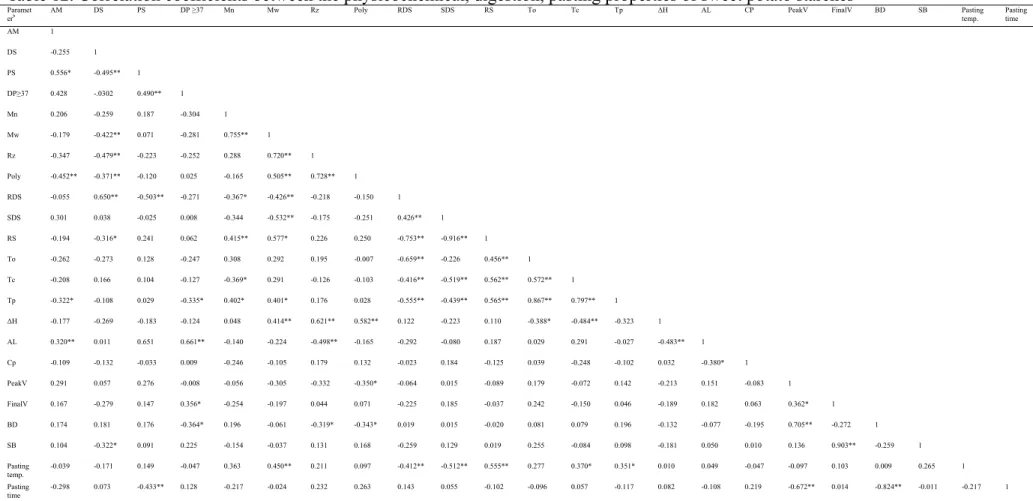
AM 1 DS -0.255 1 PS 0.556* -0.495** 1 DP≥37 0.428 -.0302 0.490** 1 Mn 0.206 -0.259 0.187 -0.304 1 Mw -0.179 -0.422** 0.071 -0.281 0.755** 1 Rz -0.347 -0.479** -0.223 -0.252 0.288 0.720** 1 Poly -0.452** -0.371** -0.120 0.025 -0.165 0.505** 0.728** 1 RDS -0.055 0.650** -0.503** -0.271 -0.367* -0.426** -0.218 -0.150 1 SDS 0.301 0.038 -0.025 0.008 -0.344 -0.532** -0.175 -0.251 0.426** 1 RS -0.194 -0.316* 0.241 0.062 0.415** 0.577* 0.226 0.250 -0.753** -0.916** 1 To -0.262 -0.273 0.128 -0.247 0.308 0.292 0.195 -0.007 -0.659** -0.226 0.456** 1 Tc -0.208 0.166 0.104 -0.127 -0.369* 0.291 -0.126 -0.103 -0.416** -0.519** 0.562** 0.572** 1 Tp -0.322* -0.108 0.029 -0.335* 0.402* 0.401* 0.176 0.028 -0.555** -0.439** 0.565** 0.867** 0.797** 1 ∆H -0.177 -0.269 -0.183 -0.124 0.048 0.414** 0.621** 0.582** 0.122 -0.223 0.110 -0.388* -0.484** -0.323 1 AL 0.320** 0.011 0.651 0.661** -0.140 -0.224 -0.498** -0.165 -0.292 -0.080 0.187 0.029 0.291 -0.027 -0.483** 1 Cp -0.109 -0.132 -0.033 0.009 -0.246 -0.105 0.179 0.132 -0.023 0.184 -0.125 0.039 -0.248 -0.102 0.032 -0.380* 1 PeakV 0.291 0.057 0.276 -0.008 -0.056 -0.305 -0.332 -0.350* -0.064 0.015 -0.089 0.179 -0.072 0.142 -0.213 0.151 -0.083 1 FinalV 0.167 -0.279 0.147 0.356* -0.254 -0.197 0.044 0.071 -0.225 0.185 -0.037 0.242 -0.150 0.046 -0.189 0.182 0.063 0.362* 1 BD 0.174 0.181 0.176 -0.364* 0.196 -0.061 -0.319* -0.343* 0.019 0.015 -0.020 0.081 0.079 0.196 -0.132 -0.077 -0.195 0.705** -0.272 1 SB 0.104 -0.322* 0.091 0.225 -0.154 -0.037 0.131 0.168 -0.259 0.129 0.019 0.255 -0.084 0.098 -0.181 0.050 0.010 0.136 0.903** -0.259 1 Pasting temp. -0.039 -0.171 0.149 -0.047 0.363 0.450** 0.211 0.097 -0.412** -0.512** 0.555** 0.277 0.370* 0.351* 0.010 0.049 -0.047 -0.097 0.103 0.009 0.265 1 Pasting time -0.298 0.073 -0.433** 0.128 -0.217 -0.024 0.232 0.263 0.143 0.055 -0.102 -0.096 0.057 -0.117 0.082 -0.108 0.219 -0.672** 0.014 -0.824** -0.011 -0.217 1
a Significance level: *, ** and *** = P< 0.05, 0.01 and 0.001, respectively.
54
CONCLUSION
This research was carried out to elucidate the physicochemical, pasting, digestion properties of 11 Korean sweet potato starches which were cultivated by National Institute of Crop Science, Rural Development Administration of Korean government in Korea. Variations in some physicochemical properties of starches from 11 Korean sweetpotao were observed, indicating that they might be suitable for diverse food applications. Some sweet potato starches represented unique characteristics, and could further be studied on relationship between their characteristics and genetic resource or growing conditions of them. Amylose content was 12.5-17.4%, and a similar chain length distributions of amylopectin was observed in sweet potato starches. Jeongmi starch had the highest values for Mw of amylopectin, while Daeyumi starch had the lowest values. All sweet potato
starches showed a characteristic Ca type X-ray diffraction patterns. Thermal
properties of DSC showed high values of To, Tp, and Tc in Jeongmi, but the
low value in Happymi. Pasting properties of RVA showed the lowest values of pasting temperature and setback viscosity in Happymi, but the highest values in Jeongmi starch. Happymi had not only a high breakdown value but also high peak viscosity and final viscosity. In digestion properties, Jeongmi
55
had the highest RS, and Shinyulmi and Happymi had high SDS contents. These low digestible sweet potato starches could be used in foods for diabetic patients. The current study may stimulate further interest in the use of Korean sweet potato starches in the food industry. It is desirable that further studies be performed on utilization of Korean sweet potato starches in common food products like snack foods and starch noodles.
56
References
Abdel-Aal E.S.M., Hucl P., Chibbar R., Han H., Demeke T. (2002) Physicochemical and structural characteristics of flours and starches from waxy and nonwaxy wheats 1. Cereal Chemistry 79:458-464.
Afoakwa E.O. (2011) Microstructural and physico-functional characterization of starches from selected cowpea (Vigna unguiculata L. Walp.) varieties developed for pest and disease resistance. Journal of Nutrition & Food Sciences 1:104.
Badenhuizen N. (1969) The biogenesis of starch granules in higher plants Appleton-Century-Crofts.pp. 121.
Blazek J., Copeland L. (2008) Pasting and swelling properties of wheat flour and starch in relation to amylose content. Carbohydrate Polymers 71:380-387.
Bovell-Benjamin A.C. (2007) Sweet potato: a review of its past, present, and future role in human nutrition. Advances in Food and Nutrition Research 52:3.
Brabet C., Reynoso D., Dufour D., Mestres C., Arredondo J., Scott G. (1997) Starch content and properties of 106 sweetpotato clones from the world germplasm collection held at CIP, Peru. Korea 2:1.
57
gels. Journal of Rheology 40:221-234.
Demeke T., Hucl P., Abdel-Aal E.S.M., Båga M., Chibbar R. (1999) Biochemical characterization of the wheat waxy a protein and its effect on starch properties 1. Cereal Chemistry 76:694-698.
Dreher M., Berry J. (1983) Buffalo gourd root starch. Part I. Properties and structure. Starch‐Stärke 35:76-81.
Eliasson A., Gudmundsson M. (1996) Starch: physicochemical and functional aspects. Food Science and Technology:391-469.
Eliasson A.C. (2007) Viscoelastic behaviour during the gelatinization of starch I. Comparison of wheat, maize, potato and waxy-barley starches. Journal of Texture Studies 17:253-265.
Englyst H.N., Kingman S., Cummings J. (1992) Classification and measurement of nutritionally important starch fractions. European Journal of Clinical Nutrition 46:S33.
Evers A., Stevens D. (1985) Starch damage. Advances in Cereal Science and Technology 7:321-349.
Gérard C., Barron C., Colonna P., Planchot V. (2001) Amylose determination in genetically modified starches. Carbohydrate Polymers 44:19-27. Gallant D.J., Bouchet B., Baldwin P.M. (1997) Microscopy of starch:
evidence of a new level of granule organization. Carbohydrate Polymers 32:177-191.
58
Gibson T., Solah V., McCleary B. (1997) A procedure to measure amylose in cereal starches and flours with concanavalin A. Journal of Cereal Science 25:111-119.
Goñi I., Garcia-Alonso A., Saura-Calixto F. (1997) A starch hydrolysis procedure to estimate glycemic index. Nutrition Research 17:427-437. Goddard M.S., Young G., Marcus R. (1984) The effect of amylose content on
insulin and glucose responses to ingested rice. The American Journal of Clinical Nutrition 39:388-392.
Gomand S., Lamberts L., Visser R., Delcour J. (2010) Physicochemical properties of potato and cassava starches and their mutants in relation to their structural properties. Food Hydrocolloids 24:424-433.
Guraya H.S., Kadan R.S., Champagne E.T. (1997) Effect of rice starch-lipid complexes on in vitro digestibility, complexing index, and viscosity. Cereal Chemistry 74:561-565.
Han X.Z., Hamaker B.R. (2001) Amylopectin fine structure and rice starch paste breakdown. Journal of Cereal Science 34:279-284.
Hanashiro I., Abe J., Hizukuri S. (1996) A periodic distribution of the chain length of amylopectin as revealed by high-performance anion-exchange chromatography. Carbohydrate Research 283:151-159. Hoover R. (2001) Composition, molecular structure, and physicochemical
59
Polymers 45:253-267.
Hoseney R.C. (1994) Principles of cereal science and technology American Association of Cereal Chemists (AACC).
Jane J., Chen Y., Lee L., McPherson A., Wong K., Radosavljevic M., Kasemsuwan T. (1999) Effects of amylopectin branch chain length and amylose content on the gelatinization and pasting properties of starch 1. Cereal Chemistry 76:629-637.
Jenkins D.J.A., Jenkins A.L., Wolever T.M.S., Josse R.G., Wong G.S. (1984) The glycaemic response to carbohydrate foods. The Lancet 324:388-391.
Kaur M., Sandhu K.S., Lim S.T. (2010) Microstructure, physicochemical properties and in vitro digestibility of starches from different Indian lentil (Lens culinaris) cultivars. Carbohydrate Polymers 79:349-355. Leach H.W., McCowen L., Schoch T.J. (1959) Structure of the starch granule.
I. Swelling and solubility patterns of various starches. Cereal Chemistry 36:534-544.
Lehmann U., Robin F. (2007) Slowly digestible starch–its structure and health implications: a review. Trends in Food Science & Technology 18:346-355.
Lindeboom N., Chang P.R., Tyler R.T. (2004) Analytical, biochemical and physicochemical aspects of starch granule size, with emphasis on
60
small granule starches: a review. Starch‐Stärke 56:89-99.
Lopez‐Rubio A., Flanagan B.M., Gilbert E.P., Gidley M.J. (2008) A novel approach for calculating starch crystallinity and its correlation with double helix content: A combined XRD and NMR study. Biopolymers 89:761-768.
Ludwig D.S. (2000) Dietary glycemic index and obesity. The Journal of nutrition 130:280S-283S.
Mahasukhonthachat K., Sopade P., Gidley M. (2010) Kinetics of starch digestion in sorghum as affected by particle size. Journal of Food Engineering 96:18-28.
Moorthy S. (1994) Tuber crop starches. 2 ed. CTCRI.pp. 52.
Noranizan M., Dzulkifly M., Russly A. (2010) Effect of heat treatment on the physico-chemical properties of starch from different botanical sources. International Food Research Journal 17:127-135.
Oladebeye A., Oshodi A., Oladebeye A. (2009) Physicochemical properties of starches of sweet potato (Ipomea batata) and red cocoyam (Colocasia esculenta) cormels. Pakistan Journal of Nutrition 8:313-315.
Panlasigui L.N., Thompson L.U., Juliano B.O., Perez C.M., Yiu S.H., Greenberg G.R. (1991) Rice varieties with similar amylose content differ in starch digestibility and glycemic response in humans. The
61
American Journal of Clinical Nutrition 54:871-877.
Patindol J.A., Gonzalez B.C., Wang Y.J., McClung A.M. (2007) Starch fine structure and physicochemical properties of specialty rice for canning. Journal of Cereal Science 45:209-218.
Rasper V. (1971) Investigations on starches from major starch crops grown in Ghana: III.Particle size and particle size distribution. Journal of the Science of Food and Agriculture 22:572-580.
Sajilata M., Singhal R.S., Kulkarni P.R. (2006) Resistant starch–a review. Comprehensive reviews in food science and food safety 5:1-17. Sandhu K.S., Lim S.T. (2008) Digestibility of legume starches as influenced
by their physical and structural properties. Carbohydrate Polymers 71:245-252.
Singh N., Singh J., Kaur L., Singh Sodhi N., Singh Gill B. (2003) Morphological, thermal and rheological properties of starches from different botanical sources. Food Chemistry 81:219-231.
Snow P., O'Dea K. (1981) Factors affecting the rate of hydrolysis of starch in food. The American Journal of Clinical Nutrition 34:2721-2727. Srichuwong S., Sunarti T.C., Mishima T., Isono N., Hisamatsu M. (2005)
Starches from different botanical sources II: Contribution of starch structure to swelling and pasting properties. Carbohydrate Polymers 62:25-34.
62
Stevenson D.G., Doorenbos R.K., Jane J., Inglett G.E. (2006) Structures and functional properties of starch from seeds of three soybean (Glycine max (L.) Merr.) varieties. Starch‐Stärke 58:509-519.
Svegmark K., Hermansson A. (1993) Microstructure and rheological properties of composites of potato starch granules and amylose: a comparison of observed and predicted structures. Food Structure 12:181-193.
Teow C.C., Truong V.D., McFeeters R.F., Thompson R.L., Pecota K.V., Yencho G.C. (2007) Antioxidant activities, phenolic and β-carotene contents of sweet potato genotypes with varying flesh colours. Food Chemistry 103:829-838.
Tester R.F., Karkalas J. (1996) Swelling and gelatinization of oat starches. Cereal Chemistry 73:271-277.
Tester R.F., Morrison W.R. (1990) Swelling and gelatinization of cereal starches. I. Effects of amylopectin, amylose, and lipids. Cereal Chemistry 67:551-557.
Tsakama M., Mwangwela A., Manani T., Mahungu N. (2010) Physicochemical and pasting properties of starch extracted from eleven sweetpotato varieties. African Journal of Food Science and Technology 1:090-098.