중금속 흡착능 Leuconostoc mesenteroides CJNU 0705 균주를
활용한 피부 건강기능성 소재 개발
한민희, 문기성*
한국교통대학교생명공학전공
Received: May 11, 2020 / Revised: August 21, 2020 / Accepted: August 21, 2020
서 론
최근 산업화와 도시화에 기인하여 미세먼지(PMs; particulate matters)가글로벌이슈로자리잡은지오래되 었다. 미세먼지는인체에흡수되어다양한질환에영향을미 치며특히외부에노출되는피부도예외는아니다. 피부질환 이발생하는주요원리는미세먼지로인한활성산소의발생 에따른염증성인자의생성이다[1]. 국내의한보고에따르 면서울지역미세먼지에는유독성의비소(As), 카드뮴(Cd), 납(Pb) 등이검출되며이는암발생에도영향을미치는것으 로확인되었다[2]. 따라서미세먼지에함유된중금속의인체 흡수를줄이는것은궁극적으로다양한질환을예방하는방 법이될수있으며그러한목적으로중금속흡착능을가진 인체유익균이활용될수있다. 특히장관, 질등인체여러 영역에서공생관계를이루고있으며다양한발효식품에서 발견되는주요균속으로잘알려진 Lactobacillus 속유산 균은다수의연구를통해중금속소거능이있는것으로확 인되었으며저비용으로균주의대량생산이가능하여그활 용성이높다[3]. 같은범주에속하는 Leuconostoc mesenteroides 유산균종 은자연계에널리분포하며김치발효의주요균종으로잘 알려져 있으며 자당(sucrose)을 이용하여 세포 외 다당체 (exoplolysaccharide)인덱스트란(dextran)을생산할수있다 [4, 5]. 덱스트란을 생산하는 주요 유산균종은 Leu.mesenteroides, Leu. citreum, Lactobacillus plantarum,
Weissella confusa 등이며그중에서도활용도가높은덱스
트란은 Leuconostoc 속이생산한다[6]. 덱스트란은포도당
(D-glucose)으로구성된고분자의다당체이며α-1,6 글루코
Development of Skin Health Promoting Materials Using Leuconostoc mesenteroides
Min-Hui Han and Gi-Seong Moon*
Major of Biotechnology, Korea National University of Transportation, Jeungpyeong 27909, Republic of Korea
Leuconostoc mesenteroides CJNU 0705 was isolated from a breast milk sample and identified by 16S rRNA gene sequencing and confirmed by its ability to produce dextran from tryptic soy agar plates supple-mented with 2% sucrose. This strain can absorb various heavy metals including lead (Pb) and cadmium (Cd) which are both found in fine dust and have been shown to be harmful to human skin. In addition, Leu. mesenteroides CJNU 0705 has demonstrated antimicrobial activity against Propionibacterium acnes, the primary causative agent of acne. Given these traits it was natural to evaluate the use of this strain in the fermentation of several natural extracts from green tea, carrot, annual wormwood, parsley, broccoli, and corn silk, which are known to improve skin health, to see if it could increase their dextran content when supplemented with no sucrose, 2% sucrose, or 2% sucrose and 3% yeast extract. The extracts supplemented with both yeast and sucrose were found to produce the most dextran, which was confirmed by the scanning electron microscope (SEM) images. These results suggest that Leu. mesenteroides CJNU 0705 and its fer-mented natural extracts could be used as functional materials for improving human skin health.
Keywords: Leuconostoc mesenteroides, breast milk, heavy metal, dextran, Propionibacterium acnes
*Corresponding author
Tel: +82-43-820-5251, Fax: +82-43-820-5272 E-mail: [email protected]
오스결합의주사슬에α-1,2, α-1,3, α-1,4 글루코오스결합
의다양한가지를가지고있다. 이는자당을기질로한덱
스트란슈크레이스(dextransucrase; 1,6-α-D-glucan-6-α -glucosyltransferase, EC 2.4.1.5.)의 작용으로 생합성된다
[7]. 덱스트란은구조에따라서물리화학적특성이다양하게
나타날수있고특히 GRAS (generally regarded as safe)에
속하는유산균이생산할경우안전성이확보되어식품, 화장 품및의약품소재로서활용도가매우크다[8]. 본연구에서는피부건강기능성과관련하여모유유래 Leu. mesenteroides CJNU 0705 균주의중금속(납과카드뮴) 흡 착능을검증하였으며피부건강기능소재로서의활용성을높 이기위하여여드름원인균으로잘알려진 Propionibacterium acnes 균주에대한항균활성을확인하였다. 또한피부건강 에유익한것으로잘알려진천연원료(녹차, 당근, 개똥쑥, 파 슬리, 브로콜리, 옥수수수염)의추출물에 Leu. mesenteroides CJNU 0705 균주를적용하여덱스트란생산조건을확립하 였다.
재료 및 방법
실험재료 식물성천연원료인녹차, 당근, 개똥쑥, 파슬리, 브로콜리, 옥수수수염은분말혹은원물형태로구매 혹은제공받았 다. 녹차와당근분말은농업회사법인푸른산㈜ (서울) 제품 을구매하였고개똥쑥과파슬리분말은인그린㈜ (포천) 제 품을구매하였으며브로콜리분말과옥수수수염원물은서 원대학교(청주)로부터제공받았다. 모유 유래 유산균 분리 및 동정 기증받은모유(2007년충북지역)를 0.1% 펩톤수(w/v)로 10 진희석하고 MRS (de Man, Rogosa, Sharpe) 고체배지(BD,Sparks, MD)에도말하여 37℃, 24시간혐기적으로배양하
였다. 즉, GasPakTM EZ Anaerobe Container System (BD)을 사용하여혐기 jar (Oxoid Ltd., UK)에서 24시간
배양한후무작위로콜로니를채취하여 MRS broth에서배 양한다음 2차에걸쳐 3분획법으로순수분리하여 -76℃초 저온냉동고에보관하였다. 보관된균주들을대상으로그 람염색 및 현미경 관찰을 통하여 유산균으로 추정되는 CJNU 0705 균주를선발하였다. 선발된 CJNU 0705 균주 는 16S rRNA 유전자염기서열분석으로동정하였다. 즉,
국내 생명공학기업(Macrogen Co., Korea)에 의뢰하여
27F (5'-AGAGTTTGATCMTGGCTCAG-3')와 1492R
(5'-TACGGYTACCTTGTTACGACTT-3') 프라이머를 이용한
16S rRNA 유전자 PCR 증폭, 염기서열분석및동정을수
행하였다.
덱스트란 생성 확인
CJNU 0705 균주가 Leu. mesenteroides 균종으로동정되
어추가검증을위해덱스트란생성유무를확인하였다. 즉,
CJNU 0705 균주를 tryptic soy broth (BD)에계대 배양하 여활성화시킨 후 2% 자당(w/v; Daejung Co., Korea)이함 유된 tryptic soy agar (BD) 고체배지에배양액 2 μl (ca. 106
CFU)를점적하여 25℃에서배양하면서콜로니주변에점질
물이생성되는지를확인하였다[5, 9].
중금속 흡착능
Leu. mesenteroides CJNU 0705 균주의생균 및사균에
대한중금속흡착능실험을진행하였다. MRS broth에서배
양된 Leu. mesenteroides CJNU 0705 균주의생균과 80℃,
30분의 조건으로 처리한 사균 5 ml을 취하여 원심분리 (10,000 rpm, 4℃, 5분)한후상등액을제거하고 3차증류수 100 µl로 세포 현탁 후 최종농도 100 ppm의 CdSO4 및 Pb(NO3)2 용액 5 ml에각각첨가하였다. 이를 30℃, 200 rpm 으로 6시간동안진탕배양하였으며원심분리(10,000 rpm, 4℃, 5분) 후상등액을주사여과(0.45 μm 주사필터; Anylab, Korea)하여 잔류 중금속을유도결합플라즈마질량분석기 (ICP-MS, Australia)로정량분석하였다. 여드름 원인균에 대한 항균활성 여드름 원인균으로 알려진 P. acnes 균종에 대한 Leu. mesenteroides CJNU 0705 균주의항균활성유무를확인하
기위하여한천확산법(agar diffusion method)을사용하였 다. 즉, MRS 고체배지에하룻밤배양한 Leu. mesenteroides CJNU 0705 균주 2 μl (ca. 106 CFU)를 점적하여 37℃,
12시간배양한후그위에지시균(P. acnes KCTC 3314)이
1% (ca. 107 CFU/ml) 함유된 RCM (reinforced clostridial medium; BD) soft agar (0.7% agar, w/v)를 부었다. 이를
상기의혐기적방법으로 48시간배양한후콜로니주변에생
성되는생육저해환(inhibition zone)을관찰하였다. 천연 추출물에서의 덱스트란 생산 조건
식물성천연원료인녹차, 당근, 개똥쑥, 파슬리, 브로콜리 (이상분말), 옥수수수염(원물)을각각열수추출하고추출물 에 Leu. mesenteroides CJNU 0705 균주를접종하여덱스트
란생산조건을최적화하였다. 즉, 원료 분말혹은원물을
1차증류수와혼합(최종농도 2%)하여 100℃에서 1시간열
수추출한후원심분리(4,000 rpm, 4℃, 10분)하고상등액을 0.45 µm 멤브레인필터(Merck Millipore, Ireland)로감압 여과하였다. 추출물(A), 추출물+자당(2%)(B) 및추출물+
자당(2%) +효모추출물(3%)(C)을 배지로 사용하여 Leu.
접종한후 25℃에서배양하면서경시적으로생균수를측정 하였다. 48시간배양액에대해서는원심분리(5,000 rpm, 4℃, 5분) 후세포를회수하여주사전자현미경(scanning electron microscope; JSM-6700F, JEOL, Japan) 사진을촬영하였다.
또한 24시간배양액의균체량과덱스트란생성량을확인하 기위하여원심분리(5,000 rpm, 4℃, 15분)한후상등액에 2배의 100% EtOH을첨가하여 24시간동안상온에서방치 하였다. 이후원심분리(5,000 rpm, 4℃, 15분)하여상등액을 제거하고 100% EtOH로현탁한후은박접시에담아 80℃에 서건조하여무게를측정하였다[5]. 균체는증류수에현탁한 후상기의조건으로건조하여무게를측정하였다. 통계처리 3반복실험의결과값은평균혹은평균 ± 표준편차로나
타내었으며 SPSS (ver. 25, SPSS Inc., USA) 프로그램을사
용하여일원분산분석(one-way ANOVA)으로유의성을검증
하고 Duncan’s multiple range test로사후검정하였다.
결과 및 고찰
모유 유래 유산균 분리 및 동정
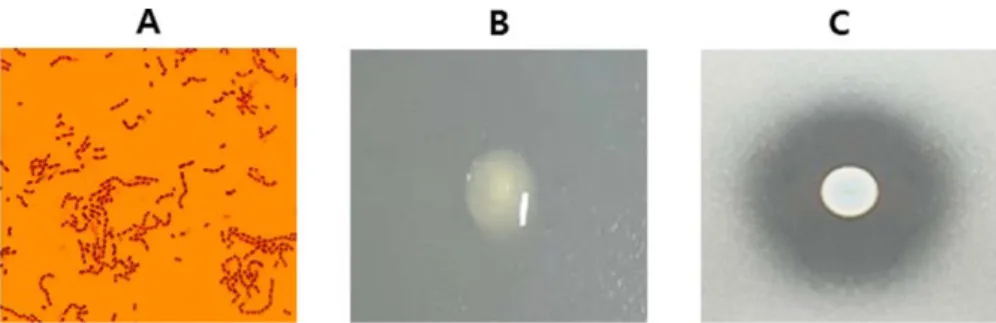
모유유래분리균주인 CJNU 0705는그람양성세균으로
확인되었으며(Fig. 1A) 16S rRNA 유전자염기서열에기초 한동정결과 Leu. mesenteroides로확인되었다. 해당염기서
열은미국립보건원생명공학정보센터 GenBank (accession
no. MT348592)에 제출 및 보관되었다. 선행연구에서
16S rRNA 유전자부분염기서열에기초한차세대염기서열
(NGS, next generation sequencing) 분석결과 Leuconostoc
속균종은 Weissella 속균종과함께초유및수유 6개월째 모유시료에서우점종으로 확인되었다[10]. 또한메타게놈 분석방법이아닌실제균주분리실험에서도드물지만 모 유시료에서 Leu. mesenteroides 균주가분리된사례가있 다[11]. 덱스트란 생성 확인
CJNU 0705 균주가 Leu. mesenteroides 균종으로동정되
어추가검증을위해덱스트란생산유무를확인하였다. 2%
자당(Daejung Co.)이함유된 tryptic soy agar (BD) 고체배 지에배양액 2 μl (ca. 106 CFU)를점적하여 25℃에서배양 한결과콜로니로부터점질물이생산되는것을관찰하였다 (Fig. 1B) [5, 9]. 유산균이생산하는세포 외 다당체(EPS, exopolysaccharides)는다양한환경으로부터세포를보호하 는기능을하며또한다른세포와의상호작용에서도중요한 역할을한다[12]. 덱스트란의합성은덱스트란슈크레이스에 의해자당의글리코사이드결합(glycosidic bond)이분해되 면서생성된포도당잔기들이신장되고있는글루칸(glucan) 중합체에결합되면서이루어진다[13]. 특히분자량이작은 덱스트란은기능성화장품소재로활용되고있다[14]. 중금속 흡착능
Leu. mesenteroides CJNU 0705 균주의생균 및사균에
대해중금속흡착능을확인하였다. 납의경우대조구(무처리 구)의잔류농도는 35.74 ppm인반면, 생균과사균처리의 경우잔류농도가각각 18.46과 25.14 ppm으로나타나각각 48.35%와 29.66%가제거되는효과가있었다. 또한카드뮴 의경우대조구(무처리구)의잔류농도는 37.83 ppm인반 면, 생균과 사균 처리의 경우 잔류 농도가 각각 31.89와 33.30 ppm으로나타나각각 15.70%와 11.97%가제거되었 다(Table 1). Leu. mesenteroides CJNU 0705 균주의생균
뿐만아니라, 사균에서도 중금속흡착능이나타나는것은
Leu. mesenteroides CJNU 0705 균주를활용한피부건강기
능성소재생산시공정상살균과정이있더라도그유효성
을기대할수있어장점으로판단된다.
전세계적으로중금속오염은심각하며이는인체건강뿐
만아니라환경적인관점에서도큰문제이다. 중금속중에서
도납과카드뮴은독성이강한것으로잘알려져있으며 “The
ATSDR (Agency for Toxic Substances and Disease Registry) 2019 Substance Priority List (https://www.
Fig. 1. Gram staining of Leuconostoc mesenteroides CJNU 0705 (A), dextran production from the strain on tryptic soy agar con-taining 2% sucrose (B), and antimicrobial activity of the strain against Propionibacterium acnes KCTC 3314.
atsdr.cdc.gov/spl/)”에서각각 2위와 7위를차지하였다. 국내 의경우최근미세먼지로인한불편함이가중되고있으며그 속에유해성중금속(납, 카드뮴, 비소, 망간, 아연, 크롬등) 이함유되어있어사람들의건강을위협하고있다. Park 등 [2]의초봄서울북부지역미세먼지에함유된중금속분석 결과에의하면납의경우최대 392.2 ng/m3이검출되었으며 카드뮴은최대 2.9 ng/m3이검출되었다. 중금속중에서도납, 수은, 카드뮴, 비소, 니켈등은일부화장품에서도검출되며 이에과도하게노출되면알레르기성접촉성피부염(allergic contact dermatitis)과같은피부질환이발생할수있다[15]. 따라서다양한환경중의중금속이체내유입혹은피부에 접촉되는것을막는것이필요하며이를위해유산균이활 용될수있다. Bhakta 등[16]은카드뮴과납을흡착할수있 는유산균주(Cd70-13, Pb71-1)를환경시료(진흙)로부터분 리하였으며 동정결과 Lactobacillus reuteri로 나타났다. Cd70-13과 Pb71-1 균주는 MRS 배지상에서카드뮴과납을 각각 25%와 59% 제거하였다. Liu 등[17]의보고에따르면 L. plantarum YW11 균주는납에대한흡착력이아주우수 하여최대 99.9%의흡착력을보였으며 YW11 균주에대한
납의최소저해농도(MIC, minimum inhibitory concentration)
가 1000 mg/l (ppm) 이상으로나타나내성또한강한것으 로확인되었다. 이러한특성의분자기작을규명하기위하여 단백질체(proteome)를분석한결과 25개의단백질이과발현 되었으며이들은아미노산과지질대사, 에너지대사, 세포 벽생합성, 물질수송과관련이있는것으로확인되었다. 또 한김치에서분리한 Leu. mesenteroides L-96 균주는납에 대한내성및제거능이우수하였으며마우스를이용한동물 실험에서납과함께 L-96 균주를투여한군이대조군(납만 투여)에비해간독성이줄어들었다[18]. 따라서선발된 Leu. mesenteroides CJNU 0705 균주는납과카드뮴에대한흡착 능이우수하여환경중의중금속제거와인체내흡수를방지 할수있는바이오소재로서활용될수있을것이다. 여드름 원인균에 대한 항균활성
Leu. mesenteroides CJNU 0705 균주가여드름원인균인
P. acnes에대하여항균활성을나타내는지확인하기위하여
한천확산법으로 시험한 결과 Leu. mesenteroides CJNU 0705 균주의콜로니주변에 P. acnes KCTC 3314 균주에대 한생육저해환이나타나는것을확인하였다(Fig. 1C). 유산 균을활용한여드름균및여드름균에의한염증반응억제에 관한 연구논문들이 다수 발표되었다. Jeong 등[19]은 L. plantarum 균주가 생산하는 박테리오신이 여드름균 P. acnes에의해유발되는각질형성세포(HaCaT)의염증성사 이토카인의발현량이감소됨을보고하였고, Kang 등[20]은 사람유래의유산균이여드름형성에영향을미치는 P. acnes 와 Staphylococcus epidermidis 균주를효과적으로억제함 을 확인하였고 동정결과 Lactobacillus salivarius subsp. salicinius와 Lactobacillus fermentum으로나타났다. 또한
Koleva 등[21]의연구에서는식용달팽이장내에서유산균
들을분리하였으며동정결과 Enterococcus 속, Lactococcus 속, Leuconostoc 속, Lactobacillus 속, Weissella 속균주들 이확인되었고이중 Leu. mesenteroides P4/8 균주가유일하 게여드름균 P. acnes에대하여항균활성을보였다. 이러한 유산균들의항균활성은젖산을포함하는유기산, 과산화수 소및박테리오신에기인하는것으로알려져있으며[20] Leu. mesenteroides CJNU 0705 균주의경우유기산에의한항균 활성으로추정되었다. 천연 추출물에서의 덱스트란 생산 조건 추출물(A), 추출물+자당(2%)(B) 및추출물+자당(2%)+효모 추출물(3%)(C)을 배지로 사용하여 Leu. mesenteroides
CJNU 0705 균주를 1% (ca. 107 CFU/ml) 접종한후 25℃에
서배양하면서경시적으로생균수를측정한결과, 전체적으
로 C 배지에서가장잘생장하는것으로확인되었으며파슬
리, 브로콜리, 옥수수수염의 경우 A 배지에서도 Leu. mesenteroides CJNU 0705 균주의생장이관찰되었다(Fig. 2). C 배지에서 48시간 배양한 Leu. mesenteroides CJNU
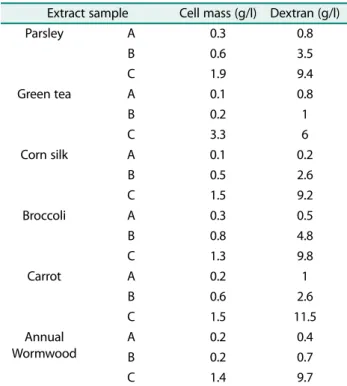
0705 균주의주사전자현미경사진촬영결과덱스트란이세 포벽을감싸고있는것이확인되었으며(Fig. 3), 또한 24시 간대배양액의균체량과덱스트란생산량을비교한결과 A, B, C 배지순서에따라증가하는양상을보였다(Table 2). 특 히 C 배지에서덱스트란생산량이급격히증가하는것은질 소원으로첨가된효모추출물에의한덱스트란슈크레이스의 활성증가영향으로추정되며 Kim 등[22]의연구에서도제 한배지(자당 20%(w/v), K2HPO4 0.5%(w/v), 감자분말 0.1%(w/v))에효모추출물의농도(0−5%)를달리하여적용했 을때 3% 농도에서 Leu. mesenteroides SM 균주발효물의 점조도가가장높게나타났고그원인으로서덱스트란슈크 레이스의활성증가로추론한바있다. 피부노화의주요원인은유해인자에의한산화적스트레
Table 1. Quantitative analysis of biosorption of Leuconostoc
mesenteroides CJNU 0705 for lead and cadmium.
Heavy metal Concentration (ppm)
Control* Live cell Dead cell Lead (Pb) 35.74±2.33c 18.46±0.56a 25.14±1.26b Cadmium (Cd) 37.83±1.90b 31.89±1.53a 33.30±2.99a
*Control: no treatment of bacteria.
Values are represented as mean ± SD from triplicate experi-ments and different uppercase letters in the row mean signifi-cantly different (p < 0.05).
스로 알려져 있어 항산화 활성이 우수한 파이토케이컬 (phytochemicals)이피부건강에도움이될수있으며이들의 소재화기술은중요하다[23]. 본연구에서사용한천연원료 인파슬리, 녹차, 옥수수수염, 브로콜리, 당근, 개똥쑥은피 부건강에도움이되는소재로잘알려져있으며화장품으로 도개발되었다[23−26]. 이러한 천연원료의 추출물을 단독으로 사용하여 Leu. mesenteroides CJNU 0705 균주를접종했을때균체량이가 장적었으며추출물에탄소원(자당)을첨가했을때균체량이 다소증가하였고탄소원과질소원(효모추출물)을모두첨가 한경우균체량이가장많았다(Table 2). 그결과와연동해 서덱스트란의생산량도 C > B > A 배지순이었다. 특히, 당 근추출물의경우자당과효모추출물이첨가되었을때덱스 트란의생산량이 11.5 g/l로사용한추출물중에서가장많 았다. 그외파슬리, 녹차, 옥수수수염, 브로콜리, 개똥쑥추 출물의덱스트란생성량은동일조건에서각각 9.4, 6, 9.2, 9.8, 9.7 g/l로나타났다. 추출물에자당과효모추출물을첨
가하여배양한 Leu. mesenteroides CJNU 0705 균주의주사
전자현미경사진에서덱스트란이세포벽을감싸고있는현
상이관찰되었는데(Fig. 3), 이러한현상은 Leu. citreum을대
상으로한선행연구에서도관찰되었으며덱스트란합성에
관여하는덱스트란슈크레이스합성유전자(dsrC)의돌연변이
유도결과점질물이사라진깨끗한표면의세포벽이확인되
Fig. 2. Viable cell counts of Leuconostoc mesenteroides CJNU 0705 in hot-water extracts of green tea, carrot, annual wormwood, parsley, broccoli, and corn silk. -◆-, hot-water extracts; -■-, hot-water extracts added with 2% sucrose; -▲-, hot-water extracts added
with 2% sucrose and 3% yeast extract. The values indicate averages of triplicate experiments. **, p < 0.01 and ***, p < 0.001 when com-pared with the hot-water extracts by one-way ANOVA with Duncan’s multiple range test.
Table 2. Quantitative analysis of cell mass and dextran after 24 h cultivation in hot-water extract samples.
Extract sample Cell mass (g/l) Dextran (g/l)
Parsley A 0.3 0.8 B 0.6 3.5 C 1.9 9.4 Green tea A 0.1 0.8 B 0.2 1 C 3.3 6 Corn silk A 0.1 0.2 B 0.5 2.6 C 1.5 9.2 Broccoli A 0.3 0.5 B 0.8 4.8 C 1.3 9.8 Carrot A 0.2 1 B 0.6 2.6 C 1.5 11.5 Annual Wormwood A 0.2 0.4 B 0.2 0.7 C 1.4 9.7
A, hot-water extracts; B, hot-water extracts added with 2% sucrose; C, hot-water extracts added with 2% sucrose and 3% yeast extract.
었다[27].
본 연구에서는 모유 유래 유산균 Leu. mesenteroides
CJNU 0705 균주를활용한피부건강기능성소재개발과관
련하여 Leu. mesenteroides CJNU 0705 균주의중금속흡착
능, 여드름균에대한항균활성, 천연원료를배지원으로한덱
스트란생산최적조건을확인하였다. 최근식이및환경적인
요인에의한피부건강상태의악화는다양한피부질환을유
발한다. Leu. mesenteroides CJNU 0705 균주는 미세먼지
속유해중금속인납과카드뮴에대한흡착능력을가지고있
어중금속노출에의한피부질환을예방하는데도움을줄수
있다. 또한청소년뿐만아니라성인에서도흔하게나타나는
여드름은피부상재균인 P. acnes에의한염증이그원인중
에 하나인데[28], Leu. mesenteroides CJNU 0705 균주는
P. acnes에대한항균활성을가지고있어그러한염증을완
화시키는데기여할수있다. 마지막으로피부친화적천연원
료를기본배지원으로하여 Leu. mesenteroides CJNU 0705
균주의덱스트란생산조건을최적화하였다.
결론적으로모유유래유산균 Leu. mesenteroides CJNU
0705 균주는중금속흡착, 여드름원인균억제및천연원료
의발효를통해생산된덱스트란의기능성을중심으로피부
건강기능성소재생산에활용될수있을것이다.
요 약
Leu. mesenteroides CJNU 0705 균주는모유에서분리되
었으며 16S rRNA 유전자염기서열분석과자당(2%)이포
함된 tryptic soy agar plate상에서의덱스트란생성능을통
하여 동정하였다. Leu. mesenteroides CJNU 0705 균주는
미세먼지속에존재하는피부유해성중금속인납과카드뮴
에대한흡착능이있으며이러한성질은사균상태에서도확
인되었다. 또한 Leu. mesenteroides CJNU 0705 균주는여
드름원인균인 P. acnes 균주에대하여항균활성을나타내
Fig. 3. SEM images of Leuconostoc mesenteroides CJNU 0705 cells cultured in hot-water extracts added with 2% sucrose and 3% yeast extract for 48 h. Cells in tryptic soy broth (TSB) (A), TSB added with 2% sucrose (B), green tea (C), carrot (D), annual
었다. 마지막으로피부건강기능소재로잘알려진녹차, 당 근, 개똥쑥, 파슬리, 브로콜리및옥수수수염추출물을기본 배지(A)로하여 2% 자당(B) 혹은 2% 자당과 3% 효모추출물 (C)을각각의추출물에첨가한후 Leu. mesenteroides CJNU
0705 균주를접종및배양하여덱스트란생산량을확인한
결과 C 배지가최적배지로확인되었으며덱스트란의생산은
주사전자현미경사진으로도관찰되었다. 결론적으로모유유
래의 Leu. mesenteroides CJNU 0705 균주나이를이용한
천연발효추출물은피부건강기능소재로활용될수있을것
이다.
Conflict of Interest
The authors have no financial conflicts of interest to declare.
References
1. Kim KE, Cho D, Park HJ. 2016. Air pollution and skin diseases: Adverse effects of airborne particulate matter on various skin diseases. Life Sci. 152: 126-134.
2. Park EJ, Kang M, You DE, Kim DS, Yu SD, Chung KH, et al. 2005. Health risk assessment of heavy metals in fine particles col-lected in Seoul metropolitan area. J. Environ. Toxicol. 20: 179-186. 3. Monachese M, Burton JP, Reid G. 2012. Bioremediation and tol-erance of humans to heavy metals through microbial processes: a potential role for probiotics? Appl. Environ. Microbiol. 78: 6397-6404.
4. Jeong EJ, Moon DW, Oh JS, Moon JS, Seong H, Kim KY, et al. 2017. Development of cabbage juice medium for industrial pro-duction of Leuconostoc mesenteroides starter. J. Microbiol.
Bio-technol. 27: 2112-2118.
5. Hwang SK, Hong JT, Jung KH, Chang BC, Hwang KS, Shin JH, et
al. 2008. Process optimization of dextran production by Leuco-nostoc sp. strain YSK isolated from fermented kimchi. J. Life Sci. 18: 1377-1383.
6. Zhou Q, Feng F, Yang Y, Zhao F, Du R, Zhou Z, et al. 2018. Charac-terization of a dextran produced by Leuconostoc
pseudomesen-teroides XG5 from homemade wine. Int. J. Biol. Macromol. 107(Pt B): 2234-2241.
7. Khalikova E, Susi P, Korpela T. 2005. Microbial dextran-hydrolyz-ing enzyme: fundamentals and applications. Microbiol. Mol. Biol.
Rev. 69: 306-325.
8. Feng F, Zhou Q, Yang Y, Zhao F, Du R, Han Y, et al. 2018. Charac-terization of highly branched dextran produced by Leuconostoc
citreum B-2 from pineapple fermented product. Int. J. Biol. Mac-romol. 113: 45-50.
9. Gu JJ, Ha YJ, Yoo SK. 2015. Isolation and characterization of dex-trans produced by Leuconostoc sp. strain JYY4 from fermented kimchi. J. Korean Oil Chemists Soc. 32: 758-766.
10. Cabrera-Rubio R, Collado MC, Laitinen K, Salminen S, Isolauri E, Mira A. 2012. The human milk microbiome changes over
lacta-tion and is shaped by maternal weight and mode of delivery.
Am. J. Clin. Nutr. 96: 544-551.
11. Heikkilä MP, Saris PE. 2003. Inhibition of Staphylococcus aureus by the commensal bacteria of human milk. J. Appl. Microbiol. 95: 471-478.
12. Zannini E, Waters DM, Coffey A, Arendt EK. 2016. Production, properties, and industrial food application of lactic acid bacte-ria-derived exopolysaccharides. Appl. Microbiol. Biotechnol. 100: 1121-1135.
13. Werning ML, Notararigo S, Nácher M, Fernández de Palencia P, Aznar R, López P. 2012. Biosynthesis, purification and biotechno-logical use of exopolysaccharides produced by lactic acid bacteria, pp. 83-114. In El-Samragy Y (ed), Food Additive. InTech, Rijeka, Croatia.
14. Patel S, Goyal A. 2011. Functional oligosaccharides: production, properties and applications. World J. Microbiol. Biotechnol. 27: 1119-1128.
15. Borowska S, Brzóska MM. 2015. Metals in cosmetics: implica-tions for human health. J. Appl. Toxicol. 35: 551-572.
16. Bhakta JN, Ohnishi K, Munekage Y, Iwasaki K, Wei MQ. 2012. Characterization of lactic acid bacteria-based probiotics as potential heavy metal sorbents. J. Appl. Microbiol. 112: 1193-1206.
17. Liu S, Zheng Y, Ma Y, Sarwar A, Zhao X, Luo T, et al. 2019. Evalua-tion and proteomic analysis of lead adsorpEvalua-tion by lactic acid bacteria. Int. J. Mol. Sci. 20: 5540.
18. Yi YJ, Lim JM, Gu S, Lee WK, Oh E, Lee SM, et al. 2017. Potential use of lactic acid bacteria Leuconostoc mesenteroides as a probi-otic for the removal of Pb(II) toxicity. J. Microbiol. 55: 296-303. 19. Jeong JW, Jung YH, Lee JS, Yoon SW, Lee SY, Lee HC, et al. 2016.
The suppression of inflammatory cytokines induced by
Propion-ibacterium acnes using bacteriocin isolated from Lactobacillus plantarum K-1 BR. J. Life Sci. 26: 970-975.
20. Kang MS, Oh HJ, Lee HC, Oh JS. 2009. Isolation and identification of lactic acid bacteria inhibiting the proliferation of
Propionibac-terium acnes and Staphylococcus epidermidis. J. Bacteriol. Virol. 39: 11-19.
21. Koleva Z, Dedov I, Kizheva J, Lipovanska R, Moncheva P, Hristova P. 2014. Lactic acid microflora of the gut of snail Cornu aspersum.
Biotechnol. Biotechnol. Equip. 28: 627-634.
22. Kim JE, Whang K, Lee SP. 2012. Physicochemical properties of dextran produced by Leuconostoc mesenteroides SM according to concentration of yeast extract and its modulation of rheologi-cal properties. Korean J. Food Sci. Technol. 44: 216-223.
23. Kim EA. 2007. Phytochemicals and beauty food. Food Sci. Ind. 40: 3-9.
24. Cho BO, Shin JY, Che DN, Hwang YM, Lee HS, Ryu C, et al. 2016. Improvement effect of corn silk, perilla leaf and grape stem extract mixture against UVB-induced skin damage and com-pound 48/80-induced pruritus. J. Rad. Ind. 10: 231-242. 25. Kim MK. 2018. Antioxidant, antimicrobial and anti-inflammatory
activities of broccoli leaf extracts. J. Invest. Cosmetol. 14: 153-159. 26. Kang GJ, Kang NJ, Han SC, Koo DH, Kim YS, Lee JH, et al. 2012.
Inhibitory effect of artemisinic acid isolated from Artemisia
annua L on the MCD in HaCaT keratinocytes. Korean J. Pharma-cogn. 43: 217-223.
27. Jin Q, Li L, Kim YJ, Han NS. 2014. Construction of a dextran-free
Leuconostoc citreum mutant by targeted disruption of the
dex-transucrase gene. J. Appl. Microbiol. 117: 1104-1112.
28. Park HJ, Choi SW, Che KO, Koh JS, Kim HO, Park YJ. 2000. A com-parison of the sebum excretion rate and the density of
Propioni-bacterium acnes between adult acne and adolescent acne. Korean J. Dermatol. 38: 1199-1204.