Hydrogen Storage by K-decorated Silicon Materials Bull. Korean Chem. Soc. 2012, Vol. 33, No. 5 1719 http://dx.doi.org/10.5012/bkcs.2012.33.5.1719
High Hydrogen Capacity and Reversibility of K-Decorated Silicon Materials
Min Hee Park, Seol Ryu,† Young-Kyu Han,‡,* and Yoon Sup Lee*
Department of Chemistry, Korea Advanced Institute of Science and Technology (KAIST), Daejeon 305-701, Korea *E-mail: [email protected]
†Department of Chemistry, Chosun University, Gwangju 501-759, Korea
‡Division of Materials Science, Korea Basic Science Institute (KBSI), Daejeon 305-333, Korea. *E-mail: [email protected] Received November 15, 2011, Accepted February 23, 2012
We have investigated the H2 adsorption structures and binding energies of the metal (M)-doped (M = Li, Na, K, Mg, and Al) silicon complexes, M-Si19H11 andM-Si24H12, using density functional calculations. Alkali metals are preferred as doping elements because the Mg-Si and Al-H2 interactions are weak. The maximum numbers of H2 molecules that can be adsorbed are four and five for M=Li and K, respectively. We propose that the K-decorated silicon material might be an effective hydrogen storage material with high hydrogen capacity and high reversibility.
Key Words : Alkali metal, Density functional calculation, Hydrogen storage, Potassium, Silicon
Introduction
For more than a decade, hydrogen, as an alternative to traditional energy sources such as oil and natural gas, has been the focus of research and development efforts in all technologically advanced countries of the world. It is strong-ly believed that hydrogen can help address the growing demand for energy and thus slow down global climate change.1,2 There are significant challenges in storing the large quantities of hydrogen that will be necessary in the hydrogen energy economy. The principal challenges in improving hydrogen storage technologies are increasing their efficiency, size, weight, capacity, and ultimately, their cost.3,4 Currently available methods for storing and deliver-ing hydrogen fuel include compressed hydrogen, liquefied hydrogen, metal hydride storage, and nanostructure storage. However, so far no material has been successful in com-bining the hydrogen storage capacity for on-board systems such as automotive engineering with the ability to reversibly adsorb and desorb hydrogen under proper kinetic and thermodynamic conditions.5-9
Despite the great progress of carbon-based nanostructures, including nanotubes,10,11 fullerenes,12,13 and nanoscrolls,14,15 carbon materials are difficult for achieving a high adsorption capacity of hydrogen unless they have an extremely high specific surface. A solution to this problem is doping carbon-based porous materials, such as fullerene and carbon nanotube with metal atoms such as alkali metals, which opens a new strategy for hydrogen storage research. Doping carbon-based materials with some metals can enhance the hydrogen storage capacity significantly owing to the higher H2 binding affinity of decorated atoms than that of pristine
carbon-based materials.12,16
Compared with carbon, silicon has more electrons in the outer shells, which leads to higher polarizability and a stronger dispersion force. Accordingly, the silicon materials
exhibit a stronger van der Waals attraction to hydrogen than the corresponding carbon analogues. Many previous theore-tical investigations have suggested the possibility of promis-ing silicon materials and predicted their structures and properties for the development novel materials for hydrogen storage.17-23
In the present work, we evaluate the hydrogen storage capacity of metal-adsorbed silicon systems (metal=Li, Na, K, Mg, and Al) using quantum chemical calculations and propose relevant materials that satisfy both the high storage capacity and high reversibility required for hydrogen fuel storage.
Computational Details
Calculations of the total energies and geometry optimi-zation were performed with the generalized gradient approxi-mation (GGA) of Perdew-Wang (PW91)24 as implemented in the Gaussian03 package.25 The 6-31G(d,p) basis sets were used. Geometry optimizations were carried out without any symmetry constraints.
An exhaustive search for the lowest-energy structures was performed for each specific H2 adsorption on the metal-decorated silicon complex. The binding energies (ΔEB) of H2
molecules adsorbed on the silicon complexes, Si19H11 (SiI) and Si24H12 (SiII), were evaluated by the formula,
ΔEB = (energy of silicon material with (n–1)H2) + (energy
of H2) – (energy of silicon material with nH2),
where a positive binding energy denotes a stable complex against the H2 dissociation.
Results and Discussion
We selected the SiI (Si19H11) and SiII (Si24H12) as model
1720 Bull. Korean Chem. Soc. 2012, Vol. 33, No. 5 Min Hee Park et al.
such as silicon nanowires and silicon nanotubes. The metal-decorated silicon complex was formed with a SiI or SiII system and a single metal atom (Li, Na, K, Mg, and Al). We found that the metal atoms bind with the silicon systems in a η6 fashion. The binding energies of metal atoms are summarized in Table 1. The binding energies of the metal atoms vary significantly from the lowest for Mg to the highest for Al. The binding energies of the Li atom decorated on the center of SiI and SiII hexagon rings are 2.38 eV and 1.88 eV, respectively, which is larger than that of Li on carbon nanotubes, 1.64 eV, due to the dense electron cloud around the silicon rings. The binding energies of the K atom are 2.10 eV and 1.65 eV for SiI and SiII, respectively, which is ~0.2 eV larger than those of the Na atom. The Mg atom seems to be a poor doping element because the binding energies of Mg with the silicon materials are low at about 1.0 eV lower than the K cases.
Table 2 lists the binding energies for consecutive adsorp-tion of addiadsorp-tional H2 species to the metal-decorated silicon
complexes for metal elements along with the average bind-ing energies (ΔEB). We found that all the metals bind with
H2 molecules in a dihydrogen (H2) form, but not in a
dihydride (2H) form. Our calculations show that the binding energy of H2 on the undecorated system is 30 meV, which is
similar to the reported values (30-40 meV) for undecorated silicon nanotubes.20 Compared with the undecorated system, the binding energies of a H2 molecule on the alkali
metal-decorated silicon complex are found to be 3-5 times larger. The enhanced binding is due to the charge transfer from the
metal atoms and silicon materials. A local dipole can subsequently be formed on a metal-decorated silicon system, which can then induce a dipole on the molecular hydrogen. The charge-induced dipole interactions reinforce the adsorp-tion energy between the decorated systems and the hydrogen molecules.
The first H2 molecules (n = 1) bind with the Li-decorated
silicon complexes (H2…Li-SixHy) with binding energies of
150 meV for both SiI and SiII. After the first H2 molecule
binds to Li, the binding energies between the H2 molecule
and the Li-decorated silicon complexes gradually decrease to 38 meV (SiI) and 35 meV (SiII) for the fifth H2 binding
energies. On the other hand, it is notable that K-decorated silicon systems show similar binding energies from the
Figure 1. Optimized structures of the Si19H11 (SiI) and Si24H12
(SiII).
Table 1. Calculated binding energy (ΔEn) between metal atoms (metal=Li, Na, K, Mg, and Al) and silicon materials (Si19H11: SiI and Si24H12: SiII).Units are in eV
Silicon materials Li Na K Mg Al SiI 2.38 1.93 2.10 1.14 2.55 SiII 1.88 1.45 1.65 0.60 2.11 Table 2. Calculated binding energy (ΔEn) by successive additions of H2 molecules to metal-decorated silicon materials (Si19H11: SiI, Si24H12: SiII)
Unit Metal ΔEn (meV) (meV)ΔEB n = 1 n = 2 n = 3 n = 4 n = 5 SiI Li 150 76 68 46 38 76 Na 93 103 76 84 46 80 K 87 84 87 73 68 80 Mg 90 46 38 63 41 56 Al 38 33 44 35 38 38 Unit Metal ΔEn (meV) ΔEB
(meV) n = 1 n = 2 n = 3 n = 4 n = 5 SiII Li 150 84 63 49 35 76 Na 93 101 73 90 22 76 K 60 87 101 84 68 80 Mg 38 90 41 44 38 50 Al 41 38 22 30 60 38
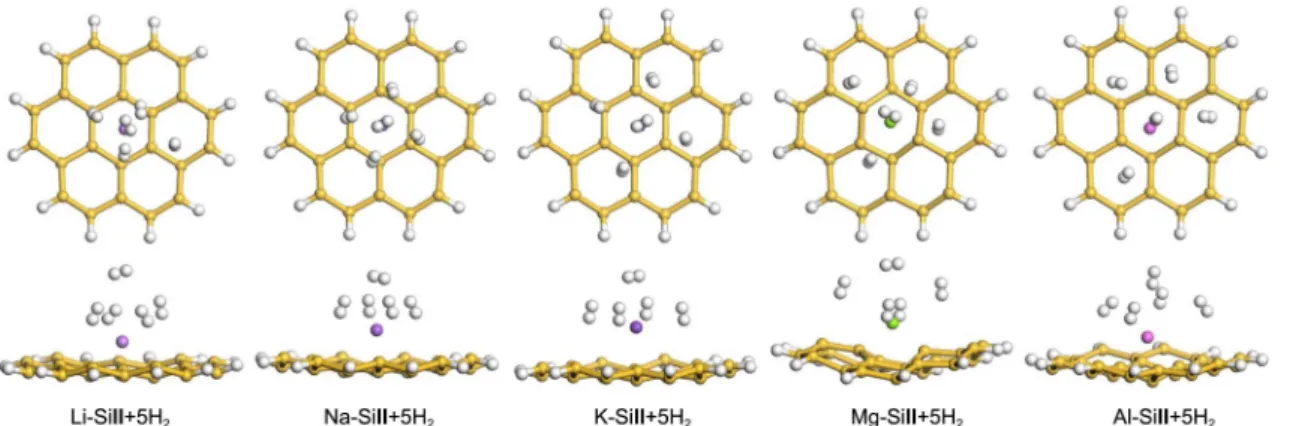
Figure 2. Optimized structures of the maximum number of H2 adsorbed on the metal-decorated SiII complexes (metal=Li, Na, K, Mg, and Al).
Hydrogen Storage by K-decorated Silicon Materials Bull. Korean Chem. Soc. 2012, Vol. 33, No. 5 1721
first to the fifth H2 molecule adsorbed on the SiI and SiII
complexes, indicating the higher reversibility of K-de-corated silicon materials with respect to Li-deK-de-corated silicon materials. In this regard, Na shows poorer reversibility than K. The enhancement of reversibility from Li to K can be attributed to the different size of alkali metals. The ionic (covalent) radii are 0.60 (1.34) Å and 1.33 (1.96) Å for Li and K, respectively. As a doping element, the Al atom seems irrelevant, because its binding energies with H2 molecules
are weak (ΔEB values of 38 meV for both the SiI and SiII
cases) compared with those of undecorated silicon materials. Figure 2 shows the optimized structures of metal-de-corated SiII complexes (metal=Li, Na, K, Mg, and Al) in interaction with five H2 molecules. The distances between
the Li atom and the five H2 molecules vary significantly
from 2.3 Å to 4.3 Å, whereas the K atom adsorbs up to five H2 molecules on the SiII complex within a similar distance,
3.1-3.2 Å. The distances between the Al-decorated SiII system and the H2 molecules are somewhat longer (3.7-4.2
Å) than other metal atoms, reflecting a weaker interaction with H2 molecules than other metal-decorated complexes
(see Table 2).
Conclusions
Alkali metals are preferred candidates as doping elements because the Mg-Si and Al-H2 interactions are weak. The
maximum numbers of H2 molecules that can be adsorbed are
four and five for M=Li and K, respectively. We propose that K-decorated silicon material might be an effective hydrogen storage material with high hydrogen capacity and high reversibility.
Acknowledgments. This work was supported by grants (2010-0016243, 2010-0001632) from the National Research Foundation of Korea. This work was also supported by the National Research Foundation of Korea Grant funded by the Korean Government (MEST) (NRF-2010-C1AAA001-0029018). Computational resources were provided by KISTI (KSC-2011-C2-18).
References
1. Coontz, R.; Hanson, B. Science 2004, 305, 957.
2. Crabtree, G. W.; Dresselhaus, M. S.; Buchanan, M. V. Phys. Today 2004, 57, 39.
3. Schlapbach, L.; Zuttel, A. Nature 2001, 414, 353. 4. Züttel, A. Mater. Today 2003, 6, 24.
5. Fichtner, M. Adv. Eng. Mater. 2005, 7, 443.
6. Liu, C.; Fan, Y. Y.; Liu, M.; Cong, H. T.; Cheng, H. M.; Dresselhaus, M. S. Science 1999, 286, 1127.
7. Chen, P.; Wu, X.; Lin, J.; Tan, K. L. Science 1999, 285, 91. 8. Sun, Q.; Wang, Q.; Jena, P. Nano. Lett. 2005, 5, 1273.
9. Chen, P.; Xiong, Z. T.; Luo, L. Z.; Lin, J. Y.; Tan, K. L. Nature 2002, 420, 302.
10. Cho, J. H.; Park, C. R. Catal. Today 2007, 120, 407.
11. Durgun, E.; Ciraci, S.; Yildirim, T. Phys. Rev. B 2008, 77, 085405. 12. Chandrakumar, K. R. S.; Ghosh, S. K. Nano. Lett. 2008, 8, 13. 13. Kuc, A.; Zhechkov, L.; Patchkovskii, S.; Seifert, G.; Heine, T.
Nano. Lett. 2007, 7, 1.
14. Cabria, I.; Lopez, M. J.; Alonso, J. A. J. Chem. Phys. 2005, 123, 204721.
15. Park, N.; Hong, S.; Kim, G.; Jhi, S. H. J. Am. Chem. Soc. 2007, 129, 8999.
16. Chen, L.; Zhang, Y.; Koratkar, N.; Jena, P.; Nayak, S. K. Phys. Rev. B 2008, 77, 033405.
17. Barnard, A. S.; Russo, S. P. J. Phys. Chem. B 2003, 107, 7577. 18. Fagan, S. B.; Baierle, R. J.; Mota, R.; da Silva, A. J. R.; Fazzio, A.
Phys. Rev. B 2000, 61, 9994.
19. Fagan, S. B.; Mota, R.; Baierle, R. J.; Paiva, G.; da Silva, A. J. R.; Fazzio, A. J. Mol. Struc. (THEOCHEM) 2001, 539, 101. 20. Lan, J. H.; Cheng, D. J.; Cao, D. P.; Wang, W. C. J. Phys. Chem. C
2008, 112, 5598.
21. Zhang, M.; Kan, Y. H.; Zang, O. J.; Su, J. M.; Wang, R. S. Chem. Phys. Lett. 2003, 379, 81.
22. Zhang, R. Q.; Lee, H. L.; Li, W. K.; Teo, B. K. J. Phys. Chem. B 2005, 109, 8605.
23. Zhang, R. Q.; Lee, S. T.; Law, C. K.; Li, W. K.; Teo, B. K. Chem. Phys. Lett. 2002, 364, 251.
24. Perdew, J. P.; Wang, Y. Phys. Rev. B 1992, 45, 13244.
25. Frisch, M. J.; Trucks, G. W.; Schlegel, H. B.; Scuseria, G. E.; Robb, M. A.; Cheeseman, J. R.; Montgomery, J. A., Jr.; Vreven, T.; Kudin, K. N.; Burant, J. C.; Millam, J. M.; Iyengar, S. S.; Tomasi, J.; Barone, V.; Mennucci, B.; Cossi, M.; Scalmani, G.; Rega, N.; Petersson, G. A.; Nakatsuji, H.; Hada, M.; Ehara, M.; Toyota, K.; Fukuda, R.; Hasegawa, J.; Ishida, M.; Nakajima, T.; Honda, Y.; Kitao, O.; Nakai, H.; Klene, M.; Li, X.; Knox, J. E.; Hratchian, H. P.; Cross, J. B.; Bakken, V.; Adamo, C.; Jaramillo, J.; Gomperts, R.; Stratmann, R. E.; Yazyev, O.; Austin, A. J.; Cammi, R.; Pomelli, C.; Ochterski, J. W.; Ayala, P. Y.; Morokuma, K.; Voth, G. A.; Salvador, P.; Dannenberg, J. J.; Zakrzewski, V. G.; Dapprich, S.; Daniels, A. D.; Strain, M. C.; Farkas, O.; Malick, D. K.; Rabuck, A. D.; Raghavachari, K.; Foresman, J. B.; Ortiz, J. V.; Cui, Q.; Baboul, A. G.; Clifford, S.; Cioslowski, J.; Stefanov, B. B.; Liu, G.; Liashenko, A.; Piskorz, P.; Komaromi, I.; Martin, R. L.; Fox, D. J.; Keith, T.; Al-Laham, M. A.; Peng, C. Y.; Nanayakkara, A.; Challacombe, M.; Gill, P. M. W.; Johnson, B.; Chen, W.; Wong, M. W.; Gonzalez, C.; Pople, J. A. Gaussian 03, revision E.01; Gaussian, Inc.: Wallingford CT, 2004.