R E S E A R C H A R T I C L E
Open Access
Effective behavioral intervention strategies
using mobile health applications for
chronic disease management: a systematic
review
Jung-Ah Lee
1, Mona Choi
2*, Sang A Lee
3and Natalie Jiang
4Abstract
Background: Mobile health (mHealth) has continuously been used as a method in behavioral research to improve self-management in patients with chronic diseases. However, the evidence of its effectiveness in chronic disease management in the adult population is still lacking. We conducted a systematic review to examine the effectiveness of mHealth interventions on process measures as well as health outcomes in randomized controlled trials (RCTs) to improve chronic disease management.
Methods: Relevant randomized controlled studies that were published between January 2005 and March 2016 were searched in six databases: PubMed, CINAHL, EMBASE, the Cochrane Library, PsycINFO, and Web of Science. The inclusion criteria were RCTs that conducted an intervention using mobile devices such as smartphones or tablets for adult patients with chronic diseases to examine disease management or health promotion. Results: Of the 12 RCTs reviewed, 10 of the mHealth interventions demonstrated statistically significant improvement in some health outcomes. The most common features of mHealth systems used in the reviewed RCTs were real-time or regular basis symptom assessments, pre-programed reminders, or feedbacks tailored specifically to the data provided by participants via mHealth devices. Most studies developed their own mHealth systems including mobile apps. Training of mHealth systems was provided to participants in person or through paper-based instructions. None of the studies reported the relationship between health outcomes and patient engagement levels on the mHealth system. Conclusions: Findings from mHealth intervention studies for chronic disease management have shown promising aspects, particularly in improving self-management and some health outcomes.
Keywords: Mobile applications, Disease management, Mobile health, Chronic disease management, Self-management Background
The prevalence of chronic diseases, such as cancer, car-diovascular diseases, chronic pain, diabetes, and respira-tory diseases is continuously increasing with regard to an aging society worldwide. According to the World Health Organization, chronic diseases are the leading cause of mortality in the world, accounting for more than 60% of all deaths [1]. Chronic disease is, therefore, a global burden. For example, according to the report by
the Centers for Disease Control and Prevention (CDC) in the United States (US), about half of all American adults, approximately 117 million people, have one or more chronic disease conditions including heart disease, stroke, cancer, type 2 diabetes, obesity, or arthritis [2]. One in four adults in the US had two or more chronic diseases in 2012 [2]. Chronic diseases are the main cause of death among Americans, with 48% dying from cancer or heart diseases in 2010 [3]. In 2010, about 86% of Americans’ health care expenditure was for chronic dis-ease treatment [4]. Therefore, chronic disease manage-ment is now a major public health issue in the US. Likewise, managing chronic diseases is also a challenge
* Correspondence:[email protected]
2College of Nursing, Mo-Im Kim Nursing Research Institute, Yonsei University,
50 Yonsei-ro, Seodaemun-gu, Seoul, Republic of Korea03722 Full list of author information is available at the end of the article
© The Author(s). 2018 Open Access This article is distributed under the terms of the Creative Commons Attribution 4.0 International License (http://creativecommons.org/licenses/by/4.0/), which permits unrestricted use, distribution, and reproduction in any medium, provided you give appropriate credit to the original author(s) and the source, provide a link to the Creative Commons license, and indicate if changes were made. The Creative Commons Public Domain Dedication waiver (http://creativecommons.org/publicdomain/zero/1.0/) applies to the data made available in this article, unless otherwise stated.
in other countries [5, 6]. For instance, over 40% of the population aged 15 years or older had a chronic disease condition in the European Union countries [5] and chronic diseases accounted for a substantial proportion of deaths throughout Southeast Asia [6].
With advances in mobile technologies, approaches based on mobile health (mHealth)—defined as “an area of electronic health (eHealth) with the provision of health services and information via mobile tech-nologies such as mobile phones and Personal Digital Assistants (PDAs)” [7]—have been very popular in health care and public health [8–11]. Current evi-dence shows that the advantages of using mHealth devices are not only for the improvement of diagnosis and treatment but also the social connection with people [12]. Behavioral interventions using mobile ap-plications (apps) on smartphones or tablet computers
in enhancing self-management for patients with
chronic diseases, such as heart failure [13] or diabetes [14], have been studied [9, 12]. For instance, a food intake diary, physical activity monitoring, and home blood sugar monitoring via mHealth systems are commonly used for diabetes management [14–16] while monitoring of weight, symptoms, and physical activity are common features of heart failure interven-tions [13, 17].
However, the evidence from current literature using the mHealth approach on improving health outcomes is inconsistent; some studies have shown that mHealth-based behavioral interventions are potentially effective in chronic disease management, whereas other studies did not obtain supportive results [9]. Previously, the evalu-ation of mHealth-based research focused on feasibility and acceptability of mHealth tools.
Rather than relying on feasibility research, which often does not utilize randomization in their intervention and/ or a control group, and often lacks an effective size, a number of systematic or integrated reviews examined randomized controlled trials (RCTs) in diabetes manage-ment. These studies have demonstrated positive physio-logical and behavioral outcomes as well as incentive driven outcomes with mHealth systems [14–17]. How-ever, there is limited literature showing that mHealth ap-proaches can be useful for the self-management in patients with other chronic diseases. Therefore, an in-depth evaluation of RCTs on interventions that employ mHealth technologies and participants’ adherence to the interventions, training methods, intervention dosage, and length of follow-ups as outcomes of interest should be performed to provide recommendations on what fac-tors make mHealth interventions effective for chronic disease management.
Thus, the purpose of this study was to perform a sys-tematic review of RCTs using mHealth interventions for
chronic disease management in adult populations to examine the effectiveness of mHealth interventions on health outcomes and process measures.
Methods
The Preferred Reporting Items for Systematic Review and Meta-Analysis (PRISMA) guidelines [18] were used in this systematic review. The PICOS (participants, in-terventions, comparisons, outcomes, and study design) approach was used to develop a research question to guide the search strategies and review: that is, do inter-ventions using mobile health applications improve health outcomes and process measures for adults with chronic diseases in RCTs?
Search strategies
Searches were performed to retrieve studies that were published in peer-reviewed journals from January 2005 to March 2016, and written in English; the following da-tabases were used: PubMed, CINAHL, EMBASE, the Cochrane Library, PsycINFO, and Web of Science. We used combinations of the key words and indexing terms such as MeSH or Emtree linked to the search domains. An example of a PubMed search strategy is as follows: for mobile interventions, “Mobile Applications”[Mesh] OR “Cell Phones”[Mesh] OR “Computers, Handheld”[-Mesh] OR “mobile health” OR “m-health” OR mhealth OR “mobile-health” OR smartphone* OR “smart-phone*” OR “mobile phone*” OR “mobile-phone*” OR “cellular phone*” OR “cellular-phone*” OR “smart device*” OR “smart-device*” OR “tablet* PC*” OR “tablet-based” OR “tablet* device*”; for chronic disease outcomes, “Disease Management”[Mesh] OR “Chronic Disease/prevention and control”[Mesh] OR “Chronic Disease/therapy”[Mesh] OR “disease* manag*” OR “disease* monitor*” OR moni-tor* OR “health promot*” OR Promot*, and for method, “Randomized Controlled Trial” [Publication Type] OR “Randomized Controlled Trials as Topic”[Mesh] OR “Controlled Clinical Trial”[Publication Type] OR rando-mized[Title/Abstract] OR randomised[Title/Abstract] OR randomly[Title/Abstract] OR“random* assign*”[Title/Ab-stract] OR trial*[Title/Abassign*”[Title/Ab-stract]. Then, those three groups of search results were combined with“AND” (see Additional file1for search strategy for each database). Study selection
The inclusion criteria were as follows: adult patients with chronic diseases (except diabetes) as the target population, an intervention that involved using a mobile application for smartphones or tablets, and assessing the health outcomes and process measures. The exclusion criteria were as follows: studies that focused on a healthy population, pregnant women, non-adults (i.e., adoles-cents and children), or healthcare providers (e.g., apps
for physicians’ or nurses’ use only); studies that used only qualitative methods (e.g., focus groups or group/in-dividual interviews) or simple usability tests; and studies that measured psychological outcomes only (Table 1). Two reviewers (MC and SAL) independently screened titles, abstracts, and full-text articles to decide whether an article was relevant to the review. In case of disagree-ment, a third person was consulted (JL). We excluded studies of diabetes management because several system-atic reviews and integrated reviews have already been published to report the effectiveness of mHealth-based interventions [14–17]. Only studies published in peer-reviewed journals were included.
Data extraction
Data were extracted from the selected articles and en-tered into an electronic data sheet. The contents of the data sheet included year of publication, research ques-tion or purpose, study design, types of disease, types of outcome and measurement, and the main results. In in-stances of disagreement, each case was discussed by the authors.
Assessment of risk of bias
Selection bias (random sequence generation and alloca-tion concealment), performance bias (blinding of partici-pants and personnel), detection bias (blinding of outcome assessment), attrition bias (incomplete out-come data), reporting bias (selective reporting), and other biases (determined according to sample size calcu-lation method, inclusion/exclusion criteria for patients’ recruitment, comparability of baseline data, funding sources, and any other potential methodological flaw that might have influenced the overall assessment) were assessed with the tool for risk of bias given in the Cochrane Handbook for Systematic Reviews of Interven-tion [19]. For each risk of bias item, the studies were classified as “unclear,” “low,” or “high” risk of bias re-spectively. Two reviewers (MC and SAL) assessed the
trials independently and disagreements between two au-thors were resolved via discussion.
Operational definitions of the terms used in this review Studies on feasibility assess whether or not an interven-tion is appropriate for further testing, whereas studies on acceptability (which is a component of feasibility) de-termine how recipients react to that intervention [20]. Effectiveness is defined as an intervention study that shows statistical differences of one or more outcomes of interest measured between intervention and control groups. Health outcomes included physiological out-comes (e.g., gait and balance in patients with Parkinson’s disease or fatigue in patients with cancer) and psycho-logical outcomes (e.g., quality of life, depressive
symp-toms, anxiety). Process measures [21] included
participants’ adherence to, satisfaction with, and/or the level of engagement with mHealth systems. These process measures could be assessed via quantitative tools such as surveys or qualitative methods such as open-ended questions or a focus group interviews with inter-vention participants.
Results
Figure1shows the PRISMA flow diagram indicating the search process to select the final studies that met the in-clusion criteria and thus were included in this systematic review. A study conducted by Kristjánsdóttir et al. was published as part 1 [22] and part 2 [23], which corsponded to short-term and long-term follow-ups, re-spectively. The results of both follow-ups were reviewed. Accordingly, the results of this systematic review are based on 12 studies from 13 published articles with quantitative evaluations.
Table 2 presents the summary of 12 RCT studies
reviewed in this paper. The variety of chronic diseases managed using mobile apps included allergic rhinitis and asthma, cancer, cardiovascular diseases, chronic pain, chronic kidney disease, lung transplantation, Par-kinson’s disease (PD), and spinal bifida. Diabetes man-agement using mHealth apps has been evaluated in other literature and thus was not included. Among the 12 studies reviewed, 10 studies showed statistically sig-nificant mHealth app intervention effects on some vari-ables that were examined in each study, while two of the 12 studies reviewed showed no statistically significant mHealth intervention effects on outcomes of interest when comparing between treatment and control groups. Two studies in this review were feasibility studies aimed at testing mHealth interventions for chronic disease management [24, 25] and one study was a pilot study evaluating a smartphone-based symptom management system for chemotherapy management [26]. These stud-ies were also listed as RCTs.
Table 1 Inclusion and exclusion criteria
Inclusion
criteria • studies that included adult patients withchronic diseases (except diabetes) as the
target population
• studies that involved using a mobile application • studies that focused on disease management
or health promotion Exclusion
criteria
• studies that included healthy people, pregnant women, non-adults (i.e., adolescents and children), and healthcare providers
• studies that used only qualitative methods or simple
usability tests
• studies that measured psychological outcomes only
Studies reporting significant effects on outcomes
The majority of mHealth RCT-studies in this systematic review (10 out of 12 studies, 83.3%) showed statistically significant effects on health outcomes by incorporating mobile applications in managing chronic diseases. Those studies demonstrated improved physical functioning, ad-herence to prescribed medications, and/or ease of symp-tom evaluation and reports to care providers, as well as process measures including patient satisfaction with mHealth management and feasibility of smart-phone-based self-management interventions.
Kearney et al. [26] in the United Kingdom reported significant improvement in fatigue (odds ratio, OR = 2.29; 95% CI, 1.04–5.05; P = 0.040) and hand-foot syn-drome (OR control/intervention =0.39; 95% CI, 0.17– 0.92; P = 0.031) in patients with lung, breast, and colo-rectal cancer using a mobile phone-based remote
moni-toring of chemotherapy-related symptoms in
comparison to the usual care group. In Norway, Krist-jánsdóttir et al. [22, 23] showed a favorable effect on pain management in a 4-week follow-up (catastrophizing score lower for Intervention, M = 9.20, SD = 5.85, com-pared to Control, M = 15.71, SD = 9.22, P < 0.01, with a large effect size, Cohen’s d = 0.87) but not in the 5-month and 11-5-month follow-ups (outcome variables
including catastrophizing, acceptance, functioning, and symptom level, all P > 0.1). In Spain, Garcia-Palacios et al. [27] developed an ecological momentary assessment (EMA) for chronic pain in fibromyalgia patients and found that patients with less familiarity with technology using a mobile EMA system via their smartphones showed higher levels of compliance than patients with a paper-based diary (complete record t =− 4.446, d = 1.02, reference Cohen’s d > =0.8, large effect). In Turkey, Cingi et al. [28] reported that patients with allergic rhinitis or asthma displayed better quality of life or well-controlled asthma scores by using the mHealth intervention com-pared to the control group (all P < 0.05). Dicianno et al. [24] demonstrated the feasibility of a mHealth interven-tion for patients with spina bifida to improve self-management skills and high usage of the mobile system was associated with positive changes in the self-management skills. In Sweden, Hägglund et al. [29] tested a tablet-based intervention in patients with heart failure (HF) and found improved self-care and health-related quality of life (HRQoL) and a reduction in HF-related hospital days (risk ratio, RR = 0.38; 95% CI, 0.31– 0.46; P < 0.05). In Israel, Ginis et al. [25] conducted home-based smartphone-delivery automated feedback training for gait in people with PD, and found significant Fig. 1 PRISMA flow diagram for the systematic review process. The step-by-step process of the application of inclusion and exclusion criteria
generated the final number of studies included in the systematic review.†Note: Kristjánsdóttir et al. (2013) was published as part 1 [22] and part 2
Table 2 Summary of studies reviewed Year/Autho r/Country Pu rpose o f Stud y Sampl e Type s o f Diseas e Types of Outcom es and Measure ments Main Resu lts 2009 Kear ney et al. United Kingd om To evaluate the impact of a mob ile phone-bas ed remot e m o n itoring, advanced symptom ma nag e me nt sy st em (A Sy MS ©) on the incidence, sev er ity and di st re ss of si x ch em o th e rap y-related symptoms in p at ients with lun g ,b reast, or colo re ctal cancer. n = 112 (56 in each interven tion or control group) patien ts from 7 clinical site s throu ghout the UK. Inclusion crite ria: comm encing a new cou rse of chemot herapy treatme nt, receiving out patie nt chemot herapy, age ≥ 18 , written informe d cons ent given, able to read and write Eng lish, and deem ed by member s of the clinical te am as be ing phy sically and psycho logically fit to particip ate in the study. Chem otherapy rel ated toxi city in patie nts with lung , breast , or col orect al cance r • Severit y and distress o f the six symptom s inc luding vo mitin g, nausea, dia rrhea , hand-f oot syndrom e, sore mou th/throat, and fatigue. • Inciden ce – (did symp tom occur? Y/N), Severit y and distress (scores 0– 3) of the six indi vidual symp toms. • ASyMS ha s integ rated the Commo n Toxicit y Criteria Adverse Event s (C TCAE) grading system and the Chemot herap y Sympt om Assessm ent Scal e. • Paper vers ion of the electr onic symp tom questionna ire was administrat ed at basel ine, chemoth erapy cycles 2, 3, 4, an d 5 in bot h gro ups. • Two of the six symptom s measu red (fatig ue and ha nd-foot syndrom e) showe d statist ical sign ificanc e betw een the contro l and interven tion groups (resp ectively , p = 0.04 0, p = 0.031). • Patien ts rep orted improve d comm unicat ion wit h health profes sionals, im provements in the manageme nt of their sy mptom s, and feeling reas sured their sy mptom s were being mon itored whil e at home whe n using ASyMS . 2013 Kristj ánsdóttir et al. Norw ay To study the long te rm effect s of a 4-we ek sma rt ph on e in te rv en tio n wi th di ar ie s an d th er ap is t fee db ac k fol lo wi ng an in pa ti en t chro ni c pa in re h ab ilit at io n pr og ra m (1 1-mo nt h fo llow up of 20 13 Kr is tj án sd ó tt ir et al . st ud y) n = 135 (in terven tion group: 69/con trol group: 66) Inclusion criteria: fem ale, age ≥ 18, particip ating in the inpatient mu ltidime nsional rehabilitation progr amfo r chroni c pain, having chron ic widespre ad pain > 6 mont hs (with or witho ut diagno sis of fibrom yalgia), not particip ating in an other research projec t at the rehab cen ter, being able to use a sm artpho ne, and not being dia gnose d with a profound psych iatric disorde r. Chro nic wid espread pain or Fibrom yalgi a • Catastro phizing [Pain catastrophizing scale (PCS) ] • Accept ance [Chron ic pai n accept ance questionna ire (CPAQ )] • Emotio nal dis tress [modi fied Gener al Hea lth Que stionnaire (GHQ)] •Import ance and succ ess in liv ing accord ing to one ’s own values in 6 dom ains (famil y, inti mate relationshi ps, friendship, work , health, an d p e rsonal growth) [Chron ic Pai n Values Inven tory (CPVI)] • Pain, fatigue, sleep disturbance [Visual analog sc ales (VAS )] • Impact of Fibrom yalgi a on functioni ng and sy mptom le vels the past we ek [Fibromyalgi a Impact Question naire (FIQ)] • Functioni ng [Short -Form Healt h Survey (SF-8)] • Use of noni nteracti ve websi te [self-rep ort at T3 (4 weeks after disc harge)] Short-t erm follow-up resul ts: • Interven tion group rep orted less catastrophizing (p < 0.001). • Result s from the pe r-protocol analysi s indicate interven tion with diarie s and written personalized feedback red uced catas troph izing and increased acce ptance and effects persisted 5 mont hs after the interven tion. • Increased improve ment in valu es-bas ed living in the interve ntion group • Contr ol group showed an increased level of fatig ue and a tende ncy tow ard an increase in slee p disturbance at the 5-mon th follow-up. Long-t erm 11-mo nth follow-up resul ts: • The betw een-grou p differ ences on catastrophizing, accept ance, fun ctionin g, and symptom le vel
Table 2 Summary of studies reviewed (Continued) Year/Autho r/Country Pu rpose o f Stud y Sampl e Type s o f Diseas e Types of Outcom es and Measure ments Main Resu lts • Feasibility of the smartphone interven tion (single question for post-interve ntion) were no longer eviden t (p > 0.10). • More improve ment in catastrophizing scores dur ing the follow-up pe riod (T2-T5) in the interven tion group (p = 0.045) • Positive effect on accept ance was found within the interven tion group (p < 0.001). • Small to large negati ve effect s we re found within the contro l group o n functioni ng and symptom levels, emoti onal dis tress, an d fatigue (p = 0.05) . • Redu ction in disea se impac t (measured by FIQ) fou nd for interven tion group (p = 0.03 ). • Long-t erm results are amb iguous . 2013 Garci a-Palac ios et al. Spain To compare com pliance with pap er dia ry vs. smartphone dia ry, aggreg ated ecolog ical mom entary assessment (EMA) dat a vs. retro spective data, and ass ess acce ptabi lity of EMA proc edure s. n = 40 (interve ntion group:20/co ntrol group:20) Inc lusion criteria: met criteria for FMS, defin ed by the Ameri can Coll ege of Rhe umatol ogy and were diagno sed by a rheumatolog ist. Fibro myalgia syn drome (FMS) • EMA pai n and fatigue (0 –10 Numeric al Rating Scales) • Mood (fac e-based pictorial 7-point scale) • Weekl y retrosp ective ratin g of pain and fatigue [Brie f Pain Inve ntory (BPI) and Brief Fatigue Inven tory (B FI)] • Accept ability and prefere nces (sel f-rep ort) • Smartph one cond ition (smartphon e diary) showe d highe r levels of com pliance than paper condit ion (paper diary) (p < 0.01). • Retros pective asses sment produc es overestimation of even ts (p ain an d fatigue , p < 0.01 ). • Smartph one cond ition pre ferred and accepted ov er pap er diary, even in participan ts with low familiarity with techno logy. 2014 Vuo rinen et al. Finland To study w he ther mu lt id isciplina ry care with telemoni to ring lead s to dec re as ed HF -r el at ed ho sp it al iz at io n n = 94 (interve ntion group: 47/ contro l group: 47) Inclusion crite ria: diagno sis of systolic heart failure, age 18 –90 years, NY HA (New Work Hea rt Hea rt failu re (HF) • Number of HF-r ela ted hospita l d ay s (data from hospita l elect ronic h ealth re cord system ) • Clinical effect ivenes s [death from any cause, heart transplan t operation or listing for trans plant operation, le ft vent ricular ejectio n fraction (LVEF,% ) • No diff erence found in the numbe r of HF-related hospital days (p = 0.351). • Interven tion group used more heal th care res ources . • No st atistically significan t differ ences in pat ients ’clinical heal th status or self-care behavior.
Table 2 Summary of studies reviewed (Continued) Year/Autho r/Country Pu rpose o f Stud y Sampl e Type s o f Diseas e Types of Outcom es and Measure ments Main Resu lts Associ ation) fun ctional class ≥ 2, left ventricular ej ection fraction ≤ 35%, need for a regul ar che ck-up visit, and ti me from the last vis it of less than 6 mont hs. measu red by echoc ardiography, plasma conc entrat ion of N-termi nal of the prohorm one brain natriuretic pept ide (NT-proB NP, ng /1), creatinine, sodi um, and po tassium ] • Self-care behavior (European Hea rt Failure Self-Care Behavior Scal e) • Use of heal th care res ources (analy zed outpat ient vis its) 2015 Cing i et al. Turk ey To in ve st iga te the im pa ct of a m o bile patient engage m ent ap p lica tion o n h ea lt h o u tcomes an d q ual ity of life n = 2282 interve ntions (physic ian on cal l patien t eng agement trial, POPET for pat ients with allerg ic rh initis or asthma) POP ET-AR (interve ntion gro up: 88/con trol group: 51) POPET-Ast hma (in terventi on group: 60/ contro l group:29) All ergic rhinitis (A R) an d asth ma patie nts • Healt h outcom es and qua lity of life [AR groups: Rhiniti s Qual ity of Life Quest ionnaire (RQLQ) , asthma groups: Asth ma Contr ol Test (A CT)] • POPET-AR group showe d better cl inical impro vemen t than the control group in term s of ov erall RQLQ score as we ll in me asures of ge neral problems, activity, symp toms other than nose/e ye, and emoti on dom ains (p < 0.05). • More p at ients in the P OP ET-As thma group achiev e d a wel l-co n trolle d as thma scor e compa red to th e co n tro l g ro up (p < 0 .05). 2015 Dicianno et al. United States To d e termine feasi bil ity of the in tera ctiv e m ob ile hea lth an d rehabilita tion (iMHer e) system and its effects o n p sychosocial and m ed ic al outcomes n = 2 3 (interve ntion group:13 / contro l group:10) Inc lusion criteria: age 18 –40, primary diagno sis of mye lomening ocele with hydro cephalus, abi lity to use smartpho ne, and living within 100 mi les of testing site to all ow for techni cal support . Sp ina bifid a (SB) • Usage (the num ber of part icipant responses to remind ers, use of secu re mess aging, or photo uploads ) • Physi cal inde pende nce (Craig Handi cap Asses sment and Re porting Techni que Short Form, Physical indepe ndence dom ain) • Self managemen t skill (Adolesc ent Self-Man agemen t and Inde pen dence Scal e II) • Depres sive symp toms (The Beck Dep ression Inven tory-II) • Percep tion of patient-centere d car e • Smartp hon e system w as found to b e feasib le and associa ted w ith short-term se lf-rep o rted imp rovements in sel f-ma n ag eme n t skill s.
Table 2 Summary of studies reviewed (Continued) Year/Autho r/Country Pu rpose o f Stud y Sampl e Type s o f Diseas e Types of Outcom es and Measure ments Main Resu lts (Patie nt Asses sment of Chronic Illness Care) • Qualit y of Life (Wo rld Hea lth Organi zation Q uality of Life Brief Instrument) • Numb er of UTIs (diag nosed UTIs) • Numb er of wound s (unique skin bre akdown episod es that were at le ast stage II) • Numb er of emer gen cy de partment (ED) visits (ED vis its for any reaso n) • Numb er of ED visits due to UTI or wound • Numb er of pla nned an d unpl anned hospi talizations • Numb er of hospi talizat ions due to UTI or wound 2015 Hägg lund et al. Swed en To evaluate whethe r a home interve ntion system (HIS ) using a table t had an eff ect on se lf-care be havior. n = 8 2 (interve ntion group: 42/con trol group:40) Inclusion crite ria: hospi talized and diagno sed for HF with reduced e jection fra ction (HFrEF ) and/ or preserved EF (HFp EF), treatme nt with diure tics, and referred straigh t to prim ary care. Hea rt failu re (HF) • Diseas e-specific self-care (European Heart Failure Se lf-Care Behavior Scal e) • Healt h-related quality of life (HRQoL) (Ka nsas City Cardiomyop athy Quest ionnaire) • Adhere nce (frequ ency of HIS use) • Knowle dge (Dutch Heart Fai lure Knowle dge Scale) • HF-rel ated hospi tal days (patients ’cas e book s) • Interven tion group sho wed improve ment in se lf-care and HRQoL, reduc tion in HF-rel ated hospi tal days. 2015 Mar tin et al. United States To invest igate whe ther a full y automate d m Health intervention wi th tr ac kin g an d te xt in g components increa ses p hysica l act ivi ty . n = 4 8 [unblinded = 3 2 (smart texts = 16, no texts = 16), blinde d = 16] Unblin ded part icipants were random ized to smart text s or no te xts in ph ase II (weeks 4– 5). Inclusion crite ria: age s 18 –69, using a Fitbug compat ible smartphon e (iPhone ≥ 4S, Galaxy ≥ S3) . Card iovas cular disea se (CVD) • Mean chang e in accele romet er-measured daily step cou nt (measured by Fitbug Orb) • Attain ment of prescrib ed 10,000 step s/day goal (measured by Fitbug Orb) • Change s in total dai ly activity and aerob ic time (me asured by Fitbug O rb) • Interven tion with text ing compon ent increased phy sical activit y (p < 0.001). 2015 Piette et al. United States To compare the eff ects of sy stemat ic feed back to HF pat ients ’careg ivers and HF pat ients rece iving standard mHe alth. n = 372 (in terven tion group:189/ contro l group: 183) Inclusion crite ria: HF dia gnosis, ej ectio n fraction < 40%, able to name el igible CarePartner Hea rt failu re (HF) • HF-rel ated qua lity of life (Minne sota Living with Hea rt Failure Question naire) • Patient-CP com munication (quantit ative teleph one sur veys) • Medication adhe rence and self-c are (Revised Hea rt Failure Self-Care Beh avior Scal e) • mHeal th + CP (interve ntion) group showe d im provement in me dication adhe rence an d careg iver comm unication . • mHeal th + CP may improve qualify of life in patie nts with greater depre ssive symp toms and also decrease pat ients ’
Table 2 Summary of studies reviewed (Continued) Year/Autho r/Country Pu rpose o f Stud y Sampl e Type s o f Diseas e Types of Outcom es and Measure ments Main Resu lts (CP) that is a rel ative or friend living outsid e their home. risk of shortn ess of breath and sudden we ight gains. 2016 Cubo et al. Spain To evalu ate th e cost-effectiveness of h o me-b ased motor m onitoring (HBM M) with in -o ffice visits versus in-office vi sit s alone in patients wi th ad va nc ed Parki nson ’s disease n = 40 (in tervention group: 20/contr o l group: 20) Inclusion cr iteria :non-demented outpatients from a tertiary re gional m ov ement dis o rd ers clinic, Mini-Mental Scale score > 24, and di ag n o se d w ith i dio p ath ic, ad va n ced PD. Parki nson ’s disea se (PD) • Motor (U n ified P ar kins o n’ sD is e as e Rating Scale and Hoehn and Yahr staging Sca le) and non-motor (Non-Motor Sympto m s Q uestionna ire Scale) sym p tom se veriti e s • Cost-e ffectiveness (in crement al cost-ef fectivene ss ratio) • Direct costs (sta ndard ized questionna ire) • Qualit y of life (Eur oQoL) • Neurop sychiatric symptom s (Hospi tal Anxiet y Depression Scal e, Scale for Eva luation of Neurop sychiatric Disorders, Parkinson Psychiatric Rating Scal e) • Comor biditie s (Cum ulative Illness Rating sc ale-Geri atric) • HBMM was found to be cost-ef fective in im provement of function al status, mot or severity, and mot or compl ication s. 2016 DeVit o Dabbs et al. United Stat es To compare the efficacy of an m H e alth in terv e ntion in pr omoting self-managemen t beha viors and self-car e agency, rehospitalization, an d m or tality at home d ur in g the first year after lung transpl antation. n = 201 (intervention group: 99/contr o l g ro up: 102) In cl usi o n criteria: age > 18, recei ved transpl antation at the U niv e rsity o f P it tsbu rg h Medi ca l C enter, and coul d re ad and spea k Engl ish. Lung transpl ant recip ients (LTR s) • Self-m onitor ing (perce ntage of days that LTR s performed self-monitor ing) • Adhere nce to reg imen (Heal th Habi ts Su rvey) • Critical heal th (p ercentag e of critical indi cators) • Self-care agency (Perce ption of Self-Care Age ncy) • Healt h outcom es (medical records) • The interven tion group performed self-monitor ing (p < 0.001), adhe red to me dical regim en. (p = 0.046), and reporte d abnorm al health indicators (p < 0.001) more frequently. Than the usual car e group. • Both groups did not diff er in re-hos pitalization (p = 0.51) or mortality (p = 0.25). 2016 Ginis et al. Israel an d Belg ium To d e termine the fea si b ility and eff ectiveness o f the ga it tr aining CuPi D-sys tem for p eopl e w it h Pa rk in so n’ sd is e as e in th e h o m e en vi ronment. n = 40 (interve ntion group: 22/cont rol group: 18) Inclusion crite ria: ability to walk 0 min continu ously, sco re of ≥ 24 on Montre al Co gnitive Assessm ent, Hoehn and Yahr Stage II to III in ON-state, and on stable PD me dication. Parki nson ’s disea se (PD) • Single and dual task gait (gait spee d) • Balance (mini -Balanc e Evaluation Syste ms Test, Fou r Square Step Test, Fal ls Efficac y Scale-I nternat ional) • Enduranc e and physical capacity (2 Mi nute Wal k Test, The CuPiD-system was feasibl e and effect ive, as the interven tion group improve d sig nificantly more on bal ance and maintained qua lity of life com pared to the contro l group.
Table 2 Summary of studies reviewed (Continued) Year/Autho r/Country Pu rpose o f Stud y Sampl e Type s o f Diseas e Types of Outcom es and Measure ments Main Resu lts Physi cal Ac tivity Scale for the Elde rly) • Diseas e severity (Move men t Disorders Unified Parki nson ’s Diseas e Rating Scal e – motor exa minatio n) • Freezin g of gait (Ne w FOG Quest ionnaire, Ziegler proto col) • Cogni tion (Co lor Tra il Test A & B, sitting & walkin g verbal fluency) Qualit y of life (Sho rt Form 36 Healt h Survey)
improvement in balance (F(2,108)= 3.73, P = 0.04) from
baseline to post-test.
Martin et al. [30] in the US found that an automated text message system increased physical activity to pre-vent cardiovascular diseases in phase 1 (weeks 2 to 3) and phase 2 (weeks 4 to 5), all P < 0.001. Piette et al. [31] in the US reported that the intervention group involving “CarePartners” connecting to a relative or friend living outside their home showed improvement in medication adherence and caregiver communication (all P < 0.05). DeVito Dabbs et al. [32] in the US conducted an RCT for patients with lung transplantation and reported im-provement in self-monitoring (OR = 5.11; 95% CI, 2.95– 8.87; P < 0.001), adherence to medical regimen (OR =1.64; 95% CI, 1.01–2.66, P = 0.046), and reported ab-normal health indicators more frequently (OR = 8.9; 95% CI, 3.60–21.99; P < 0.001).
Studies reporting similar or no effects on outcomes Two of the twelve studies reviewed (16.7%) showed simi-lar or no effects of mHealth-based interventions on main outcomes of interest compared to control groups. In Finland, Vuorinen et al. [33] found no difference in the number of HF-related hospital days (incidence rate ratio, IRR = 0.812, P = 0.351). However, patients in the telemonitoring intervention group used more healthcare resources; increased number of visits to the nurse (IRR = 1.73; 95% CI, 1.38–2.15; P < 0.001), more time spent with nurses (mean difference = 48.7 min, P < 0.001), and increased number of telephone contacts initiated by nurses (IRR = 5.6; 95% CI, 3.41–7.63; P < 0.001). In Spain, Cubo et al. [34] reported a trend of lower PD functional status (the Unified Parkinson’s Disease Rating Scale, UPDRS I) in patients on home-based monitoring compared to patients in standard in-office visits (P = 0.06), while other outcomes (measured by UPDRS II, III, IV subscales) and HRQoL in PD did not show statisti-cally significant differences between the intervention and control groups. Cubo et al. [34], however, explained that the approach of using home-based motor monitoring via mHealth applications compared to standard office visits in the 1-year follow up was cost-effective (incremental cost-effectiveness ratio, ICER, per unit of UPDRS sub-scales ranging from€126.72 to € 701.31).
mHealth interventions
Table 3 presents the details of mHealth interventions including duration, mobile app type, app content, and training methods. A quarter of the studies (3 out of 12) reported the feasibility of the mHealth interven-tion as a pilot study to assess the potential for suc-cessful implementation of the mHealth intervention to patients/participants [24–26]. The majority of stud-ies used smartphones as a mobile device, two studstud-ies
[29, 34] used tablets for mHealth interventions, and two studies used telemonitoring wireless devices in-cluding weight scales for patients with HF [29] or gait detectors for patients with PD [25]. The length of in-terventions ranged from two weeks to twelve months; half of the studies (6/12, 50%) had more than six-month intervention periods and follow-ups. Most common components of mHealth interventions
in-cluded remote symptom monitoring and
self-assessment as well as tailored automated messages or self-care education to coach patients with chronic dis-ease conditions that needed active disdis-ease manage-ment. One particular study by Kearney et al. was more inclusive in that it provided real-time feedback and tailored such feedback for symptom management depending on the severity, offering pharmacological, nutritional, or behavioral advice when needed [26].
The sample size of the studies reviewed was be-tween 28 (patients with spina bifida) and 372 (pa-tients with heart failure). In terms of subjects, studies included patients who were 18 years and above, with some studies limited to a particular age range such as 18–40 [24] or up to 69 years [30]. The mean age of participants in the mHealth intervention studies ranged from 30-year-old patients with spina bifida [24] to 75-year-old patients with HF [29]; the approximate average age group in this 12-study re-view was in the 50s. None of the studies reported
ef-fectiveness of mHealth intervention by age
categories. These 12 studies also did not report par-ticipants’ prior experience with mobile devices such as smartphones or educational background, which may have affected the ability to use mHealth apps via mobile devices. Outcomes of interventions were measured either by mHealth systems directly or by paper-based questionnaires.
In terms of mHealth intervention training, either face-to-face information sessions at baseline or paper-based instructions were used in most studies. Kearney
et al. [26] found that symptoms were reported
differently on a paper-based questionnaire and mobile phone. Participants in the mobile group reported lower levels of fatigue compared to those in the paper-based group (OR non-mobile/mobile= 2.29, 95% CI
1.04–5.05, P = 0.04) [26]. Reporting cancer toxicity symptoms (e.g., hand-foot syndrome and mucositis) in real time might allow for more accurate measure-ment [26].
None of the studies reported process measures, in-cluding adherence, level of engagement, and/or satisfac-tion with the mHealth systems. Potentially, there was limited information on such measures in the published articles with the authors possibly publishing the process measures elsewhere.
Table 3 Details of mobile application intervention for chr onic disease management Stud y Length of Intervent ion Name of Mob ile App lication and Platform Prog ram of Inte rvention Delive ry of Interve ntion (Train ing of mHe alth) 2009 Kear ney et al. Unit ed Kingd om Five time pointe s (base line, chemoth erapy cycle 2, 3, 4, an d; each cycle has up to 14 days). Adva nced symptom manage ment syst em (ASyM S©) • A mobile phon e-based remot e monito ring and repo rting of chemot herapy-relat ed toxicit y. • Participant s compl eted the elec tronic symp tom questionna ire on their mob ile ph one, took their temper ature using an electr onic therm ome ter and entered the value into the app lication twice a day for 2 we eks after their first 4 cycle s of che mothera py • Patien ts receive d tailore d se lf-care advi ce on the ir mob ile phone bas ed on the severity of symp toms reported Patien ts we re train ed on how to use the syst em by nurs es working in the ir local clinic who had receive d training by the study team on how to use the system . 2013 Kris tjánsdóttir et al. Norw ay 4 weeks App lication: Diaries and Daily Si tuation al Feed back Smart phone: HTC TyT N (touc hscreen and keyboard) • The interve ntion cons iste d of 4 compo nents: face -to-face se ssion – 1 h indi vidual se ssion with nurs e, we b-based diarie s – 3 diary ent ries/ day using the smartphone, writt en situa tional feedback – daily writt en feedback from therapist on info rmation provided in diary, and audio files – 4 m indfulness exerc ises guide d by the auth ors • All particip ants rece ived access to a non-interact ive website with inf ormation on se lf-managemen t strategies for people with chroni c pai n • Self-re ported ass essm ents on paper we re gath ered be fore (T1) and after (T2) the inpatient progr am, imme diately after the sm artphon e interve ntion wh ich was 4 we eks after disc harge (T3 ), and 5 (T4 ) and 11 mon ths (T5) afte r the smartphon e interven tion Patien ts att ended an informationa l group meeting . Partic ipants were lent sm artpho nes and receive d info rmation abou t their therapist for the interve ntion dur ing the face-to-face sessi on. 2013 Gar cia-Pal acios et al. Sp ain 2 weeks Soft ware app lication: F-EM A (ecologi cal moment ary ass essment ) Smartph one: HTC Diam ond 1 (TOUC H Diam ond 1, HTC Corporation , New Taipei City, Taiwan ) Software : Win dows Mob ile 6.1 • Sess ion 1 (7 day s): particip ants we re random ly assigne d a self-record cond ition and recorded their pain, fatigue, and moo d 3 ti mes/day • Sess ion 2 (7 day s): accept ability quest ionnaire and Brief Pain Inve ntory (BPI) and Brief Fatigue inve ntory (BFI) we re administered regarding the first cond ition, an d partic ipants rece ived the other self-record cond ition • Sess ion 3: acce ptabi lity questionna ire, BPI and BF I, and prefere nce questionna ire we re adm inistere d regarding the second cond ition Participants atten ded an individ ual information sessio n during the first we ek. They we re giv en verb al instructions on the self-record method , exp lanations of the scales, an d pract iced rating the scales with the researcher. An information she et with defin itions of each scale and instructions for the self-recording were giv en to each pat ient.
Table 3 Details of mobile application intervention for chronic disease management (Continued) Study Leng th of Interve ntion Name of Mobile App lication and Platform Program of Interve ntion D elivery of Interven tion (Trai ning of mHeal th) 2014 Vuo rinen et al. Finland 6 mon ths Applicat ion name not available. Applicat ion enable d recording of all necessary me asurements and symptom s. • Patient made me asurements (blood pressure , pulse, and body we ight) , assesse d symp toms (dizzine ss, dy spnea, palpitat ion, we akness, and ed ema), and evaluated ov erall cond ition (dete riorated, improve d, or remained unch anged) once a week • Patient received automatic machine -based feed back of whe ther parame ter was within personal targets se t b y nurs e • Nurse contac ted pat ient each time measuremen t was beyond target level s Pat ients giv en a home -care pac kage: weight scale , bloo d press ure meter, mob ile phon e, an d se lf-care instruction s. 2015 Cing i et al. Turkey 1 mon th (pat ients with all ergic rhinitis (AR)), 3 mon ths (asthma patie nts) Applicat ion: phy sician on cal l patien t engage ment trial (POPET -AR; POPET-Asth ma) • The applicat ion allowed pat ients to com municate with the ir physician, record the ir heal th statu s and medication com pliance • Provide d mot ivational an d educational cont ent • Remin ded pat ients to take prescrib ed medi cations Pat ients we re educated on the rec ommend ed use of pre scrib ed medications an d inf ormed about the Rhini tis Qualit y of Life Q uestion naire and the Ast hma Con trol Test. Tri al info rmation, app lication trai ning, an d techni cal support was available online . 2015 Dicianno et al. United States 12 mont hs Applicat ion: iMHer e Sm artphon e: Androi d Provi ded particip ants with a p h one pla n that included unlimi ted text ing and data. • Interven tion cons isted of 6 mod ules, a w e b-base d clinician port al, and a 2-way com munic ation system • Modules served as rem inders to perform variou s self-c are task s, record wo unds, manage me dications, compl ete mood surveys, and for secure me ssaging • Patient problems were triaged on a web-based das hboard for physicians Part icipants we re instructed to use the module s based on the ir own pre scribed prot ocol s. 2015 Hagg lund et al. Swed en 3 mon ths Applicat ion: HIS: OPTILOG G Tablet wirelessly conn ected to we ight scale. • HIS monitore d we ight and symptom s, titrate d diure tics, and provi de d info rmation about HF and lifestyle advice Inte rvention group rec eived a basal inf ormation she et. The HIS was installed in their home . 2015 Mar tin et al. United States 5 we eks Smartph one app lication : Fitbug Digital physical activit y tracker: Fitbug Orb Sm artpho ne texting system: Reify • Autom ated mHe alth interve ntion with tracking an d text ing com ponents • Unblinde d part icipants cou ld view their dai ly step coun t, activ ity ti me, and aerob ic activ ity time throu gh smartphone an d w e b interf aces; No training men tioned .
Table 3 Details of mobile application intervention for chronic disease management (Continued) Stud y Leng th of Inte rvention Name of Mob ile App lication and Platform Prog ram of Interve ntion Delive ry of Interve ntion (Train ing of mHe alth) blinde d part icipants we re unab le to vie w this info rmation • Smart text s d e livered coaching 3 time s/day aimed at individ ual enco uragement an d fos tering feedback loops by an automated, physician writt en, theory -based algorithm with a goal of 10,00 steps/day 2015 Piet te et al. United Stat es 12 mon ths mHeal th applicat ion was not men tioned . Interve ntion used interac tive voice response (IVR ) teleph one cal ls. • Standard mHe alth group rece ived weekly interac tive voic e respon se (IVR) calls with tailore d se lf-managemen t advice • mHeal th + CarePartner (CP) group rece ived the same interven tion but with automated email s sen t to the ir CP afte r each IVR call wit h feedback about the heart failure (HF) pat ient ’s status and suggestion s to sup port disea se care • CP calle d their patien t-partner weekly to review repo rts an d add ress ide ntified probl ems Both gr oups wer e ma iled inform ati o n about H F se lf-care. C Ps received gui d eli n es ab out how to communicate in a p osi tiv e m otiv ati n g w ay, avoi d conflict b y respectin g b ounda ries, include in-home car egiver s, an d re spect co n fidentia lit y. 2016 Cub o et al. Spain 12 mon ths Syste m: Kine sia, inc luded tablet software app, wirele ss finger-worn mot ion sensor unit, an d auto -mate d we b-base d symp tom repo rting. • All patie nts with Parkinson ’s disea se (PD) compl eted structured questionna ires an d were assesse d unde r the be neficial eff ect of the antipark insoni an dru gs in the clinic every 4 mont hs followi ng the sam e prot ocol • PD mot or symp toms we re monit ored at home 1 day/m onth with 3– 6 mot or asses sments and a structured questionnaire in the HBMM group Assistant brought Kinesia de vice and provided train ing in each particip ant ’s hom e. 2016 DeV ito Dabb s et al. Un ited States 12 mon ths Prog ram: Pocket Pe rsonal Assistant for Tra cking Hea lth (Pocket PATH) • Participant s recorded dai ly heal th indi cators, viewe d grap hical displays o f tre nds, and rece ived automatic feed back mess ages when reach ing critical thresho ld values usin g the Pock et PATH system Patien ts rece ived scripte d disc harge instructions from an interve ntioni st and an inst ruction bind er emphas izing the import ance of pe rforming dai ly self-manage ment be haviors at home in 60 min train ing sessio ns. 2016 Gi nis et al. Israel and Belg ium 6 weeks CuPiD-syst em: sm artphon e (Galaxy S3-mini, Samsu ng, Sou th Korea), docking statio n, 2 iner tial measu reme nt units (EXL s3, EXEL srl., Italy) , and 2 app lications (the aud io-bio feedback, ABF-g ait app , the instrumente d cuei ng for freezing of gai t, FOG -cue app ) • The CuPiD-syst em me asured gait in real -time, provi ded positi ve and correcti ve audit ory biofe edback (ABF) on gait paramete rs, an d rhyth mical audit ory cuei ng to prevent or overco me freezi ng of gait (FOG ) episod es Researc hers provi ded gait train ing to CuP iD particip ants for 30 mi n, 3 times/ week for 6 w e eks. Participants with FOG were taught ways to avoid FOG and practiced for an addit ional 30 min, 3 times/ week using the FOG-c ue app. Pictures and pe rsonalized instructions were also given to part icipants. Teleph one cons ultation was available for system support .
Risk of bias assessment
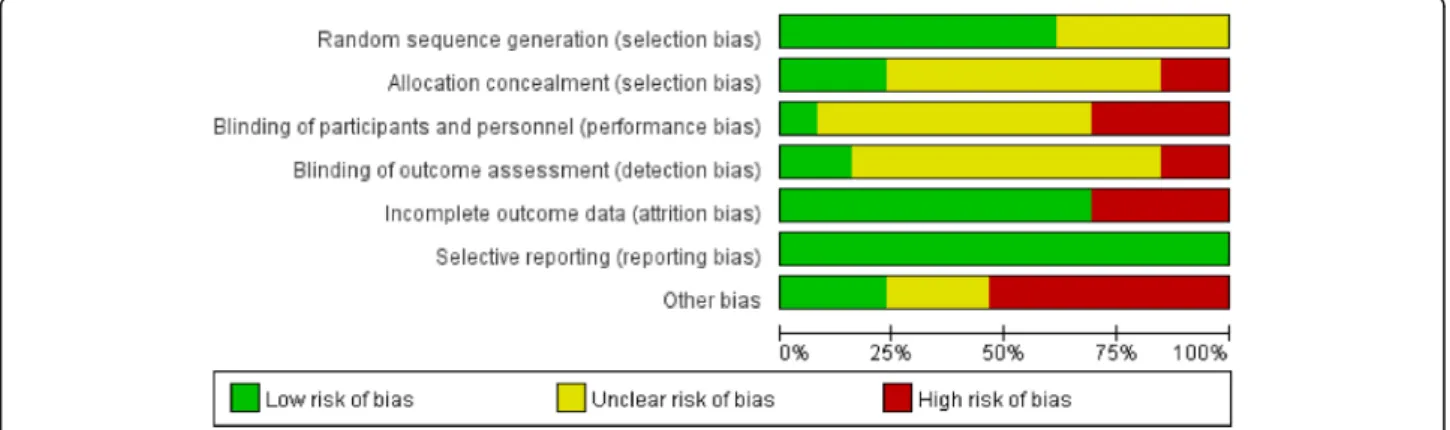
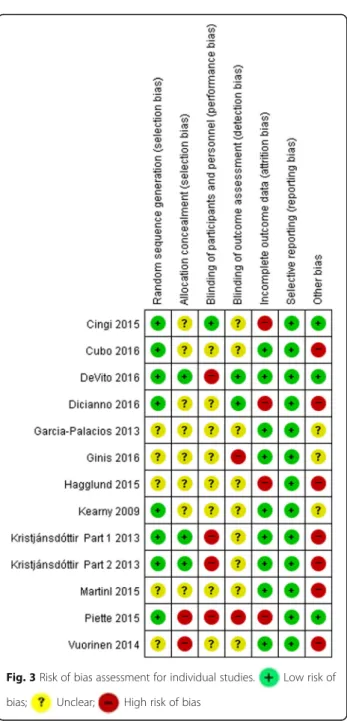
The risk of bias in the reviewed studies is summarized in Fig.2 and shown for individual studies in Fig. 3. The intervention studies generally performed well in their risk of bias for random sequence generation (62% low risk), allocation concealment (23% low risk), blinding of participants and personnel (8% low risk), blinding of outcome assessors (15% low risk), incomplete outcome data (69% low risk), and selective reporting (92% low risk) (Fig.2).
Considering the method of randomization, 5 trials did not present details of randomization [25,27,29,30,33]. Only 2 studies reported use of an adequate allocation concealment method [22, 32]. Although due to the na-ture of the mHealth intervention, it is almost impossible to blind participants and healthcare providers, one study described the blinding of participants by providing the same mobile phone application to both experimental and control groups with different functionalities. The ex-perimental group was given communication, health sta-tus, or medication usage tracking, and a survey questionnaire, whereas the control group received only the survey questionnaire [28]. Only two trials were iden-tified as blinding the outcome assessors. Four trials failed to provide a full description of participants and losses to follow-up during their trials [24,28,29,31]. All studies had a low risk for reporting bias. Devito et al. had low risk for all items except blinding of participants and personnel [32]. Hägglund et al. had low risk only for reporting bias [29] (Fig.3).
Discussion
This systematic review has found a potential favorable effect of mHealth interventions on health outcomes and process measures in patients with chronic diseases in-cluding asthma, cancer, cardiovascular diseases, chronic pain, spina bifida, or Parkinson’s disease. The results from the reviewed RCTs showed improvement in some
health outcomes in patients in managing their chronic disease.
There were some commonalities and differences in using mHealth in the reviewed studies. One of the com-mon features useful in mHealth interventions is pre-set and tailored feedback on reported symptoms. The mo-bile application systems used in the reviewed studies were developed by the study team and validated and refined in the previous studies that were conducted before the RCTs. None of the commercial health apps were used in the reviewed studies. Most studies utilized research staff to provide training in mHealth systems for the participants via face-to-face or information group sessions, or through information materials, while one study [26] used local nurses to train patients. None of the reviewed studies addressed whether their mHealth systems were incorporated into daily medical practice in either clinic settings or acute care hospitals, meaning that there were no signs of their implementa-tion in real health care systems. Challenges in real-life settings may relate to lack of financial incentives for providers in using mHealth tools or uncertainty regard-ing privacy and security of information transferred via mHealth systems [35].
Interventions to promote self-management in
patients with chronic diseases started from web-based and/or telephone-based interventions to mHealth-based interventions. Unlike those previous behavioral interventions limited to places where patients with chronic diseases had access to the treatment advice, mHealth interventions have advanced features such as real-time symptom monitoring and feedback [25, 34, 36]. For example, patients with PD receive real-time feedback on their selected gait parameters during their walks via the preset gait app developed from evidence-based exercise guidelines [25]. This is an example of how using well-designed and validated
mHealth apps in daily life can benefit health
outcomes.
The number of smartphone users has shown great in-creases; in the US [37] it is estimated to reach 224.3 mil-lion in 2017, up from 171 milmil-lion in 2014; worldwide it was [38] 2.32 billion in 2017, up from 1.57 billion in 2014. Approximately 77% of people in the US owned smartphones in 2016 [39]. Using mobile devices for mHealth is essential nowadays and approaches of mHealth vary from sending text messaging for medical appointment reminders to monitoring and assessing symptoms in real-time, virtually at any location via wire-less networks. Interventions using mHealth have also eased medical coaching for caregivers as care partners with healthcare professionals for effective chronic
disease management. Piette et al. [31] studied the com-parative effectiveness of mHealth interventions support-ing HF patients and their family caregivers and showed improvement for medication adherence and caregiver communication. The impact of including caregivers as a part of mHealth users—one of the care supporting groups—on actual patients’ health outcomes should con-tinue to be studied in the context of an increasing aging society.
Moreover, long-term follow-ups of responses from pa-tients and caregivers who have used mHealth need to be evaluated. Areas that need to be studied include the optimum length of time and frequency of the mHealth delivery system as well as type of technology and train-ing. For example, effective frequencies of automated
re-minders or coaching messages, when additional
reminders should be sent, and when people become tired or irritated by automated messages need to be studied. Users of mHealth might experience fatigue from automated reminders and eventually mHealth interven-tions could become ineffective. Other systematic reviews on chronic disease management showed that the fre-quency of input into mHealth systems was a burden on participants and affected the attrition rate [17]. In this review, the length of the intervention in the 12 studies varied from 2 weeks to 12 months; 5 of 12 studies (about 42%) had less than 2-month interventions while 4 stud-ies (about 33%) had 1 year of intervention. The positive health outcomes of the various studies were not directly related to the length of the intervention or training methods of mHealth in the reviewed studies.
One aspect of mHealth approaches that also needs to be considered is effective clinical communication be-tween patients and healthcare professionals who need to respond to patients’ questions via mHealth systems. Cingi et al. [28] reported healthcare providers (i.e., resi-dents) expressed an improvement in communication with patients via mHealth; however, they found that using mHealth tools as the primary method of commu-nication was strongly opposed by the healthcare pro-viders. Vuorinen et al. [33] also reported a significant increase in the communication (i.e., telephone contacts) between nurses and patients which in turn increased the nurses’ workload during the trial. One recommendation for reducing health care providers’ workload in mHealth interventions is using advanced technology to respond to patients’ questions regarding symptoms assessed and reported via the mHealth systems.
While considering positive health outcomes (e.g., re-duction of hospital readmission for HF-related condi-tions or medication adherence) of patients with chronic diseases, burden of healthcare professionals should be measured as an outcome of mHealth interventions. An
adequate triage system can decrease healthcare
Fig. 3 Risk of bias assessment for individual studies. Low risk of
professionals’ response time for emergency needs re-ported by mHealth users [28].
Common recommendations discussed in the studies of this systematic review to improve mHealth interventions include a simple and user-friendly-designed mHealth system, data confidentiality, lay language use for struc-tured and automated feedback or advice, positive motiv-ation and improving engagement [28], and inclusion of patient’s social supporters, such as family members, friends, and/or peers [31].
There are several limitations in this systematic review. First, we only selected randomized controlled trials for this review and most of them were funded studies. Therefore, the mHealth systems or smartphone apps used in the studies were validated and relatively reliable compared to health apps commercially available on the market. Literature from studies on smartphone-based in-terventions for chronic disease management that were small scale with or without control group and/or had a short-term follow-up has shown ambivalent results. Thus, we intended to choose robust studies that used randomization, control groups, and relevant follow-ups for outcomes. We looked at the outcome changes at dif-ferent follow-up points.
Second, we did not include mHealth intervention studies for diabetes management since there is ample lit-erature on diabetes management using mobile technol-ogy approaches [14–17]. Third, we excluded studies wherein health apps were used only by health profes-sionals such as physicians or specialized clinical nurses. We focused on patient-centered health apps as a part of mHealth interventions in the review. Lastly, most of the reviewed studies provided smartphones or tablets to par-ticipating patients and thus, the results from this review cannot yet be generalized among those who have finan-cial concerns regarding purchasing mHealth tools. Al-though the availability of wireless networks is increasing, potential mHealth users such as patients with chronic diseases or their caregivers may have limited data ser-vices for their mobile deser-vices due to financial concerns. This might be an important issue during an emergency when patients may have no access to evidence-based medical advice via mHealth devices.
Conclusion
The findings from the majority of reviewed studies that used mHealth interventions showed some health out-come improvement in patients with chronic disease con-ditions. Favorable factors in mHealth approaches are automated text reminders, frequent and accurate symp-tom monitoring (often in real time), and improved com-munication between patients and healthcare providers resulting in enhanced self-management in patients with chronic conditions. Thus, the future of mHealth is
presumably optimistic. The relationship between engage-ment of users on mHealth tools and outcome improve-ment should be further studied. The studies reviewed in this paper showed disease-specific mHealth interven-tions that might be different from commercial mobile health apps available to the public. Rigorously tested mHealth apps developed through research should be further considered to be made available to the general population.
Additional file
Additional file 1:Title of data: Detailed search strategy per database. Detailed search strategy per database in order to find all published interventions using mobile health applications to improve chronic disease management for adults in randomized controlled trials. (DOCX 21 kb)
Abbreviations
CDC:The US Centers for Disease Control and Prevention; EMA: Ecological
momentary assessment; HF: Heart failure; mHealth: Mobile health;
PD: Parkinson’s disease; RCTs: Randomized controlled trials; UPDRS: Unified
Parkinson’s Disease Rating Scale; US: The United States of America
Acknowledgements
The authors thank Yoori Yang, MSN, College of Nursing, Yonsei University and Laura Narvaez, BS, Sue and Bill Gross School of Nursing at University of California Irvine for their assistance in literature search and abstract reviews. We also thank Dr. Priscilla Kehoe for her thorough editorial support.
Funding Not applicable.
Availability of data and materials Not applicable.
Authors’ contributions
Design of the study protocol: JL, MC; Data collection and analysis: MC, SAL, NJ; Data interpretation: JL, MC, SAL; Drafting the manuscript: JL, MC, SAL, NJ. All authors revised the article critically, gave feedback and approved the final manuscript.
Ethics approval and consent to participate Not applicable.
Consent to publication Not applicable.
Competing interests
The authors declare that they have no competing interests.
Publisher’s Note
Springer Nature remains neutral with regard to jurisdictional claims in published maps and institutional affiliations.
Author details
1Sue and Bill Gross School of Nursing, University of California Irvine, Irvine,
CA, USA.2College of Nursing, Mo-Im Kim Nursing Research Institute, Yonsei
University, 50 Yonsei-ro, Seodaemun-gu, Seoul, Republic of Korea03722.
3College of Nursing and Health Sciences, University of Massachusetts, Boston,
MA, USA.4Program in Public Health, University of California Irvine, Irvine, CA,
Received: 24 June 2017 Accepted: 25 January 2018
References
1. World Health Organization. Noncommunicable diseases country profiles 2014.
2014.http://apps.who.int/iris/bitstream/10665/128038/1/9789241507509_eng.
pdf. Accessed 22 Dec 2017.
2. Ward BW, Schiller JS, Goodman RA. Multiple chronic conditions among US
adults: a 2012 update. Prev Chronic Dis. 2014;11:E62.https://doi.org/10.
5888/pcd11.130389.
3. US Centers for Disease Control and Prevention. Death and Mortality: NCHS
FastStats Web Site. 2013.https://www.cdc.gov/nchs/fastats/deaths.htm.
Accessed 22 Dec 2017.
4. US Agency for Healthcare Research and Quality. Multiple Chronic
Conditions Chartbook: 2010 Medical expenditure panel survey data. AHRQ
Publication No Q14–0038. 2014.https://www.ahrq.gov/sites/default/files/
wysiwyg/professionals/prevention-chronic-care/decision/mcc/mccchartbook. pdf. Accessed 22 Dec 2017.
5. Nolte E, Knai C, McKee M. Managing chronic conditions: experience in eight
countries. 2008.http://www.euro.who.int/__data/assets/pdf_file/0008/
98414/E92058.pdf?ua=1. Accessed 22 Dec 2017.
6. Sharma J. Chronic disease managment in the South-East Asia Region: a
need to do more. WHO South East Asia J Public Health. 2013;2(2):79–82.
https://doi.org/10.4103/2224-3151.122935.
7. Healthcare Information and Management Systems Society. Definitions of
mHealth. 2012.http://www.himss.org/definitions-mhealth. Accessed 22 Dec 2017.
8. Bitsaki M, Koutras G, Heep H, Koutras C. Cost-Effective Mobile-Based
Healthcare System for Managing Total Joint Arthroplasty Follow-Up. Healthc
Inform Res. 2017;23(1):67–73.https://doi.org/10.4258/hir.2017.23.1.67.
9. Hamine S, Gerth-Guyette E, Faulx D, Green BB, Ginsburg AS. Impact of
mHealth chronic disease management on treatment adherence and patient
outcomes: a systematic review. J Med Internet Res. 2015;17(2):e52.https://
doi.org/10.2196/jmir.3951.
10. Park YT. Emerging New Era of Mobile Health Technologies. Healthc Inform
Res. 2016;22(4):253–4.https://doi.org/10.4258/hir.2016.22.4.253.
11. Free C, Phillips G, Felix L, Galli L, Patel V, Edwards P. The effectiveness of
M-health technologies for improving M-health and M-health services: a systematic
review protocol. BMC Res Notes. 2010;3:250.
https://doi.org/10.1186/1756-0500-3-250.
12. Fiordelli M, Diviani N, Schulz PJ. Mapping mHealth research: a decade of
evolution. J Med Internet Res. 2013;15(5):e95.https://doi.org/10.2196/jmir.2430.
13. Widmer RJ, Collins NM, Collins CS, West CP, Lerman LO, Lerman A. Digital
health interventions for the prevention of cardiovascular disease: a
systematic review and meta-analysis. Mayo Clin Proc. 2015;90(4):469–80.
https://doi.org/10.1016/j.mayocp.2014.12.026.
14. de Ridder M, Kim J, Jing Y, Khadra M, Nanan R. A systematic review on
incentive-driven mobile health technology: as used in diabetes management. J
Telemed Telecare. 2017;23(1):26–35.https://doi.org/10.1177/1357633X15625539.
15. Cui M, Wu X, Mao J, Wang X, Nie M. T2DM self-management via
smartphone applications: a systematic review and meta-analysis. PLoS One.
2016;11(11):e0166718.https://doi.org/10.1371/journal.pone.0166718.
16. Sieverdes JC, Treiber F, Jenkins C. Improving diabetes management with
mobile health technology. Am J Med Sci. 2013;345(4):289–95.https://doi.
org/10.1097/MAJ.0b013e3182896cee.
17. Whitehead L, Seaton P. The effectiveness of self-management mobile
phone and tablet apps in long-term condition management: a systematic
review. J Med Internet Res. 2016;18(5):e97.https://doi.org/10.2196/jmir.4883.
18. Liberati A, Altman DG, Tetzlaff J, Mulrow C, Gøtzsche PC, Ioannidis JP, et al.
The PRISMA statement for reporting systematic reviews and meta-analyses of studies that evaluate health care interventions: explanation and elaboration.
PLoS Med. 2009;6(7):e1000100.https://doi.org/10.1371/journal.pmed.1000100.
19. Higgins JPT, Altman DG, Sterne JAC. Chapter 8: Assessing risk of bias in
included studies. In: Higgins JPT, Green S, editors. Cochrane Handbook for
Systematic Reviews of Interventions. 2011.http://handbook-5-1.cochrane.
org/chapter_8/8_assessing_risk_of_bias_in_included_studies.htm. Accessed 22 Dec 2017.
20. Bowen DJ, Kreuter M, Spring B, Cofta-Woerpel L, Linnan L, Weiner D, et al.
How we design feasibility studies. Am J Prev Med. 2009;36(5):452–7.https://
doi.org/10.1016/j.amepre.2009.02.002.
21. Hebert M. Telehealth success: evaluation framework development. Stud
Health Technol Inform. 2001;84(Pt 2):1145–9.
22. Kristjansdottir OB, Fors EA, Eide E, Finset A, Stensrud TL, van Dulmen S, et al.
A smartphone-based intervention with diaries and therapist-feedback to reduce catastrophizing and increase functioning in women with chronic widespread pain: randomized controlled trial. J Med Internet Res. 2013;15(1): e5.https://doi.org/10.2196/jmir.2249.
23. Kristjansdottir OB, Fors EA, Eide E, Finset A, Stensrud TL, van Dulmen S, et al.
A smartphone-based intervention with diaries and therapist feedback to reduce catastrophizing and increase functioning in women with chronic widespread pain. part 2: 11-month follow-up results of a randomized trial. J
Med Internet Res. 2013;15(3):e72.https://doi.org/10.2196/jmir.2442.
24. Dicianno BE, Fairman AD, McCue M, Parmanto B, Yih E, McCoy A, et al.
Feasibility of using mobile health to promote self-management in spina
bifida. Am J Phys Med Rehabil. 2016;95(6):425–37.https://doi.org/10.1097/
phm.0000000000000400.
25. Ginis P, Nieuwboer A, Dorfman M, Ferrari A, Gazit E, Canning CG, et al.
Feasibility and effects of home-based smartphone-delivered automated feedback training for gait in people with Parkinson's disease: a pilot
randomized controlled trial. Parkinsonism Relat Disord. 2016;22:28–34.
https://doi.org/10.1016/j.parkreldis.2015.11.004.
26. Kearney N, McCann L, Norrie J, Taylor L, Gray P, McGee-Lennon M, et al.
Evaluation of a mobile phone-based, advanced symptom management system (ASyMS) in the management of chemotherapy-related toxicity. Support
Care Cancer. 2009;17(4):437–44.https://doi.org/10.1007/s00520-008-0515-0.
27. Garcia-Palacios A, Herrero R, Belmonte MA, Castilla D, Guixeres J, Molinari G,
et al. Ecological momentary assessment for chronic pain in fibromyalgia using
a smartphone: a randomized crossover study. Eur J Pain. 2014;18(6):862–72.
28. Cingi C, Yorgancioglu A, Cingi CC, Oguzulgen K, Muluk NB, Ulusoy S, et al.
The "physician on call patient engagement trial" (POPET): measuring the impact of a mobile patient engagement application on health outcomes and quality of life in allergic rhinitis and asthma patients. Int Forum Allergy
Rhinol. 2015;5(6):487–97.https://doi.org/10.1002/alr.21468.
29. Hägglund E, Lynga P, Frie F, Ullman B, Persson H, Melin M, et al.
Patient-centred home-based management of heart failure. Findings from a randomised clinical trial evaluating a tablet computer for self-care, quality of
life and effects on knowledge. Scand Cardiovasc J. 2015;49(4):193–9.https://
doi.org/10.3109/14017431.2015.1035319.
30. Martin SS, Feldman DI, Blumenthal RS, Jones SR, Post WS, McKibben RA, et
al. mActive: a randomized clinical trial of an automated mHealth intervention for physical activity promotion. J Am Heart Assoc. 2015;4(11).
31. Piette JD, Striplin D, Marinec N, Chen J, Trivedi RB, Aron DC, et al. A mobile
health intervention supporting heart failure patients and their informal caregivers: a randomized comparative effectiveness trial. J Med Internet Res.
2015;17(6):e142.https://doi.org/10.2196/jmir.4550.
32. DeVito Dabbs A, Song MK, Myers BA, Li R, Hawkins RP, Pilewski JM, et al. A
randomized controlled trial of a mobile health intervention to promote
self-management after lung transplantation. Am J Transplant. 2016;16(7):2172–
80.https://doi.org/10.1111/ajt.13701.
33. Vuorinen AL, Leppanen J, Kaijanranta H, Kulju M, Helio T, van Gils M, et al.
Use of home telemonitoring to support multidisciplinary care of heart failure patients in Finland: randomized controlled trial. J Med Internet Res.
2014;16(12):e282.https://doi.org/10.2196/jmir.3651.
34. Cubo E, Mariscal N, Solano B, Becerra V, Armesto D, Calvo S, Arribas J, Seco
J, Martinez A, Zorrilla L, et al. Prospective study on cost-effectiveness of home-based motor assessment in Parkinson's disease. J Telemed Telecare.
2016;23(2):328–38.https://doi.org/10.1177/1357633X16638971.
35. Lee JA, Evangelista LS, Moore AA, Juth V, Guo Y, Gago-Masague S, et al.
Feasibility study of a mobile health intervention for older adults on oral anticoagulation therapy. Gerontol Geriatr Med 2016;2:2333721416672970. doi:https://doi.org/10.1177/2333721416672970.
36. Mera TO, Heldman DA, Espay AJ, Payne M, Giuffrida JP. Feasibility of
home-based automated Parkinson's disease motor assessment. J Neurosci
Methods. 2012;203(1):152–6.https://doi.org/10.1016/j.jneumeth.2011.09.019.
37. Statista. Number of smartphone users in the United States from 2010 to
2022 (in millions). 2017.
https://www.statista.com/statistics/201182/forecast-of-smartphone-users-in-the-us. Accessed 22 Dec 2017.
38. Statista. Number of smartphone users worldwide from 2014 to 2020 (in
billions). 2017.
https://www.statista.com/statistics/330695/number-of-smartphone-users-worldwide. Accessed 22 Dec 2017.
39. Pew Research Center. Record shares of Americans now own smartphones,
have home broadband. 2017.http://www.pewresearch.org/fact-tank/2017/