This content has been downloaded from IOPscience. Please scroll down to see the full text.
Download details:
IP Address: 203.255.172.21
This content was downloaded on 01/11/2016 at 06:23
Please note that terms and conditions apply.
You may also be interested in:
WIMPs search by means of thin NaI(Tl) array K Fushimi, H Kawasuso, E Aihara et al.
Analytic Calculation of Photofractions for NaI(Tl) Scintillation Crystals to Monoenergetic Gamma Rays
Kunio Kaminishi
Dark matter searches with NaI scintillators in the Canfranc underground laboratory: ANAIS experiment
J Amaré, B Beltrán, J M Carmona et al.
Experimental validation of response function of a NaI (Tl) detector modeled with Monte Carlo codes M.T. Hajheidari, M.J. Safari, H. Afarideh et al.
Cosmic-Ray Contribution to the Background of NaI Scintillation Spectrometers Eiichi Tanaka, Susumu Itoh, Toshiyuki Hiramoto et al.
Field Emission Studies of Sodium Iodide and Mercury on Tungsten Hiroshi Washimi
Background study of NaI(Tl) crystals for the KIMS-NaI experiment
View the table of contents for this issue, or go to the journal homepage for more 2016 J. Phys.: Conf. Ser. 718 042001
Background study of NaI(Tl) crystals for the
KIMS-NaI experiment
P Adhikari1, G Adhikari1, S Choi2, C Ha3, I S Hahn4, EJ Jeon3, H W
Joo2, W G Kang3, H J Kim5, H O Kim3, K W Kim2, N Y Kim3, S K
Kim2, Y D Kim1,3, Y H Kim3,6, H S Lee3, J H Lee3, M H Lee3, D S
Leonard3, J Li3, S Y Oh1, S L Olsen3, H K Park3, H S Park6, K S Park3, J H So3, Y S Yoon3
1 Department of Physics, Sejong University, Seoul 05006, Korea
2
Department of Physics and Astronomy, Seoul National University, Seoul 08826, Korea 3
Center for Underground Physics, Institute for Basic Science, Daejeon 34047, Korea
4 Department of Science Education, Ewha Womans University, Seoul 03760, Korea
5
Department of Physics, Kyungpook National University, Daegu 41566, Korea
6 Korea Research Institute of Standards and Science, Daejeon 34113, Korea
Abstract. The DAMA experiment has reported an annual-modulation signal in an array
of low-background NaI(Tl) scintillating crystals that may be caused by WIMP-nucleon interactions. However, to date there has been no direct confirmation of this result that uses the same taget nuclides. The Korea Invisible Mass Search (KIMS) collaboration has been engaged in an extensive R&D program to grow ultra-low background NaI(Tl) crystals for use as a direct test of the DAMA result using same nuclide targets. Six crystals were grown from different powders in order to understand mechanisms of internal background contaminations and to reduce their effects. Studies of internal backgrounds in these crystals were performed with the ultimate goal of reducing internal background contamination levels to 1 dru at 2 keV.
1. Introduction
The Korea Invisible Mass Search (KIMS) experiment searched for weakly interacting massive particles (WIMP) dark matter using an array of ultra-low-background CsI(Tl) crystal detectors at the Yangyang Underground laboratory (Y2L) near the east coast of the Korean peninsula [1,
2]. The DAMA/LIBRA experiment has claimed the observation of an annual modulation
signature similar to that which would be produced by WIMPs [3] while other experiments, including KIMS-CsI [4, 5], reported null results. However, alternative interpretations of the DAMA/LIBRA results as being primarily due to WIMP-sodium nuclei interactions, which would be the case for low-mass WIMPs, cannot be ruled out. Therefore, it is necessary to try to reproduce the DAMA/LIBRA observations with crystal detectors of the same NaI(Tl) composition.
2. The Experimental Setup
We used the Y2L experimental setup that was used for the KIMS-CsI experiment [5, 6] to measure background contamination levels in various NaI(Tl) crystals. This includes a 12-module array of CsI(Tl) crystals inside a shield that consists, from inside out, of 10 cm of copper, 5 cm
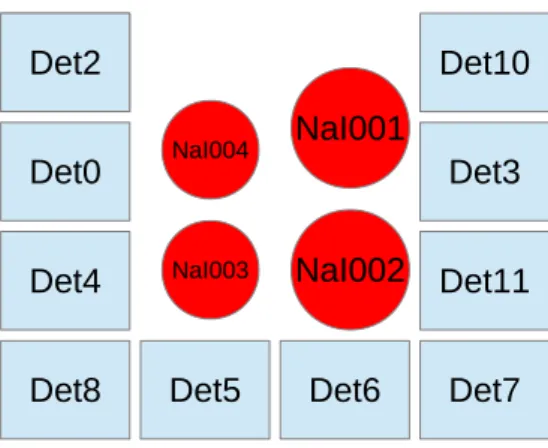
of polyethylene, 15 cm of lead, and 30 cm of liquid-scintillator-loaded mineral oil. This shielding attenuates external neutrons and gamma rays, and vetoes cosmic-ray muons. Six R&D-stage NaI(Tl) crystals were tested inside the CsI(Tl) detector array using a configurations as shown in Fig. 1. Det2 Det10 Det3 Det11 Det7 Det6 Det5 Det8 Det4 Det0 NaI002 NaI001 NaI003 NaI004
Figure 1. Schematic view of the NaI(Tl) (circles) and CsI(Tl) (squares) crystal arrangements used for the measurements reported here. In the later tests, NaI-003 and NaI-004 were replaced by NaI-005 and NaI-006.
Table 1. Specifications of the NaI(Tl) crystals. The “Powder” acronyms are AS-B
(AS-C): Alpha Spectra purified powder, SA-AG: Sigma-Aldrich Astro-Grade powder (reduced K content), SA-CG: Sigma-Aldrich Crystal-Growth powder, and AS-WSII: Alpha Spectra WIMPScint-II grade powder. The names of the crystal growing companies are abbreviated as AS: Alpha-Spectra and BH: Beijing-Hamamatsu. The last two columns are the months the crystals were grown and transported to Y2L.
Crystal Size (D×L) Powder Company T (Growth) T (Y2L)
NaI-001 500 × 700 AS-B AS 2011.9 2013.9 NaI-002 4.200 × 1100 AS-C AS 2013.4 2014.1 NaI-003 4.500 × 3.500 SA-AG AS 2014.4 2014.9 NaI-004 4.500 × 3.500 SA-CG AS 2014.3 2014.9 NaI-005 4.200 × 1100 AS-WSII AS 2014.7 2014.12 NaI-006 4.800 × 8.800 SA-CG BH 2014.10 2015.1
3. Internal Natural Backgrounds
The production of ultralow background crystals requires a comprehensive understaning of
the internal contamination of natural radioisotopes in existing crystals. Table 2 lists the
contamination levels for the six crystals as measured with the test configurations described above.
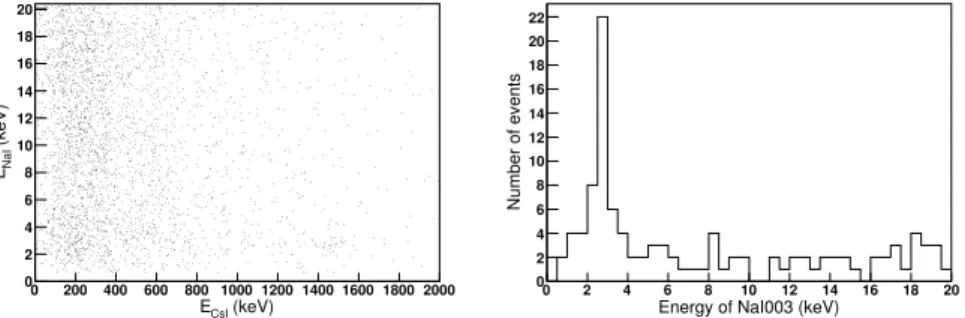
3.0.1. 40K background In our setup, 40K decays are identified by coincidence signals between 1460 keV γ-rays in the CsI(Tl) detectors and 3 keV X-rays in the NaI(Tl). Fig. 2 (left) shows
Table 2. Background rates from internal radioactive contaminants in the NaI(Tl) crystals. Chain equilibrium was assumed for the interpretation of radioactivity measurements related to 238U and 232Th. For the “α Rate”, each alpha particle is counted as one decay.
Crystal natK (40K ) 238U 232Th α Rate Light Yield
(unit) (ppb) (ppt) (ppt) (mBq/kg) (Photoelectrons/keV) NaI-001 40.4 ± 2.9 < 0.02 < 3.2 3.29 ± 0.01 15.6 ± 1.4 NaI-002 48.1 ± 2.3 < 0.12 0.5 ± 0.3 1.77 ± 0.01 15.5 ± 1.4 NaI-003 25.3 ± 3.6 < 0.14 0.5 ± 0.1 2.43 ± 0.01 13.3 ± 1.3 NaI-004 > 116.7 − − − 3.9 ± 0.4 NaI-005 40.1 ± 4.2 < 0.04 0.2 ± 0.1 0.48 ± 0.01 12.1 ± 1.1 NaI-006 > 127.1 < 0.05 8.9 ± 0.1 1.53 ± 0.01 4.4 ± 0.4
a scatter plot of NaI vs CsI energies for coincidence events; the 40K signal is the small island of ∼3 keV NaI(Tl) signals and ∼1460 keV CsI signals. Fig. 2 (right) shows the energy spectrum of events in the NaI crystal that are in coincidence with an E = 1460 ± 150 KeV signal in one of the CsI counters. The 40K background level in each crystal is determined by comparing the measured coincidence rate with a Geant4-simulated rate using the method described in Ref. [6].
(keV) CsI E 0 200 400 600 800 1000 1200 1400 1600 1800 2000 (keV) NaI E 0 2 4 6 8 10 12 14 16 18 20
Energy of NaI003 (keV)
0 2 4 6 8 10 12 14 16 18 20 Number of events 0 2 4 6 8 10 12 14 16 18 20 22
Figure 2. (left) A scatterplot of NaI-003 signals (vertical) versus CsL crytal energys (horizontal) for coincidence events. (right) The NaI-003 crystal’s energy distribution for events in coincidence with a 1460 ± 150 kev γ-ray in one of the CsI crystals. The40K events correspond to the distinct peak near 3 keV in the NaI-003 detector’s energy spectrum.
From these data we determine that NaI-003 crystal, which was grown from SA-AG powder, has a natK contamination level of 25.3 ± 3.6 ppb. This is the lowest natK contamination of all of the six tested crystals and is in good agreement with the vendor’s ICP-MS measurement of 25 ppb for this powder. Due to low light yields from NaI-004 and NaI-006, which were made with SA-CG powder, we are only able to establish lower limits on thenatK contamination levels of more than 100 ppb, consistent with the listed contamination levels for the SA-CG powder.
Based on these measurements, we conclude that the source of 40K contamination in the
NaI(Tl) crystals is mostly from contamination in the NaI powder, and no significant amount of
contamination is introduced during the crystal growing procedure. The natK measurements for
the six crystals are listed in Table 2.
The natK content in the DAMA crystals are in the 10−20 ppb range [11]. Further R&D on procedures for additional potassium reduction in the NaI powder are in progress. In the near future, the potassium background is expected to be reduced to a level lower than the level which was achieved by DAMA/LIBRA.
3.0.2. 238U background Assuming equilibrium in the 238U decay chain, we can evaluate the contamination level in the NaI(Tl) crystals by exploiting the 237 µs mean lifetime of 214Po α-decay, which immediately follows its production via β-decay of 214Bi as described in Refs. [6]. Using pulse shape differences to distinguish betweenα-induced and β-induced events, we can determine238U contamination levels in the six crystals. We found no significant time-dependent exponential components that are a characteristic of 214Po and from this we infer that the 238U background levels in the crystals are all below the ppt level (see Table 2).
3.0.3. 232Th background Contamination from the 232Th decay chain was studied by using
α − α time interval measurements in the crystals. In this case, we looked for a 216Po α-decay component that has a mean decay time of 209 ms that follows its production via the α-decay of 220Rn . Figure 3 (right) shows distributions of the time differences between two adjacent α-induced events in NaI-006, which shows a clear216Po signal. The232Th contents in all of the crystals, inferred assuming chain equilibrium, are listed in Table 2.
s) µ Mean time (
-0.4 -0.2 0 0.2 0.4 0.6 0.8 1 1.2 1.4
Pulse height (arbitrary units)
0 500 1000 1500 2000 2500 3000 t (s) ∆ 0 0.5 1 1.5 2 2.5 3 3.5 4 4.5 5 Number of events 100 200 300 400 500 600
Figure 3. (left) A scatter plot of Mean time (horizontal) versus pulse height(vertical) The distinct island of events with high energies and smaller meantimes are due to α-induced events. (right) The time difference distribution between two successive α-induced events in the NaI-006 crystal.
3.0.4. 210Pb background In the 222Rn decay chain, 210Po ( half life = 138 days), produced
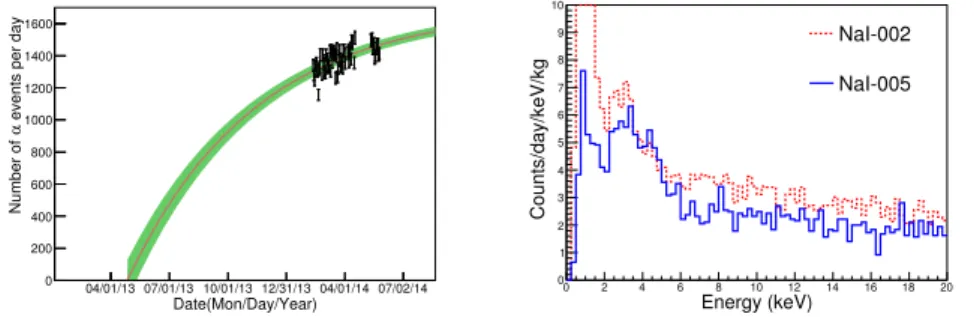
by the beta decay of 210Pb (half life = 22 years) and 210Bi (half life = 5 days), subsequently decays via alpha emission to 206Pb. Thus, at the time that an 222Rn contamination occurs, if the 210Po contamination is zero, it will grow with a characteristic time of τPo = 200 days until an equilibrium is reached. This change in the total alpha rate over time can be used to infer the date that the 222Rn contamination occurred. Figure 4(left) shows the total alpha rates in a crystal as a function of data-taking time (in days).
The210Po alpha activity grows as
Rα(t) ≈ A(1 − e−(t−t0)/τPo), (1)
where t0 is the time when the initial 210Pb contamination occurred, assuming that the
contamination occurred over a single short time period. The fits to the time dependence of the 210Po alpha signals shown in Fig. 4 (left) indicate that t0 occurs around the time that the crystal was grown. However, since the preparation of the NaI powder takes place about two months prior to the crystal growing, it is still possible that some contamination occurred during the powder production procedures.
Date(Mon/Day/Year)
04/01/13 07/01/13 10/01/13 12/31/13 04/01/14 07/02/14
events per day
α Number of 0 200 400 600 800 1000 1200 1400 1600 Energy (keV) 0 2 4 6 8 10 12 14 16 18 20 Counts/day/keV/kg 0 1 2 3 4 5 6 7 8 9 10 NaI-002 NaI-005
Figure 4. (left) The measured increases in alpha activity is fitted to a model that assumes a single, instantaneous 210Po contamination event occurred for each crystal. (right) Background event spectra for energies below 20 keV in the NaI-002 (red line) and NaI-005 (blue line) crystals.
3.0.5. Background summary Figure 4 (right) shows a comparison of background levels in the
NaI-002 and NaI-005 crystals. The factor of three reduction of210Pb that is observed in NaI-005 compared to that for NaI-002 encourages us to expect to be able to achieve a 2 dru (differential
rate unit = counts/day/keV/kg) background level at 6 keV. Below 6 keV, 40K X-rays and
cosmogenic activations of I, Te, and 22Na isotopes are the main contributors to the remaining background. These cosmogenically activated backgrounds are expected to disappear after a year deep underground at Y2L [14].
To understand background contributions from internal radioisotopes, we used Geant4-based
Monte-Carlo simulations. From these we determine that a 40 ppb contamination of natK in
NaI-005 produces a background count rate of approximately 0.7 dru in the 2−4 keV energy range. This will be further reduced in crystals grown from a different batch of an SA-AG powder (10 ppb) or by using an AS-WSIII powder (16 ppb) for future crystals. The submersion of the crystal array in a surrounding liquid scintillating veto system (LSV) will further reduce backgrounds from40K events and bring this background contribution to below the 0.2 dru level. For the 210Pb contaminations in the crystals, the contribution to the total background in NaI-005 is already at about the 0.5 dru level for energies below 10 keV. The development of chemical purification techniques using ion-exchange resins to remove210Pb from the NaI powder would lead to an additional reduction of the210Pb background by a factor of two (to less than 0.3 dru).
4. Conclusion
We procured and tested six NaI(Tl) crystals as part of a program to develop
ultra-low-background NaI(Tl) crystals for WIMP searches. We have reduced the 210Pb and
40K backgrounds in some crystals and have achieved a 2 dru background level for recoil energies around 6 keV. Additional powder purification procedures and the implementation of an LSV system should further reduce the background level to about 1 dru.
Acknowledgments
This research was funded by the Institute for Basic Science (Korea) under project code IBS-R016-D1 and was supported by the Basic Science Research Program through the National Research Foundation of Korea funded by the Ministry of Education (NRF-2011-35B-C00007). References
[1] Kim Y et al 2005 Nucl.Instrum.Meth.A. 552 456 [2] Lee H et al 2005 Nucl.Instrum.Meth.A. 571 644
[3] Bernabei R et al (DAMA/LIBRA Collaboration) 2010 Eur. Phys. J. C 67 39 [4] Lee H et al (KIMS Collaboration) 2007 Phys. Rev. Lett. 99 091301
[5] Kim S et al (KIMS Collaboration) 2012 Phys. Rev. Lett. 108 181301 [6] Kim K et al 2015 Astropart. Phys. 62 249
[7] Aoruke E et al (XENON100 Collaboration) 2012 Phys. Rev. Lett. 109 181301 [8] Akerib D et al (LUX Collaboration) 2014 Phys. Rev. Lett. 112 091303 [9] Agness R et al (CDMS Collaboration) 2014 Phys. Rev. Lett. 112 041302 [10] Lee H et al (KIMS Collaboration) 2006 Phys. Lett. B 633 201
[11] Bernabei R et al 2008 Nucl. Instrum. Methods Phys. Res., Sect. A 592 3 [12] Gerbier G et al 1999 Astropart. Phys. 11 287
[13] Lee H et al 2014 JINST 9 P11015
[14] Amare J et al 2015 J. Cosmol. Astropart. Phys. 1502 046