http://dx.doi.org/10.5012/bkcs.2011.32.9.3290
Salen-Aluminum Complexes as Host Materials for Red Phosphorescent
Organic Light-Emitting Diodes
Hye Jin Bae, Kyu Young Hwang, Min Hyung Lee,†,* and Youngkyu Do* Department of Chemistry, KAIST, Daejeon 305-701, Korea. *E-mail: [email protected]
†Department of Chemistry and Energy Harvest-Storage Research Center, University of Ulsan, Ulsan 680-749, Korea *E-mail: [email protected]
Received June 11, 2011, Accepted July 20, 2011
The properties of monomeric and dimeric salen-aluminum complexes, [salen(3,5-tBu)2Al(OR)], R = OC6H4 -p-C6H6 (H1) and R = [salen(3,5-tBu)AlOPh]C(CH3)2 (H2) (salen = N,N'-bis-(salicylidene)-ethylenediamine) as host layer materials in red phosphorescent organic light-emitting diodes (PhOLEDs) were investigated.H1 and H2 exhibit high thermal stability with decomposition temperature of 330 and 370 °C. DSC analyses showed that the complexes form amorphous glasses upon cooling of melt samples with glass transition temperatures of 112 and 172 °C. The HOMO (ca. −5.2 ~ −5.3 eV) and LUMO (ca. −2.3 ~ −2.4 eV) levels with a triplet energy of ca. 1.92 eV suggest that H1 and H2 are suitable for a host material for red emitters. The PhOLED devices based on H1 and H2 doped with a red emitter, Ir(btp)2(acac) (btp = bis(2-(2'-benzothienyl)-pyridinato-N,C3; acac = acetylacetonate) were fabricated by vacuum-deposition and solution process, respectively. The device based on vacuum-deposited H1 host displays high device performances in terms of brightness, luminous and quantum efficiencies comparable to those of the device based on a CBP (4,4'-bis(N-carbazolyl)biphenyl) host while the solution-processed device with H2 host shows poor performance. Key Words : Salen-aluminum complex, Host materials, Red phosphorescence, OLEDs
Introduction
Organic light-emitting devices with phosphorescent emitters doped into host materials (PhOLEDs) have been extensively investigated due to their high internal quantum efficiency up to 100% of a theoretical value from contribution of both singlet and triplet excitons for light-emission.1-7 Phosphore-scent emitters doped into host materials are also found to reduce saturation of emissive sites and triplet-triplet annihi-lation. Along with heavy metal complexes which constitute the majority of phosphorescent emitters in PhOLEDs due to their high quantum efficiency, the selection of a proper host material is also regarded as important to achieve high efficiency in PhOLEDs. The host materials for PhOLEDs should possess higher triplet energy than guest materials to prevent reverse energy transfer from the guest to the host and high thermal stability to form stable amorphous films.
4,4'-Bis(N-carbazolyl)biphenyl (CBP)8,9 is one of the popular host materials in the PhOLED reported so far. Despite its high efficiency in green PhOLEDs, however, CBP host utilized in red PhOLEDs has often caused low efficiencies and high driving voltages10 mainly owing to the poor matching of energy levels between CBP and adjacent hole- and electron-transporting layers, resulting in deep charge trapping in the emitting layer.11-13 To circumvent this problem, novel host materials based on organometallic com-plexes have been reported in red PhOLEDs. For example, zinc complex supported by bis[2-(2-benzothiazoyl)pheno-late ligand showed improved driving voltage, efficiency, and device lifetime.14 We have recently demonstrated that the
penta-coordinated salen-Al complexes (salen = N,N'-bis-(salicylidene)-ethylenediamine) can be used as good hole-blocking materials15 as well as emitting layer materials16 in OLEDs. Particularly, we have found that salen-Al moiety can act as a host in the dopant assembly OLEDs based on heterodinuclear Al/Ir complex through efficient energy transfer from the salen-Al moiety to the Ir(III) emitter.17 These versatile uses of salen-Al complexes as layer materials in OLEDs could be mainly attributable to their proper HOMO and LUMO energy levels (ca. −5.4 and −2.3 eV), high thermal stability, and high PL efficiency. In a continu-ous effort to utilize the salen-Al complexes in OLEDs, we have set out to investigate whether the salen-Al complexes could act as host materials in red PhOLEDs.
In this report, monomeric [salen(3,5-tBu)2Al(OR)], R = C6H4-p-C6H6 (H1) and dimeric [salen(3,5-tBu)2Al(OR)], R
= [salen(3,5-tBu)AlOPh]C(CH
3)2 (H2) were investigated as host materials for red PhOLEDs. A device fabricated with H1 host by vacuum deposition in combination with Ir(btp)2 -(acac) (btp = bis(2-(2'-benzothienyl)-pyridinato-N,C3); acac = acetylacetonate)7 as a red emitter shows improved maximum current efficiency of 32.15 cd·A−1 when compared with the reference device based on CBP host. Particularly, since solution processed PhOLEDs are advantageous in terms of easy and low-cost scalable process,18-21 H2 host was utilized as host material for a solution-processed red phosphorescent device. Details of synthesis, characterization, and utilization of H1 and H2 as host materials in red PhOLEDs are described.
Experimental Section
General Considerations. All operations were performed under an inert nitrogen atmosphere using standard Schlenk and glove box techniques. Anhydrous grade solvents (Aldrich) were dried by passing through an activated alumina column and stored over activated molecular sieves (5 Å). Spectro-photometric-grade chloroform was used as received from Aldrich. Commercial reagents were used without any further purification after purchasing from Aldrich (3,5-Di-tert-butyl-2-hydroxybenzaldehyde, ethylenediamine, trimethyl-aluminum (2.0 M solution in toluene), 4-phenylphenol, bisphenol A. H1 was prepared according to the previously reported procedures by our group.15,16 CDCl
3 from Cam-bridge Isotope Laboratories was used after drying over activated molecular sieves (5 Å). NMR spectra of compounds were recorded on a Bruker Avance 400 spectrometer (400.13 MHz for 1H, 100.62 MHz for 13C) at ambient temperature. Chemical shifts are given in ppm, and are referenced against external Me4Si (1H, 13C). Elemental analyses were perform-ed on an EA1110 (FISONS Instruments) by the Environ-mental Analysis Laboratory at KAIST. Thermogravimetric analyses (TGA) were carried out under a nitrogen atmos-phere at a heating rate of 10 °C/min with a Dupont 9900 Analyzer. The melting transition (Tm) and glass transition (Tg) temperatures were measured by differential scanning calorimetry (DSC, TA Instrument Q100) at heating and cooling rates of 10 oC·min−1. UV-vis and emission spectra were recorded on a Jasco V-530 and a Spex Fluorog-3 Luminescence spectrophotometer, respectively, in CHCl3 solvent with a 1-cm quartz cuvette at ambient temperature. Cyclic voltammetry experiment was performed using an AUTOLAB/PGSTAT12 system.
Synthesis of [(3,5-Di-tBu)salenAlOPh]2C(CH3)2 (H2). A solution of (3,5-di-tBu)2salen (2.0 mmol) in 30 mL of toluene was treated with 1.1 equiv of trimethylaluminum (1.1 mL) at −78 °C. The reaction mixture was slowly allowed to warm to room temperature and then refluxed for 1 h. After cooling to ambient temperature, the solvent was removed under reduced pressure. Washing with n-hexane followed by drying in vacuo afforded the Al precursors (P1). Next, the solution of bisphenol A (0.25 g, 0.5 mmol) in 10 mL of toluene was added to the solution of P1 (1 mmol) in
20 mL of toluene via cannula. The reaction mixture was refluxed at 110 °C for 4 h. After cooling, the yellow pre-cipitate was filtered off, washed with Et2O and n-hexane, and finally dried in vacuum. Yield: 72%. 1H NMR (CDCl
3): δ 8.29 (s, 4H), 7.49 (d, J = 2.6 Hz, 4H), 6.97 (d, J = 2.5 Hz, 4H), 6.58 (d, J = 8.6 Hz, 4H), 6.18 (d, J = 8.6 Hz, 4H), 3.97 (m, 4H), 3.63 (m, 4H), 1.46 (s, 36H), 1.32 (s, 6H), 1.28 (s, 36H). 13C NMR (CDCl 3): δ 169.85, 163.39, 157.68, 140.97, 139.84, 138.18, 130.76, 126.98, 126.83, 118.61, 118.35, 54.95, 40.98, 35.57, 33.97, 31.37, 31.17, 29.73. Anal. Calcd for C79H106Al2N4O6: C, 75.21; H, 8.47; N, 4.44. Found C 76.04, H 8.63, N 4.62. TGA: Td5 = 481 °C. DSC: Tm = 275 °C, Tg = 172 °C.
Cyclic Voltammetry. Cyclic voltammetry measurements were carried out with a three-electrode cell configuration consisting of platinum working and counter electrodes and a Ag/AgNO3 (0.1 M in acetonitrile) reference electrode at room temperature. The solvent was acetonitrile and 0.1 M tetrabutylammonium hexafluorophosphate was used as the supporting electrolyte. The oxidation potentials were record-ed at a scan rate of 50 mV·s−1 and reported with reference to the ferrocene/ferrocenium (Fc/Fc+) redox couple.
Fabrication of Electroluminescence Devices. EL devices A and B having the following configurations were fabri-cated: ITO/NPB/H1 or CBP: Ir(btp)2(acac)/BCP/Alq3/LiF/ Al. The OLEDs were fabricated by thermal evaporation onto a cleaned glass substrate precoated with indium tin oxide (ITO) without breaking the vacuum. Prior to organic layer deposition, the ITO substrates were exposed to UV-ozone flux for 20 min following degreasing in isoprophylalcohol. NPB (40 nm), H1 or CBP:Ir(btp)2(acac) (8 wt %, 30 nm), BCP (10 nm), Alq3 (40 nm), LiF (1 nm), Al (100 nm) were grown by thermal evaporation at the base pressure of < 5 × 10⁻⁷ torr (deposition rates: NPB, BCP, Alq3 = 1 Å/s, LiF = 0.1 Å/s, Al electrode = 3 Å/s). All the materials were purified using train sublimation before use. EL devices C having the following configurations were fabricated: ITO/ PEDOT:PSS/H2:Ir(btp)2(acac)/BCP/Alq3/LiF/Al. PEDOT used as a hole-injection layer was spin-coated onto pre-cleaned ITO (60 min baking at 120 oC). EML (H2 and Ir(btp)2(acac)) was fabricated by spin coating from a 1,2 dichloroethane solution at the rate of 2,500 rpm, which was then subjected to baking at 80oC for 30 min. The film thickness of the EML was determined with a TENCOR alpha-step 500 profiler and was estimated to be 30 nm. BCP (20 nm), Alq3 (30 nm), LiF (1 nm), and Al (100 nm) were successively deposited on top of the EML using the vacuum evaporation method under vacuum (~7× 10⁻⁷ torr) (deposi-tion rate: BCP, Alq3 = 1 Å/s, LiF = 0.11 Å/s, Al electrode = 3 Å/s). EL spectra were obtained with a PR-650 spectrometer. Current-voltage and luminance-voltage characteristics were recorded on a current-voltage source (Keithley 237) and a luminescence detector (PR-650).
Results and Discussion
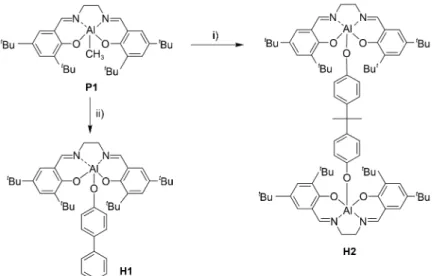
the salen-Al complexes H1 and H2 is shown in Scheme 1. The preparation of H1 was followed by the procedure reported previously by us15,16 and H2 was also analogously synthesized by the reaction of salen-Al precursor and bisphenol A in a 2:1 molar ratio. H2 was obtained as air-stable yellow powder in good yield (72%). The formation of H2 has been confirmed by 1H and 13C NMR spectroscopy and elemental analysis.
The thermal properties of the complexes were investigated by thermogravimetric analysis (TGA) and differential scann-ing calorimetry (DSC). Both complexes exhibit high Td5 of 330 and 371 oC, respectively, (Figure 1) and have high glass transition temperature (Tg) of 112 and 172 oC (Figure 2) that are much higher than that of CBP (62oC).22 The high thermal stability of H1 and H2 appears to be originated from both the steric protection of the Al-center by tert-butyl groups and the penta-coordinate bonding nature around the Al center. The higher Td and Tg values of dimeric H2 than those of H1 and other monomeric salen-Al complexes16 is in accordance with the steric bulkiness of H2 that can restrict molecular motion. Particularly, both complexes form amorphous glasses upon cooling of melt samples, which was also confirmed by
the absence of melting transitions in the second heating DSC curve, pointing to good film forming capability and thus reduction of the possibility of phase separation upon heat-ing.23,24
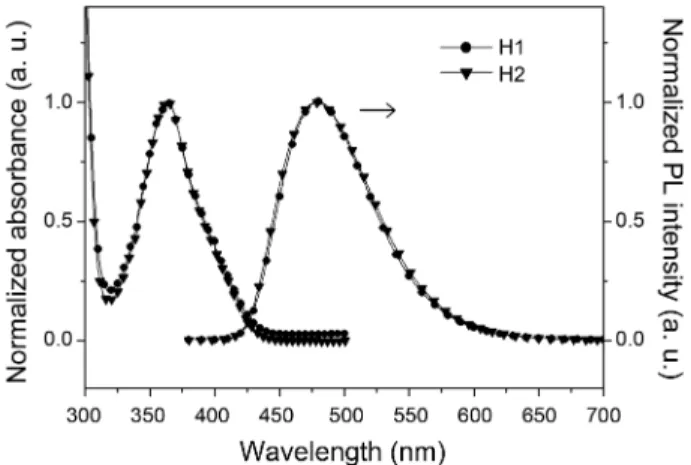
The optical properties of H1 and H2 were investigated by means of UV-vis absorption and photoluminescence (PL) spectroscopy (Figure 3 and Table 1). H1 and H2 exhibit almost the same absorption features with maximum absorp-tion around at 364 nm attributable to π-π* transitions of salen-moiety.16,26 The identical emission features are also observed with the same maximum emission wavelength around at 480 nm. The similar optical properties of H1 and H2 indicate that the salen-Al fragments of H2 are electro-nically isolated due to the absence of π conjugation via bisphenol A bridging ligand.
The HOMO and LUMO energy levels of H1 and H2 were estimated from the optical band gaps and oxidation onset potentials measured by UV-vis absorption and cyclic volt-ammetry (CV). The HOMO and LUMO energy levels and hence the band gap (Eg = 2.9 eV) of both complexes are found to be similar as listed in Table 1. The HOMO levels of
Scheme 1. Synthesis of H1 and H2. Reaction conditions: i) 4-phenylphenol, reflux, 4 h/toluene, 79%; ii) bisphenol A, reflux, 4 h/toluene, 72%.
Figure 1. TGA curves of H1 and H2. Figure 2. (a) The first and (b) second heating DSC curves of H2 at 10 °C/min.
H1 and H2 (−5.3 and −5.2 eV, respectively) are closer to that of NPB ( N,N'-bis(naphthalene-1-yl)-N,N'-bis(phenyl)-benzi-dine) hole-transporting material (ca. −5.4 eV)28 than that of CBP (ca. −6.0 eV). Thus, the hole injection from an NPB layer into an salen-Al host could be more facile than the injection into a CBP. Since the Eg values (2.9 eV) of H1 and H2 are smaller than that of CBP27 (3.1 eV), it is also expected that OLED devices with H1 and H2 as a host may prevent deep charge trapping in the emitting layer. Being consistent with this result, the triplet energy levels (ET ) of both complexes are estimated to be about 1.92 eV, which is well matched with that of red phosphorescent Ir(btp)2(acac) (ET = 2.0 eV).29 Comparison with the high ET of CBP (ca. 2.56 eV)4 indicates that the triplet energy transfer from H1 and H2 host to the red dopant could occur much effectively.
OLED Performance. In order to test the host capability of H1 and H2, red PhOLED devices (devices A-C) were fabricated and their performances were evaluated. Device A which adopts H1 as a host was fabricated by vacuum deposition. Device B with a CBP host was also compared as a reference device of H1 host. Devices A and B have been constructed in the following configuration: ITO/NPB (40 nm)/A or B:Ir(btp)2(acac) (8 wt %, 30 nm)/BCP (10 nm)/ Alq3 (40 nm)/LiF(1 nm)/Al (100 nm) (BCP = bathocuproine, Alq3 = tris(8-hydroxyquinolinolato)aluminium). In the case of device C with H2 host, the hole-injection and active layers were constructed by spin-coating: ITO/PEDOT:PSS
(40 nm)/C:Ir(btp)2(acac) (12 wt %, 30 nm)/BCP (20 nm)/ Alq3 (30 nm)/LiF (1 nm)/Al (100 nm) (PEDOT:PSS = poly-(3,4-ethylenedioxythiophene):poly(styrenesulfonate)).
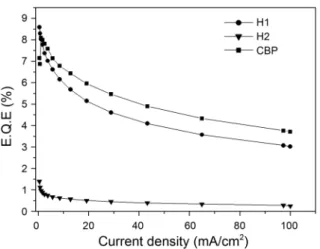
As shown in Figure 4, all the devices A-C emitted an almost same red light typical of Ir(btp)2(acac)-based OLEDs featuring the electroluminescence (EL) spectra with an emission maximum λem of 620 nm (CIE coordinates of x = 0.67, y = 0.32 for devices A and B and x = 0.66, y = 0.33 for device C). This result indicates that H1 and H2 properly function as host materials for the red emission of Ir(btp)2 -(acac). Moreover, the absence of any emission from H1 and H2 host materials in the devices A and C indicates the complete energy transfer from H1 and H2 host to Ir(btp)2 -(acac). According to the luminous efficiency-current density-luminance characteristics of devices shown in Figure 5, device A with H1 host exhibits a maximum luminous efficiency (ηL) of 32.15 cd·A−1 which is higher than that of device B with CBP host (21.15 cd·A−1). At the luminance of 100 cd·m−2, the luminous efficiency of device A (7.26 cd·A−1) is also higher than that of device B (7.0 cd·A−1). Further-more, the overall high external quantum efficiency (ηEQE) is also observed for device A (max. ηEQE = 8.59%) in a wide range of current density although it is somewhat lower than that for device B (Figure 6). The high performance of device
Table 1. Optical, electrochemical, and thermal data for H1 and H2 λabs (nm)
(log ε)a λ(η)em/nma,b HOMO(eV)c LUMO(eV) (eV)ETd (°C)Tde (°C)Tgf H1 (4.04)364 (0.31)480 −5.3 −2.4 1.92 330 112 H2 (4.30)363 (0.31)481 −5.2 −2.3 1.92 371 172 aCHCl
3 solution. (1.0 × 10⁻⁵ M). bηrel is the relative PL efficiency with
respect to that (0.55) of quinine sulfate.25cHOMO energy levels were determined from the oxidation potentials measured by cyclic voltam-metry in CH2Cl2. dTriplet energy level from a phosphorescence peak measured at 77 K. eAt a heating rate of 10 °C·min−1 under N2. fAt heating and cooling rates of 10 oC·min−1.
Figure 3. UV-vis absorption and emission spectra of H1 and H2 in CHCl3 solution (1.0 × 10⁻⁵ M).
Figure 4. EL spectra of devices A-C incorporating H1, CBP, and H2 as a host material, respectively.
Figure 5. Luminous efficiency-current density-luminance charac-teristics for devices A-C.
A with H1 host could be related to the proper ET as well as HOMO and LUMO levels of H1 for red phosphorescent emitter. On the other hand, device C with H2 host shows a maximum luminous efficiency of 0.737 cd·A−1 and a maximum external quantum efficiency of 1.39%, all of which however are much lower than those of devices A and B. These results indicate that the spin-coated H2 complex can function as host materials for red emission, but the overall performance is poorer than those of devices fabri-cated by vacuum deposition.
In summary, we have demonstrated that salen-aluminum complexes possess a relatively narrow band gap and high thermal stability that are suitable for host material in red PhOLEDs. The PhOLED devices based on salen-aluminum complexes doped with Ir(btp)2(acac) can be fabricated by both deposition and solution process. The vacuum-deposited device containing monomeric H1 host display high device performances in terms of brightness and luminous and external quantum efficiencies comparable to those of the CBP-based device. However, the solution-processed device based on dimeric H2 host showed poor device performances.
Acknowledgments. Financial supports from the National Research Foundation of Korea (No. 2010-0008264 for Y. Do and No. 2010-0007796 for M.H. Lee) and the Priority Research Centers Program of the NRF (No. 2009-0093818 for M.H. Lee) is gratefully acknowledged. We would like to thank Dongwoo Fine-Chem Co. for assisting with the EL measurements.
References
1. Baldo, M. A.; O’Brien, D. F.; You Y.; Shoustikov, A.; Sibley, S.; Thompson, M. E.; Forrest, S. R. Nature (London) 1998, 395, 151. 2. Wong, W.-Y.; Ho, C.-L.; Gao, Z.-Q.; Mi, B.-X.; Chen, C.-H.;
Cheah, K.-W.; Lin, Z. Angew. Chem. Int. Ed. 2006, 45, 7800. 3. Ikai, M.; Tokito, S.; Sakamoto, Y.; Suzuki, T.; Taga, Y. Appl. Phys.
Lett. 2001, 79, 156.
4. Adachi, C.; Kwong, Djurovich, R. P.; Adamovich, V.; Baldo, M. A.; Thompson, M. E.; Forrest, S. R. Appl. Phys. Lett. 2001, 79, 2082.
5. Kwong, R. C.; Nugent, M. R.; Michalski, L.; Ngo, T.; Rajan, K.; Tung, Y.-J.; Weaver, M. S.; Zhou, T. X.; Hack, M.; Thompson, M. E.; Forrest, S. R.; Brown, J. J. Appl. Phys. Lett. 2002, 81, 162. 6. Ren, X.; Li, J.; Holmes, R. J.; Djurovich, P. I.; Forrest, S. R.;
Thompson, M. E. Chem. Mater. 2004, 16, 4743.
7. Lamansky, S.; Djurovich, P.; Murphy, D.; Abdel-Razzaq, F.; Lee, H.-E.; Adachi, C.; Burrows, P. E.; Forrest, S. R.; Thompson, M. E. J. Am. Chem. Soc. 2001, 123, 4304.
8. O’Brien, D. F.; Baldo, M. A.; Thompson, M. E.; Forrest, S. R. Appl. Phys. Lett. 1999, 74, 442.
9. Baldo, M. A.; Lamansky, S.; Burrows, P. E.; Thompson, M. E.; Forrest, S. R. Appl. Phys. Lett. 1999,75, 4.
10. Adachi, C.; Baldo, M. A.; Forrest, S. R.; Lamansky, S. L.; Thomapson, M. E.; Kwong, R. C. Appl. Phys. Lett. 2001, 78, 1622.
11. Tsuzuki, T.; Tokito, S. Adv. Mater. 2007, 90, 276.
12. Jeon, W.-S.; Park, T.-J.; Park, J.-J.; Pode, R.; Jang, J.; Kwon, J.-H. Org. Electron. 2009, 10, 240.
13. Gong, X.; Ostrowski, J. C.; Moses, D.; Bazan, G. C.; Heeger, A. J. Adv. Funct. Mat. 2003, 13, 439.
14. Kanno, H.; Ishikawa, K.; Nishio, Y.; Endo, A.; Adachi, C.; Shibata, K. Appl. Phys. Lett. 2007, 90, 123509.
15. Hwang, K. Y.; Lee, M. H.; Jang, H.; Sung, Y.; Lee, J. S.; Kim, S. H.; Do, Y. Dalton Trans. 2008, 1818.
16. Hwang, K. Y.; Kim, H.; Lee, Y. S; Lee, M. H.; Do, Y. Chem. Eur. J. 2009, 15, 6478.
17. Huh, J. O.; Lee, M. H.; Jang, H.; Hwang, K. Y.; Lee, J. S.; Kim, S. H.; Do, Y. Inorg. Chem. 2008, 47, 6566.
18. Ho, C.-L.; Wong, W.-Y.; Gao, Z.-Q.; Chen, C.-H.; Cheah, K.-W.; Yao, B.; Xie, Z. Y.; Wang, Q.; Ma, D. G.; Wang, L. X.; Yu, X.-M.; Kwok, H.-S.; Lin, Z. Y. Adv. Funct. Mater. 2008, 18, 319. 19. Ge, Z. Y.; Hayakawa, T.; Ando, S.; Ueda, M.; Akiike, T.; Miyamoto,
H.; Kajita, T.; Kakimoto, M. Adv. Funct. Mater. 2008, 18, 584. 20. Rehmann, N.; Hertel, D.; Meerholz, K.; Becker, H.; Heun, S.
Appl. Phys. Lett. 2007, 91, 103507.
21. Hou, L. D.; Duan, L.; Qiao, J.; Li, W.; Zhang, D. Q.; Qiu, Y. Appl. Phys. Lett. 2008, 92, 263301.
22. Tsai, M.-H.; Hong, Y.-H.; Chang, C.-H.; Su, H.-C.; Wu, C.-C.; Matoliukstyte, A.; Simokaitiene, J.; Grigalevicius, S.; Grazulevicius, J. V.; Hsu, C.-P. Adv. Mater. 2007, 19, 862.
23. Santerre, F.; Bedjia, I.; Dodelet, J. P. Chem. Mater. 2001, 13, 1739. (b) Liou, G.-S.; Hsiao, S.-H.; Chen, W.-C.; Yen, H. J. Macromolecules 2006, 39, 6036.
24. Cozzi, P. G.; Dolci, L. S.; Garelli, A.; Montalti, M.; Prodi, L.; Zaccheroni, N. New J. Chem. 2003, 27, 692.
25. Melhuish, W. H. J. Phys. Chem. 1961, 65, 229.
26. Jegier, J. A.; Muñoz-Hernández, M.-Á.; Atwood, D. A. J. Chem. Soc., Dalton Trans. 1999, 2583.
27. Gao, Z. Q.; Mi, B. X.; Tam, H. L.; Cheah, K. W.; Chen, C. H.; Wong, M. S.; Lee, S. T.; Lee, C. S. Adv. Mater. 2008, 20, 774. 28. Tseng, R. J.; Chiechi, R. C.; Wudl, F.; Yang, Y. Appl. Phys. Lett.
2006, 88, 093512.
29. Sudhakar, M.; Djurovich, P. I.; Hogen-Esch, T. E.; Thompson, M. E. J. Am. Chem. Soc. 2009, 125, 7796.
Figure 6. External quantum efficiency-current density characteri-stics for devices A-C.