© Korean Powder Metallurgy Institute 1181
-1. Introduction
The glass-ceramic method is used for precipitating crystalline phases in glass matrix by heating the glass. The advantages of this method are that the crystal forms at a lower temperature than it does in the case of a solid-state reaction and that controlling the grain size is relatively easy. In the case of ferrites, the idiomorphic fine powder of the target crystal is obtained by leaching a glass matrix with a dilute HCl solution after the heat treatment for crystal-lization.
We showed recently that Y-type barium ferrite (Ba2Zn2Fe12O22) powder was obtained by the glass-ceramic method.1 However, the details of the formation mechanism were not fully clarified. The purpose of the present study is to present basic data on formation mechanism of Y-type Ba-hexaferrite prepared by the glass-ceramic method.
2. Experimental Procedure
The glass composition used in this study was 0.1ZnO・ 0.9(0.3Fe2O3・0.5BaO・0.2B2O3). The glass was prepared from reagent-grade BaCO3, ZnO, Fe2O3, and B2O3 by melting the mixture in a platinum crucible at 1623 K for 2 h in air. The melt was poured onto a stainless-steel plate and pressed immediately with a stainless-steel iron to obtain glass flakes. The glass transition temperature (Tg) and
crystallization temperature of the glass samples were estimated by the differential thermal analysis (DTA). The glass specimens were heated at temperatures between 823 and 1173 K for 2 h in air. The crystalline phases precipated by heating glass specimens were identified by X-ray diffraction (XRD) with CuK radiation. In addition, High
temperature X-ray diffraction (HT-XRD) was used for phase identification at elevated temperatures between 293 and 1123 K.
3. Result and Discussion
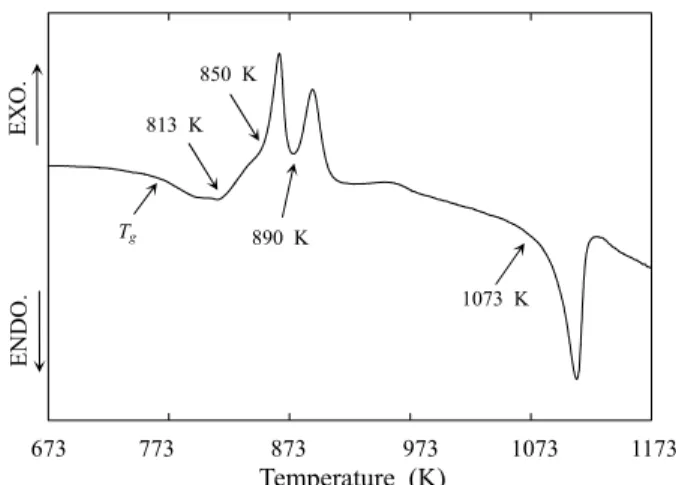
Fig. 1 shows the DTA curve obtained from a glass specimen. Three exothermic peaks and an endothermic peak were clearly visible above the glass transition temperature, Tg. The three
exothermic peaks between 813 and 973 K suggested precipitation of at least three kinds of crystalline phases. The endothermic peak at 1073 K suggested the melting of crystalline phases that precipitate at low temperatures.
2006 POWDER METALLURGY World Congress PC09-W-09 400673 773 873 973 1073 1173 500 600 700 800 900 Temperature (K) Tg 813 K 890 K 1073 K 850 K EXO. ENDO .
Fig. 1. Differential thermal analysis curve of a glass Specimen.
Formation Mechanism of Y-type Barium Ferrite Prepared
by the Glass-ceramic Method
Chinatsu Hori1a, Hiroki Miki1b, Masahiro Nagae1c and Tetsuo Yoshio1d 1
Graduate School of Environmental Science, Okayama University, Okayama 700-8530, Japan a
[email protected], [email protected] c
[email protected], [email protected] Abstract
Y-type barium ferrite (Ba2Zn2Fe12O22) was prepared by the glass-ceramic method. Glasses with composition of 0.1ZnO・
0.9(0.3Fe2O3・0.5BaO・0.2B2O3) were prepared, and the precipitation behavior of Y-type ferrite from the glass matrix was
investigated by heating glass specimens at various temperature. α-BaFe2O4 which is a precursor of M-type ferrite
(BaFe12O19) was precipitated at about 813 K and an unknown compound, phase X, was precipitated at about 850 K. M-type
ferrite and Y-type ferrite started to form at about 923 K and 1103 K, respectively. The formation of Y-type ferrite was int erpreted as the result of the reaction of M-type ferrite with a melt of phase X.
© Korean Powder Metallurgy Institute 1182 -In order to investigate the formation mechanism of Y-type Ba-hexaferrite (hereafter “Y-type”) by the glass-ceramic method, glass specimens were heated at various temperatures. Fig. 2 shows XRD patterns of non-leached specimens heated for 2 h. The specimen heated at 823 K was composed of -BaFe2O4. The specimen heated at 883 K was composed of -BaFe2O4 and an unknown compound, which we shall refer to as phase X. The two exothermic peaks below 890 K were because of precipitation of these compounds. No compounds matching the diffraction pattern of phase X were found in the JCPDS data files. The exothermic peak at 890 K was ascribed to the formation of M-type Ba-hexaferrite (hereafter “M-type”), which was detected at 923 K. It appears that -BaFe2O4 is a precursor of M-type. The precipitation of Y-type started around 1073 K, coexisting with M-type and phase X. The peak intensity of M-type decreased gradually with increasing peak intensity of Y-type above 1073 K. A liquid phase was identified in the specimens heated at temperatures above 1073 K.
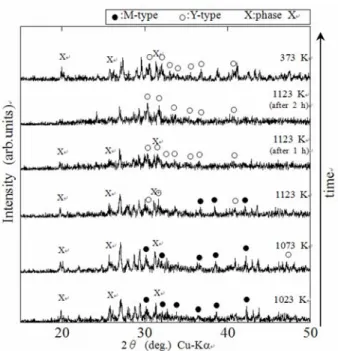
Fig. 3 shows HT-XRD patterns of a glass specimen. The peak intensity of M-type and phase X decreased gradually with increasing peak intensity of Y-type with increasing
Fig. 3. High temperature X-ray diffraction patterns of a glass specimen.
heating time at 1073 K. After the specimen was cooled down, the peak of phase X was detected again. These results indicate that the endothermic peak is because of the melting of phase X and that Y-type forms basically through the reaction of M-type with a melt of phase X.
4. Summary
The formation behavior of Y-type Ba-hexaferrite in the glass-ceramic method was studied. Glasses with composition of 0.1ZnO・0.9(0.3Fe2O3・0.5BaO・0.2B2O3) were heated at various temperatures and precipitated crystalline phases were identified. An unknown compound, phase X, was precipitated at about 850 K. The precipitation of M-type ferrite was detected at about 923 K. The formation of Y-type ferrite was explained by the reaction of M-type ferrite with a melt of phase X.
5. References
1. M.Nagae, “Preparation of Y-type Barium Hexaferrite by the Glass-Ceramic Method” J. Am. Ceram. Soc., 89[3] 1122-1124 (2006).
:α-BaFe2O4 :M-type :Y-type X:phase X
10 20 30 40 50 60 70 823 K 883 K 923 K 1023 K 1123 K 1073 K 1173 K In ten sity (arb .u nits) X X X X X X X X X X X X X X X X X X X X X X X 2θ (deg.) Cu-Kα
Fig. 2. X-ray diffraction patterns of non-leache dspecimens heated at various temperatu res for2h.