Development of an Enhanced Loose Parts Monitoring System (LPMS)
Jin-Ho Parka, Young-Chul Choia,Kyoung-Sik Choib, Jea-kyu Rub, Chang-Ho Sohnba Korea Atomic Energy Research Institute, 150 Duckin Dong Yusung Gu, Daejuon city, Korea, 305-353 b Samchang enterprise co., #974-1, Goyeon-ri, woongchon-myon, ulju-gun, ulsan, Korea, 689-871
1. Introduction
An enhanced Loose Parts Monitoring System(LPMS) has been developed by KAERI(Korea Atomic Energy Research Institute), not only to improve the performance of an on-line signal processing for a monitoring system but also to enhance the evaluation technique of the true impact signals by loose parts. The conventional LPMS system has many drawbacks, one of which is the missing of the impact signals when the event occurs during a short period and it has few diagnostic tools. This new system has taken into account the state-of-the-art technology to cover the problems with the conventional system.
2. Enhanced LPMS
The new LPMS is mainly comprised of the three main parts, that is, a hardware, a monitoring software, and an analysis software[1].
2.1 Hardware
Figure 1 shows the schematic of the hardware system in the new LPMS that can accommodate total 24 channels simultaneously as the input.
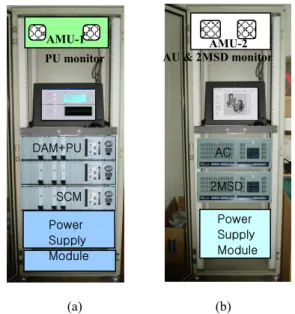
It consists of 24 SCM(Signal Conditioning Module)s, 24 DAM(Data Acquisition Module)s, a PU(Processing Unit), a 2MSD(two minutes data storage device) to accommodate the digitized signals from the continuous triggering, AU(Analysis Unit), and other subsidiary features. As shown in Figure 2, the DAM is designed to integrate a DSP(Digital Signal Processor) board with high performance DSP chip, and an AD converter with a 200 kHz sampling rate including an anti-aliasing filter into single system. The analog band pass filtering is being performed programmably through the control of the monitoring software in the SCM(Figure 2). The hardware system has two cabinets; one is for the real time operating in which the SCM, the DAM, and the PU are incorporated and the other for the data storage, diagnostics and database in which AU and 2MSD are included as shown in Figure 3.
Figure 1. The hard schematic of the enhanced LPMS
(a) (b)
Figure 2. The picture of (a) Signal conditioning module(SCM), (b) Data acquisition module(DAM)
(a) (b)
Figure 3. The picture of new LPMS hardware system. (a) Online monitoring computer, (b) Analysis computer
2.2 Monitoring software
The key features of the monitoring software is to control the two different kinds of the triggering functions; one is a fixed setpoint triggering and the other a floating one. Also it performs a discrimination algorithm whose procedure is basically composed of 7 steps. All of the triggering function is continuously operated on a real time basis for 24 channels simultaneously. The main features of the monitoring software are shown in Figure 4 and Figure 5.
AU & 2MSD monitor PU monitor AMU-1 AMU-2 DAM+PU AC 2MSD Power Supply Module SCM Power Supply Module
Transactions of the Korean Nuclear Society Autumn Meeting Busan, Korea, October 27-28, 2005
Figure 4. GUI in the monitoring software
(a) (b)
Figure 5. (a) Discrimination window, (b) Captured signal
2.3 Analysis software
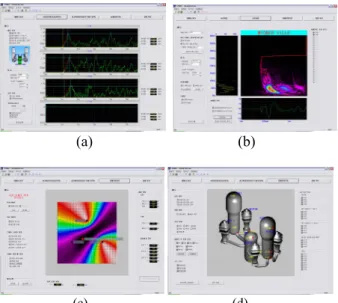
The application software is configured on the MS Windows operating system, and developed on a user-friendly GUI (Graphic-User Interface) basis. In the analysis software, the localization of the metal impact source is improved using a non-stationary time-frequency analysis as shown in Figure 6[2-3]. Also an enhanced mass evaluation technique is incorporated into the software(Figure 7).
(a) (b)
(c) (d)
Figure 5. Window program for source localization using Wigner-Ville distribution. (a) TOAD(Time of arrival difference) can be determined at the time domain and envelop domain, (b) TOAD can be determined by time-frequency analysis, (c) impact source localization at the plate, and (d) power plant.
(a) (b)
Figure 6. Window program for mass estimation using Wigner-Ville distribution
This new equipment includes not only the major functions of the current LPMS but also additional state-of-the-art techniques. Accordingly, it is recommended that it can be used for the replacement of the current system and also for the new Korean nuclear power plant to be operated.
3. Conclusion
A new enhanced LPMS system is developed. It contains many of new features in both hardware and software. Further we are going to integrate it into the other structure health monitoring systems; such as IVMS, ALMS, and RCP-VMS.
REFERENCES
[1] J-H Park, Development of a Loose Parts Monitoring System(LPMS), IAEA TECDOC meeting, On-line condition monitoring of equipment and processes in NPP using advanced diagnostic systems, Knoxville, 2005.
[2] J-H Park et al, Application of a Continuous Wavelet Transform to the Impact Location Estimation in Plate Type Structures, Autumn proceedings of KSNVE, 2004.
[3] J-H Park and J-H Lee, Application of Continuous Wavelet Transform to the Impact Location Estimation of the Loose Parts Monitoring System (LPMS), International Journal of Nuclear Energy Science and Technology, To be published.