Development of the arrangement plan optimization
for Accelerator & Beam Application Building
Jung Min Nam,a Kyeong-Jun Mun,a Jun Yeon Kim,a Byung Ho Choi,a Suk Tae Yoo,b a Yuseong P.O.Box 105, Daejeon, 305-600, Republic of Korea, [email protected] b 360-9 Mabuk-ri, Guseong-eup, Yongin-si, Gyeonggi-do, Republic of Korea, [email protected]
1. Introduction
The Proton Engineering Frontier Project (PEFP), approved and launched by the Korean government in July 2002, consist of a 100 MeV proton linear accelerator development and programs for its utilization and application. According to PEFP, expected to complete in March 2012, proton accelerator research center will be founded on the project host site where Korean government will select.
In this paper, the optimized arrangement design process of the Accelerator & Beam Application Building, which is the main part of conventional facilities in the proton accelerator research center is described.
2. The conventional design type
In this paper, we made a comparative analysis to derive the new optimization design type based on four separate design types, that is, from type A to type D, concerning the Accelerator & Beam Application Building.
2.1. The conventional design type A
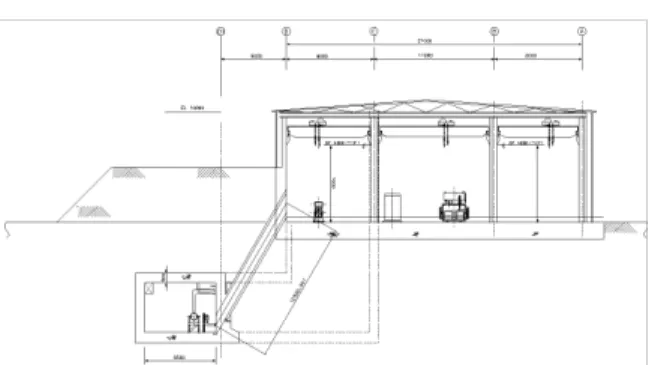
Figure 1. The section of design type A
The Accelerator Tunnel and the Klystron Gallery, which sets at a depth of 5.5m, makes a vertical arrangement form. The space between the Accelerator Tunnel and the Klystron Gallery is filled with Backfill materials to meet a sufficient thickness for radiation shielding. Backfill materials are also used as intermediation of load transmission.
The Electric Cable Chase, which is set up on a slant, is attached to the Accelerator Tunnel and the basement slab of the Klystron Gallery. In the aspect of space utilization, Design type A is superior to ESS/SNS, but
its shortcoming is that because it requires much excavation work, its constructional efficiency can be reduced and neighboring constructional process also can be delayed.
It has another disadvantage that it requires much construction period because the Klystron Gallery can be constructed only after completion of the Accelerator Tunnel.
In the consideration of relative displacement of the Accelerator Tunnel and the Klystron Gallery, it is difficult in waterproofing because the structural separation of the Electric Cable Chase and basement slab of the Klystron Gallery is needed.
The type A has difficulty in compaction of Structural Backfill in the section of the Electric Cable Chase from structural safety viewpoint.
Because the lower part of the Accelerator Tunnel is located at the depth of 10m from the surface of the earth, structural section such as wall and basement becomes thicker according to the influence of the subterranean water. This leads to reduction in economic feasibility.
To prepare for the earthquake occurrence, it is necessary to investigate reciprocal action between two structures according to the Backfill. The atypical arrangement and the inelastic movement of Backfill cause structural problems such as a crack. Inequable load of the Accelerator Tunnel makes difficulty in sinking control. As a result of the examination of safety about buoyant force, it is necessity to establish an additory structural counterplan.
2.2 The conventional design type B
Figure 2. The section of design type B
As shown in Figure 2, the Accelerator Tunnel structure is located in underground adjacently, not directly in the lower part of the Klystron Gallery Building.
The Electric Cable Chase links the Accelerator
Transactions of the Korean Nuclear Society Autumn Meeting Busan, Korea, October 27-28, 2005
Tunnel to the Klystron Gallery Building. In case, the RF Wave Guide, the I&C, the Beam Monitor and the Cable is installed, as shown in Figure 2.
2.3 The conventional design type C
Figure 3. The section of design type C
As shown in Figure 3, in the design type C, the Accelerator Tunnel and the Beam Application Building are connected by way of the Beam Transport Tunnel. Therefore, it is difficult to construct the Beam Transport Tunnel in cost, construction, etc. That is, underground structure is danger of a water leakage and it increases excavation work.
In this design, structural safety is poor as compared with other designs and it needs compaction of the circumference of the Beam Transport Tunnel.
The utilization of a building site becomes poor, because additional shielding structure is needed when shielding area is decentralized.
2.4 The conventional design type D
Figure 4. The section of design type D
As shown in Figure 4, in the design type D, because the Accelerator Tunnel and the Beam Application Building is located in the same structure, the Beam Transport Tunnel is unnecessary.
This type has other two advantages; excellent in Structural safety of the Accelerator Tunnel and a rare possibility of the leakage.
In this type, shielding structure can be simplified by shielding for separately two different areas for shielding; one is the Klystron Gallery, the other is composed of the Accelerator Tunnel, the Beam Application Building and the Beam Application research Area.
The disadvantage of this type is that there is no space to set up facilities concerning a beam application because a shielding concrete of the upper part of the Accelerator Tunnel.
3. The proposed design type
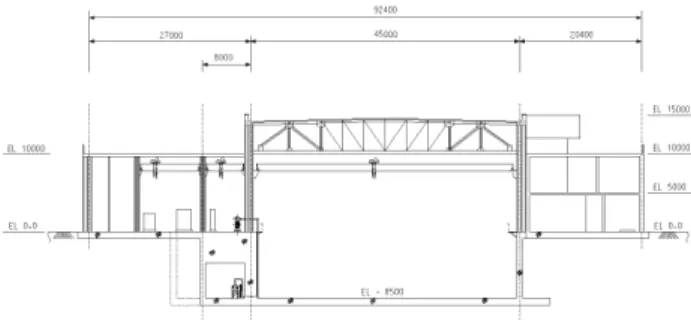
As shown in Figure 5, in the proposed design type, the Accelerator Tunnel is located in the directly lower
part of the Klystron Gallery Building. Therefore, the entrance for person or equipment, stair and elevator, is needed. Because the Accelerator Tunnel and the Klystron Gallery is located in the same structure, a width of the Klystron Gallery is determined followed by that of the Accelerator Tunnel.
Figure 5. The section of proposed design type
Because one side wall of the Accelerator and the Klystron Gallery Building share that of the Beam Application Building, the RF Wave Guide, the I&C, the Beam Monitor and the Cable is connected to Accelerator Tunnel by way of Beam Application Building. Therefore, the extra Chase(the RF Wave Guide, the I&C, the Beam Monitor and the Cable) is unnecessary. The Beam Transport Tunnel is also unnecessary, because the Accelerator Tunnel and the Beam Application Building is located in the same structure.
Because the Removable Wall is installed in the Experimental Hall, detailed arrangement will be conducted after conducting detailed design for the Accelerator & Beam Application Building.
The sloping roof is adopted for the Accelerator & Application building to guarantee the structural safety.
4. Conclusion
From the comparative analysis of the conventional design, We can derive the new optimization design type for Accelerator & Beam Application building, the proposed design type satisfies requirements of space utilization, economical efficiency and structural stability effectively.
Acknowledgement
This work is a part of the “Proton Engineering Frontier Project” which is sponsored by the Ministry of Science and Technology of Korea under “21C Frontier R&D Program”.
REFERENCES
[1] B. H. Choi, "Status of The Proton Engineering Frontier Project", Proc. of 2005 Particle Accelerator Conference, May 16-20, 2005, Knoxville Convention Center, Knoxville, Tennessee, USA.