© Korean Powder Metallurgy Institute 790 -1. Introduction
Sintered rare-earth permanent magnets (REPM, including Sm2Co17, SmCo5, and Nd2Fe14B magnets) are widely used in many fields due to their excellent magnetic property. But they are quite brittle and easily crack in the course of fabrication, machine work and application. But for many years, the systematic investigations on the fracture behavior and mechanical characteristics of REPM have been very rarely reported. Only a few researchers investigated their bending strength, impact toughness and thermal expansion, and so on1-3. It is an interesting work to investigate fracture behavior of sintered rare-earth magnets, which will be helpful to find a way of improving their fracture resistance. The failure of brittle materials is usually caused by a dynamic load, particularly by an impact load. So, the impact stability of sintered Nd-Fe-B magnets were also investigated in this article.
2. Experimental and Results
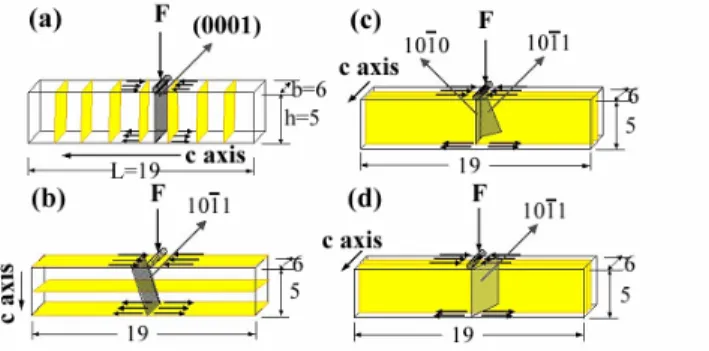
Three groups of bending specimens with different orientations, cut from the same block of rare-earth magnet, were studied using a 3-point bend test. There is different stress status in the close-packed plane of main phase for the three group specimens, as shown in Fig. 2 (The light planes represent the close-packed plane. The dark planes represent the fracture surface. Here, we assume that a perfect alignment has beeen achieved). The size of bend specimen was 5 mm × 6 mm × 19 mm. Every group has three specimens. The crack surfaces has been carefully observed
and photographed. A scanning electron microscope (SEM) was used to study the microfractography of the examined magnets. The effects of Nd content, and Pr, Dy substitution on the impact stability of Nd2Fe14B magnets were also investigated by a falling-weight impact test. The falling-weight potential of m*g*h, which made the specimen fracture, was used to characterize the impact stability of the specimen.
Table 1 presents the measured results of the bending strength. It shows that the bending strength of the examined magnets obviously displays anisotropy. The SEM micro- fractograph of the examined magnets were shown in Fig. 1. For Sm-Co magnets (including Sm2Co17 and SmCo5-type magnets), three group specimens have the same fracture micromechanism. The fracture micromechanism of Sm2Co17- type magnet is of cleavage fracture (see Fig. 1a). The fracture micromechanism of SmCo5-type magnet is of quasi-cleavage. For Nd2Fe14B magnet, the fracture micro- mechanism of all the three groups of specimens is mainly intergranular fracture. However, transgranular cleavage is found in the micro-fractrograph of Group 1, partially (as shown by white arrows in Fig. 1b). And the bending strength of Group 1 is obviously lower than that of the other two groups (see Table 1).
The crack surfaces revealed that the fracture of the rare-earth magnet is typically brittle fracture. For Nd2Fe14B
magnet, the macrofractograph of three group specimens is approximately the same: the fractures are flat, and
perpendicular to the biggest tensile stress. For both Sm2Co17 and SmCo5-type magnets, the macrofractograph appears to be clearly anisotropic. A sketch map of fracture of Sm-Co magnets is shown in Fig. 2. Sm-Co magnets tend to cleavage fracture in the close-packed (0001) plane or in the
2006 POWDER METALLURGY World Congress
C09-02-1
*Invited
A Study on Fracture Behavior and Impact Stability of Sintered Rare-earth
Permanent Magnets
Wei Li1,a, Anhua Li1,b, Huijie Wang1,c, Shengzhi Dong1,d, and Yongquan Guo1,e 1
Division of Functional Materials, Central Iron & Steel Research Institute, Beijing 100081, P. R. China a
[email protected], [email protected], [email protected], d
[email protected], [email protected] Abstract
The fracture behavior and mechanical characteristics of sintered rare-earth magnets were investigated. It shows that the fracture behavior and bending strength of the magnets obviously exhibit anisotropy. Sm-Co magnets tend to cleavage fracture in the close-packed (0001) plane or in the (1011) plane. The fracture mechanism of Nd2Fe14B magnet mainly appears to be intergranular fracture. The anisotropy of fracture behavior and mechanical strength of sintered rare-earth magnets is caused mainly by the strong crystal-structure anisotropy and the grain alignment texture. The effects of Nd content, and Pr, Dy substitution on the impact stability of Nd2Fe14B magnets were also reported.
© Korean Powder Metallurgy Institute 791
-(1011) plane. The crystal structure of REPM alloys is quite complex, and their slip modes are very few. Brittle cleavage fracture generally happens in the alloys. The grain orientation texture of sintered REPM makes that cleavage fracture proceeds more easily and the fracture toughness decreases4.
The impact stability of Nd-Fe-B magnets linearly increases with increasing Nd content (see Fig. 3). The increased Nd-rich phase may contribute to the improvement of impact stability by its plastically deforming to reduce the level of the stress concentration. It shows that the magnets with Dy substitution have better impact stability than the magnets with Pr substitution. The Dy-substitution magnets has higher bonding strength between close-packed basal planes due to the lanthanide contraction along c-axis of R2Fe14B compounds, so have higher elastic modulus. The elastic modulus has important influences on the impact property of materials. The time of the impact decreases with increasing elastic modulus, and the needed energy of specimen fracture increases with decreasing impact time. Table 1. Bending strength of experimental magnets (σbb /MPa)
Group No. Magnets
and specimen No.
Group 1
(c-axis //l) (c-axis//h) Group 2 (c-axis//b)Group 3
① 59 70 111 ② 89 81 105 ③ 102 88 103 Sm2Co17 -type Average 83 80 106 ① 108 92 95 ② 112 87 115 ③ 105 53 95 SmCo5 -type Average 108 77 105 ① 275 325 290 ② 280 340 330 ③ 295 335 325 Nd2Fe14B Average 283 333 315
Fig. 1. SEM Microfractographs of: (a) Sm2Co17 magnet, (b) SmCo5 magnet,
(c) Nd2Fe14B magnet.
Fig. 2. Sketch map of fracture of Sm-Co magnets: (a) Group. 1 specimens, (b) Group. 2 specimens, (c) Group. 3 specimens of Sm2Co17 magnet,
(d) Group. 3 specimens of SmCo5 magnet.
Fig. 3. Effect of Nd content on the impact stability of sint ered Nd-Fe-B magnets.
3. Summary
The fracture behavior and bending strength of sintered REPM obviously exhibit anisotropy. Sm-Co magnets tend to cleavage fracture in the close-packed (0001) plane or in the (1011) plane. The fracture mechanism of Nd2Fe14B magnet mainly appears to be intergranular fracture. Both the volume fraction of ductile Nd-rich phase and the elastic modulus of the matrix phase have important influences on the impact stability of sintered Nd-Fe-B magnets.
We thank the National Natural Science Foundation of China (Grant No.50371019) for financial support of the study.
4. References
1. F. Ishimoto, K. Yamamoto and W. Takahashi, Journal of Japan society powder and powder metallurgy (in Japanese) 44, p.940 (1997).
2. J. A. Horton, J. W. Herchenroeder, J. L. Wright and D. S. Easton, Mater. Trans., JIM 37, p.860 (1996)
3. Sun T D, Zhu J H, and Wang D W, Acta Metallurgica Sinica (in Chinese) 15, p.58 (1979).
4. G. Henry, D. Horstmann, and H. X. Zeng (eds.), De Ferri Metallographia Ⅴ Fraktographie und Microfrakt ographie, Beijing, China, pp. 62-64, 1990.
14 15 16 17 18 19 20 21 22 23 150 200 250 300 350 400 150 200 250 300 350 400 Impact stab ility (J* 10 -3 ) Nd content (at. %), in NdxFe94-xB6