INTRODUCTION
The creation of stimuli-responsive surfaces has attracted a considerable attention owing to their biological applica-tions including tissue engineering, biosensor, and drug deliv-ery (Mendes 2008; Martien et al. 2010; Techawanitchai et al. 2011). Stimuli-responsive surfaces have been widely fa-bricated through a non-covalent or covalent introduction of smart polymers onto the substrate surface that can respond to external stimuli such as temperature, pH, light, solvent, electrical potential, or a combination thereof (Shirtcliffe et al. 2005; Yu et al. 2005; Heinz et al. 2008).
The surface grafting has been preferred owing to its advan-tages including the controllable introduction of the grafted chains onto a surface with a high density without affecting the bulk properties, and the long-term stability of the
cova-lently-grafted chains (Cui et al. 1999; Uhlmann et al. 2006). Thus, stimuli-responsive polymers were introduced onto the surface of various substrates through a variety of surface
-initiated polymerization methods using chemical initiators, UV-radiation, plasma treatment, and high-energy radiation (γ-rays or electron beams) (Spridon et al. 2012; Biazar et al. 2011).
Ion beam-induced graft polymerization is a fascinating method to introduce a thermally-responsive polymer on the surface of a substrate owing to its several advantages such as a surface-specific modification, no requirement of toxic chemicals such as an additional initiator or organic solvent, and good reliability and controllability (Hook et al. 2006; Zi-auddin and Sabatini 2011). Thus, this method has been used in the formation of functional groups on a polymer surface suitable for electronic and biological applications (Yun et al. 2010; Hwang et al. 2011). In spite of these merits, the pre-paration of a thermally-responsive poly (N- isopropylacryla-mide) (PNIPAAm)-grafted surface through ion beam- induc-ed grafting has not been studiinduc-ed yet.
Journal of Radiation Industry 6 (4) : 317~322 (2012)
─ ─ 317 ──
The Preparation of a Thermally Responsive Surface by
Ion Beam-induced Graft Polymerization
Chang-Hee Jung, Wan-Joong Kim, Chan-Hee Jung, In-Tae Hwang and Jae-Hak Choi* Research Division for Industry and Environment, Advanced Radiation Technology Institute,
Korea Atomic Energy Research Institute, Jeongeup 580-185, Korea
Abstract --In this study, the preparation of a temperature-responsive poly(N-isopropylacrylamide) (PNIPAAm)-grafted surface was performed using an eco-friendly and biocompatible ion beam -induced surface graft polymerization. The surface of a perfluoroalkoxy (PFA) film was activated by ion implantation and N-isopropylacrylamide (NIPAAm) was then graft polymerized selectively onto the activated regions of the PFA surfaces. Based on the results of the peroxide concentration and grafting degree measurements, the amount of the peroxide groups formed on the implanted surface was dependant on the fluence, which affected the grafting degree. The results of the FT -IR-ATR, XPS, and SEM confirmed that the NIPAAm was successfully grafted onto the implanted PFA. Moreover, the contact angle measurement at different temperatures revealed that the sur-face of the PNIPAAm-grafted PFA film was temperature-responsive.
Key words : Ion-beam, Graft polymerization, PNIPAAm, Contact angle
* Corresponding author: Jae-Hak Choi, Tel. +82-63-570-3062, Fax. +82-63-570-3090, E-mail. [email protected]
In this study, an eco-friendly and biocompatible method to generate a thermally-responsive surface through ion beam
-induced grafting was described. The surface of a polymer film was modified through ion implantation and followed by surface graft polymerization under various conductions. The resulting surface was characterized in terms of the peroxide concentration, grafting degree, chemical structure, and mor-phology. Furthermore, the thermally-responsive behavior of the resulting films was demonstrated by measuring the water contact angle at different temperatures.
MATERIALS AND METHODS
Materials
Perfluoroalkoxy (PFA) films (100μm thickness, Ashai Glass Co., Ltd.) were washed by sonication in acetone for 20 min and dried in a vacuum oven at room temperature over-night prior to use. N-isopropylacrylamide (NIPAAm, 97%), 1,1-dipheyl-2-picryhydrazyl (DPPH) were purchased from Aldrich Company and used without further purification.
The surface graft polymerization by ion implantation
The surfaces of well-cleaned PFA films were implanted with 150 keV H++
ions at room temperature at various flu-ences ranging from 5×10¹⁴to 1×10¹⁶ ions cm-2. The
pres-sure in the implanter’s target chamber was 1×10⁻⁵to 1×
10-6Torr. The ion beam current density was less than 1.0
μA cm-2to prevent a thermal effect on the substrate. The resulting PFA films were stored in air for 24 h for further oxidation.
The implanted PFA films were put into glass tubes con-taining a 20 wt% aqueous solution of NIPAAm, and then purged with nitrogen gas for 30 min to remove oxygen. For graft polymerization, the tubes were placed in a constant temperature water bath at 62�C for 12 h. Afterward, the re-sulting films were taken out of the tubes and thoroughly washed with deionized water to remove the homopolymers. The resulting PNIPAAm-grafted PFA films were then dried under a vacuum at 50�C.
Surface characterization
The amount of peroxide groups generated on the PFA sur-face after ion implantation was measured using a well-known
DPPH method described in the literature (Suzuki et al. 1986). Briefly, the implanted PFA substrates were immersed in a glass tube containing a DPPH solution in toluene with a con-centration of 10-4 M. After purging with nitrogen, the glass
tube was heated to 70�C and kept at that temperature for 5 h to decompose the peroxide groups formed on the surfaces. The amounts of DPPH molecules binding to the formed ra-dicals were calculated from the difference in the absorbance at 520 nm between the original and residual DPPH solutions using an S-1100 UV-Vis spectrophotometer (Scinco Co., Ltd., Korea).
The grafting degree of the PNIPAAm grafted on the sur-face of the PFA substrates was determined using a Fourier transform infrared spectrometer (FT-IR) equipped with an attenuated total reflection (ATR) prism (FT-IR-ATR, Varian 640). As the base substrate was PFA, the characteristic absorption bands attributed to C-F asymmetric stretching vibrations in CF2groups were observed at about 1142 cm-1.
The absorption of amide carbonyl derived from NIPAAm grafts appeared at 1650 cm-1. The peak intensity ratio of (I
1650
/I1142) was used to determine the graft density of PNIPAAm
on the surface. The known amount of PNIPAAm was cast on the surface of the PFA film and used for a calibration curve (Akiyama et al. 2004).
The surface chemical composition of the control, implant-ed, and PNIPAAm-grafted PFA surfaces was investigated using an X-ray Photoelectron Spectrometer (MultiLab 2000, Thermo electron corporation, England) employing Mg-Kα radiation and the Advantage 3.70 program installed in the instrument was used to separate the XPS peaks in the C1s core level spectra. The applied power was 14.5 keV and 20 mA.
The temperature-dependant contact angles of the PNIPAAm
-grafted PFA surfaces were measured by a sessile drop me-thod using a Phoenix 300 contact angle analyzer (Surface Electro Optics Co.) equipped with a environmental chamber that can control the temperature within a range of 0 to 100�C. The surface morphology of the control, implanted, and PNIPAAm-grafted PFA surface was investigated using a scanning electron microscopy (SEM, JEOL JSM-6390).
RESULTS AND DISCUSSION
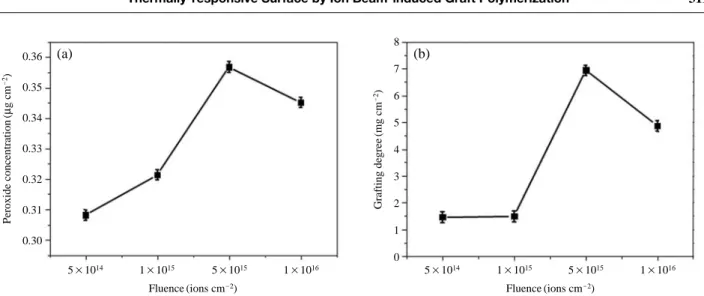
PFA surfaces at different fluences were determined by a well-established DPPH method, and the results are present-ed in Fig. 1(a). The peroxide concentrations formed on the PFA surfaces increased with increasing the fluence to 1× 10¹⁵ ions cm-2, beyond which it decreased. This result indi-cates that the peroxide groups were effectively generated on the implanted surface at lower fluences through ion implan-tation-induced oxidation, but at fluences higher than 1×10¹⁵
ions cm-2, the carbonization prevailed, resulting in a reduc-tion of peroxide concentrareduc-tion (Cho et al. 2003). Further-more, as shown in Fig. 1(b), the change in the grafting de-gree as a function of the fluence exhibited a similar tendency to the peroxide concentration. The highest grafting degree,
6.9 mg cm-2, was obtained on the implanted PFA at a flu-ence of 1×10¹⁵ ions cm-2, which exhibited the highest per-oxide concentration. This result can be ascribed to the fact that the higher amounts of peroxide groups used to initiate the graft polymerization can generate a higher number of PNIPAAm chains on the PFA surface (Kim et al. 2006).
The surface chemical structure of the control, implanted, and PNIPAAm-grafted PFA films were analyzed using FT
-IR-ATR and the results are shown in Fig. 2. The PFA film implanted at a fluence of 5×10¹⁴ ions cm-2and PNIPAAm -grafted PFA film with a grafting degree of 6.9 mg cm-2were used for this analysis. As shown in the control PFA spectrum of Fig. 2(a), the typical absorption bands attributed to the asymmetric and symmetric stretching of CF2groups in the
PFA were identified at about 1142, 1207, and 985 cm-1,
re-spectively (Nasef 2001). As shown in Fig. 2(b), identical bands were observed in the spectrum of the implanted PFA without the formation of new bands corresponding to the oxidized species. On the other hand, as presented in Fig. 2(c), new characteristic bands assigned to the chemical structure of PNIPAAm appeared at 3286 and 1545 cm-1for the
secon-dary amide, 2971 and 1459 cm-1for the aliphatic
hydrocar-bon, and 1650 cm-1for the carbonyl group, respectively
(Huilin et al. 2004).
The surface chemical compositions of the control, implant-ed, and PNIPAAm-grafted PFA films were investigated using XPS and the results are presented in Fig. 3. As shown in Fig. 3(a) and 3(b), in the case of the implanted PFA, the [O] /[C] atomic ratio increased with increasing the fluence to 1 ×10¹⁵ ions cm-2, over which it decreased. In contrast, the
Fig. 1. The peroxide concentration (a) and grafting degree (b) as a function of the fluence.
Fig. 2. FT-IR-ATR spectra of the control (a), implanted (b), and PNIPAAm-grafted PFA films (c).
0.36 0.35 0.34 0.33 0.32 0.31 0.30 (a) (b) 5×10¹⁴ 1×10¹⁵ 5×10¹⁵ 1×10¹⁶ Fluence (ions cm-2) 5×10¹⁴ 1×10¹⁵ 5×10¹⁵ 1×10¹⁶ Fluence (ions cm-2) 8 7 6 5 4 3 2 1 0 Peroxide concentration (μ g cm -2) Grafting degree (mg cm -2) Absorbance (arb. unit) 3073 3286 2971 (c) (b) (a) 1207 1459 1545 1650 985 1142 4000 3500 3000 2500 2000 1500 1000 Wavenumbers (cm-1)
3(b)가 맞는지 확인해주세요!
[F]/[C] atomic ratio exhibited an inverse tendency. For the PNIPAAm-grafted PFA, the [O]/[C] ratio further increased in comparison to that of the implanted PFA and in reverse, the [F]/[C] ratio further decreased as well. Furthermore, this change in the [O]/[C] and [F]/[C] atomic ratios was clearly dependant on the grafting degree. Therefore, the results ver-ified that the PNIPAAm was successfully grafted onto the implanted PFA surface.
The surface morphologies of the control, implanted, and PNIPAAm-grafted PFA films were investigated using SEM observation, the results of which are shown in Fig. 4. The PFA film implanted at a fluence of 5×10¹⁴ ions cm-2and PNIPAAm-grafted PFA film with a grafting degree of 6.9 mg cm-2were used for this SEM observation. As shown in Fig. 4(a) and 4(b), the control and implanted PFA exhibited similar smooth surface morphologies meaning that the ion implantation did not bring about a morphological change in the PFA surface. On the other hand, as shown in Fig. 4(c),
the surface morphology of the PNIPAAm-grafted PFA was much rougher in comparison to those of the control and
im-Fig. 3. [O]/[C] (a) and [F]/[C] ratio (b) of the control, implanted and PNIPAAm-grafted PFA films as a function of the fluence.
Fig. 4. SEM images of surface morphology of control (a), implanted (b), and PNIPAAm-grafted PFA films (c): the insets magnify the dotted rectangles in the respective images.
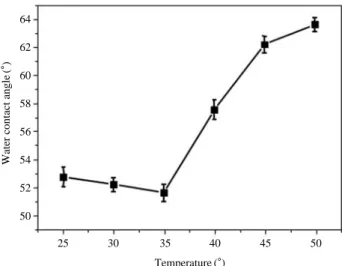
Fig. 5. Water contact angles of the PNIPAAm-grafted PFA films as the function of the temperature.
Water contact angle
(� ) 64 62 60 58 56 54 52 50 25 30 35 40 45 50 Temperature (�) 0.20 0.15 0.10 0.05 0.00 Implanted PFA PNIPAAm-g-PFA Implanted PFA PNIPAAm-g-PFA 0 5×10¹⁴ 1×10¹⁵ 5×10¹⁵ 1×10¹⁶ Fluence (ions cm-2) 0 5×10¹⁴ 1×10¹⁵ 5×10¹⁵ 1×10¹⁶ Fluence (ions cm-2) 2.0 1.6 1.2 0.8 0.4 0.0 [O]/[C] [F]/[C] (a) (b) (a) (b) (c)
planted ones.
The thermally-responsive behavior of the PNIPAAm- graft-ed PFA surface was investigatgraft-ed by measuring the water contact angle at temperatures between 25 and 50�C, and the results are shown in the Fig. 5. The PNIPAAm-grafted PFA with a grafting degree of 6.9 mg cm-2prepared through ion implantation at a fluence of 5×10¹⁴ ions cm-2was used for the temperature-dependant contact angle measurement. Below 40�C, the surface exhibited contact angles of around 52�, but at a higher temperature, the contact angles increas-ed to about 64�. This thermally-responsive behavior can be attributed to the temperature-dependant conformation trans-formation of the PNIPAAm (Balamurugan et al. 2003; Heinz et al. 2008).
CONCLUSION
In this research, a temperature-responsive PNIPAAm
-grafted surface was successfully fabricated through ion beam
-induced surface graft polymerization. Based on the results of the peroxide concentration and grafting degree measure-ments, the peroxide groups, used as an initiator for the sur-face graft polymerization, were effectively generated on the PFA surface through ion implantation and their fluence- de-pendant concentration determined the grafting degree of NIPAAm on the PFA surface. The results of the FT-IR-ATR, XPS, and SEM confirmed that the NIPAAm was success-fully grafted onto the implanted PFA. Moreover, the contact angle measurement at different temperatures demonstrated that the surfaces of PNIPAAm-grafted PFA films were tem-perature-responsive. The resulting PFA films are applicable to a variety of biological applications.
ACKNOWLEDGEMENTS
This work was supported by the National Research Foun-dation Grant funded by the Ministry of Education, Science, and Technology, Korea (2012-M2A2A6013189).
REFERENCES
Akiyama Y, Kikuchi A, Yamato M and Okano T. 2004.
Ultra-thin Poly(N-isopropylamide) Grafted Layer on Polystyrene Surfaces for Cell Adhesion/Detachment Control. Langmuir
20:5506-5511.
Balamurugan S, Mendez S, Balamurugan S, O’Brien MJ and Lopez GP. 2003. Thermal Response of Poly(N- isopropyla-crylamide) Brushes Probed by Surface Plasmon Resonance. Langmuir 19:2245-2549.
Biazar E, Khorasani MT and Daliri M. 2011. Cell Sheet Engi-neerin: Solvent Effect on Nanometric Grafting of Poly-N -isopropylacrylamide onto Polystyrene Substrate under Ultra-violet Radiation. Int. J. Nanomedicine. 6:295-302. Cho JS, Han S, Kim KH, Beag YW and Koh SK. 2003. Surface
Modification od Polymers by Ion-Assisted Reaction. Thin Soild Films. 445:332-341.
Cui FZ and Luo ZS. 1999. Biomaterials Modification by Ion -Beam Processing. Surf. Coat. Technol. 112:278-285. Heinz P, Bretagnol F, Mannelli I, Sirghi L, Valsesia A, Ceccone
G, Gilliland D, Landfester K, Rauscher H and Rossi F. 2008. Poly(N-isopropylacrylamide) Grafted on Plasma- Activat-ed Poly(ethylene oxide): Thermal Response and Interaction with Proteins. Langmuir 24:6616-6175.
Hook AL, Thissen H and Voelcker NH. 2006. Surface Manipu-lation of Biomolecules for Cell Microarray Applications. Trends Biotechnol. 24:421-477.
Huilin T, Carla E, Heitzman and Paul VB. 2004. Patterned Poly (N-isopropylacrylamide) Brushes on Silica Surfaces by Microcontact Printing Followed by Surface-Initiated Poly-merization. Langmuir 20:8313-8320.
Hwang IT, Kim DK, Jung CH, Lee JS, Choi JH, Nho YC, Suh DH and Shin K. 2011. Patterned Immobilization of Bio-molecules on a Polymer Surface Functionalized by Radia-tion Grafting. J. Nanosci. Nanotechnol. 11:4562-4566. Kim JB, Ganesan, Yoo YS, Choi JH and Lee SY. 2006. Simple
Patterning of Cell on Biocompatible Nonchemically Ampli-fied Resist. Macromol. Rapid Commun. 27:1442-1445. Martien A, Cohen S, Wilhelm TS, Jan G, Marcus M, Christopher
O, Manfred S, Gleb BS, Lgal S, Vladimir VT, Marek U, Francoise W, Stefan Z, lgor L and Sergiy M. 2010. Emerg-ing Applications of Stimuli-Responsive Polymer Materials. Nature Materials. 9:101-113.
Mendes PM. 2008. Stimuli-Responsive Surfaces for Bio- Appli-cations. Chem. Soc. Rev. 37:2512-2529.
Nasef MM. 2001. Effect of Solvents on Radiation-Induced Gra-fting of Styrene onto fluorinated Polymer Films. Polymer Int. 50:338-346.
Shirtcliffe NJ, McHale G, Newton MI, Perry CC and Roach P. 2005. Porous Materials show Superhydrophobic to Super-hydrophilic Switching. Chem. Commun. 3135-3137. Spridon D, Curecheriu L, Dobromir M and Dumitrascu N. 2011.
Atmos-pheric Pressure Plasma Conditions. J. Appl. Polym. Sci.
124:2377-2382.
Suzuki M, Kishida A, Iwata H and Ikada K. 1986. Graft Copo-lymerization of Acrylamide onto a Polyethylene Surface Pretreated with a Glow Discharge. Macromolecules 19: 1804-1808.
Techawanitchai P, Tamamoto K, Ebara M and Aoyagi T. 2011. Surface Design with Self-Heating Smart Polymers for On -Off Switchable Traps. Sci. Technol. Adv. Mater. 12:044609. Uhlmann P, Ionov L, Nitschke M, Grundke K, Motornov M, Minko S and Stamm M. 2006. Surface Functionalization by Smart Coatings: Stimuli-Responsive Binary Polymer Bru-shes. Prog. Org. Coat. 55:168-174.
Yun JM, Jung CH, Kim DK Hwang IT, Choi JH, Ganesan R and Kim JB. 2010. Photosensitive Polymer Brushes Grafted onto PTFE Film Surface for Micropatterning of Proteins. J. Mater. Chem. 20:2007-2012.
Yu X, Wang Z, Jiang Y, Shi F and Zhang X. 2005. Reversible pH-Responsive Surface: From Superhydrophobicity to Su-perhydrophilicity. Adv. Mater. 17:1289-1293.
Ziauddin J and Sabatini DM. 2011. Microarrays of Cells Expres-sing Defined cDNAs. Nature 411:107-110.
Manuscript Received: October 7, 2012 Revised: November 17, 2012 Revision Accepted: December 10, 2012