서
론
국화 (Chrysanthemum×morifolium)는 장미 등과 함께 화훼시장에서 높은 시장가치를 가지는 화훼류로서, 다양 한 화형과 화색으로 분류되고, 화색은 안토시아닌 및 카 로티노이드 등의 색소의 구성 및 함량에 따라 결정된다. 화려한 화색과 화형은 소비자의 선호도에 가장 큰 영향 을 미치는 요소로 현재까지 일부 연구가 이루어졌다 (Schwinn et al. 1993; Hayashi and Todoriki 1996; Ohmiya─ ─ 147 ──
감마선 변이체 스프레이 국화
‘ARTI-purple’
의 화색 관련
유전자 발현 분석
성상엽
1,2∙이유미
1∙김상훈
1∙하보근
1∙강시용
1김진백
1∙김홍기
2∙김동섭
1,*
1한국원자력연구원 방사선과학연구소, 2충남대학교 응용생물학전공Expression Analysis of Flower Color Related Genes in Spray-type
‘ARTI-purple’ Developed by Gamma-ray Mutagenesis
Sang Yeop Sung
1,2, Yu-Mi Lee
1, Sang Hoon Kim
1, Bo-Keun Ha
1, Si-Yong Kang
1,
Jin-Baek Kim
1, Hong Gi Kim
2and Dong Sub Kim
1,*
1Advanced Radiation Technology Institute, Korea Atomic Energy Research Institute, Jeongeup 580-185, Korea
2Department of Agricultural Biology, Graduate School, Chungnam National University, Daejeon, Korea
Abstract -- Anthocyanins are major plant pigment and produced through phenylpropanoid
pathway. In this study, anthocyanin biosynthesis mechanisms of chrysanthemum flowers were studied using ‘Argus’ and flower color mutant ‘ARTI-purple’ which were induced by 40 Gy gamma irradiation (Co60). And, three chrysanthemums, ‘Ford’, ‘Yeonja’ and ‘Orando’ were
additionally used as the check varieties to understand the relationship between flower color and expression patterns of genes. The expression patterns of the anthocyanin biosynthetic genes were matched with the flower color of the check varieties. High anthocyanin concentration of ‘Orando’ showed the high expression of anthocyanin biosynthetic genes. In the white flower of ‘Ford’, expressions of CHI, DFR and ANS were not identified. Despite different flower color, ‘Argus’ and ‘ARTI-purple’ showed different expression patterns compared with the check varieties. From the dot blot analysis, we screened the seven genes showing the different expressions between ‘Argus’ and ‘ARTI-purple’.
Key words : Chrysanthemum, Authocyanin, Flower, Gamma irradiation, Expression
* Corresponding author: Dong Sub Kim, Tel. +82-63-570-3311, Fax. +82-63-570-3319, E-mail. [email protected]
et al. 2006). 여러 색소 중 안토사이닌은 페닐프로파노이 드 (phenylpropanoid) 경로에서 유도되는 제일 크고 아주 다양한 식물 색소 그룹이다. 수산기와 메틸기의 수와 위 치에 따라 또한 glycosylation과 방향족 또는 지방족 acylation에 따라 색과 안정성이 다른 다양한 형태의 안 토시아닌 분자가 되며, 붉은색, 노란색, 보라색 등이 대표 적으로 확인된다 (Springob et al. 2003). 안토시아닌은 국 화의 화색을 결정하는 주요 색소임에도 불구하고, 각 성 분의 생합성 과정에 대한 연구는 국화에서 활발하게 이 루어지지 못했다. 그 동안 국화의 안토시아닌 합성 유전 자는 chalcone synthase (CHS), chalcone isomerase (CHI),
flavonoid-3-hydroxylase (F3H), flavonoid-3′-hydroxylase (F3′H), dihydroflavonol 4-reductase (DFR), anthocyanidin synthase (ANS), anthocyanidin 3-O-glucoside-6 ′′-O-mal-onyltransferase (3MaT1), anthocyanidin 3-O-glucoside-3′′, 6′′-O-dimalonyltransferase (3MaT2) 등, 구조 합성 효소가 확인 되었다 (Suzuki et al. 2004; Seo et al. 2007). 하지만 국화에서 화색에 따른 이러한 유전자의 발현양상에 대 한 연구는 미비하다. 한편, 국화 화훼 품종의 개발은 주로 전통 육종 방법 인 교배육종을 비롯하여 방사선을 이용한 돌연변이 육 종을 통해 이뤄지고 있으며, 최근에는 형질전환 기술을 통해서도 시도되고 있다. 특히, 자연 돌연변이 빈도는 지 극히 낮은 확률로 발생되며, 돌연변이의 빈도를 증가시 키기 위하여 감마선, 이온빔, 전자선 등을 이용한 방사선 돌연변이 육종법은 다른 화학적 돌연변이 유기보다 돌 연변이 처리 과정이 안전하고 용이하다. 국화의 다양한 화형, 화색 품종의 개량 및 품질 향상을 위해 방사선 돌 연변이 육종 기술이 이용되고 있으며, 전 세계 화훼 시 장에서 돌연변이 육종에 의해 등록된 화훼류는 약 600 여 품종으로 확인되며, 그 가운데 254개가 국화 품종이 며, X선과 γ선을 이용하여 50% 이상이 네덜란드와 인도 에서 개발되었다 (FAO-IAEA; http://www.mvgs.iaea.org/ MVD/Default.htm) (Yamaguchi et al. 2008). 최근 일본에 서도 ‘Imajin’, ‘Arajin’, ‘Emi-akari’, ‘Princess kagawa’, ‘Dreaming’, ‘Ray Sunrise’ 등 ion beam과 X선 조사를 통 한 품종개발이 보고된 바 있으며 국내에서도 조직배양 기술과 감마선 돌연변이 육종 기술을 접목하여 국화 신 품종 개발을 위한 육종 연구가 보고되고 있다(Park 2005; Park et al. 2007; Lee et al. 2008).
본 연구에서는 ‘Argus’ 국화와 이로부터 유기된 돌연 변이 품종 ‘ARTI-purple’을 활용한 국화 화색 관련 유전 자 연구를 ‘Ford’, ‘Orando’, ‘Yeonja’ 품종과 비교하여 실시했으며, 국화 화색을 결정하는 안토시아닌 생합성에 관여하는 주요 유전자의 발현 양상을 확인하고, 추가로 안토시아닌 함량에 영향을 미치는 것으로 추정되는 잠 재적 유전자를 추가로 분리하고 발현양상을 확인하였다.
재료 및 방법
1.실험 재료
국화 ‘Argus’ 품종을 2005년에 줄기의 기내배양을 통 해 대량 증식한 후, 유식물체에 한국원자력연구원 저준 위 감마선 조사시설 (60Co)에서 40 Gy를 조사하여 3주간 의 발근 후 방사선육종시험장 온실에 정식하였다. 그리 고 2006년에서 2007년 사이에 삽목 증식을 통해 고정된 ‘ARTI-purple’ 품종을 육성하였다 (Park et al. 2007). 그리 고 대조군으로 ‘Ford’ ‘Orando’, ‘Yeonja’를 사용하였다.2. Total RNA
분리
국화는 개화 후 약 20일이 경과하면 국화 화형 및 화 색이 완성된다. 그리고 이 후로 시간이 진행되면 꽃잎에 서 안토시아닌 침적이 나타나며, 노화가 진행된다. 국화 샘플링은 개화 후 20일째 만개한 꽃잎 (Ray floret)을 채 취하였으며, -80�C에 보관하였다. 채취한 꽃잎(Ray floret) 2 g을 막자 사발로 곱게 갈은 후, 10 ml의 Trizol regeant 를 이용하여 제안된 protocol을 따라 RNA를 추출하였 다(Invitrogen, USA). 이후 DNase 처리 및 NanoDrop ND-1000 spectrophotometer (NanoDrop Technologies, USA)을 이용하여 정량을 하였다.3. Dot blot
분석
1) Preparation of membrane
분리된 cDNA clones로부터 유전자 발현 차이의 확인 을 위해, reverse dot blot hybridization을 수행하였다. 먼저 국화 꽃잎으로부터 수집된 cDNA library clone을 50μl volume으로 saturation PCR을 하였고, 이를 Hybond N++ membranes (Amersham, Germany)에 vacuum blotter (Gibco BRL)을 이용하여 blotting 하였다. 그리고 CL-1000 Ultra-violet Crosslinker (UVP Inc, England)을 이용하여 고정하 고 4�C에서 digoxigenin-labeled cDNA를 hybridization 하기 전까지 보관하였다.
2) Probe synthesis and hybridization of membranes ‘Argus’와 ‘ARTI-purple’의 total RNAs을 분리하고 DIG DNA labeling kit (Roche, Switzerland)을 이용하여 digox-igenin-labeled cDNAs을 합성하였다. 그리고 4�C에서 보 관중인 membrane을 2시간동안 62�C에서
pre-hybridiza-tion한 후 digoxigenin-labeled cDNAs 1μg을 16시간동안
62�C에서 hybridization 하였다. DIG Nucleic acid detection
kit (Roche, Switzerland)을 이용하여 membranes을 세척 하고, X-ray films에 30분간 노출하였다. 그리고 최종적으 로 ‘Argus’와 ‘ARTI-purple’으로부터 얻어진 두 장의
membrane에 각각 clone을 비교하였다.
4.
프라이머 제작 및
relative RT-PCR분석
실험에 이용한 프라이머는 cDNA library를 통해 확인 된 시퀀스를 이용하여 gene specific primer를 Primer 3
Software (http://www.genome.wi.mit.edu/cgi-bin/primer/ primer3.cgi)를 통해 제작하였다. Relative RT-PCR은 Pfaffl
(2001)의 실험을 참조하여 진행하였다. 분리된 RNA를
100 ng μl-1로 정량하고 α-tubulin을 reference 유전자로
이용하였다. 그리고 EcoTM Real-Time PCR system을 통해
SYBR green II fluorescence dye (Takara, Japan)을 이용하 여 발현을 검정하였다.
결과 및 논의
1.안토시아닌 생합성 유전자의 분리 및 발현 분석
안토시아닌 생합성 유전자의 연구는 아라비돕시스, 페 튜니아, 옥수수, 포도 등 여러 식물체에서 오랫동안 연구 되어 왔으며, 지금까지 상당한 연구의 결과가 누적되었 다(Yamaguchi et al. 1999; Kobayashi et al. 2001; Park et al.2008). 안토시아닌 합성은 크게 Phenylpropanoid
biosyn-thesis 경로에서 안토시아닌 전구체인 Cinnamoyl-CoA가 합성되며, Flavonoid biosynthesis 경로를 통해 naringenin 에서 안토시아닌 전구체 flavonoid류와 이들의 복합적 구조체인 안토시아닌 생합성이 이루어진다 (Castaneda-~ Ovando et al. 2009). 국화 ‘Argus’와 이로부터 유기된 보라색 화색 변이체 ‘ARTI-purple’의 안토시아닌 합성 유전자의 발현 양상 을 확인하기 위해 추가적인 대조군으로 흰색 꽃잎, 분홍 색 꽃잎, 자홍색 꽃잎의 색상을 가지는 ‘Ford’, ‘Yeonja’, ‘Orando’ 세 품종의 발현 양상을 함께 비교분석 하였다 (Fig. 1). 안토시아닌 합성 유전자의 발현양상을 확인하 기 위해, ‘Argus’와 ‘ARTI-purple’ 그리고 이미 분리된 유 전자를 활용하여 유사도가 가장 높은 conserved region에 대한 프라이머를 80~200 bp 사이로 제작하였다(Table 1). 분석 결과, 대조군으로 확인한 ‘Ford’, ‘Yeonja’, ‘Orando’ 세 품종에서 CHI, F3H, DFR, ANS의 발현 양상이 국화 꽃잎에서 나타나는 안토시아닌 함량과 유사하게 증가하 는 패턴으로 확인이 되었으며, 흰색 꽃잎의 ‘Ford’는 F3H, DFR, ANS의 유전자 발현이 확인되지 않았다 (Fig. 2). 하지만 ‘Argus’와 ‘ARTI-purple’에서 유전자의 발현 양상은 큰 차이가 없이 나타나거나 CHI, F3H의 발현은 보라색 꽃잎을 가지는 ‘ARTI-purple’에서 오히려 감소
Fig. 1. Used plant materials.
‘Argus’ ‘ARTI-purple’ ‘Ford’ ‘Yeonja’ ‘Orando’
Table 1. Summary of differential expression in qPCR of the five chrysanthemum varieties. Clone number was arbitrarily annotated in clones of cDNA library. All of genes description is best matched with NCBI blastx databases
Clone No. Accession No. Annotation [Species] E-value
EA0505 AAD39103.1 LIM domain protein WLIM-1 [Helianthus annuus] 2E-99
EF0212 ADD79961.1 14-3-3 family protein [Dimocarpus longan] 1E-127
EG0505 ACK37352.1 S-adenosyl-L-methionine synthetase [Chrysanthemum coronarium] 0.0 ED0208 ACW83616.2 mevalonate diphosphate decarboxylase [Panax ginseng] 1E-132 EF0208 XP_002510738.1 phosphofructokinase, putative [Ricinus communis] 2E-55 EA0105 ACF17637.1 putative arogenate dehydratase [Capsicum annuum] 1E-80
하는 것으로 확인이 되었다. 이러한 사실로부터 ‘Argus’ 품종은 colorless의 안토시아닌류를 가지거나, 꽃잎에서 안토시아닌의 합성이 다른 이화작용과 함께 일어나 꽃 잎에서 안토시아닌이 축적이 되지 못하는 것으로 추정 되었다. 즉 ‘Argus’와 ‘ARTI-purple’에서 나타나는 화색 의 차이는 대조군에서 확인된 안토시아닌 합성 유전자 의 발현 양상에 따른 안토시아닌 함량의 차이가 아니라 다른 요인이 추가적으로 작용할 가능성이 있는 것으로 확인되었다. 2.
‘
Argus’
와 ‘
ARTI-purple’
에서 다르게 발현되는
유전자 분석
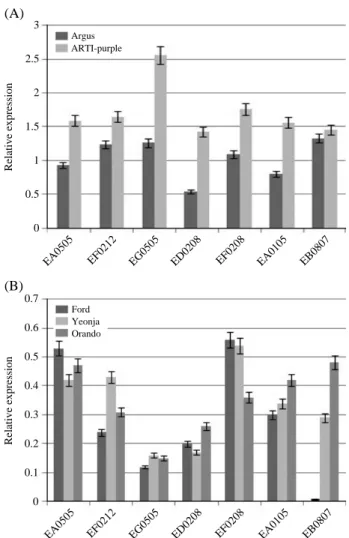
추가적으로 ‘Argus’와 ‘ARTI-purple’ 사이에 화색의 차 이, 즉 안토시아닌의 함량의 차이가 나타나는 원인을 추 적하기 위해서 ‘Argus’와 ‘ARTI-purple’ 간에 발현적 차 이를 보이는 유전자를 dot blot hybridization을 통해 발 현을 스크린하였으며, 그 결과로부터 발현에서 차이를 보인 7개 유전자를 대조군 국화 품종과 함께 real-timePCR분석을 수행하였다 (Table 1). LIM domain protein
WLIM-1, 14-3-3 family protein, S-adenosyl-L-methionine synthetase, mevalonate diphosphate decarboxylase, phos-phofructokinase, arogenate dehydratase, glutathione S-transferase는 모두 ‘ARTI-purple’에서 발현이 증가한 것 으로 확인되었다. 특히 glutathione S-transferase는 페튜 니아의 AN9과 높은 homology를 가지고 있었으며
(pos-itive identities; 81%), 대조군 세 품종에서 발현 양상은 안 토시아닌 함량과 매우 유사하게 변화하는 것을 확인할 수 있었으나, ‘Argus’와 ‘ARTI-purple’ 사이에서는 발현 차이가 크게 나타나지 않았다. 또한 S-adenosyl-L-methio-nine synthetase는 대조군 품종에서 매우 낮은 발현 양상 (‘Argus’ 대비 10%, ‘ARTI-purple’ 대비 5% 수준)을 띄고, ‘ARTI-purple’에서 발현이 가장 큰 폭으로 증가한 것을 확인할 수 있었다 (약 2배). 그리고 ‘Argus’와
‘ARTI-pur-Fig. 3. Relative expressions of differentially expressed seven genes by dot blot analysis between ‘Argus’ and ‘ARTI-purple’, in five chrysanthemums. A: qPCR of ‘Argus’ and ‘ARTI-pur-ple’, B: qPCR of check varieties.
0.7 0.6 0.5 0.4 0.3 0.2 0.1 0 3 2.5 2 1.5 1 0.5 0 EA0505
EA0505 EF0212 EG0505 ED0208 EF0208 EA0105 EB0807 EF0212 EG0505 ED0208 EF0208 EA0105 EB0807
Relative expression
Relative expression
(A)
(B)
Fig. 2. Relative expressions of the anthocyanin biosynthetic genes in five chrysanthemums. A: qPCR of ‘Argus’ and ‘ARTI-purple’, B: qPCR of check varieties.
Relative expression Relative expression 1.8 1.5 1.2 0.9 0.6 0.3 0 2.5 2 1.5 1 0.5 0 CHS CHI F3H DFR ANS CHS CHI F3H DFR ANS Argus ARTI-purple Ford Yeonja Orando (A) (B) Argus ARTI-purple Ford Yeonja Orando
ple’ 사이에서 Mevalonate diphosphate decarboxylase의 발 현이 가장 큰 폭의 증가를 보였다(Fig. 3).
결
론
안토시아닌은 가끔 어린 식물조직에서 나타나며, 조직 이 성숙함에 따라 사라지기도 한다. 일반적으로 안토시 아닌의 기능은 가시광선과 자외선을 흡수하기 때문에 조직을 보호하기 위해 차광역할을 하는 것으로 추정되 며, 또한 산화방지 능력이 있어 산화적인 피해로부터 세 포를 보호하는 것으로 추정된다 (Mol et al. 1998;Winkel-Shirley 2002; Zhang et al. 2004). 가시적으로 나타나는 안 토시아닌 함량의 손실은 엽록소의 증가, 안토시아닌 생 합성 유전자의 발현감소, 광보호제가 필요하지 않을 때 의 식물의 안토시아닌 분해능력 증가 등의 복합요인에 기인된 것으로 추정되며, 반대로 낙엽과 같이 조직의 노 후와 함께 확인되는 안토시아닌의 증가는 여전히 확실 한 해답을 찾지 못하고 있는 실정이다. 최근 안토시아닌 의 연구는 안토시아닌 생합성 유전자에 의존적으로 이루 어졌으나, 브룬펠시아 꽃잎에서 안토시아닌의 분해 가능 성을 처음으로 제시 및 확인하였다 (Vaknin et al. 2005;
Oren-Shamir 2009; Bar-Akiva et al. 2010). 본 연구에서 우리는 국화로부터 안토시아닌의 생합성에 관여하는 주 요 유전자를 분리하고, 발현 양상을 확인하였으며, 국화 꽃잎에서 나타나는 안토시아닌 함량과 비교하여 유전자 발현 양상을 비교한 결과, 대조군에서는 안토시아닌 함 량과 유사하게 합성 유전자의 발현이 증가되는 것을 확 인할 수 있었으나, ‘Argus’ 품종과 감마선 돌연변이체 ‘ARTI-purple’에서는 이러한 특성을 확인할 수 없었다. 이러한 결과는 국화 꽃잎에서 나타나는 안토시아닌 함 량은 추가적으로 안토시아닌 함량 제어에 관여된 메커 니즘의 존재나 안토시아닌의 분해, 또는 colorless antho-cyanin의 존재 가능성을 시사한다. 그리고 추가적으로 확 인한 유전자의 발현 양상 확인을 통해 확인된 glutathione
S-transferase는 안토시아닌의 channel protein으로 알려 진 페튜니아의 AN9 유전자와 ortholog의 가능성이 있을 것으로 판단되며, 그 외 확인된 유전자에 대해 추가적인 연구를 통해서 국화에서 안토시아닌 함량에 영향을 미 치는 추가적인 요소 또는 메커니즘 연구를 진행할 수 있을 것으로 기대된다.
참 고 문 헌
Bar-Akiva A, Ovadia R, Rogachev I, Bar-Or C, Bar E, Freiman
Z, Nissim-Levi A, Gollop N, Lewinsohn E, Aharoni A, Weiss D, Koltai H and Oren-Shamir M. 2010. Metabolic networking in brunfelsia calycina petals after flower open-ing. Journal of Experimental Botany 61(5):1393-1403. Castaneda-Ovando A, Pacheco-Hernández MdL, Páez-Hernán-~
dez ME, Rodríguez JA and Galán-Vidal CA. 2009. Chemi-cal studies of anthocyanins: A review. Food Chemistry
113(4):859-871.
Hayashi T. and Todoriki S. 1996. Sugars prevent the detrimen-tal effects of gamma irradiation on cut chrysanthemums. HortScience 31(1):117-119.
Kobayashi S, Ishimaru M, Ding CK, Yakushiji H and Goto N. 2001. Comparison of udp-glucose:Flavonoid 3-o-glucosyl-transferase (ufgt) gene sequences between white grapes (vitis vinifera) and their sports with red skin. Plant Science 160(3): 543-550.
Lee GJ, Chung SJ, Park IS, Lee JS, Kim JB, Kim DS and Kang SY. 2008. Variation in the phenotypic features and tran-scripts of color mutants of chrysanthemum (Dendranthema grandiflorum) Derived from Gamma ray Mutagenesis. J Plant Biol. 51(6):418-423.
Mol J, Grotewold E and Koes R. 1998. How genes paint flowers and seeds. Trends in Plant Science 3(6):212-217.
Ohmiya A, Kishimoto S, Aida R, Yoshioka S and Sumitomo K. 2006. Carotenoid cleavage dioxygenase (cmccd4a) con-tributes to white color formation in chrysanthemum petals. Plant Physiology 142(3):1193-1201.
Oren-Shamir M. 2009. Does anthocyanin degradation play a significant role in determining pigment concentration in plants? Plant Science 177(4):310-316.
Park IS and Song HS. 2005. Current trends of mutation breed-ing by radiation technology at domestic and foreign orna-mentals. J. Kor. Flower Res. Soc. 13(3):184-200.
Park IS, Lee GJ, Kim DS, Chung SJ, Kim JB, Song HS, Goo DH and Kang SY. 2007. Mutation breeding of a spray chry-santhemum ‘Argus’ by gamma-ray irradiation and tissue culture. Flower Res. J. 15(1):52-57.
Park J-S, Kim J-B, Cho K-J, Cheon C-I, Sung M-K, Choung M-G and Roh K-H. 2008. Arabidopsis r2r3-myb transcrip-tion factor atmyb60 functranscrip-tions as a transcriptranscrip-tional repressor of anthocyanin biosynthesis in lettuce (lactuca sativa) Plant Cell Reports 27(6):985-994.
Pfaffl MW. 2001. A new mathematical model for relative quan-tification in real-time rt-pcr. Nucleic Acids Research 29(9): e45.
Schwinn KE, Markham KR and Giveno NK. 1993. Floral flav-onoids and the potential for pelargonidin biosynthesis in commercial chrysanthemum cultivars. Phytochemistry
35(1):145-150.
flavonoid 3′5′-hydroxylase andflavonoid 3′-hydroxylase accelerates decolorization in transgenic chrysanthemum petals. Journal of Plant Biology 50(6):626-631.
Springob K, Nakajima J-i, Yamazaki M and Saito K. 2003. Recent advances in the biosynthesis and accumulation of anthocyanins. Natural Product Reports 20(3):288-303. Suzuki H, Nakayama T, Yamaguchi M-a and Nishino T. 2004.
Cdna cloning and characterization of two dendranthema× morifolium anthocyanin malonyltransferases with different functional activities. Plant Science 166(1):89-96.
Vaknin H, Bar-Akiva A, Ovadia R, Nissim-Levi A, Forer I, Weiss D and Oren-Shamir M. 2005. Active anthocyanin degradation in brunfelsia calycina (yesterday-today-tomor-row) flowers. Planta 222(1):19-26.
Winkel-Shirley B. 2002. Biosynthesis of flavonoids and effects of stress. Current Opinion in Plant Biology 5(3):218-223.
Yamaguchi H, Shimizu A, Degi K and Morishita T. 2008. Effects of dose and dose rate of gamma ray irradiation on mutation induction and nuclear DNA content in chrysan-themum. Breeding Science 58(3):331-335.
Yamaguchi M-A, Oshida N, Nakayama M, Koshioka M, Ya-maguchi Y and Ino I. 1999. Anthocyanidin 3-glucoside mal-onyltransferase from dahlia variabilis. Phytochemistry 52(1): 15-18.
Zhang Z, Pang X, Xuewu D, Ji Z and Jiang Y. 2004. Role of peroxidase in anthocyanin degradation in litchi fruit peri-carp. Food Chemistry 90(1-2):47-52.
Manuscript Received: March 26, 2012 Revised: April 12, 2012 Revision Accepted: May 22, 2012