P2-10 / K. Kim
• IMID 2009 DIGEST
Luminescent properties of a Zn
2SiO
4:Mn
2+film phosphor
prepared by spray pyrolysis
Kyoungun Kim, Young-Min Moon, Sungho Choi*, Sun Sook Lee, Taek-Mo Chung
and Ha-Kyun Jung
Advanced Materials Division, Korea Research Institute of Chemical Technology, P.O. Box 107, Yuseong, Daejeon 305-600, Republic of Korea
Tel: 82-42-860-7372, e-mail: [email protected]
Keywords : green phosphor, spray pyrolysis, transparent film
Abstract
Transparent Zn2SiO4:Mn2+ film has been synthesized by
spray pyrolysis with various spraying conditions. It illuminates an efficient green emission with the relative emission intensity about 45% under 147nm excitation of a commercial powder phosphor. Additionally, the zinc precursors and additives play a key factor both controlling luminous efficiency and transparency.
1. Introduction
To achieve the emissive transparent display devices, a highly efficient phosphor films with good transparency under visible wavelength region have attracted much attention in recent years. [1] In comparison with the conventional powder phosphors, film phosphors have advantages such as superior adhesion, high contrast and resolution due to the reduction of light scattering. [2,3]. Various deposition techniques have been used in the growth of film phosphors, including spray pyrolysis (SP), sputtering, evaporation, sol–gel spin coating, and pulsed-laser deposition (PLD) [4-8]. In spite of active investigations on film phosphors, they are yet to be developed for practical use because of their poor luminescence efficiencies due to the internal total reflection and the wave-guiding effect of high refractive index materials [9].
In this paper, highly efficient Zn2SiO4:Mn2+ film
phosphor with good transparency was prepared by ultrasonic SP process. Using this method, we can obtain a film-type phosphor layer without additional organic-based screen printing process. Also, the film composition and growth rate are easily controllable via SP process.
2. Experimental
Zn2SiO4:Mn2+ film phosphors were prepared by a
spray pyrolysis method. Various zinc sources such as zinc nitrate, zinc sulfate and zinc acetate and tetraethyl orthosilicate (TEOS) were used as zinc and silicon sources of Zn2SiO4, which served as a host
material. Manganese acetate was used as manganese activator and doping concentration was fixed at 10 mol% zinc. The ultrasonic transducer for commercial humidifier (frequency=1.7 MHz) was used to generate the liquid droplets. Resultant liquid droplets formed from spay solution were transferred to the high temperature tube furnace by carrier gas adjusted to 20 L/min. The substrate, used quartz in this case, was held from 100 to 300℃ by heating inside the quartz tube. After coating, films were annealed at 1100℃ for 12h under air ambient.
The corresponding film phosphors were indentified through the X-ray diffraction using a Rikaku DMAX-33 X-ray diffractometer with Cu Ka radiation. The vacuum ultra violet (VUV) photoluminescence were measured using 147 nm krypton lamp as an excitation source at room temperature. Film surface and particle morphology of the corresponding film phosphors were investigated using a Philips XL 30S FEG scanning electron microscope (SEM). Finally, the transmittance of the film phosphor was measured in the wavelength range of 400-800 nm using a UV-Vis spectrophotometer (Shimadzu UV-2501 PC).
3. Results and discussion
Fig. 1 shows the XRD patterns of both film and powder Zn2SiO4:Mn phosphors prepared by spray
P2-10 / K. Kim
IMID 2009 DIGEST • pyrolysis. All diffraction peaks are well matched to
willemite Zn2SiO4, JCPDS card #37-1485. Except
the broad diffraction peak at 2θ=22o ascribed to quartz
substrates, the relative intensity of film-type phosphor is similar to that of powder samples. Thus, Zn2SiO4:Mn film prepared by spray pyrolysis on the
amorphous substrate is possibly grown polycrystalline or simply coating with powder samples. No matter which one is the real film condition from SP-process, our suggested method is beneficial to prepare a transparent emissive phosphor layer than using other conventional method like as printing and vacuum process.
Fig. 1. XRD patterns of (a) Zn2SiO4:Mn 2+
film phosphor coated on quartz prepared by spray pyrolysis and (b) Powder phosphor prepared via same procedure. Reference JCPDS data of willemite Zn2SiO4 is shown.
Fig. 2 shows the emission spectra under VUV excitation and transmittance of the resultant film phosphor prepared with various zinc precursors. Inserted SEM images show in Fig. 2 (a) are the surface morphology of corresponding film phosphors. Under the excitation at 147 nm, the PL peak is centered at 524 nm regardless of zinc precursor. This is attributed to the spin forbidden 4T
1(4G)→6A1(6S)
transition in Mn2+ ions in Zn
2SiO4 [10,11]. The
relative emission intensity and transmittance of corresponding films, however, are strongly dependent on the choice of zinc precursor. Spray-pyrolyzed film phosphor prepared both using zinc nitrate and zinc sulfate illuminates a prominent green emission with the relative emission intensity about 45% of a powder Zn2SiO4:Mn2+ phosphor under 147nm excitation. The
transmittance of the Zn2SiO4:Mn2+ using the zinc
nitrate (or zinc sulfate) ranges from 35% at the 400 nm-blue regions to 40 % at the 700 nm- red regions. Such transparency is confirmed by the readability of some characters through the film sample. Thus, it has been found that various zinc precursors a key factor both controlling luminous efficiency and transparency.
(a)
(b)
Fig. 2. VUV-PL ((a)) and transmittance ((b)) of Zn2SiO4:Mn2+ film phosphor obtained with various zinc precursors.
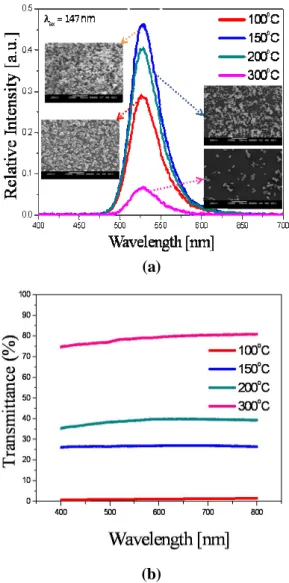
Fig. 3 (a) and (b) shows emission spectra and transmittance of Zn2SiO4:Mn2+ phosphor films
prepared at various deposition temperatures, respectively. The optimum synthesis temperature for the efficient luminescent film phosphor was 200°C. As it can be seen in inserted SEM images, the amount of deposited particles is lower for higher deposition temperature. The transmittance of the Zn2SiO4:Mn2+
in the various temperatures observed from about 5% to 80%. As it can also be seen from Fig. 3 (b), the
P2-10 / K. Kim
• IMID 2009 DIGEST
transmittance increase as a function of substrate temperature, being about 3% for films grown at 100°C, about 40% for films grown at 200°C and 80% for films grown at 300°C.
By using a proper precursor solution and spray conditions, highly efficient Zn2SiO4:Mn film phosphor
with good transparency under visible light was obtained. Overall solution properties such as pH, mole fraction and spray ambient additionally affect the morphology and optical properties of corresponding film and leads to higher luminescence intensity of spray-pyrolyzed Zn2SiO4:Mn2+ film.
(a)
(b)
Fig. 3. (a) VUV-PL and (b) transmittance of Zn2SiO4:Mn2+ film phosphor prepared by various substrate temperatures.
4. Summary
Film type green-emitting Zn2SiO4:Mn2+ phosphor
was easily obtained using the solution-based film growth method, ultrasonic SP. With optimization of growth condition (substrate temperature) and proper selection of precursor, it should be possible to make improved output emission efficiency with higher transparency phosphor layer. We expect that this film phosphor could be applied for the generation of emissive transparent display devices.
5. References
1. G. Buhler, C. Feldmann, Appl. Phys. A 87, 631 (2007).
2. S.L. Jones, D. Kumar, K.G. Cho, R. Singh, P.H. Holloway, Displays 19, 151 (1999).
3. S. Shionoya, W.M. Yen, H. Yamamoto, Phosphor Handbook, CRC Press, NY, 2006.
4. J. Hao, M. Cocivera, Appl. Phys. Lett. 79, 740 (2001).
5. C.M. Lin, Y.Z. Tsai, J.S. Chen, Thin Solid films 515, 7994 (2007).
6. S. Onodera, Mater. Res. Bull., 31, (1996) 793. 7. Z. Ji, L. Kun, S. Yongliang, Y. Zhizhen, J. Cryst.
Growth 255, 353 (2003).
8. J. Yan, Z. Ji, J. Xi, C. Wang, J. Du, S. Zhao, Thin Solid Films 515, 1877 (2006).
9. Y.R. Do, Y.C. Kim, S.H. Cho, J.H. Ahn, J.G. Lee, Appl. Phys. Lett., 82, 4172 (2003).
10. Y. Hao, Y. Wang, J. Lumin., 122, 1006 (2007). 11. R.P.S. Chakradhar, B.M. Nagabhushana, G.T.
Chandrappa, K.P. Ramesh, J.L. Rao, J. Chem. Phys., 121, 10250 (2004).