저작자표시-비영리-변경금지 2.0 대한민국 이용자는 아래의 조건을 따르는 경우에 한하여 자유롭게 l 이 저작물을 복제, 배포, 전송, 전시, 공연 및 방송할 수 있습니다. 다음과 같은 조건을 따라야 합니다: l 귀하는, 이 저작물의 재이용이나 배포의 경우, 이 저작물에 적용된 이용허락조건 을 명확하게 나타내어야 합니다. l 저작권자로부터 별도의 허가를 받으면 이러한 조건들은 적용되지 않습니다. 저작권법에 따른 이용자의 권리는 위의 내용에 의하여 영향을 받지 않습니다. 이것은 이용허락규약(Legal Code)을 이해하기 쉽게 요약한 것입니다. Disclaimer 저작자표시. 귀하는 원저작자를 표시하여야 합니다. 비영리. 귀하는 이 저작물을 영리 목적으로 이용할 수 없습니다. 변경금지. 귀하는 이 저작물을 개작, 변형 또는 가공할 수 없습니다.
석사학위논문
흰다리새우(
Litopenaeus vannamei
) 사료
내 메티오닌/시스틴의 적정 첨가비에
관한 연구
제주대학교 대학원
해양생명과학과
김 수 환
2018년 2월
흰다리새우(
Litopenaeus vannamei
) 사료
내 메티오닌/시스틴의 적정 첨가비에
관한 연구
지도교수 이 경 준
김 수 환
이 논문을 이학 석사학위 논문으로 제출함
2017년 12월
김수환의 이학 석사학위 논문을 인준함
심사위원장 최 광 식
위 원 정 석 근
위 원 이 경 준
제주대학교 대학원
2017년 12월
Study on optimum methionine/cystine ratio
in diets for Pacific white shrimp
(
Litopenaeus vannamei
)
Soohwan Kim
(Advised by Professor Kyeong-Jun Lee)
A thesis submitted in partial fulfillment
of the requirement for the Degree of
Master of Science
Department of Marine Life Sciences
GRADUATE SCHOOL
JEJU NATIONAL UNIVERSITY
목 차
ABSTRACT ···ⅱ
LIST OF FIGURES ···ⅲ
LIST OF TABLES ···ⅳ
1. 서 론 ···1
2. 재료 및 방법 ···3
2.1. 실험사료 ···3
2.1. 실험새우 및 사육관리 ···7
2.2. 샘플수집 및 분석 ···8
2.3. 사료유인성검사 ···15
2.4. 사료 내 아미노산 수중 용해도 측정 ···15
2.5. 소화율 분석 ···17
2.6. 통계학적 분석 ···18
3. 결 과 ···19
4. 고 찰 ···26
5. 요약문 ···29
6. 참고문헌 ···30
Abstract
This study was conducted to investigate the proper ratio of methionine and cystine (free L-Met, free L-Cys) on cystine availability, replacement effect of methionine with cystine, growth performance, feed utilization and non-specific immunity of Pacific white shrimp (Litopenaeus vannamei). Seven experimental diets were formulated to supplement L-methionine and L-cystine in different proportions [Met:Cys; 100:0 (M10C0), 90:10 (M9C1), 80:20 (M8C2), 70:30 (M7C3), 60:40 (M6C4), 50:50 (M5C5) and 0:100 (M0C10). The shrimp (initial weight: 1.10g) were randomly distributed into 28 acrylic tanks of 96 L capacity at a density of 15 shrimps per tank and three groups of shrimps were fed one the experimental diets for 8 weeks. At the end of the feeding trial, no significant difference was observed in growth performance, feed utilization and survival. In non-specific immunity, the results of SOD were significantly higher in M9C1 group than in the M7C3, M6C4, and M5C5 groups. SOD was the lowest in M6C4 group (P<0.05). No significant differences were observed in NBT, PO, anti-protease and lysozyme. The results of the shrimp whole-body composition revealed no significant differences among dietary treatments. In the palatability test, the difference contents or ratio of Met and Cys in the diets did not affect the feed intake of shrimp. In the case of apparent digestibility coefficient of dry matter (ADCd), M8C2 diet group was significantly higher among all diet groups. Shrimp fed the M9C1 diet showed significantly (P<0.05) higher ADC of protein than that of other diet. M6C4 diet group was significantly lowest in ADCd and ADCp. Replacement of Met with Cys in feeds could have any negative effect on the ADCd and ADCp of L. vannamei. Therefore, L-cystine may be useful as an alternative amino acid to L-methionine in feeds for L. vannamei.
LIST OF FIGURES
Fig. 1. Preparation of the experimental diets. ···7
Fig. 2. Shrimp culture system for the feeding trial. ···8
Fig. 3. Measurement of growth performance in every
2 weeks during the feeding trial. ···9
Fig. 4. Collection of blood samples. ···10
Fig. 5. Measurement of DO, pH and ammonia
concentration in the feeding trial tanks. ···13
Fig. 6. Collected feces and its chromium oxide
LIST OF TABLES
Table 1. Formulation of the seven experimental diets for
Pacific white shrimp (% DM). ···4
Table 2. Proximate composition of the seven experimental
diets (% DM). ···5
Table 3. Methionine and cystine concentrations in seven
experimental diets for Pacific white shrimp. ···6
Table 4. Summary of water quality parameters observed
during the 8 weeks growing period. ···14
Table 5. Leftover methionine and cystine concentrations
in M5C5 diet after leaching test for the time
interval. ···16
Table 6. Growth performance and feed utilization of
white shrimp (IBW: 1.10±0.01) fed the seven
experimental diets for 8 weeks. ···20
Table 7. Non-specific immune responses of Pacific
white shrimp fed the seven experimental diets
for 8 weeks. ···21
Table 8. Whole body proximate composition (%, DM) of
experimental Pacific white shrimp fed the seven
experimental diets for 8 weeks. ···22
Table 9. Methionine and cystine concentrations of whole
the seven experimental diets for 8 weeks. ···23
Table 10. Consumed feed intake (palatability test) for
Pacific white shrimp fed the seven experimental
diets. ···24
Table 11. Apparent digestibility coefficient (%, ADC) of
dry matter and protein in the test diets
determined by fecal collection for Pacific white
1. 서 론
세계적으로 어획량이 감소함에 따라 양식의 중요성이 커지면서 양식 생산 량 또한 빠르게 증가하고 있다(Chiu et al., 2016). 세계 양식 생산량이 증가함 에 따라 새우 양식장 및 새우 양식 생산량 또한 급격하게 증가하고 있는 추세 이다(López et al., 2003). 새우는 우리나라를 비롯하여 세계 각국에서 기호식 품으로 각광받는 중요한 수산생물로, 세계 여러 나라에서 양식되고 있다(FAO, 2015). 그 중 흰다리새우(Litopenaeus vannamei)는 멕시코 중부에서부터 페루 북부에 이르는 태평양 연안에서 어획되는 종으로써 세계적으로 가장 많이 양 식되는 주요 양식 종으로 2014년 생산량은 약 360 만 톤을 기록하였으며, 이 는 전체 새우 생산량의 약 80% 정도를 차지한다(Lin and Mui, 2017; Smith et al., 1985). 또한, 배합사료만을 공급하여 약 5-6개월이라는 단기간 사육으로 출하가 가능하기 때문에 전 세계적으로 생산량이 증가하고 있는 고부가가치 양식 갑각류이다. 하지만 흰다리새우 양식 생산량 증가에 비해 새우 사료에 관한 연구는 아직 미흡한 실정이다. 단백질을 주 에너지원으로 이용하는 새우의 특성상 (Sookying and Davis., 2011) 사료 내 부적합한 단백질 함량이나, 아미노산 조성에 따른 단백 질의 질 저하는 흰다리새우의 성장을 지연, 감소시키거나 불필요한 사료비용 을 증가시키는 결과를 초래한다. 따라서, 단백질을 구성하는 각 아미노산의 적 절한 조성과 함량은 흰다리새우 배합사료에 있어서 첫 번째로 고려해야 할 사 항이다. 어분(Fish meal)은 우수한 아미노산 조성, 필수지방산, 콜레스테롤, 비 타민, 미네랄 등의 함유와 미지성장인자를 포함하고 있어서 양어사료뿐만 아 니라 새우사료에서도 최고의 단백질 사료원이다(Hardy and Tacon., 2002; Amaya et al., 2007; Gatlin et al., 2007). 상업용 새우 사료에는 약 25-50%의 어분이 첨가되고 있으며, 최근 세계적으로 어분의 공급이 일정하지 않고 가격 이 계속적인 증가 추세에 있어 사료의 가격을 증가시키는 주요 원인으로써 가 격을 낮추기 위해 어분 첨가량을 최소화하기 위한 연구가 활발하다(Suárez et al., 2009). 그 중에서도 대두박과 같은 식물성 단백질원과 분리대두단백, 농축대두단백과 같은 식물성 정제 단백질 사료원에 대한 어분대체 연구가 활발히 진행되고 있다(Lee et al., 2002; Pham et al., 2008). 대두박은 질 좋은 단백질, 합리적인 가격, 일관된 이용성과 같은 장점이 있어서 사료 내 식물성 단백질 원으로 활발히 사용되고 있다(Piedad-Pascual et al., 1990; Lim and Dominy, 1992). 하지만, 대두박은 새우 성장에 필요한 메티오닌(Methionine)과 같은 필 수아미노산의 부족으로 인하여 사료 내 첨가함량이 제한적이다(Alam et al., 2005). 이러한 추세를 감안한다면, 향후 식물성단백질을 다량 포함하는 새우양 식용 배합사료에는 어분의 아미노산을 보충하기 위한 제한 아미노산(limiting amino acids)의 첨가 중요성이 더욱 더 커질 것으로 판단된다(NRC, 2011). 식물성단백질원 중 첫 번째 제한 아미노산으로 간주되는 메치오닌은 외부 로부터 반드시 공급되어야 하는 필수아미노산으로, 콜린(Choline) 및 기타 여 러 대사과정의 전구체로서 알려져 있다. 사료 내 메치오닌의 함량이 부족할 경우, 어류의 성장과 사료효율에 악영향을 끼칠 수 있다고 보고되었다(Khan, 2014). 시스틴은 비필수아미노산으로써 단백질합성 및 타우린과 글루타티온의 생합성에 관여하는 생리학적으로 중요한 아미노산이다(Abidi and Khan, 2011). 메치오닌 전구체로부터 합성된 시스틴(Cystine)은 몇몇 어종에서 메치 오닌 요구량을 대체(약 40-60 %) 할 수 있다고 보고되고 있다(Wilson, 2002). 황 함유 아미노산의 요구량은 메치오닌 또는 메치오닌과 시스틴의 적절한 혼 합물에 의해 충족 될 수 있으며, 총 황함유아미노산 요구량이라고도 한다 (NRC, 2011). 어류나 갑각류에서 메치오닌의 요구량(혹은 총 황함유아미노산 요구량)을 조사하기 위해서는 사료원료 내 시스틴의 함량과 그에 따른 사료 내 첨가함량을 고려하는 것이 매우 중요하며, 비필수아미노산인 시스틴으로 필수아미노산인 메치오닌을 대체할 경우, 잠재적으로 사료에 소요되는 비용을 절감할 수 있다(Goff and Gatlin, 2004).
따라서 이 연구는 흰다리새우를 대상으로 사료 내 메치오닌과 시스틴의 적정첨가비율과 그에 따른 성장, 사료효율, 소화율 및 비특이적 면역력을 알아 보고자 수행되었다.
2. 재료 및 방법
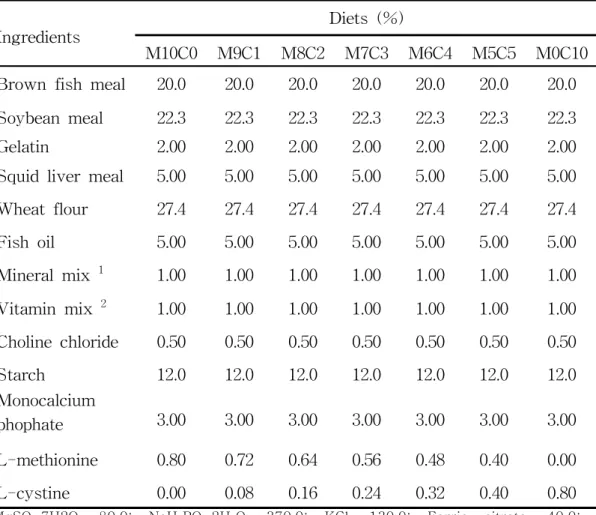
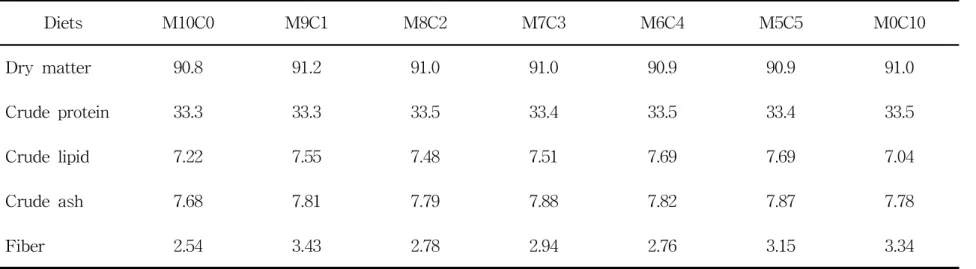
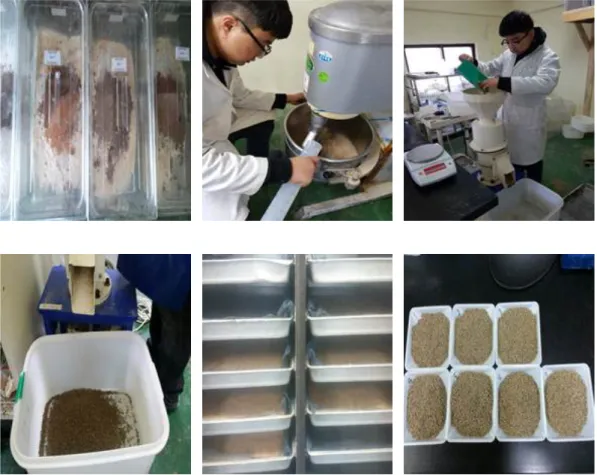
2.1. 실험사료 실험에 사용된 7개의 실험사료는 조단백질 33.4%, 조지방 7.5%로 제조하 였으며, 에너지는 17.7 MJ/kg로 제주대학교 해양과학연구소(사료영양연구실) 에서 제조하여 사양시험에 사용하였다. 약 20%의 어분이 첨가된 기초사료에 메치오닌(Met)과 시스틴(Cys)의 첨가 비율을 10:0(M10C0), 9:1(M9C1), 8:2(M8:C2), 7:3(M7C3), 6:4(M6C4), 5:5(M5C5), 0:10(M0C10)을 달리하여 총 7 가지의 실험사료를 제조하였다(Table 1). Met:Cys 비율의 10:0(M10C0) 사료 는 Positive control로, 0:10(M0C10) 비율 사료는 Negative control로 지정하여 시험사료를 디자인하였다. 실험에 사용된 사료의 일반성분 분석 결과는 Table 2에 나타내었으며, 사료 내 Met 및 Cys 함량 분석 결과는 Table 3에 나타내 었다. 실험사료는 사료원들을 혼합기에 넣어 섞은 다음, 어유를 첨가한 뒤 사 료원 총 중량의 10%에 해당하는 증류수를 첨가하여 모든 사료원을 상업용 믹 서기(NVM-14-2P, Gyeonggido, Korea)를 사용하여 혼합 후 펠렛 성형기 (SP-50, Daegu, Korea)를 사용하여 직경 2-3mm 크기로 압출 성형하였다 (Fig 1). 제작된 실험 사료는 동결건조기로 -40°C에서 24시간 건조시킨 후, 사 료공급 전까지 -20°C 냉동고에 보관한 후 실험에 사용하였다.Table 1. Formulation of the seven experimental diets for Pacific white shrimp (% DM).
1MgSO
4.7H2O, 80.0; NaH2PO4.2H2O, 370.0; KCl, 130.0; Ferric citrate, 40.0;
ZnSO4.7H2O, 20.0; Ca-lactate, 356.5; CuCl, 0.2; AlCl3. 6H2O, 0.15; Na2Se2O3, 0.01;
MnSO4.H2O, 2.0; CoCl2.6H2O, 1.0.
2L-ascorbic acid, 121.2; DL-α tocopheryl acetate, 18.8; thiamin hydrochloride, 2.7;
riboflavin, 9.1; pyridoxine hydrochloride, 1.8; niacin, 36.4; Ca-D-pantothenate, 12.7; myo-inositol, 181.8; D-biotin, 0.27; folic acid, 0.68; p-aminobezoic acid, 18.2; menadione, 1.8; retinyl acetate, 0.73; cholecalficerol, 0.003; cyanocobalamin, 0.003.
Ingredients Diets (%)
M10C0 M9C1 M8C2 M7C3 M6C4 M5C5 M0C10
Brown fish meal 20.0 20.0 20.0 20.0 20.0 20.0 20.0
Soybean meal 22.3 22.3 22.3 22.3 22.3 22.3 22.3
Gelatin 2.00 2.00 2.00 2.00 2.00 2.00 2.00
Squid liver meal 5.00 5.00 5.00 5.00 5.00 5.00 5.00
Wheat flour 27.4 27.4 27.4 27.4 27.4 27.4 27.4 Fish oil 5.00 5.00 5.00 5.00 5.00 5.00 5.00 Mineral mix 1 1.00 1.00 1.00 1.00 1.00 1.00 1.00 Vitamin mix 2 1.00 1.00 1.00 1.00 1.00 1.00 1.00 Choline chloride 0.50 0.50 0.50 0.50 0.50 0.50 0.50 Starch 12.0 12.0 12.0 12.0 12.0 12.0 12.0 Monocalcium phophate 3.00 3.00 3.00 3.00 3.00 3.00 3.00 L-methionine 0.80 0.72 0.64 0.56 0.48 0.40 0.00 L-cystine 0.00 0.08 0.16 0.24 0.32 0.40 0.80
Table 2. Proximate composition of the seven experimental diets (% DM).
The values are mean of three replicate analyses.
Diets M10C0 M9C1 M8C2 M7C3 M6C4 M5C5 M0C10 Dry matter 90.8 91.2 91.0 91.0 90.9 90.9 91.0 Crude protein 33.3 33.3 33.5 33.4 33.5 33.4 33.5 Crude lipid 7.22 7.55 7.48 7.51 7.69 7.69 7.04 Crude ash 7.68 7.81 7.79 7.88 7.82 7.87 7.78 Fiber 2.54 3.43 2.78 2.94 2.76 3.15 3.34
Table 3. Methionine and cystine concentrations in seven experimental diets for Pacific white shrimp.
The values are mean of three replicate analyses.
% in sample M10C0 M9C1 M8C2 M7C3 M6C4 M5C5 M0C10
Methionine 1.22 1.13 1.02 0.97 0.88 0.87 0.62
Fig. 1. Preparation of the experimental diets. 2.2. 실험새우 및 사육관리
시험에 사용된 흰다리새우는 충남 당진에 위치한 새우양식장(네오엔비즈 ㈜)에서 구입하여 제주대학교 양어사료영양학연구실 내 새우전용 사양시험 시 설(Fig 2)에서 진행하였다. 시험 새우는 2 주 동안 시판 배합사료(DongA one, Busan, South korea)를 공급하면서 사육시험 환경에 적응할 수 있도록 순치시 킨 후 사료공급 시험에 사용하였다. 예비사육 후 새우(초기평균무게: 1.10 g) 는 총 28 개의 96L 수조에 각 15 마리씩 무작위로 선택하여, 시험 사료구당 4 반복이 되도록 배치하였다. 모든 시험수조에 용존산소 유지를 위하여 에어스 톤을 설치하였고, 전 시험기간 동안 사육수온은 실내온풍기 및 각 수조에 수
중히터를 설치하여 28 - 31℃ 범위로 유지되었다. 사료공급은 1일 4회(08:30, 13:00, 17:30 & 20:00h)에 나누어 8 주간 제한공급(어체중의 6 ~ 12%)을 실시 하였다.
Fig. 2. Shrimp culture system for the feeding trial. 2.3. 샘플수집 및 분석
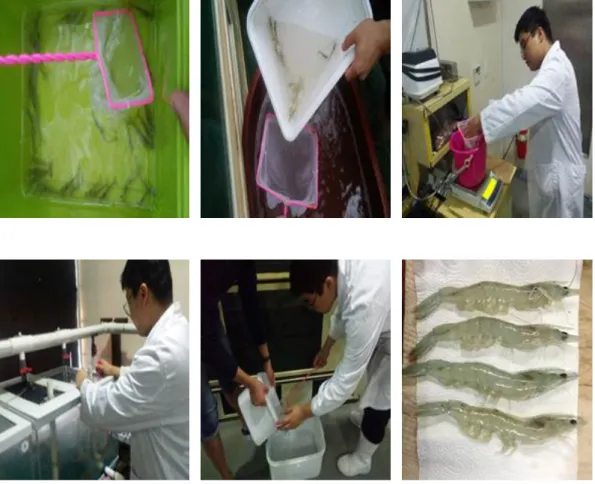
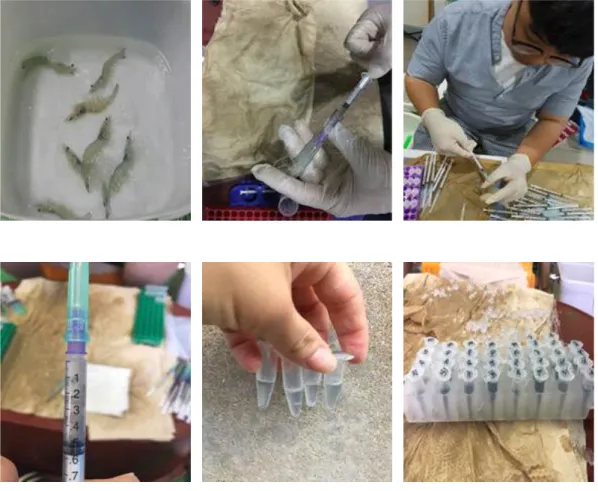
시험 새우 무게측정은 2주마다 실시하였으며, 측정 18시간 전에 시험 새우 의 스트레스를 줄이기 위해 모든 시험 새우를 절식시켰다(Fig 3). 최종 무게측 정 후 수조당 4마리의 새우를 무작위로 선별하여 얼음물에 마취 시킨 후,
다(Fig 4). 채혈된 hemolymph는 대식세포활성(NBT; nitroblue-tetrazolium)을 분석한 후, 원심분리기(Micro 17 TR; HanilBioMed Inc., Gwangju, Kroea)를 이용하여 800 g로 10분간 혈장을 분리하여 비특이적 면역력 분석에 사용되었 다. 소화율분석을 위한 새우의 분(feces) 수집은 사료공급 30분 후, 사이펀 (siphoning) 및 환수를 하여 수조에 남은 사료 및 이물질을 깨끗이 청소하고, 이후 3시간 후부터 배설되는 분을 사이펀으로 수집하여 증류수로 세척한 후에 거름종이를 이용하여 필터(filter)시킨 후, 분석용 샘플로 사용할 때까지 -40°C 저온 냉동고에 보관하였다.
Fig. 3. Measurement of growth performance in every 2 weeks during the feeding trial.
Fig. 4. Collection of blood samples.
성장률과 사료효율 관련 조사항목과 계산식은 다음과 같다:
증체율(WG, %) = 100 × (final mean body weight – initial mean body weight)/initial mean body weight; 사료효율(FCR) = dry feed fed/wet weight gain; 단백질이용효율(PER) = wet weight gain/total protein given; 일간성장률(SGR, %) = [(loge final body weight – loge initial body
weight)/days]× 100; 사료섭이량(FI, g) = dry feed fed/shrimp.
시험사료 및 분의 일반성분 분석은 AOAC (1995) 방법에 따라 수분은 상 압가열건조법(125℃, 3h), 조회분은 직접회화로법(550℃, 6h), 단백질은 자동
al. (1959)의 방법에 따라 Soxhlet 추출장치(Soxhlet Heater system C-SH6, Korea)를 이용하여 분석하였다.
사료 및 새우 전어체 내의 황아미노산분석은 먼저, 사료 및 새우 전어체 시료 약 0.02g을 정밀히 취하여 Test tube에 넣고 6N HCl 을 15ml 를 가한 후, 약 1 분간 질소가스로 충전하고 감압밀봉하여 110℃의 Dry oven에서 24 시간 동안 산가수분해시켰다. 24 시간 후, Dry oven에서 Test tube 를 꺼내어 상온에서 식힌 다음, 분해된 시료를 55℃ Water bath 에서 증류수를 넣어 2 회 반복으로 감압농축시켰다. pH 2.20 Dilution buffer 로 25ml Volumetric flask 에 정용한 후, 0.45ul Membrane filter 로 여과 후, 희석하여 아미노산 조 성 분석 시스템 (Amino acid composition analysis system) 을 사용하여 시료 내 황 아미노산 함량을 측정하였다.
혈액내의 대식세포 활성(NBT activity)은 Zhang et al (2013)의 분석방법 을 응용하여 호흡폭발 동안의 호중구(Neutrophils)에 의한 oxidative radical 생성량을 측정하였는데 분석방법은 다음과 같다. 우선, Hemolymph 50 ul을 200 ul HBSS(Hank’s balanced salt solution)용액과 혼합한 뒤 25°C에서 반응 시켰다. 30분 후 zymosan (0.1% Hank’s solution) 100 µL 첨가 후 37°C 에서 2시간 동안 반응시켰다. NBT solution(0.3%)을 100 ul씩 넣은 뒤 37°C 에서 2 시간 동안 반응시켰다. 600 ul 100% methanol을 넣고 10분 동안 원심분리 (6500 rpm) 후 상층액을 버려내고 70% methanol 100 µL로 3번 세척한 뒤 5 분 동안 건조시켰다. 2M KOH 700 µL 와 DMSO 800 µL 를 첨가한 후, 620 nm에서 흡광도를 측정하였다. Lysozyme 활성분석은 Swain et al (2007)의 방법을 기초로 분석하였다. 라이소자임은 비특이적(선천적) 면역반응에 속하는 항균효소 중의 하나로써, 특정세균에 대한 특이적인 항균작용이 아닌 비특이적으로 다양한 균에 대한 항균작용을 나타내는 효소이다. 병원균에 대한 항균 메커니즘은 세균 세포벽 의 구성성분인 peptidoglycan의 β-1,4-글루코시드 결합을 가수분해 하여 세균 의 세포벽을 파괴함으로써 항균작용을 나타낸다. 라이소자임은 특히 그람양성 균에 대한 항균효과가 뛰어나다. 이러한 기작에 기인하여 lysozyme activity는 어류를 포함한 새우에 있어서의 비특이적 면역반응을 측정하는 분석항목으로
널리 이용되고 있으며, 새우사료 내 면역활성인자 (ascorbic acid, β-glucan, probiotics 등)들의 첨가 시 새우의 혈청 및 조직에 있어서 증가된 lysozyme activity를 확인 할 수 있으며, 이러한 결과는 비특이적 면역반응의 증가 또는 어류의 면역력의 향상을 나타내는 결과로 해석된다.
Phenoloxidase 활성분석은 Hernandez-Lopez et al. (1996)의 방법을 기초 로 분석하였다. Phenoloxidase는 갑각류의 방어기작에 매우 중요한 역할을 하
는 효소로서 혈구세포 내 Prophenoloxidase 형태로 존재하다가
Prophenoloxidase activating system 에 의해 활성화된다. 활성화된
Phenoloxidase 는 옵소닌을 생산하여 혈구의 식세포 활동과 외래 항원에 대한 피복작용을 촉진시키며 혈액응고 반응에 참여한다. 따라서 hemolymph 내 Phenoloxidase 활성은 새우의 선천성 면역의 중요한 지표로 사용된다.
Superoxide dismutase (SOD) 활성은 superoxide dismutase assay kit (Sigma, 19160)를 이용하여 분석하였다. 96-well plates에 20 µL radical detector를 첨가한 후 혈액 샘플을 10 µL씩 넣는다. 그 후 20 µL xanthine oxidase를 첨가하여 20분간 반응시킨 후, microplate reader (Themo)를 이용 하여 450 nm에서 흡광도를 측정하였다.
혈청 내 anti-protease의 활성은 Ellis (1990a)의 분석방법을 바탕으로 분 석하였다. 혈청 20 μl와 20 μl of standard trypsin solution (Type II-S, from porcine pancreas, 5 mg ml-1,Sigma-Aldrich)을 혼합한 후 10분간 22°C에서
배양한다. 200 μl of phosphate buffer (0.1 M, pH 7.0)와 250 μl azocasein (2%) (Sigma-Aldrich)를 첨가하고 22 °C에서 1시간동안 배양 후 500 μl 의 trichloro acetic acid (10%) (TCA)를 다시 첨가한 후 22°C에서 30분간 배양한
다. 배양된 용액을 원심분리(6000 g, 5분)하고 100 μl 를 96-well plates에 분
주 후, 100 μl의 NaOH (1 N)을 첨가하여 microplate reader 430 nm에서 흡광 도를 측정하였다.
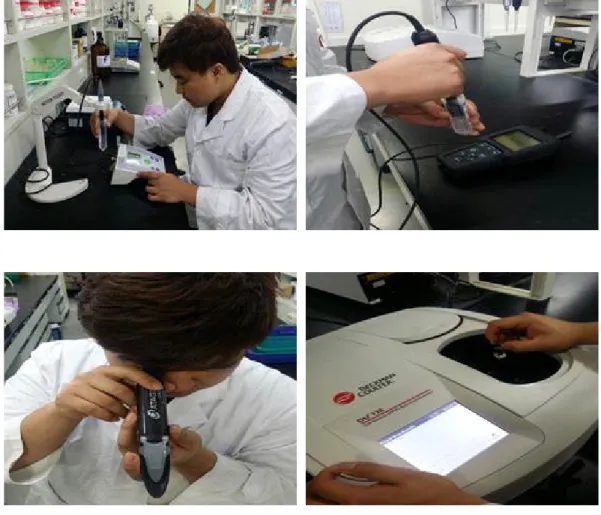
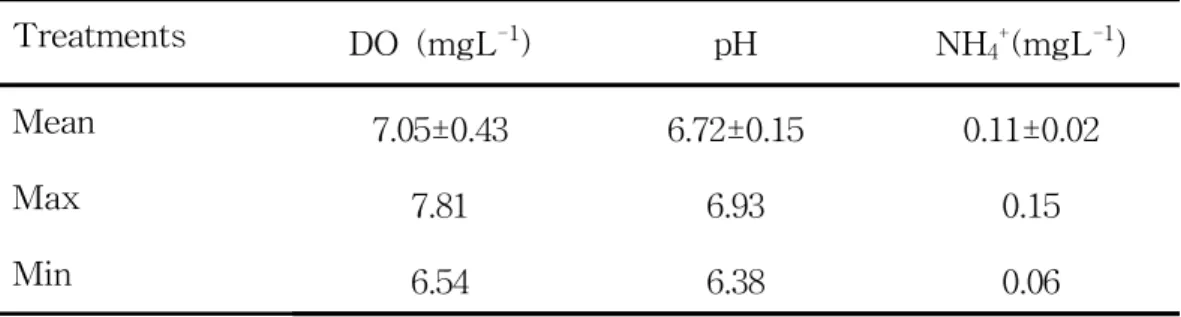
8 주간의 사양시험 기간 동안 28개의 사양시험 수조에서 해수 샘플을 채 취하여 5일에 한번씩 수질분석을 실시하였다(Fig 5). 샘플은 각 탱크마다 같은
A216 Benchtop Meter (Thermoscientific), pH는 Seven Compact (METTLER
TOLEDO)를 사용하여 측정하였다. NH4+는 Verdouw et al. (1978)의 방법을
사용하여 분석하였으며, 수질분석에 대한 결과는 Table 4에 나타내었다.
Fig. 5. Measurement of DO, pH and ammonia concentration in the feeding trial tanks.
Table 4. Summary of water quality parameters observed during the 8 weeks growing period.
Treatments DO (mgL-1) pH NH
4+(mgL-1)
Mean 7.05±0.43 6.72±0.15 0.11±0.02
Max 7.81 6.93 0.15
2.4. 사료유인성검사(Palatability test) 3 회에 걸쳐서 각 15 마리씩 배치된 28 개의 시험수조에 정량한 사료를 동시에 공급하여 시험사료를 모두 섭취하는데 소요되는 시간을 측정하였다. 일반적으로 어류를 대상으로 측정되는 항목으로 사료 내 첨가제에 의한 사료 섭이촉진 효과를 조사하기 위해 사용하는 항목으로, 본 연구용역에서도 새우 를 대상으로 시험적으로 시도하였다. 유인성검사 시의 사육수온은 29~31℃ 범 위로 유지되었으며, 사료공급은 제한공급(어체중의 4%)을 하였다. 2.5. 사료 내 아미노산 수중 용해도 측정
사료 내 아미노산(Met, Cys) 수중 용해도 측정은 Chi et al. (2011)의 방법
을 토대로 분석되었다. 1L의 해수(30.0 g L-1)에 시험사료 M5C5 2.5 g을 넣고 상온에서 사료를 80 rpm으로 회전시켜 용해시켰다. 용해된 사료를 filter 에 걸러주고, 남아있는 염분을 증류수로 씻어내었다(5, 10, 20 & 30분후). 그 후4 0℃ 건조오븐에서 건조시킨 다음, 부경대학교 사료영양연구소 및 한국기초과 학연구원 제주센터로 샘플을 의탁하여 사료 내 남아있는 Met과 Cys의 함량을 측정하였으며, 그 결과는 Table 5에 나타내었다.
Table 5. Leftover methionine and cystine concentrations in M5C5 diet after leaching test for the time interval.
Mean values of three replicates groups: values are presented as mean ± SD.
% in sample 0 min 5 min 10 min 20 min 30 min
Methionine 0.87±0.01 0.81±0.01 0.79±0.13 0.77±0.09 0.77±0.03
2.6. 소화율 분석
시험사료와 분에서의 chromium oxide 함량은 Divakaran et al. (2002)의 방법을 토대로 분석되었다. 시험사료 및 분 샘플은 회화로(550℃)에서 3시간 동안 회화시킨 후 얻어진 시료를 분석에 사용하였다(Fig 6). 먼저 chromium oxide를 mono-chromate 형태로 산화시키기 위해 샘플 5-10 mg을 측량하여 glass test tube에 옮긴다. 시료가 담긴glass test tub에 perchloric reagent (HClO4)4ml를 첨가한다. Perchloric reagent(70%) 는 100ml의 증류수에 200ml
의 질산을 혼합한 후, 냉각시킨 다음 70% perchloric acid 200ml을 혼합하여 만든다. 시료와 perchloric reagent가 첨가된 glass test tube를 가열판에 넣고 300°C 에서 15분간 가열한 후 실온에서 방냉시킨다. 전처리가 끝난 샘플은 50 ml 유리플라스크에 옮긴 후 3차 증류수로 25 mL가 되도록 정량한다. 그 후 분광광도계 (Beckman DU-730)를 이용하여 350 nm에서 흡광도를 측정하였 다. 측정한 흡광도는 시료분석과 같이 전처리 된 standard 용액으로 만들어진 standard 방정식을 이용하여 시료의 Chromium oxide 함량을 계산하였다.
시험사료의 건물 및 단백질 소화율은 다음과 같은 방법으로 계산되었다. ADC of dry matter (%) = 100 – 100 x (% Cr2O3 in diet / % Cr2O3 in
feces); ADC of protein (%) = 100 – 100 x (% Cr2O3 in diet / % Cr2O3 in
Fig. 6. Collected feces and its chromium oxide analysis. 2.7. 통계학적 분석
시험사료의 배치는 완전확률계획법(Completely randomized design)을 실 시하고, 성장 및 분석결과는 SPSS (Version 12.0) 프로그램을 이용하여 One-way ANOVA로 통계 분석되었다. 데이터 값의 유의차는 Tukey's HSD
test (P<0.05) 로 비교되었다. 데이터는 평균값±표준편차(mean±SD)로 나타내
3. 결 과
8주간의 사양시험 결과는 Table 6에 나타내었다. 사양시험 결과, 증체율, 일간성장률, 사료효율, 단백질이용효율 그리고 생존율에서 각 그룹간에 유의적 인 차이를 보이지 않았다. 사양시험 후 실시한 비특이적 면역력 분석결과는 Table 7에 나타내었다. 항산화작용 및 비특이적 면역력을 활성화시키는 효소인 SOD 결과는 시험구 중 M9C1 구가 M7C3, M6C4, M5C5에 비해 유의적으로 높았으며(P<0.05), M6C4 구가 가장 낮은 결과를 보였다(P<0.05). NBT, PO, Lysozyme, Anti-protease에서는 시험 사료구간에 유의적인 차이를 보이지 않았다 (P<0.05). 새우 전어체 일반성분분석 결과 및 Met 및 Cys 함량분석 결과는 각각 Table 8, Table 9에 나타내었다. 분석결과 사료구간에 유의적인 차이를 보이 지 않았다(P>0.05). 사료 내 Met의 함량이 감소함에도 전어체 내 Met의 축적 함량은 일정함량(약 0.35%) 이상으로 유지되었지만, 사료 내 Cys의 함량이 증 가함에 따라 전어체 내 Cys의 축적함량은 전반적으로 증가하는 경향을 보였다. 사료유인성시험 결과는 Table 10에 나타내었다. 시험결과, 각 시험구간에 유의적인 차이를 보이지 않았다(P>0.05). 소화율분석 결과는 Table 11에 나타내었다. 시험 분석결과, 건물소화율에 서는 M8C2 구가 M6C4 보다 유의적으로 높게 나타났지만 나머지 시험구별로 는 유의적인 차이가 없었다. 단백질소화율 결과에서는 M9C1구가 M6C4와 M0C10 구에 비해 유의적으로 높은 결과를 보였지만, 나머지 시험구 간에는 유의적인 차이가 없었다.Table 6. Growth performance and feed utilization of white shrimp (IBW: 1.10±0.01) fed the seven experimental diets for 8 weeks.
Values are mean of four replicates groups and presented as mean ± S.D. Values with different superscripts in the same column are significantly different (P<0.05).
1FBW: final mean body weight (g)
2Weight gain (%) = 100 x (final mean body weight – initial mean body weight) / initial mean body weight 3Specific growth ratio (% day-1)=[(loge final body weight - loge initial body weight) / days] x 100
4Feed conversion ratio = dry feed fed (g) / wet weight gain (g) 5Protein efficiency ratio = wet weight gain /total protein given
Treatments FBW1(g) WG2(%) SGR3(%) FCR4 PER5 FI6 Survival (%)
M10C0 6.23±0.56 468±55.3 3.09±0.18 2.18±0.22 1.39±0.13 15.3±0.28 96.7±6.67 M9C1 6.40±0.63 477±58.1 3.12±0.18 2.09±0.22 1.45±0.16 15.4±0.36 85.0±6.38 M8C2 6.09±0.42 454±37.5 3.05±0.12 2.22±0.30 1.36±0.18 15.4±0.22 80.0±14.4 M7C3 6.45±0.89 487±80.9 3.15±0.24 2.10±0.31 1.45±0.22 15.3±0.33 93.3±5.44 M6C4 6.15±0.90 461±83.8 3.06±0.29 2.25±0.47 1.37±0.24 15.2±0.14 98.3±3.33 M5C5 6.31±0.16 471±15.7 3.11±0.05 2.15±0.12 1.40±0.08 15.2±0.14 95.0±3.33 M0C10 6.08±0.80 453±74.7 3.04±0.24 2.27±0.27 1.33±0.14 15.4±0.68 81.7±11.4
Table 7. Non-specific immune responses of Pacific white shrimp fed the seven experimental diets for 8 weeks.
Values are mean of four replicates groups and presented as mean ± S.D. Values with different superscripts in the same column is significantly different (P<0.05).
1Nitro blue tetrazolium activity (absorbance) 2Phenoloxidase activity (absorbance)
3Superoxide dismutase (% inhibition) 4Lysozyme activity (ug ml-1) 5Antiprotease (% inhibition)
Treatments NBT1 PO2 SOD3 Lysozyme4 Anti protease5
M10C0 1.22±0.26 0.140±0.010 70.0±9.53abc 3.17±0.43 30.6±2.36 M9C1 1.33±0.18 0.148±0.020 79.3±4.30a 3.52±0.74 30.3±2.40 M8C2 1.41±0.19 0.150±0.014 78.1±8.97ab 3.01±0.88 30.5±2.48 M7C3 1.33±0.15 0.143±0.020 66.1±10.8bc 3.09±0.46 30.8±2.64 M6C4 1.40±0.23 0.146±0.019 63.5±10.7c 3.73±0.79 29.5±1.90 M5C5 1.50±0.13 0.143±0.014 66.7±2.74bc 3.28±0.61 29.1±2.32 M0C10 1.38±0.24 0.155±0.013 73.2±9.26abc 3.81±0.88 29.2±1.75
Table 8. Whole body proximate composition (%, DM) of experimental Pacific white shrimp fed the seven experimental diets for 8 weeks.
Mean values of four replicates groups, values are presented as mean ± SD.
Treatments Dry matter Protein Lipid Ash
M10C0 23.2±0.36 84.3±7.57 3.55±0.50 14.7±1.85 M9C1 23.7±0.34 75.1±3.05 3.56±0.60 14.8±0.34 M8C2 24.3±0.46 77.1±2.97 3.81±0.95 14.2±2.66 M7C3 23.6±0.60 85.5±4.88 3.79±0.92 14.2±2.50 M6C4 23.3±0.51 84.0±5.51 3.54±0.95 14.1±1.63 M5C5 24.4±0.71 82.8±5.00 3.54±0.64 14.5±0.71 M0C10 24.1±0.46 82.1±7.56 3.77±0.80 14.0±2.76
Table 9. Methionine and cystine concentrations of whole body of experimental Pacific white shrimp fed the seven experimental diets for 8 weeks.
Mean values of four replicates groups, values are presented as mean ± SD.
% in sample M10C0 M9C1 M8C2 M7C3 M6C4 M5C5 M0C10
Methionine 0.34±0.19 0.54±0.49 0.52±0.03 0.36±0.01 0.57±0.04 0.41±0.04 0.38±0.04
Table 10. Consumed feed intake (palatability test) for Pacific white shrimp fed the seven experimental diets.
M10C0 M9C1 M8C2 M7C3 M6C4 M5C5 M0C10
Table 11. Apparent digestibility coefficient (%, ADC) of dry matter and protein in the test diets determined by fecal collection for Pacific white shrimp.
Values are mean of four replicates groups and presented as mean ± S.D. Values with different superscripts in the same row are significantly different (P<0.05)
M10C0 M9C1 M8C2 M7C3 M6C4 M5C5 M0C10
Dry matter 89.9±0.36ab 89.8±0.49ab 91.0±1.11a 88.9±0.79ab 87.9±1.90b 89.5±1.03ab 88.3±0.17ab
4. 고 찰
본 연구에서 Negative control인 M0C10 실험구의 사료 내 Met의 함량이 0.62%임에도 불구하고 Met의 첨가함량이 높은 다른 실험구와 성장률을 비교하 였을 때 유의적인 차이를 보이지 않았다. 흰다리새우를 대상으로 한 Met 요구량 에 대한 연구에서 사료 내 Met의 첨가 함량을 달리하여 8주간 공급하였을 때, 사료 내 Met 요구량은 0.89%로 나타났으며, 사료 내 Met의 함량이 상대적으로 가장 높은 1.25%인 실험구보다 유의적으로 높은 성장률을 보였다(Huo et al., 2014). Red drum (Sciaenops ocellatus)을 대상으로 사료 내 Met과 Cys의 함량 을 달리하여 첨가한 후 7주간 공급한 결과, 비첨가구인 대조구에 비해 Met을 Cys으로 40-50%까지 대체한 모든 첨가구가 유의적으로 높은 성장률을 보였다 (Goff and Gatlin, 2004). Cys은 어종의 최대 성장을 위한 Met의 요구량을 줄일 수 있으며, 어종은 메치오닌 요구량이 아닌 총 황함유 아미노산 요구량 (Met+Cys)을 도출해야 한다고 보고되었다(Zhou et al., 2011). Cys은 단백질합성 과 타우린의 생합성에 영향을 줄 뿐만 아니라, 다양한 생리학정 기능에 필수적일 뿐만 아니라, Cys의 트랜스황화작용(trans-sulphuration)으로 Met의 요구량을 낮 출 수 있다(Abidi and Khan, 2011). 또한, Cys의 합성에 따른 성장률에 대한 영 향은 어류의 종에 따라 상이할 것으로 보고되므로(Khan, 2014), 본 결과를 종합 하였을 때, 흰다리새우는 어류에 비해 사료 내 Cys으로 Met을 대체할 수 있는 비율이 더 높을 것으로 사료되며, 보다 정확한 결과를 도출하기 위해 추가적인 연구에서는 기초사료에 Met과 Cys을 비첨가한 대조구를 설정하고, 실험구 사료 내에 Met과 Cys의 함량을 보다 세부적으로 디자인하여 성장률에 따른 흰다리새 우의 총 황함유아미노산 요구량을 도출하여야 할 것으로 사료된다. 본 연구의 경우, Negative control인 M0C10 실험구의 비특이적 면역력 결과 가 다른 실험구와 비교하였을 때 유의적인 차이가 나타나지 않았으며, Cys로 사 료 내 Met을 대체하더라도 흰다리새우의 비특이적 면역력에는 어떠한 영향을 끼 치지 않았다. 본 연구결과와 유사하게 토끼를 대상으로 사료 내 Met의 첨가 함
력에 영향을 주는 immunoglobulin A, G와 M에는 어떠한 영향을 주지 않는 것 으로 보고되었다(Zhang and Lee, 2008). 반면, 육계를 대상으로 사료 내 Met의 함량을 달리하여 42일간 공급한 결과, 사료 내 Met의 첨가함량이 0.5%이상인 실 험구들에 비해 Met의 함량을 0.5% 이하로 낮게 첨가할 경우, 면역세포 반응이 유의적으로 낮아졌다고 보고되었다(Rubin et al., 2007). 본 결과를 종합하였을 때, 사료 내 Met의 함량이 대상 종의 요구량에 미달할 경우 비특이적 면역력에 부정정인 영향을 줄 수 있으나, 새우의 총 황함유 아미노산 요구량과 비특이적 면역력과의 연관성에 대한 연구는 가축이나 어류에 비해 상대적으로 제한되어 있으므로 이와 관련된 추가적인 연구가 필요하다고 사료된다. 본 연구의 결과에서는 Cys로 Met을 대체하였을 때, 전어체 내 일반성분 은 유의적인 차이를 보이지 않았으며, 전어체 내 Met의 함량 또한 일정하게 유지되 었다. 감성돔을 대상으로 사료 내 Cys의 함량은 동일하게 첨가하였고, Met의 함 량만 달리하여 8주간 공급한 결과, Met의 함량이 적어질수록 전어체 내 Met의 함량 또한 유의적으로 낮아지는 결과를 보였다(Zhou et al., 2011). 본 결과를 종 합하였을 때, Met과 Cys의 체내 대사과정에서의 상호 보완적 관계에 의하여 사 료 내 Met을 Cys으로도 대체 가능함을 보여주는 간접적인 결과라 사료되며, 보 다 정확한 결과를 위해서는 보충연구가 필요하다고 판단된다. 본 연구에서는 Cys으로 Met을 대체하더라도 사료유인성에 영향을 주지 않은 것으로 나타났다. 무지개송어를 대상으로 20개의 아미노산과 사료유인성의 연관 성을 알아보기 위해 수행한 연구에서는 Met과 Cys은 사료유인성에 큰 영향을 주지 않은 것으로 보고되었다(Jones, 1989.) 본 결과를 종합하였을 때, 사료 내 Met과 Cys의 함량 및 첨가비율의 차이는 흰다리새우의 사료 섭이에 부정적인 영향을 끼치지 않을 것으로 사료되며, 보다 정확한 결과를 위해서는 보충연구가 필요하다고 판단된다. 사료 내 Met의 첨가는 북극여우 또는 개의 소화율을 증진시키며, Met은 단 백질 합성에 영향을 줌으로써 소화 효소의 활성화에 영향을 줄 수 있을 것으로 보고되었다(Blaza et al., 1982; Dahlman et al., 2002). 또한, Cys은 아밀라아제 효소의 안정성을 향상시킴으로써 사료 내 Starch의 소화율을 증진시킬 수 있는 것으로 보고되었다(Nordrum et al., 2000). 본 연구에서는 사료 내 Met과 Cys의
함량 및 첨가비율의 차이가 사료의 건물 및 단백질 소화율에는 영향을 끼치지 않았으며, 흰다리새우 내 소화대사와 Met과 Cys의 관련성에 대해서는 보충연구 가 필요하다고 판단된다. 이번 연구의 결과를 종합하였을 때, 흰다리새우 사료 내 L-methionine의 일 정 함량을 L-cystine을 첨가하여 대체하였을 경우, 흰다리새우의 성장, 사료효율, 비특이적 면역력, 생존율 및 소화율에 부정적인 영향을 주지 않을 것으로 사료되 며, L-Cystine은 흰다리새우의 사료 내 L-Methionine의 대체 아미노산으로 유용 하게 사용될 수 있을 것으로 사료된다. 추후 연구에서는 사료 내 L-methionine 및 L-cystine의 첨가 함량을 보다 세부적으로 디자인하여 흰다리새우의 총 황함 유아미노산 요구량을 규명하고, 대체아미노산으로 유용하게 사용할 수 있도록 결 과를 도출해야 할 것으로 판단된다.
4. 요 약 문
본 연구는 흰다리새우(Litopenaeus vannamei)를 대상으로 사료 내 메치오닌 과 시스틴의 적정첨가비율과 그에 따른 성장, 사료효율, 소화율 및 비특이적 면 역력을 알아보고자 수행되었다. 약 20%의 어분이 첨가된 기초사료(Control)에 Met:Cys 의 비율[100:0(M10C0), 90:10(M9C1), 80:20(M8C2), 70:30(M7C3), 60:40(M6C4), 50:50(M5C5), 0:100(M0C10)]을 조절하여 7가지의 시험사료를 제조 하여 사양시험에 사용하였다. 초기평균무게는 1.10 g이며, 사료 시험구 당 4반복 구로 96L 수조에 15 마리씩 무작위로 배치하여 8 주 동안 제한 사료공급을 실시 하였다. 사양시험 결과, 성장률, 사료효율, 생존율에서 유의적인 차이는 없었다 (P<0.05). 항산화작용 및 비특이적 면역력을 활성화시키는 효소인 SOD 결과는 시험구 중 M9C1 구가 M7C3, M6C4, M5C5에 비해 유의적으로 높았으며 (P<0.05), M6C4 구가 가장 낮은 결과를 보였다(P<0.05). NBT, PO, Lysozyme, Anti-protease에서는 시험 사료구간에 유의적인 차이를 보이지 않았다(P<0.05). 전어체 일반성분분석 결과에서는 시험구간에 유의적인 차이가 없었다(P<0.05). 사료유인성시험 결과, 사료 내 Met과 Cys의 함량 및 첨가비율의 차이는 새우의 사료 섭이에 영향을 끼치지 않는 것으로 나타났다. 시험사료의 Met 및 Cys의 수 중용해(용출)도 측정결과, 상온에서 30분 기준으로 Met은 약 12%, Cys는 약 13% 가량 용출 손실되는 것으로 보인다. 소화율분석 결과, 건물소화율에서는 M8C2 구가 유의적으로 높은 결과를 보였으며, 단백질소화율 결과에서는 M9C1 구가 유의적으로 높은 결과를 보였다. M6C4 구는 건물소화율과 단백질소화율 결과에서 유의적으로 낮은 값을 보였다. 사료 내 Met의 부분 혹은 전체를 Cys으 로 대체하더라도 흰다리새우 사료의 건물소화율과 단백질 소화율에는 아무런 영 향이 없을 것이며, 그에 따라 성장과 사료효율 및 면역력에도 영향이 없을 것으 로 판단되며, 따라서 L-Cystine은 흰다리새우의 사료 내 L-Methionine의 대체 아미노산으로 유용하게 사용될 수 있을 것으로 사료된다.5. 참고문헌
Abidi SF and Khan MA. 2011. Total sulphur amino acid requirement and cystine replacement value for fingerling rohu, Labeo rohita: effects on growth, nutrient retention and body composition. Aquaculture nutrition, 17(2).
Alam MS, Teshima SI, Koshio S, Ishikawa M, Uyan O, Hernandez LHH, and Michael FR. 2005. Supplemental effects of coated methionine and/or lysine to soy protein isolate diet for juvenile kuruma shrimp,
Marsupenaeus japonicus. Aquaculture, 248(1), 13-19.
Amaya EA, Davis DA and Rouse DB. 2007. Replacement of fish meal in practical diets for the Pacific white shrimp (Litopenaeus vannamei) reared under pond conditions. Aquaculture, 262(2), 393-401.
AOAC (Association of Official Analytical Chemists), 1995. Official Methods of Analysis. 16thedn. Association of Official Analytical Chemists,
Arlington, Virginia.
Blaza SE, Burger IH, Holme DW and Kendal, PT. 1982. Sulfur-containing amino acid requirements of growing dogs. The Journal of nutrition, 112(11), 2033-2042.
Liufu ZG. 2011. Effects of supplementation of crystalline or coated methionine on growth performance and feed utilization of the pacific white shrimp, Litopenaeus vannamei. Aquaculture nutrition, 17(2). Chiu ST, Wong SL, Shiu YL, Chiu CH, Guei WC and Liu CH. 2016. Using a
fermented mixture of soybean meal and earthworm meal to replace fish meal in the diet of white shrimp, Penaeus vannamei (Boone). Aquaculture Research, 47(11), 3489-3500.
Dahlman T, Kiiskinen T, Mäkelä J, Niemelä P, Syrjälä-Qvist L, Valaja J and Jalava T. 2002. Digestibility and nitrogen utilisation of diets containing protein at different levels and supplemented with DL-methionine, L-methionine and L-lysine in blue fox (Alopex lagopus). Animal feed science and technology, 98(3), 219-235.
Divakaran S, Obaldo LG and Forster IP. 2002. Note on the methods for determination of chromic oxide in shrimp feeds. Journal of agricultural and food chemistry, 50(3), 464-467.
Ellis AE. 1990. Serum antiproteases in fish. Techniques in fish immunology, 1, 95-99.
FAO. 2015. Statistic for fisheries and aquaculture in the world.
Gatlin DM, Barrows FT, Brown P, Dabrowski K, Gaylord TG, Hardy R W and Overturf K. 2007. Expanding the utilization of sustainable plant
products in aquafeeds: a review. Aquaculture research, 38(6), 551-579. Goff JB and Gatlin DM. 2004. Evaluation of different sulfur amino acid compounds in the diet of red drum, Sciaenops ocellatus, and sparing value of cystine for methionine. Aquaculture, 241(1), 465-477.
Hardy RW and Tacon AG. 2002. Fish meal: historical uses, production trends and future outlook for sustainable supplies. Responsible marine aquaculture, 311-325.
Hernández-López J, Gollas-Galván T and Vargas-Albores F. 1996. Activation of the prophenoloxidase system of the brown shrimp Penaeus californiensis Holmes. Comparative Biochemistry and Physiology Part C: Pharmacology, Toxicology and Endocrinology, 113(1), 61-66.
HUO Y, ZENG W, JIN M, LI M, XIE F and ZHOU Q. 2014. Methionine Requirement of Juvenile Pacific White Shrimp (Litopenaeus vannamei). Chinese Journal of Animal Nutrition, 12, 022.
Jones KA. 1989. The palatability of amino acids and related compounds to rainbow trout, Salmo gairdneri Richardson. Journal of Fish Biology, 34(1), 149-160.
Khan MA. 2014. Total sulfur amino acid requirement and cystine replacement value for fingerling stinging catfish, Heteropneustes fossilis (Bloch).
Lee, SM, Kim DJ and Cho SH. 2002. Effects of dietary protein and lipid level on growth and body composition of juvenile ayu (Plecoglossus altivelis) reared in seawater. Aquaculture Nutrition, 8(1), 53-58.
Lim C and Dominy W. 1992. Substitution of full-fat soybeans for commercial soybean meal in diets for shrimp Penaeus vannamei. Journal of Applied Aquaculture, 1(3), 35-46.
Lin YH and Mui JJ. 2017. Comparison of dietary inclusion of commercial and fermented soybean meal on oxidative status and non-specific immune responses in white shrimp, Litopenaeus vannamei. Fish & shellfish immunology, 63, 208-212.
López N, Cuzon G, Gaxiola G, Taboada G, Valenzuela M, Pascual C, Sánchez A and Rosas C. 2003. Physiological, nutritional, and immunological role of dietary β 1-3 glucan and ascorbic acid 2-monophosphate in Litopenaeus vannamei juveniles. Aquaculture, 224(1), 223-243.
Nordrum S, Krogdahl Å, Røsjø C, Olli JJ and Holm H. 2000. Effects of methionine, cysteine and medium chain triglycerides on nutrient digestibility, absorption of amino acids along the intestinal tract and nutrient retention in Atlantic salmon (Salmo salar L.) under pair-feeding regime. Aquaculture, 186(3), 341-360.
NRC (National Research Council), 2011. Nutritional Requirements of Fish. National Academy Press, Washington, DC, USA.
Pham, MA, Lee KJ, Dang TM, Lim S. J, Ko GY, Eo J and Oh DH. 2008. Improved apparent digestibility coefficient of protein and phosphorus by supplementation of microbial phytase in diets containing cottonseed and soybean meal for juvenile olive flounder (Paralichthys olivaceus). Asian-Aust. J. Anim. Sci, 21(9), 1367-1375.
Piedad-Pascual F, Cruz EM and Sumalangcay A. 1990. Supplemental feeding of Penaeus monodon juveniles with diets containing various levels of defatted soybean meal. Aquaculture, 89(2), 183-191.
Rubin, LL, Canal CW, Ribeiro ALM, Kessler A, Silva I, Trevizan L, Viola T, Raber M, Gonçalves TA and Krás R. 2007. Effects of methionine and arginine dietary levels on the immunity of broiler chickens submitted to immunological stimuli. Revista Brasileira de Ciência Avícola, 9(4), 241-247.
Smith LL, Lee PG, Lawrence AL and Strawn K. 1985. Growth and digestibility by three sizes of Penaeus vannamei Boone: effects of dietary protein level and protein source. Aquaculture, 46(2), 85-96. Sookying D and Davis DA. 2011. Pond production of Pacific white shrimp
combinations. Aquaculture 319.1, 141-149.
Suárez JA, Gaxiola G, Mendoza R, Cadavid S, Garcia G, Alanis G, Suárez A, Faillace J and Cuzon G. 2009. Substitution of fish meal with plant protein sources and energy budget for white shrimp Litopenaeus vannamei (Boone, 1931). Aquaculture, 289(1), 118-123.
Swain P, Dash S, Sahoo PK, Routray P, Sahoo SK, Gupta SD, Meher PK and Sarangi N. 2007. Non-specific immune parameters of brood Indian major carp Labeo rohita and their seasonal variations. Fish & shellfish immunology, 22(1), 38-43.
Verdouw H, Van Echteld CJA and Dekkers EMJ. 1978. Ammonia
determination based on indophenol formation with sodium salicylate. Water Research, 12(6), 399-402.
Wilson, RP. 2002. Amino acids and proteins. Fish nutrition, 3, 143-179.
Zhang YC and Li FC. 2008. Effects of Dietary Methionine on Growth Performance, Immunity Performance and Blood Metabolites of Growing Rabbits [J]. Chinese Journal of Rabbit Farming, 3, 009. Zhang SP, Li JF, Wu XC, Zhong WJ, Xian JA, Liao SA, Miao YT and Wang
AL. 2013. Effects of different dietary lipid level on the growth, survival and immune-relating genes expression in Pacific white shrimp, Litopenaeus vannamei. Fish & shellfish immunology, 34(5),
1131-1138.
Zhou F, Xiao X, Hua Y, Ngandzali BO and Shao QJ. 2011. Dietary l‐ methionine requirement of juvenile black sea bream (Sparus macrocephalus) at a constant dietary cystine level. Aquaculture Nutrition, 17(5), 469-481.