45-3 / J. Y. Chung
• IMID 2009 DIGEST
Abstract
This paper presents smart regional contrast enhancement technique of partitioned image for local dimming backlight on small-sized mobile display to reach two goals. One is to save the power consumption, and the other to improve contrast ratio of display image. Recently new advanced method is proposed, named local dimming method, that backlight LED is positioned on backside of the display panel. So it is important to partition an image by sub blocks and then post-processing independantly. This means regional contrast enhancement. After partitioning, we compare the mean luminance(Y) value of each sub-block image with the one of original whole image. If some blocks have the mean value lower than the one of whole image, they are processed with the proposed method and others are bypassed. Simultaneously the information of the processed blocks are transferred to BLC(Backlight LED Controller). And then the supply current of each backlight LED is reduced to realize the contrast ratio enhancement and at the same time to power consumption reduction. In addition, we verify this proposed method is free from blocking artifacts.
1. Introduction
Many researchers have paid considerable effort to image contrast of mobile display as well as large flat panel display. In addition, smart phone becomes more and more popular so that image quality is important for consumer. Especially smart phones are adopted by touch window panel, it deteriorates the contrast ratio on display. As well as large-sized TFT-LCD, small-sized one has been adopted LED in backlight source unit. Conventionally it was mounted on the one side(edge) on display panel. So global dimming method has been widely used. Recently new advanced method is proposed, named local dimming method.
That is, backlight LED is mounted on backside of the display panel. The reason why doing so is to get more high contrast ratio and power consumption reduction with local dimming backlight LED. In this case, it is
essential to partition an image by equal-sized sub blocks and then to be controlled each backlight LED. But, image partition makes side effects. One of them is blocking artifact. So we propose smart method to remove the blocking artifact using regional histogram stretching and simultaneously compare our proposed method with other conventional one
2. Experimental Procedure
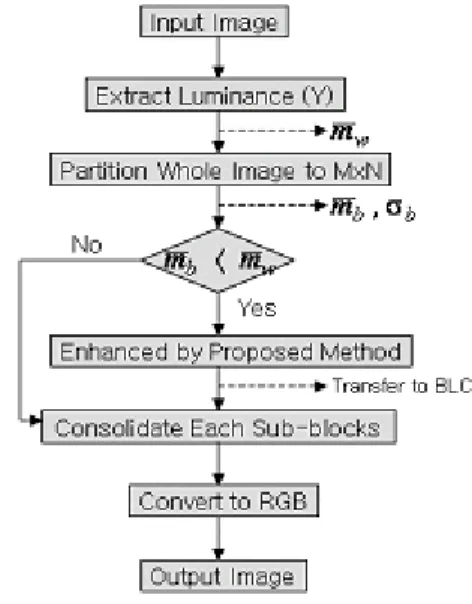
Figure 1 shows the flow chart of our proposed method.
Fig. 1. Flow Chart of our proposed method
At first, in order to reduce the calculation loading for RGB image, we extract Luminance(Y) component from RGB input image by using equation (1).[1]
Y = 0.257R+0.504G+0.098B+16
Cb = -0.148R-0.291G+0.439B+128 (1) Cr = 0.439R-0.368G-0.071B+128
And after obtaining the mean luminance(Y) of
Regional Contrast Enhancement for Local Dimming
Backlight on Small-sized Mobile Display
Jin-Young Chung
1and Ki-Doo Kim
21,2 Dept. of Electronics Engineering, Kookmin University, Seoul, Korea
Tel.:82-2-910-5073, E-mail:
[email protected]
45-3 / J. Y. Chung
IMID 2009 DIGEST • original whole image(mw), it is partitioned by MxN.
And then each mean luminance of sub blocks(mb)and each standard deviation of sub blocks(σb) are calculated. At this time some of sub blocks having the condition mb < mw, are processed by our proposed method.
Selected sub blocks are processed by regional histogram stretching as equation (2).
b b i i o
)
m
P
(
P
P
σ
−
×
α
+
=
(2)In equation (2), Pi and Po are the luminance of input
pixels and output ones in sub blocks repectively. The reciprocal of standard deviation means αis called expansion coefficient. α is arbitrary choosen in the range of preventing from blocking artifacts. This means the approaching of modified regional histogram stretching. And there is exceptional condition. All of pixles in selected sub blocks are not applied to equation (2), but. the limited pixels which are satisfied with the following equation (3) are applied. b b i b b
P
m
m
−
σ
<
<
+
σ
(3)Equation (3) means some of pixels which are concentrated on mean luminance in selected sub blocks has limited for mapping dark pixels getting more darker. Figure 2 is illustrated of it.
Fig. 2. Histogram stretching range in our proposed method
Thereafter each information of postprocessing sub blocks are transferred to backlight LED controller block and finally after consolidating sub blocks to one, the consolidated image is converted to RGB color space.
3. Results and discussion
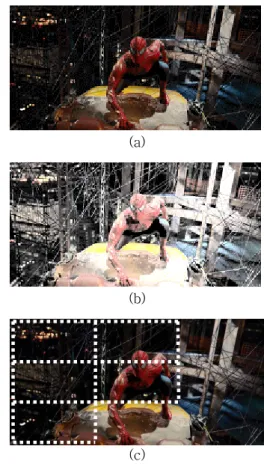
In this study, we used 24 bit RGB image. Figure 3
represents one of the simulation results. Sample image “spiderman” has the resolution, 600x285.
(a)
(b)
(c)
Fig. 3. Simulation Results
(a) original (b) global histogram equalization (c) proposed method(α=10)
In the case of Figure 3 (b), global histogram equalization is applied to whole image. Transfer function is identical to every pixels, so even bright pixels transformed more brighter resulting on wash out the color of image. Figure 3 (c) shows our proposed method. Dividing by 3x3, make total 9 sub blocks, white dotted line means selected blocks because their mean luminance has lower than one of original whole image. Figure 3 (c) is applied to limiting range condition equation (3), and as equation (2), when pixels have far from mean luminance, degree of histogram stretching extends more than near from mean luminance. This condition is for preventing blocking artifacts resulted from image partition normally. In this study, the blocking artifacts is removed effectively. Expansion coefficient α is selected intuitively. Figure 4 shows histograms compared to original and propsed method.
45-3 / J. Y. Chung • IMID 2009 DIGEST 0 2 0 0 0 4 0 0 0 6 0 0 0 1 4 0 7 9 1 1 8 1 5 7 1 9 6 2 3 5 g ra y le v e l # o f p ix e ls O rig in a l P ro p o s e d
Fig. 4. Histogram comparison for spiderman sample image(α=10)
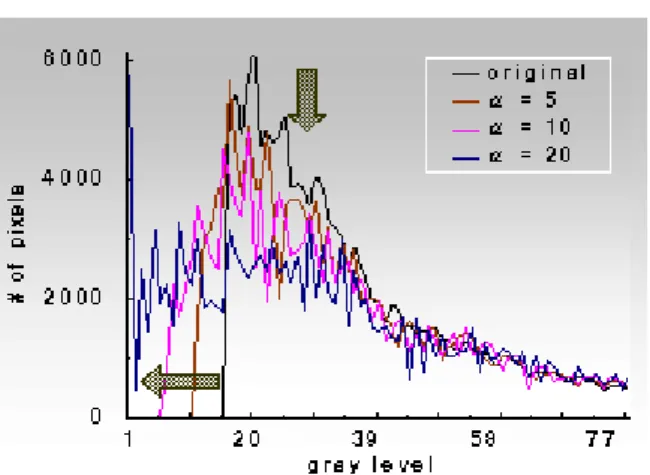
Fig. 5. Histogram variation with expansion coeffient (α)
In Figure 4, histogram of original is shifted to left after processing. It means pixels under the mean luminance (54) of original image mapped to near the 0 level. So total dynamic range is extended. At this time, degree of extension is propotional to expansion coeffient(α). It shows figure 5. The expansion coefficient more bigger, the pixels under the mean luminance go to 0 level more and more.
We verified the degree of enhancement on our proposed method by C.F.Hsu et al.[2]. In [2], authors defined luminance level of 25% and 75% on histogram of image marked C25 and C75. It is summarized on Table 1.
TABLE 1. Enhancement Ratio
Item C25 C75 C75/C25 Enhancement Ratio Original 24 65 2.7 0 α = 5 22 66 3 11% α = 10 20 67 3.4 24% α = 20 18 69 3.8 41%
In table 1, enhancement ratio is proportional to expansion coefficient α. Enhancement ratio, 41% is realized at α=20. Since the Average Picture Level(APL) of television video is less than 20%, dark resion are much more common than bright ones. So we expects the effective contrast enhancement and power saving with local dimming backlight LED by our proposed method.
4. Summary
This paper has presented regional contrast enhancement technique for local dimming backlight LED for small-size mobile display. To avoid blocking artifacts appearing whenever one image is partitioned, we proposed regional histogram stretching limited in mean and standard deviation of luminance. And we verified the enhancement ratio by max 41 % with expansion coeffient(α ).
5. References
1. K. Jack, Video Demystified, 3rd ed. LLH Technology Publishing, 2001.
2. C. F. Hsu, C. C. Lai, and J. S. Li, "Backlight Power Reduction and Image Contrast Enhancement Using Adaptive Dimming for Global Backlight Applications," SID Symposium Digest, pp. 776-779, 2008.
3. S. Srinivasan and N. Balram, "Adaptive Contrast Enhancement for Digital Video," SID Symposium Digest, pp. 1446-1449, 2007.