Journal of Computational Design and Engineering 3 (2016) 363–369
Development of web-based collaborative framework for the simulation
of embedded systems
Woong Yang, Soo-Hong Lee
n, Yong Zhu Jin, Hyun-Tae Hwang
School of Mechanical Engineering, Yonsei University, Seoul, KoreaReceived 11 January 2016; received in revised form 25 April 2016; accepted 26 June 2016 Available online 29 June 2016
Abstract
Cyber Physical System (CPS) and Internet of Things (IoT) are hot objects of interest as an extension of the embedded system. These interactive products and systems contain Mobile Devices which are most popular and used most frequently. Also these have been widely used from the control of the Nuclear Power Control System (NPCS) to IoT Home Service. Information & Communication Technology (ICT) topics of trend fused-complex current Information Technology (IT) and Communication Technology (CT) are closely linked to real space and virtual space. This immediately means the arrival of the ultra-connected society. It refers to a society in which various objects surrounding the human innovation and change in the social sector are expected through the connection between the data which are to be generated. In addition, studies of Tool-kit for the design of such systems are also actively pursued. However, only increased cooperation and information sharing between the physical object consists of a variety of machinery and equipment. We have taken into consideration a number of design variables of the high barriers to entry about the product.
In this study, It has been developed a Web-based collaboration framework which can be aflexible connection between macroscopically virtual environment and the physical environment. This framework is able to verifiy and manage physical environments. Also it can resolve the bottlenecks encountered during the base expansion and development process of IoT (Internet of Things) environment.
& 2016 Society of CAD/CAM Engineers. Publishing Servies by Elsevier. This is an open access article under the CC BY-NC-ND license (http://creativecommons.org/licenses/by-nc-nd/4.0/).
Keywords: Web-based platform; Simulation; Internet of Things (IoT); Cyber Physical System (CPS); Embedded System
1. Introduction
Subjects of Information & Communication Technology (ICT), the Information Technology (IT) and Communication Technology (CT) fused-complex closely connected to real space and virtual space have been in in limelight recently. There has been a remarkable development of network technology, includ-ing an actuator that actually works, sensinclud-ing usinclud-ing the sensor, the part that controls modules. As a result, the cooperation and information sharing between the physical object consisting of a
variety of machinery and equipment has become closer. That is, we can obtain the necessary data from various sensors and then produce the information obtained by the extraction and analysis, finally it provides the actuator that influences the operation of the controller. A series of processes allows the user center of Context-aware Service through exchange and collection of status information, interpretation and reasoning.
However, this environment is much more complex than the environment that is not connected to previously. In addition to that it has high barriers to entry and must consider a number of design variables to design the system.
In recent years, many companies and related societies are much more aware of Internet of Things (IoT). Start of IoT has evolved the development of (Radio-Frequency Identification) RFID technology and network. IoT is a similar concept as
www.elsevier.com/locate/jcde
http://dx.doi.org/10.1016/j.jcde.2016.06.004
2288-4300/& 2016 Society of CAD/CAM Engineers. Publishing Servies by Elsevier. This is an open access article under the CC BY-NC-ND license (http://creativecommons.org/licenses/by-nc-nd/4.0/).
nCorrespondence to: N201, the 1st Engineering building, Department of
Mechanical Engineering, Yonsei University, 50, Yonsei-ro, Seodaemun-gu, Seoul, Korea. Fax:+82 02 2123 2823.
E-mail address:[email protected](S.-H. Lee).
Machine to Machine(M2M) has, and we have to clarify the differentiation. When viewed as a category of existing concepts that up to several types of communications via a connection to the device, IoT is highlighted for providing services that can benefit more users in a wide range. Arduino
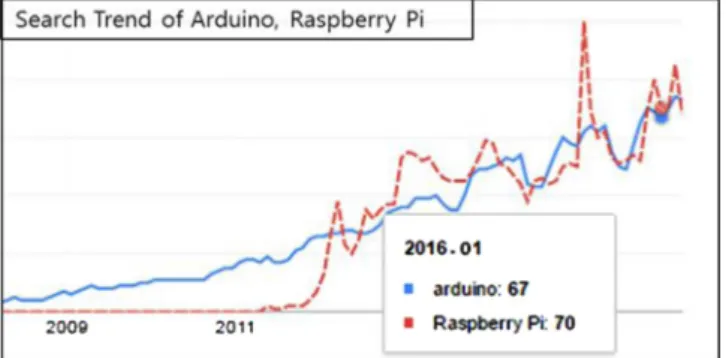
[13]or Raspberry Pi, such as parts used in embedded systems are rapidly growing. Fig. 1 illustrates the search trends of Arduino and Raspberry Pi. Health Wearable Device is one of its examples. It is capable of tracking the physical activity that is the user can check the number of steps, such as heart rates. In this reprocessing by using the tracking information, such as physical activity, results can be presented to the user as proactive proposals and recommendations.
In a broad perspective, the design of the system described above, the developer can interconnect a virtual environment with the physical process of the connection you want. However, steps to configure the hardware and software together are very difficult in this process. Also, it does not have the system for verification and management. In order to solve the bottleneck in these procedures, constructing a IoT Simulation virtual environment is always necessary. If the developer builds a model and predicts the outcome in advance through a simulation, it is possible to verify the initial intent of developers and reduce trial and error before the actual design. In this study, it has been developed a web-based collabora-tion framework which can be a flexible connection between macroscopically virtual environment and the physical environ-ment along with physical verification/management to attempt to resolve the bottlenecks encountered during base expansion and development process of IoT environment.
This paper is organized as follows. In Section 2, we discuss the trends of the related research that has been done and in
Section 3, we describe the proposed web-based collaborative framework. Scenarios-based projects will be conducted within the framework and each project's simulation environment is developed by open source Application Programming Interface (API). InSections 4and5, we discuss the results and conclusion.
2. Related works
Because of the unique properties of the complex diverse and unique Internet of Things system, people have experienced difficulties in IoT Software Development. Recently many studies about the configuration of IoT framework have been
conducted. These studies include a form of design verification through the management and simulation of IoT environment. Lina Yao and Quan Z. Sheng [7] provided integrated Web-based interface for managing the IoT environment, and developers are able to make better decisions in environment that they have placed. Lina Yao and Quan Z. Sheng's system utilizes a hierarchical framework, which can share and manage the information generated by the physical sensor.
Ho Dong Ryu and Soo Yong Jeong [8]provided a method for ensuring the reliability and stability of embedded systems which are used in IoT. This method is used to build a virtual execution environment of the software in the process of embedded systems development and analyze real-world sce-narios function performed by the path difficult to efficiently perform unit tests in a way to advance the unit tests.
The development of embedded systems, since the hardware and software elements are concurrently included, is experien-cing difficulties. Recently, research on web-based modeling and simulation is increasing[1-3].
Xuan FU Zha [9] developed a web-based framework for collaborative design of Micro-Electro-Mechanical Systems (MEMS). This framework provided different users involved in the design process from other locations and linked to the social information and can be simulated and verified from the use of client-server distributed knowledge by the design rules imposed on the additional process, verifying the expected performance simulation from the design rule violations and violation of procedure process.
Designing and development of embedded systems, is one of the most complex software development methods. It is not easy to build embedded systems software of virtual execution environment for embedded systems development. An effective way to design and implement such a complex application is modeling and simulation (M & S)[4-6].
Mohammad Moallem [10]proposed a method to solve the discontinuity between the simulation model and the final embedded software on the basis of modeling and simulation.
Seung Woo Kum and Tae Beom Lim [11]proposed the IoT integrated control framework to support the user's status informa-tion management. The proposed framework is raised to support the development of IoT services by providing an integrated management service of the IoT and single API for service configuration. Also is built a test bed for the real IoT devices and services to verify the reliability of the proposed framework.
Yong Jin Jeong [12] et al. described the prototyping embedded software development methodology that reflects the uniqueness and differentiation during development and use virtual prototyping development methodology to simulate the embedded system. IoT environment may be thought of as a combination of a number of embedded systems. It is necessary to understand the nature of the various fields of embedded systems in collaboration between system developers. Effective problem solving method while working on a project is using real prototyping. However, there is a limit to the test by creating a real prototype. So, in this study, it has been developed a Web-based collaboration framework which can be a flexible connection of macroscopically virtual environment and the
physical environment physical verification / management to attempt to resolve the bottlenecks encountered during base expansion and development process of IoT environment. Embedded system development project is more complicated than a simple generic software development project, developers can perform a project which succeeds if there is understanding of hardware and software. General-purpose software which is needed in the project, is capable of giving multi-level feedback to the improve and develop the previous process. However, in the embedded systems, because of the simultaneous progress of the hardware and software, in some cases it is impossible to give feedback in the entire process. It can minimize the disadvantages of the embedded system by the COMET model. 3. System development
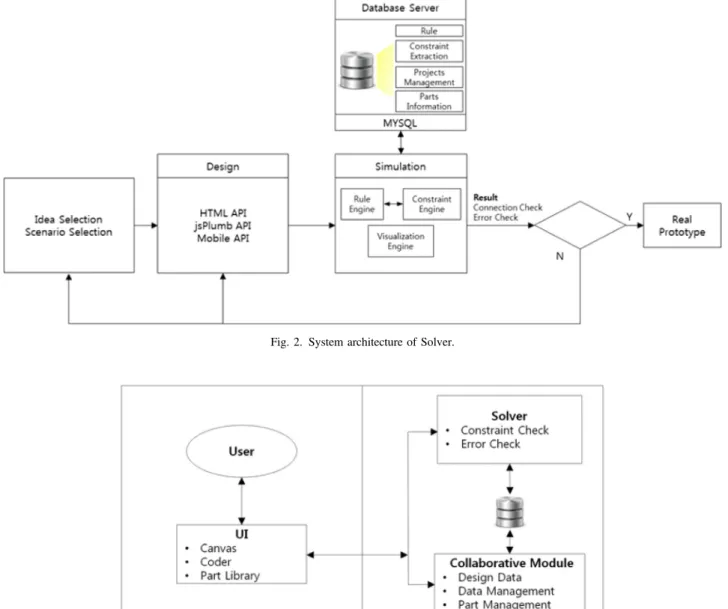
Fig. 2illustrates detail of the system architecture Solver. The current framework was developed in the main server that is voluntarily management. In various scenarios, users can
pre-design the software and hardware needed to build the IoT virtual system environment. Hardware and software of the virtual environment are linked by Block Diagram Coder. Database server in conjunction with the main server is classified in the form of rule, constraint extraction, projects management, parts information. Web-framework suggested in this paper is designed by HTML5, Javascript, jsPlumb based on API. Simulation module is made up of Rule Engine, Constraint, visualization Engine at the finish. Rule engine and Constraint engine are linked to data made by many of the design variables. As a result of which, connection check and error check sign will appear in the UI. Users grasp the meaning from the check sign and then make a decision whether or not to re-design. After selection, they will be able to go to next step that make a prototype or design the exterior design by using commercialization CAD program.
Fig. 3illustrates structural diagram of a framework proposed in this paper. Users are connected Solver that check the constraint and error and Collaborative module that manage
Fig. 2. System architecture of Solver.
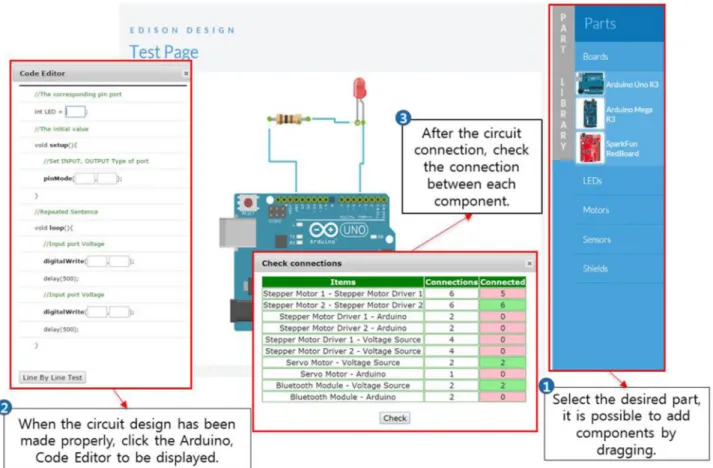
the design data, part information via GUI (Graphical user interface). UI screen is composed of Canvas, Coder, part library. First, users select the desired part, it is possible to add components by dragging. Second, they can design the circuit in the canvas. After the end of the circuit design, they check the connection between each component in real-time. When the circuit design has been made and verification has been done properly, they can proceed with the coding part in the Code Editor. Declaration and type of variables is dynamically configured in the Code Editor, depending on the circuit-design part. Code Editor has a function that line by line test. It equals to verify the code that has been compiled through the compiler. Detailed description of code is shown below each code. These processes are shown inFig. 4. Components of the framework were made in various forms of API. Moreover, it is inter-connected on the Web.
3.1. Idea selection/scenario selection
Users select a variety of scenarios in the pre- design process. Also, they want to select the software and hardware necessary for their idea. To maintain compatibility and independence between each module, Block Diagram Coder helps to inter-connect each of them.Fig. 5shows the Block Diagram Coder through the application interface. The user can change the advanced settings through the Block Diagram Coder (sensor, module design tool, and verification tool).
3.2. Block diagram coder
As described above, Web-based collaboration framework which we developed is composed of each scenario. It has more simple and specific approach for users. When moing into the scenario, it is seen that this framework has been developed with an intuitive UI. It is possible the parts are modularized to distinguish the relationship between the components. More-over, checking the connection status in real time between the
Fig. 4. Design process on the user interface.
modules is one of the many features.Fig. 6illustrates that user can check necessary connections in the modular parts.
The feature of the difference between the existing Block Diagram Coder is the result of the simulation that it can be modified to check in real time. Next section describes the simulation/verification step.
3.3. Simulation/verification
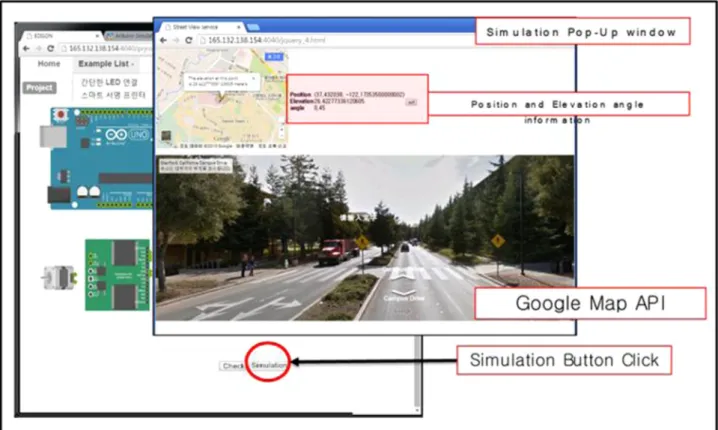
The biggest feature of the framework that we have devel-oped is that it is possible to animate the results of the simulation. An example of Simulation to be animated of the results procedure is shown in Fig. 7. Fig. 7 is obtained by capturing the state of implementation in web pages. In the above scenario, which is Smart Health Bicycle if the user has
connected all the modular devices properly, simulation pop-up screen will appear. It was developed using Google API. It operates to suit the appropriate circumstances and users can experience the real-time simulation as they need.
The user ends the pre-design process through the simulation, integrated management and verification in a row. Pre-designing the environment of complex embedded system is more efficient than any existing systems. It summarizes the advantages through the framework.
1. Visualization of simulation: when developer creates a virtual prototype on the web environment, they can simulate its work correctly. Therefore, they reduce the development time. 2. Web based framework: Another user can participate in the design process from different locations. Also the user does not need to install any software.
3. Independence and compatibility: It resolved the interlocking problems that we have developed with Web standards-based technology.
4. Data analysis and management: For users, it will provide a library and a guide for each part.
4. Results and discussion
Web-based collaboration framework for verification has been developed through the study of about 1 year. To match the IoT environment and ultra-connected society, user can choose the idea/scenario. They go through a pre-design process by using a variety of API, simulation, verification. Developing virtual environment for embedded systems pre-design has been
Fig. 6. Check connections between each module.
an interesting research issue. 123D Circuits that Autodesk has developed and Fritzing initiated at the FH Potsdam (now developed by the Friends-of-Fritzing foundation) continue to research.Table 1compares the differentiation is as follows. In order to verify the validity and the utilization of the proposed framework, we make a course for the undergraduate students and publish an open service. All 10 universities and 120 students publish the service. It is possible to run a parallel course during the theory and practice in design education and produce the embedded system by a simple operation. Therefore, this framework will utilize the educational aspects. 5. Conclusions
Web-based framework for the simulation of embedded system is advantageous to users when they want to do a module simulation for perfection in a short time without hardware and to study about the embedded system. In addition, it can examine the product instantly and control the production quality control online. This educational application can develop the embedded system without buying the hardware. It must be a beneficial tool for both students and engineers to receive professional education.
However, further there is a lot of scope for improvement. We have a plan to develop an IoT control system for the control of multi Embedded system module. It supports some basic examples and also develops IoT web applications. With IoT Systems of communication and sensing the signal, people can reduce manpower and get more advantages. Furthermore the web page, bugfixes are regulary updated and it is planned to add the module library on an ongoing basis.
Acknowledgment
This research was supported by the EDISON Program through the National Research Foundation of Korea (NRF), South Korea funded by the Ministry of Science, ICT & Future Planning, South Korea (No. 2014M3C1A6038802– 2014.07.01 ~ 2019.06.30). References
[1] Karl Hribernik et al. Co-creating the Internet of Things-First experiences in the participatory design of intelligent products with Arduino, Con-current Enterprising (ICE), in: Proceedings of the 17th International Conference, IEEE. 2011, pp. 2–5.
[2]Melgar Enrique, Ramos, Diez Ciriaco Castro. Arduino and Kinect Projects: Design, Build, Blow Their Minds. Apress 2012:28–31. [3] C. Weichel, M. Lau, D. Kim, N. Villar, H. Gellersen, MixFab: a
mixed-reality environment for personal fabrication, in: Proceedings of the 32nd annual ACM conference on Human factors in computing systems, 2014, pp. 3855–3864.
[4] T.J. Nam, Sketch-based rapid prototyping platform for hardware-software integrated interactive products, in: Proceedings of the CHI'05 extended abstracts on Human factors in computing systems, 2005, pp. 1689–1692. [5]Yao Lina, Sheng Quan Z. Web-based management of the internet of things, internet of things, people, and processes. IEEE Internet Comput. 2015:4–7.
[6]Ryu Ho Dong, Jeong Soo Yong, Lee Woo Jin, Kim Hwang Soo. IoT Internet; development of log-based testing framework for unit testing of
Table 1 Compa rison w ith related develop ment. 123D circuits Fr itzing Pa ul Ric hard –Ardu ino simula tor We b-base d Ardu ino sSimulator Functio n W eb-based Ardu ino simulation system Open source -based A rduino simulation syste m Co nsole prog ram We b-base d Ardu ino simulation syste m Maj or features Fr ee installation circuit Conne ction simula tion of the internal cod e Kore an local ization is imple ment ed schema tic circuit work is possi ble Co nnection informa tion of each modu le is rep resented by an icon that is a non-wi re type Pos sible prod uct con ceptua l desi gn of suita ble for IoT based on the sce nario Rema rks D ynamic circuit desi gn and com ponents layo ut are possi ble but It has small numb er of par ts The bigge st draw back is not a w eb-bas ed syste m. But open sour ce is possi ble to dev elopment Inf ormation o n the progra m displa yed in a pop-up w indow is inco nvenien t to use
embedded software. Korea Inf. Process Soc., Softw. Data Eng. 2015;4.9: 419–24.
[7]Zha Xuan F. Web-enabled knowledge-intensive support framework for collaborative design of MEMS, MEMS/NEMS. US: Springer; 35–71. [8]Moallemi Mohammad. Real-time and embedded systems development
based on discrete event modeling and simulation Diss.. Ottawa: Carleton University; 14–39.
[9]Kum Seung Woo, Lim Tae Beom, Park Jong Il. Design and implementa-tion of IoT collaboraimplementa-tion module supporting user context management. Inst. Embed. Eng. Korea 2015:129–37.
[10] Jeong Yeong Jin, Lee Jeong Bae, Lee, Yeongran, et al. Virtual simulation for embedded systems using prototyping technologies 207. Korea Inf. Sci. Soc. 2006;24(8)26–39.
[11] Autodesk 123D Design,〈http://www.123dapp.com/〉. [12] Fritzing,〈http://fritzing.org/home/〉.