Characteristics of the ZnSe Scintillators based on the II-IV Compound Semiconductor
W. G. Lee,a Y. K . Kim,a C. E. Chung,a J. H. Ha,a S.H. Park,a J.K. Kim ba KAERI P.O.Box 105, Yuseong, Daejeon 305-600, Korea
b iTRS of Hanyang University, 17 Hangdang-dong, Sungdong-gu, Seoul 133-791, Korea
1. Introduction
II-VI compound semiconductor has the various physical properties such as piezoelectricity, photo-electricity, luminescence and scintillation. But single crystals of the II-VI compound semiconductor didn’t fit to use the scintillator and radiation sensor because they have low transmittance and recrystallization. But recently they have the possibility for using in radiation sensors due to the advancement of the single crystal growth technique.
ZnSe(Te) scintillator was developed[1]. Scintillators based on ZnSe crystals are not hygroscopic. Their light output is 1.1 to 1.5 times higher and afterglow level after 10ms is two to three orders lower than that of CsI(Tl)[2]. The decay time (3–10 us) and density (5.42 g/cm3) of the ZnSe scintillators are quite acceptable for
their use in X-ray introscopy detectors because their radiation stability is relatively good and light output is 2.5–4 times higher than CdWO4, Bi4Ge3O12, Gd2SiO5
crystals used on similar purposes[3,4]. Now, the ZnSe scintillators based the II-VI compound semiconductor doped with the various activators were investigated.
In our study, we investigated the physical and the scintillation properties of the ZnSe single crystals based on the II-VI compound semiconductors such as the absorption curve, transmittance, radioluminescence, afterglow, light output, energy spectrum and decay time.
2. Experiment
2.1 Crystal growth
ZnSe crystals were grown by Bridgman-Stockbarger method in a vertical compression furnace under argon pressure of up to 106 Pa. A graphite crucible was used.
The temperature in the crystallization zone was 1850 K, and the growth rate was 2–5 mm/h. The source materials were ZnSe polycrystals of 5N offered by ELMA Inc. After the growth, thermal treatments of the cut samples from the same ZnSe crystals were carried out at 1290K for 24 hours in sealed quartz tubes which were filled with Zn vapor as well as in vacuum.
In our study, the size of the ZnSe specimen is the 10x10x1 mm3.
2.2 Physical properties
The transmittance curves of the ZnSe crystals were measured from 400nm to 900nm. More than 60 % of the transmittances were appeared above the 600 nm.
Their transmittance edges were different along with the activators. And the wavelength edge of the ZnSe crystal was the 474 nm and the others were in the range of 480 nm to 500 nm.
The radioluminescence which can be observed when the radiation energy is absorbed in the scintillator provides the exact wavelength of the scintillation. An X-ray was used as the radiation source from an X-ray generator. The maximum wavelengths of the ZnSe, ZnSe(Te) and the others were the 625 nm, 630 nm and the range of 600 nm to 630 nm, respectively. Figure 1 shows the radioluminescence spectra of the ZnSe, ZnSe doped with Te element and doped with O element.
500 550 600 650 700 750 0.0 5.0x10⁻¹ 1.0x100 1.5x100 Count s Channel ZnSe Zn No 2-1 ZnSe(Te) No 4-1 ZnSe(O) No 7-1
Figure 1. Radioluminescence spectra of the ZnSe single crystals at the room temperature.
2.3 Scintillation properties
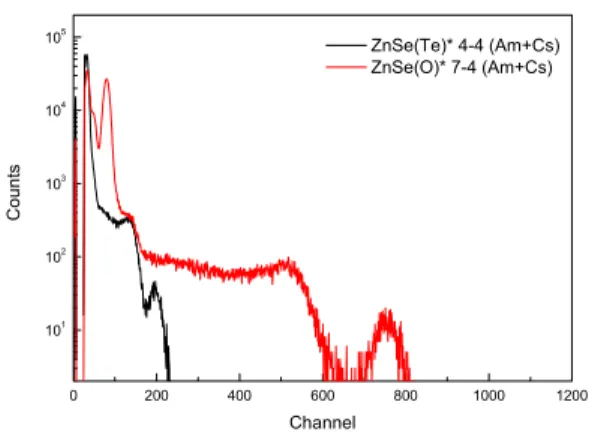
The pulse height spectra were measured with the low energy radioactive isotopes, 241Am(59.6 keV) and 137Cs(32 keV X-ray, 662 keV). The PMT
R1307(Hamamatsu) was used to measure the pulse height spectra of the ZnSe scintillators doped with the various activators. That is shown in figure 2.
The energy resolutions of the ZnSe(Te) and ZnSe(O) scintillators were 13.7 % and 7.4 %, respectively, when exposed to 137Cs γ-ray . And the X
ray peak of the 32 keV appeared distinctly.
The emission wavelengths (600 nm - 630 nm) of the scintillators are not coincidence with the response wavelength of PMT but those are matched well with a photodiode. So, the light output of the ZnSe scintillators were measured with a photodiode under an X ray. And CsI(Tl) scintillator was also measured in same condition. The light output of the ZnSe(Te) scintillator is relatively higher than that of CsI(Tl) scintillator.
Transactions of the Korean Nuclear Society Autumn Meeting Busan, Korea, October 27-28, 2005
0 200 400 600 800 1000 1200 101 102 103 104 105 Co un ts Channel ZnSe(Te)* 4-4 (Am+Cs) ZnSe(O)* 7-4 (Am+Cs)
Figure 2. Pulse height spectra of the ZnSe scintillators to the
241Am and 137Cs gamma radiations.
The afterglow is one of the important physical property. The radiation sensors of the medical equipment and the nondestructive equipment which are used with the radiation need a little of the afterglow.
The measurement method of the afterglow is that the scintillation from the ZnSe scintillators was measured with photodiode as a function the time as soon as the X-ray generator was off. The afterglow of the CsI(Tl) scintillator was measured in same condition. In case of the ZnSe scintillators afterglow are the 2.401 (5 ms). This means that the afterglow of the ZnSe scintillators is less than that of the CsI(Tl) scintillator.
In order to obtain the decay time of the ZnSe scintillators at room temperature, a pulsed Nd:YAG laser was employed as an excitation source. The repetition rate of the pulsed laser was 10 Hz with 6 ns duration.
The decay time of the ZnSe scintillators based on the II-VI compound semiconductor has the two or three factors.
3. Conclusion
We investigated the physical properties and scintillation properties of the ZnSe single crystals based on the II-VI compound semiconductors, which were doped with Te, O, etc elements. The maximum wavelength of the radioluminescence of the ZnSe single crystals were from 600 nm to 630 nm, which is coincidence with the response wavelength of the photodiode. And the ZnSe scintillators can detect the alpha, beta particles and the low energy gamma ray. The light output of the ZnSe scintillators is higher than that of CsI(Tl) scintillator. The ZnSe scintillators doped with Te, O and other elements based on the II-VI compound semiconductor can be used to an X-ray detector for the security inspection.
Acknowledgement
This work has been carried out under the Nuclear R&D program of the Ministry of Science and Technology (MOST) of Korea. We are also supported by the SRC/ERC program of MOST/KOSEF (grant # R11-2000-067-000000-0).
REFERENCES
[1] P. Schotanus, P. Dorenbos, V. D. Ryzhikov, Detection of CdS(Te) and ZnSe(Te) scintillation light with silicon photodiodes, IEEE Trans. Nucl. Sci., Vol. 39, p. 546-550, 1992.
[2] V. D. Ryzhikov, N. G. Starzhynskiy, and V. I. Silin, A new ZnSe(Te) scintillator: Luminescence mechanism, Nucl. Traces Radiat. Meas, Vol. 2, p. 53-55, 1993.
[3] Sung-Woo Kwak, Gyuseong Cho, Bong-Hwan Kim, Insu Kim, Moo Sung Jae, Comparative study of CWO and ZnSe(Te) scintillation detector on the performance of X-ray imaging system, Nucl. Instru. and Meth. Vol. A 537, p. 449-453, 2005.
[4] V.D. Ryzhikov, A.D. Opolonin, P.V. Pashko, V.M. Svishch, V.G. Volkov, E.K. Lysetskaya, D.N. Kozin, C. Smith, Instruments and detectors on the base of scintillator crystals ZnSe(Te), CWO, CsI(Tl) for systems of security and customs inspection systems, Nucl. Instru. Meth., Vol. A 537, p. 424-430, 2005.
[5] V. Ryzhikov, V. Chernikov, L. GalÕchinetskii, S. Galkin, E. Lisetskaya, A. Opolonin, V. Volkov, The use of
semiconductor scintillation crystals AIIBVI in radiation