Evaluation of Tube Rupture Propagation in a SFR steam generator during a SWR event
Jae-Hyuk Eoh, Seyun Kim, Won-Dae Jeon and Seong-O KimDivision of Fluid System Engineering, Korea Atomic Energy Research Institute 150 Dukjin-dong, Yusong-Gu, Taejon, Korea, 305-353
[email protected] ; [email protected] ; [email protected] ; [email protected]
1. Introduction
A sodium-water reaction (SWR) has been considered as one of the most important issues to be resolved for designing the steam generator and the related systems of a sodium-cooled fast reactor (SFR). In a steam generator of a typical SFR system, the sodium and water are separated by the heat transfer tube wall and it makes a strong pressure boundary between the shell-side sodium and the tube-side water/steam. For this reason, if there is a small hole or breach, even with a pin hole, on the heat transfer tube, a large amount of water/steam inside a tube may leak into the sodium phase due to a high pressure difference more than 150 bars [1], and an exothermic sodium-water chemical reaction takes place as a result.
In the previous work [2], two-dimensional temperature fields for the vicinity of the reaction zone during the very initial reaction period were estimated well by using the CFX version 5.7.1 [3]. From the previous studies [2][4], since it was obviously founded that the number of ruptured tubes during a SWR event is one of the most significant factors to determine the temperature and pressure transient during the whole period of a SWR event, a subsequent tube rupture behavior at the vicinity of the initially postulated single ruptured tube should be evaluated by considering the wastage phenomena caused by the chemical reaction.
In this study, to investigate the additional tube rupture behavior at the reaction zone, the wastage rate and the eroded tube thickness of the heat transfer tube adjacent to the initially postulated single ruptured tube is calculated by using the CFX-5 analysis results, and the effective method to evaluate the subsequent tube rupture behavior is also proposed by considering an allowable stress intensity for the conventional tube material.
2. Analysis for tube rupture propagation
2.1 Wastage phenomena on the tube material
The phenomenon which results in a damage of the heat transfer tube material due to an impingement of a reaction product with a high temperature environment is called wastage [5]. Since the leaks of water/steam from crack or pinhole defects on the steam generator tubes may cause wastage of the heat transfer tubes neighboring the ruptured tube, a subsequent tube failure can be occurred.
It was observed that the adjacent tube walls are exposed to the extremely corrosive or erosive environment arising from the impingement of the high temperature reaction products because the SWR phenomenon raises the temperature of the surrounding space considerably. In particular, since a secondary failure of the heat transfer tubes plays an important role in considering a design basis event related to the SWR pressure relief system design, many research activities have been concentrated to derive a reasonable quantification method for wastage. From the results of previous experimental study [5], the following empirical correlation for the wastage rate is provided [5] mainly for 2.25Cr-1Mo steel used as a SG tube material in KALIMER-600.
2 4400 5460 exp 0.255 ln 5.12 R N G W L T = ⎧⎨⎪−⎡⎢ ⎛⎜ ⎟⎞ + ⎤⎥⎫⎬⎪ ⎝ ⎠ ⎢ ⎥ ⎪ ⎣ ⎦⎪ ⎩ ⎭
Where WR is the wastage rate (mm/sec), L is the nozzle-to-target distance (mm), G is the leak rate (g/sec) and TN is the temperature of the fluid enveloping the region adjacent to the rupture and target tubes.
2.2 Analysis of wastage rate and tube rupture behavior Based on the previous study [2], the temperature fields at the region adjacent to the ruptured tube and target tubes are two-dimensionally calculated by CFX-5 [3], and the transient temperature variations at the vicinity of the reaction zone are shown in Figure 1.
Figure 1. 2-D temperature fields at the reaction zone [2] The wastage rates for the neighboring tubes adjacent to the initially ruptured tube are calculated by considering
Transactions of the Korean Nuclear Society Autumn Meeting Busan, Korea, October 27-28, 2005
the effects such as i) the distances from the leaked nozzle and ii) the direction of the jet stream with various inclined angles. In other words, the analyses were made for the distances from the leak position of the ruptured tube by considering three distance ratios (L/D) of 1.0, 2.0 and 3.0, and for the positions inclined to the normal direction of the jet stream with angles of +30o, +45o, -30 o and -45o. In
these cases, L is the target distance from the leak nozzle and D means the equivalent diameter of the actual leak area. Figure 2 shows the wastage rate depending on the distances from the ruptured tube and the positions inclined to the normal direction with four different angles.
1 10 0.0 0.1 0.2 0.3 0.4 0.5 0.6 0.7 +30o +45o -30o -45o
Inclined angle to the normal direction with L/Deq = 1.0 5 3 0.5 30 50 L/Deq = 1.0 L/Deq = 2.0 L/Deq = 3.0 Wa st ag e r ate , W R (m m/sec) time (msec)
Figure 2. Wastage rate depending on various positions As shown in the figure, it was easily observed that there are larger wastage rates at the shorter distances from the ruptured tube as one can imagine, and it was also found that the wastage rate of the inclined positions to the major jet stream direction such as ± 30o and ± 45o are
also larger than the normal jet direction. This is because i) the higher temperature fluids are expelled from the region adjacent the ruptured tube due to a high momentum of the water/steam caused by a jet impingement, and ii) the vortex flows are formed at the region inclined to the normal jet direction due to a strong recirculation flow in the gas phase region as shown in Figure 1 [2]. Based on the results of the wastage rate analysis, the eroded thickness of the heat transfer tubes caused by the wastage phenomena are also calculated, and the allowable design stress intensity (Sm) for 2.25Cr-1Mo steel for the postulated temperature condition of 550oC [6] is also
provided by using the relations for the hoop stress acting uniformly over the tube wall [7]. Where P is the pressure inside tube (MPa), r and t mean the radius and the thickness of the heat transfer tube (mm), respectively.
t r P
t = ⋅
σ
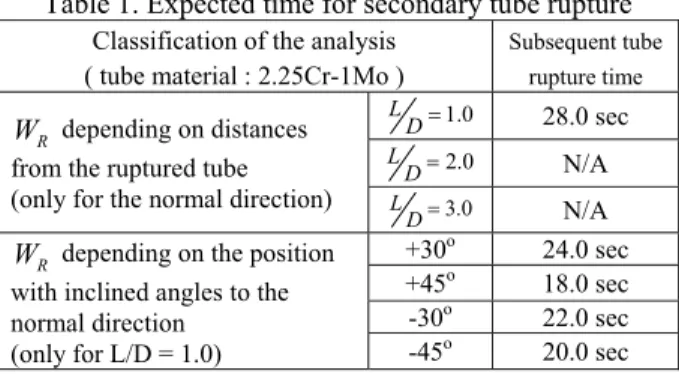
As a result of the stress analysis for the neighboring un-defected tubes, it was found that the maximum allowable stresses for the eroded heat transfer tubes may exceed the design stress integrity (Sm) as time goes by and thus a subsequent tube rupture can occur after ~ 30 sec or less as listed in Table 1.
Table 1. Expected time for secondary tube rupture
Classification of the analysis ( tube material : 2.25Cr-1Mo )
Subsequent tube rupture time 0 . 1 = D L 28.0 sec 0 . 2 = D L N/A R W depending on distances
from the ruptured tube
(only for the normal direction) LD=3.0 N/A
+30o 24.0 sec
+45o 18.0 sec
-30o 22.0 sec
R
W depending on the position
with inclined angles to the normal direction
(only for L/D = 1.0) -45o 20.0 sec
3. Conclusions
For the investigation of the secondary tube rupture behavior during a SWR event, the evaluation method for the wastage rate and eroded tube thickness of un-defected tubes neighboring the ruptured tube was developed by using the results of the two-dimensional CFX-5 analysis, and the allowable stress intensities for the conventional tube material are also investigated to evaluate the integrity of the un-defected heat transfer tubes adjacent to the ruptured tube. Based on the results calculated in this study, it was found that a secondary tube rupture can occur as time goes by but the possibility of a continuous and multiple tube rupture propagation is very low since the temperature range of the reaction zone is not high enough to cause a high wastage of the tube material. It is expected that the results of this study will contribute to a more detailed evaluation study for a multiple tube rupture behavior in the future.
ACKNOWLEDGEMENT
This study was performed under the Mid and Long-term Nuclear R&D Program sponsored by the Ministry of Science and Technology (MOST) of Korea.
REFERENCES
[1] D.H. Hahn, et al., “Design Features of Advanced Sodium-Cooled Fast Reactor KALIMER-600”, Proc. of ICAPP2004, Pittsburgh, PA USA, June 13-17 (2004).
[2] Seyun Kim, J.H. Eoh, W.D. Jeon and S.O. Kim, “Develop-ment of a multidimensional analysis methodology for a sodium-water reaction in a SFR steam generator”, Proc. of KNS, 2005 Autumn Meeting, Kyeong-ju, Korea, October 27-28, 2005 [3] CFX, “CFX-5.7.1 manual,”CFX, 2005
[4] J. H. Eoh, et al., "Numerical Investigation on the Long-term System Transient Response of a SWR Event in a LMR", J. of Nucl. Science and Tech. Vol. 40, No. 10, pp. 871-880 (2003). [5] M. Hori, "Sodium/Water Reactions in Steam Generators of Liquid Metal Fast Breeder Reactors", Atomic Energy Review - Austria, 18[3], pp.707~778 (1980)
[6] ASME Code Section III, Division 1- Subsection NH, Rules for Construction of Nuclear Facility Components, 2004 [7] Joseph E. Shigley, et al., “Mechanical Engineering Design”,
![Figure 1. 2-D temperature fields at the reaction zone [2] The wastage rates for the neighboring tubes adjacent to the initially ruptured tube are calculated by considering](https://thumb-ap.123doks.com/thumbv2/123dokinfo/4967148.52309/1.892.535.740.808.1019/temperature-reaction-neighboring-adjacent-initially-ruptured-calculated-considering.webp)