2019 ⦽ǎႊᔍᖒ⠱ʑྜྷ⦺⫭ ⇹ĥ⦺ᚁݡ⫭ םྙ᧞Ḳ
205
Study on Radiological Inventory Assessment of K 1 Reactor Vessel
Young Hwan Hwang*, Seok-Ju Hwang, and Ju-Young Yoon
KHNP Central Research Institute, 70, Yuseong-daero 1312beon-gil, Yuseong-gu, Daejeon, Republic of Korea
*
1. Introduction
During decommissioning of nuclear power plant (NPP), it is generally understood that large amount of radioactive wastes are generated. The carefully planned waste management strategy, including packaging, transportation, and disposal, is one of the most important prerequisite for the decommissioning to prevent delay or impede of the process [1]. The accurate radiological inventory assessment comes first to construct the waste management plan.
The radiological inventory assessment of activated component usually involves computer codes (Fig. 1.). The monte-carlo based computer code, MCNP, is used to understand the neutron behavior and evaluates the neutron flux and fluence over operation. The ORIGEN calculates the inventory of activated materials by neutron. It is generally accepted that accurate and detailed input of operation history, geometry of component, and materials composition should be provided to achieve accurate radiological inventory of the components.
Fig. 1. Activation Analysis Procedure [2].
2. Results and Discussions
The reactor vessel (RV), which is a representative component of NPP, is massive and relatively highly activated. The RV consists of shell, HOT/COLD legs, head, etc. The RV is covered with several layers of crumpled STS304 foil. The detailed geometry and neighboring structures are shown in Fig. 2. Since the small gap between sub-components can be a path for neutron transportation, the geometry is carefully described and confirmed, according to several walkdowns and investigations.
Fig. 2. Geometry of K1 RV and RVI.
The material composition is also an important input for analysis. As it is noted in previous analysis, the trace elements in the component significantly affects the analysis result [3]. The majority elements of the RV, which is made of carbon steel, are Fe, Mn, Cr, and Ni. (Table 1)
206
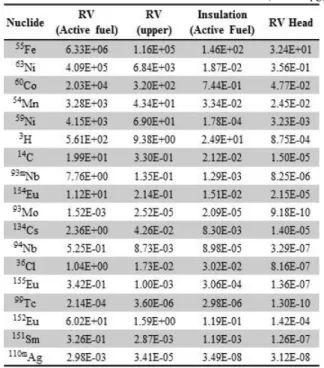
2019 ⦽ǎႊᔍᖒ⠱ʑྜྷ⦺⫭ ⇹ĥ⦺ᚁݡ⫭ םྙ᧞Ḳ Table 1. Material Composition of RV (Selected)The calculated specific activity of the K1 RV is shown in Table 2. At a standpoint of direct exposure to worker, the primary concern comes from the isotopes emitting energetic gammas [3]. The 60Co, produced from 59Co, emits 1.173 and 1.332 MeV gamma rays and attracts large attention. Although pure beta emitters are not as harmful as gamma emitter due to their low penetration characteristics in direct exposure, their potential hazard should be taken into account for disposal. The low beta energy from tritium results in a low hazard from direct exposure. However, the high mobility of 3H requires careful treatment. The 63Ni is a second most abundant nuclide in the RV. The long half-life of
63
Ni requires continuous attention when considering disposal of the RV. Also the vapor of Ni, which could be evaporated and become mobile during thermal segmentation, is harmful to workers and attracts large attention during segmentation process. It means that the sufficient local ventilation system and emergency plans should be equipped to protect workers and prevent the proliferation of contaminants.
Table 2. Specific Activity of RV (Selected)
(Unit: Bq/g)
3. Conclusion
The radiological inventory assessment is performed to understand and classify the K1 RV. The majority nuclides of activated RV are 55Fe, 63Ni, 60Co, etc. The active fuel region of the RV is classified as LLW. The specific activity of the RV head, which is replaced several years ago, is much lower than other components.
REFERENCES
[1] EPRI, Review of Waste Management Best Practices During Nuclear Plant Decommissioning, 3002005252 (2015).
[2] IAEA, Radiological Characterization of Shut-Down Nuclear Reactors for Decommissioning Purposes, TRS No.389, (1998).
[3] PNNL, Long-Lived Activation Products in Reactor Materials, NUREG/CR-3474 (1984).
![Fig. 1. Activation Analysis Procedure [2].](https://thumb-ap.123doks.com/thumbv2/123dokinfo/4976926.54091/1.892.466.780.608.951/fig-activation-analysis-procedure.webp)