© Korean Powder Metallurgy Institute 857
-1. Introduction
Silicon nitride ceramics consist of various crystal structures of Al and O atom solid solution. We used the β-Si3N4 specimens with small amounts of Al and O substitutional solid solution obtained by sintering of Si3N4, Y2O3 and Al2O3 mixed powder. It is known that Al and O atom solid solution influences various properties of sintered body as well as its formation whether Si3N4 crystals and boundary phase are formed or not [1-6]. Thus, it is important to evaluate both the crystal structures of Si3N4 and the boundary phase of the silicon nitride based ceramics in order to investigate the mechanical properties as well as the resistance to oxidation and corrosions of silicon nitride based ceramics [7]. Furthermore, the Al and O atom solid solution has been reported to facilitate the re-crystallization of Si3N4 and boundary phase formation [8-9]. Therefore, in this study, we investigated the effect of introducing oxygen into the silicon nitride based ceramics on various mechanical properties, oxidation resistance and wear resistance of silicon nitride based ceramics as cutting tools.
2. Experimental and Results 2-1. Specimen preparation
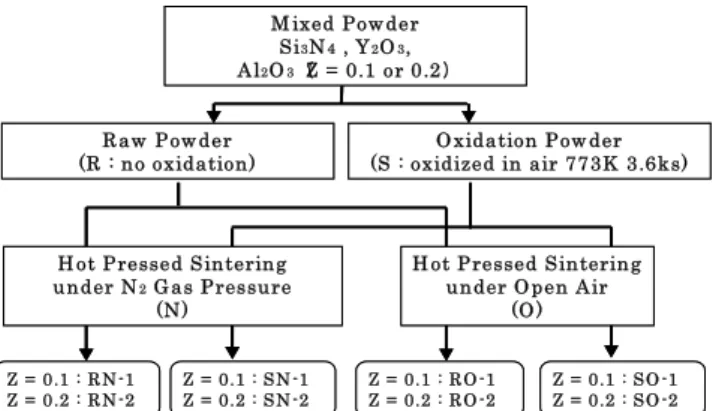
Figure 1 shows the Si3N4-Y2O3-Al2O3 ceramics production process of this research. Oxygen was introduced by three methods as follows: (1) pre-oxidation of raw powder, (2) sintering in different atmospheres with or without oxygen, and (3) controlling the amount of Al2O3 to be added as a sintering additive. The z value means the solid solution ratio indicated by a formula of Si6-zAlzOzN8-z (0 < z ≤ 4.2). We
obtained eight types of sintered bodies introduced oxygen by different methods. For the oxidation test, specimens of about 3.5mm×3.5mm×3mm in size were cut from the sintered bodies and the surface for the observation was polished into a surface roughness of 20 nm.
Z = 0.1 : RO -1 Z = 0.2 : RO -2 Z = 0.1 : SN -1 Z = 0.2 : SN -2 Z = 0.1 : RN -1 Z = 0.2 : RN -2 Z = 0.1 : SO -1Z = 0.2 : SO -2 M ixed Pow der
Si3N4, Y2O3,
Al2O3(Z = 0.1 or 0.2)
R aw Pow der
(R : no oxidation) (S : oxidized in air 773K 3.6ks)O xidation Pow der
H ot Pressed Sintering under O pen Air
(O ) H ot Pressed Sintering under N2G as Pressure (N ) Z = 0.1 : RO -1 Z = 0.2 : RO -2 Z = 0.1 : SN -1 Z = 0.2 : SN -2 Z = 0.1 : RN -1 Z = 0.2 : RN -2 Z = 0.1 : SO -1Z = 0.2 : SO -2 M ixed Pow der
Si3N4, Y2O3,
Al2O3(Z = 0.1 or 0.2)
R aw Pow der
(R : no oxidation) (S : oxidized in air 773K 3.6ks)O xidation Pow der
H ot Pressed Sintering under O pen Air
(O ) H ot Pressed Sintering
under N2G as Pressure
(N )
Fig. 1. The Si3N4 ceramics production process.
2-2. Evaluation of oxidation resistance
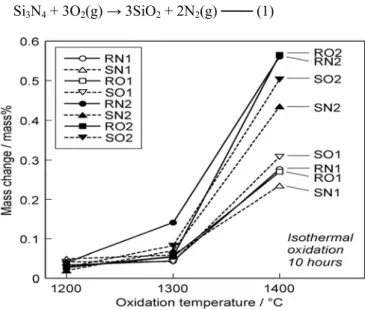
Specimens were oxidized in a dry air flow of 100 ml/min at 1200°C or 1300°C for 10 hours, or 1400°C for 1, 2, 5 and 10 hours, respectively, placed on a mullite boat in an alumina tube of an electric furnace. After oxidation, the specimens were weighed and their surfaces were analyzed by scanning electron microscopy (SEM) and X-ray diffraction analysis (XRD). Figure 2 shows the change in the mass of the specimens at each oxidation temperature for a period of 10 hours. There is a slight change in the mass of the specimen below 1300°C. However, at 1400°C, there is a remarkable change.From the SEM micrographs of the
2006 POWDER METALLURGY World Congress
C05-03-1
*Invited
The Effect of Oxygen Introduction on Oxidation Resistance
and Cutting Performance of Silicon Nitride Ceramics
Mituyoshi Nagano1,a, Hideaki Sano2,b,Shigeya Sakaguchi1,c Guo Bin Zheng2,d, and Yasuo Uchiyama2,e
1
Nippon Tungsten Co., Ltd., 3173-2, Sonobe, Kiyama-Cho, Miyaki-Gun, Saga, 841-0203, Japan
2
Department of Materials Science and Engineering, Faculty of Engineering, Nagasaki University, 1-14, Bunkyo-Machi, Nagasaki, 852-8521, Japan
a
[email protected], bsano@ nagasaki-u.ac.jp, [email protected], d
[email protected], [email protected]
Abstract
In order to clarify the wear resistance as cutting tools, the effect of oxygen addition on oxidation behavior of the β-Si3N4
ceramics with 5 mass% Y2O3 and 2 or 4 mass% Al2O3 was investigated by performing oxidation tests in air at 1300° to
1400°C and cutting performance tests. From test results, we could conclude that the mechanical properties of β-Si3N4
ceramics depending on oxygen introduction are much effective on cutting performance improvements of β-Si3N4 ceramics.
© Korean Powder Metallurgy Institute 858 -specimen after oxidation at 1400°C for 10 hours, we can see many pores in the surface of all the specimens. The size and number of these pores are different in each specimen. Considering from the shape of the pores, it is believed that these pores were formed due to the production of nitrogen gas in accordance with the following reaction.
Si3N4 + 3O2(g) → 3SiO2 + 2N2(g) ─── (1)
Fig. 2. Mass change of specimens by oxidation. 2-3. Cutting performance evaluations
Table 1 shows the mechanical properties of the specimens and their oxygen content. It is observed that z = 0.1 specimens have higher hardness and bending strength than z = 0.2 specimens. RN1 without the oxygen introduction treatment showed the highest hardness and bending strength. The cutting performance of these specimens was tested by using the ductile cast iron as a work piece, under two methods of cutting test, the high speed cutting test and heavy duty cutting, in order to clearify the difference of cutting performance. As a result, the cutting performance of high speed cutting was almost not influenced by the oxygen introduction. In heavy duty cutting, the wear occurred larger with increasing total oxygen content of specimens. However, in heavy duty cutting, SN1 containing more oxygen more
than RN1 showed minimum wear. Therefore it is considered that there is preferable oxgen content range to improve both the resistance to oxidation and the cutting performance, more than RN1. The oxygen amount in the grain and the boundary could be measured by RECO oxygen analysis. The oxygen introduction into the grains was more effective than the oxygen introduction into grain boundaries for the improvement of heavy duty cutting performance
3. Summary
Based on the above findings, we could make the following conclusions.
1) The mass of the specimens showed a remarkable increase at 1400°C, while only a slight change below 1300°C. 2) The specimens group (z = 0.1) with Al and O added
with Al2O3 of 2 mass% shows higher hardness and bending strength than z = 0.2 specimens.
3) The performance of high speed cutting was not almost influenced by the oxygen introduction. But in heavy duty cutting, increasing total oxygen content of specimens, the wear occurred larger.
4) It is considered that there is preferable oxgen content region to improve both the resistance to oxidation and the cutting performance.
4. References
1. G.G. Deeley, J.M. Herbet, Powd. Metall., 8, 145(1961) 2. G.E.Gazza, J.Am.Ceram. Soc., 56[12], 662(1973) 3. Y.Oyama, Yogyo-kyokai-shi, 82, 351(1974) 4. K.H.Jack, J. Material Sci., 11, 1135(1976) 5. Y.Oyama J.Appl.Phys., 10, 1637(1971)
6. Y.Ukyou, S.Wada, J. Cera. Sci. of J., 102[7], 623 (1994) 7. M.Nagano, Nittan Review, 20, 12 (1984)
8. M.Nagano, Proceeding of International Conf. on High Pressure Science and Technology, p470 (1997)
9. M.Nagano, Proceeding of 61th International Sym. on Ceramics Material and Component for Engines, (1997)
Table 1. The mechanical properties of specimens and the amount of oxygen contained
Density Hardness Bending strength toughnessFracture Oxygen in crystal Oxygen in boundary Total oxygen content (by RECO) Name Solution z value
g / cm3 HRA MPa MPa / m3/2 mass% mass% mass%
RN-1 0.1 3.238 93.5 870 6.35 1.90 1.78 3.68 RN-2 0.2 3.238 93.2 840 5.07 2.55 2.40 4.96 SN-1 0.1 3.238 93.5 820 6.21 1.88 1.93 3.81 SN-2 0.2 3.235 93.0 790 5.66 2.59 2.52 5.11 RO-1 0.1 3.238 93.1 800 6.59 1.75 2.20 3.95 RO-2 0.2 3.232 92.9 850 6.68 2.42 2.66 5.08 SO-1 0.1 3.234 93.1 820 6.59 1.39 2.55 3.94 SO-2 0.2 3.229 3.229 830 6.47 2.25 3.09 5.33