© Korean Powder Metallurgy Institute 903
-1. Introduction
Metal porous material is a kind of special function metal materials with remarkable pore character, which is distinguish from compact metal and has widely been used for metallurgy, mechanic, petrol, chemical, energy source, environment protection, defense, nuclear, biologic, pharmacy etc. Industry as filtration and separation, flow penetration and distribution, fluidization, silencing, burner, heat exchanger, heat pipe, flame resister and so on [1].
Metal porous materials can be divided in five types: sintered powder metals, metal fiber felt, sintered metal mesh laminates, metal foam, and metal membrane, of which the sintered metal composites including powder/powder, powder/ mesh, fiber felt/mesh, fiber felt/powder, and metal membrane with micro pore are the rapid development.
2. Information about our development Sintered powder porous material
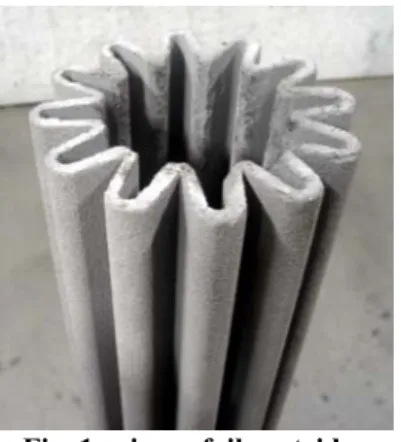
Porous metal material Lab has been established since twenty century 60s in NIN in which the key research focused in nickel, Monel and stainless steel porous filtration media. Civil application such as Ti porous material used for filtration in the medicine factory, juice purification, air distribution in oxygenator, supporter material in seawater desalt have been developed since 70s. In 1980s, to meet the requirements of oil industry and synthetic fiber industry, stainless steel, Ti, Ni porous materials and its element have been developed. In recent years, in accordance with the needs of energy and environmental protection fields such as clean coal technologies (CCTs), the irregular shape porous parts such as air cone and cinquefoil cartridge (Fig. 1) were developed.
Fig. 1. cinquefoil cartridge
Metal fiber porous material and sintered metal mesh In the end of 80’s of the last century, investigation for metal fiber porous materials was simultaneous with developing the sintered multiple-layer metal mesh. A large scale production line for sintered stainless steel fiber filter media was established in NIN in 90’s, in which the main products are stainless steel, Ni, and FeCrAl fiber and theirs filter media, laminated metal mesh, clothes and yarn of metal fiber. The normal size of the fiber filter medium is 1180×1500mm a sheet, the photos for metal fiber felts shown in Fig. 2. The sintered laminates consist of 3~7 layers metal mesh, and the filtration average rating is 5~140 µm.
NIN puts emphasis on the studying characters for the felt with gradient pore size and found that the effect of porosity on the filtration behavior mainly depends on the fiber diameter of the controlled layer, and the additional layers obviously play a role of interference to filtration behavior of the controlled layer, the air permeability coefficient of the filter medium increases with the increase of the diameter of additional layers [2].
2006 POWDER METALLURGY World Congress
D03-02-1
*Invited
Porous Metals of Northwest Institute for Non-ferrous Metal Research
Tang Huiping, Liao Jichang, Zhu JileiNorthwest Institute for Non-ferrous Metal Research (NIN) [email protected]
Abstract
In recent years, the research in porous metal got rapid development in China, especial in Northwest Institute for Non-ferrous Metal Research (NIN). Many porous metals with different raw material and different shapes were developed, which successfully employed in many fields. We believe we will earn more rapid development in the future.
© Korean Powder Metallurgy Institute 904 -Fig. 2. metal fiber felt porous elements
Metal Porous Membrane
Porous metal with coarser pore size is introduced as substrate, the metal porous membrane is prepared by fluid dynamic deposition technology. The membrane structure is shown as Fig. 3. Its porosity is more than 50%, the filtration rating is 0.1 µm to 1 µm, and the membrane thickness ranges from 50 µm to 200 µm. Ti, Ni and stainless steel porous sheet with thickness 0.2 mm and metal porous membrane system with Ф50×1600 mm are prepared, which can be used in fuel cell and juice filtration respectively [4].
In our works, other porous metals are felt/mesh, powder/ mesh composition.
Fig. 3. Tube coated with porous metal membrane
3. Out Look
With the rapid development of global economic and research in porous metal, the requirement of porous metal is rapid increasing, at the same time, the performance of porous metal obviously improved, and the new porous materials and new application fields appear. Under such nice situation, we believe a great development from sintered powder porous metal to gradient porous membrane will be got, and the applications of metal media with gradient pore size to industry will be more wide in the future.
4. References
1. Tang Huiping, Liao Jichang, in: Porous Metals-China Materials Engering Canon, Chemical Industry Press (2006), Vol.14, p: 924-933
2. Liao Jichang, Zuo Caixia and Wu Bende: Study of t he permeability of a Metal Fiber Medium with Grad ed Pore Size, Rare Metal Materials and Engineering, Vol.27, No.5 (1998), p: 286-289
3. Information on http://www.c-wmm.com/
4. Wang Qiangbin, Tang Huiping and Xi Zhengping: Rare Metal Material and Engineering, Vol.34, Suppl.3 (2005), p: 596-598