- Mingqing Zuo : 박사과정, Seonghoon Yi : 교수
Received: May 14, 2020 ; Revised: .May 28, 2020 ; Accepted: Jun. 4, 2020
†Corresponding author: Seonghoon Yi (Kyungpook Nat'l Univ.)
Tel: +82-53-950-5561, Fax: +82-53-950-6559 E-mail: [email protected]
Journal of Korea Foundry Society 2020. Vol. 40 No. 4, pp. 113~117 http://dx.doi.org/10.7777/jkfs.2020.40.4.113 pISSN 1598-706X / eISSN 2288-8381 © Korea Foundry Society, All rights reserved.
This is an Open-Access article distributed under the terms of the Creative Commons Attribution Non-Commercial License (http://creative-commons.org/licenses/by-nc/3.0) which permits unrestricted non-commercial use, distribution, and reproduction in any medium, provided the original work is properly cited.
Effects of Flux Treatment on the Glass Forming Ability and
Magnetic Properties of Fe-based Ternary Amorphous Alloys
Mingqing Zuo and Seonghoon Yi†
Department of Materials Science and Metallurgical Engineering, Kyungpook National University, Daegu 41566, Republic of Korea
Abstract
A series of Fe–P–B and Fe–Si–B amorphous alloys with high Fe contents exceeding 90 wt.% was successfully prepared by combining flux treatment and melt-spinning technique. The effects of Fe content and the flux treatment on the thermal and magnetic properties of amorphous alloys were studied. The glass-forming ability and the thermal stability of amorphous ribbons can be improved by a flux treatment, revealing the effective removal of heterogeneous nucleation sites in the ribbons through the flux treatment. It was found that Fe–Si–B ribbons exhibit higher saturation magnetization levels than Fe–P–B ribbons.
Key word: Fe–based amorphous alloy; Flux treatment; Thermal properties; Magnetic properties
1. Introduction
Fe-based magnetic amorphous alloys exhibit promising application prospects in the field of magnetism and electricity due to their excellent soft magnetic properties, such as higher effective permeability, lower coercively, lower hysteresis loss, and core loss [1, 2]. However, Fe-based amorphous alloys generally have low glass forming ability (GFA) and lower saturation magnetization (Ms)
(most are lower than 1.65 T), which restricts their extensive application. There is no doubt that the essential challenge of future Fe-based amorphous alloy is obtained the alloys with large GFA and high Ms.
Flux treatment, which is a commonly used technique in traditional metallurgy for purifying materials or adjusting microelement. The impurities are one of the important factors affecting the GFA of amorphous alloys, which become active heterogeneous nucleation sites in the process of solidification and result in the deterioration of the GFA of alloys. In 1984, Kui et al. reported that the GFA of
Pd40Ni40P20 alloy can be improved by the flux treatment
using B2O3 [3]. The bigger sized Pd42.5Cu30Ni7.5P20 alloy
could be prepared with a critical size to 80 mm by combining flux treatment and water quenching [4]. This offers great potential for improving the GFA of alloys. In this way, many magnetic Fe-based amorphous alloys have been successfully prepared by flux treatment [5-7]. Li et al. synthesized a ternary Fe80P13C7 bulk metallic glass (BMG)
with a critical diameter of 2.0 mm by combining flux treatment and J-quenching technique [8]. The critical diameter of FeCoBSiNb BMG from 1 to 2.5 mm by using the flux treatment and arc-melting [9]. Therefore, the flux treatment is an important efficient method to improve the GFA of Fe-based amorphous.
In this work, we have prepared a series of Fe–P–B and Fe–Si–B amorphous ribbons with Fe contents of higher than 90 wt.% by combining flux treatment and melt-spinning technique, and the effect of Fe content and flux treatment on the properties of ribbons were studied.
2. Experimental
Mother alloy ingots were prepared by arc-melting of high-purity Fe powders (99.9 wt.%), Si pieces (99.9 wt.%), B pieces (99.9 wt.%) and Fe3P (99.9 wt.%, consisting of 75
at.% Fe and 25 at.% P) under a high-purity argon atmosphere. The alloy ingots were fluxed in an agent composed of B2O3 and CaO with a mass ration of 3:1 at
1,150oC for several hours under a vacuum of ~10 Pa, the schematic diagram of flux treatment as shown in Fig. 1. After fluxed treatment, the alloys ingots were cooled down
to room temperature and then the amorphous alloy ribbons of 20-25 μm thickness and ~1 mm width were prepared by the single roller melt-spinning under a high-purity argon atmosphere (roller speed 40 m s−1).
The ribbon structure was identified by X-ray diffraction (XRD, Rigaku D/Max–2500, Japan) with Cu–Kα radiation. The thermal behavior was examined with a differential scanning calorimetry (DSC, Perkin Elmer Diamond, USA) at a heating rate of 0.67 K/s under argon atmosphere. The magnetic properties of as–prepared specimens were analyzed by the vibrating-sample magnetometer (VSM, Lake Shore 7404 USA) with an applied magnetic field of 1200 kA/m at room temperature. In addition, the density of the samples was determined by the Archimedes drainage method.
3. Results and Discussion
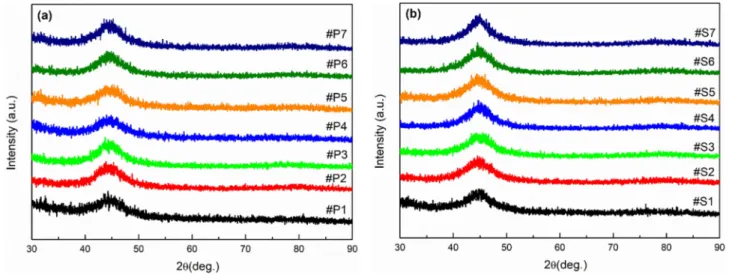
Fig. 2 shows the XRD spectra of the as-quenched (a) Fe– P–B and (b) Fe–Si–B amorphous ribbons by flux treatment revealing only a broad smooth peak around 2θ–45°and no obvious crystalline peaks can be observed. These XRD patterns are the typical amorphous nature of these specimens.
The DSC thermal curves of the as-quenched amorphous ribbons at a heating rate of 0.67 K/s are shown in Fig. 3. DSC curves of Fe–P–B series ribbons (Fig. 3(a)) observed only one exotherm al peak indicating a one-stage crystallization process; Fe–Si–B series ribbons (Fig. 3(b)) Fig. 1. Schematic diagram of flux treatment.
showed a multi-stage crystallization process. The Curie temperature (Tc), the glass transition temperature (Tg) the
onset of primary crystallization temperature (Tx) of the
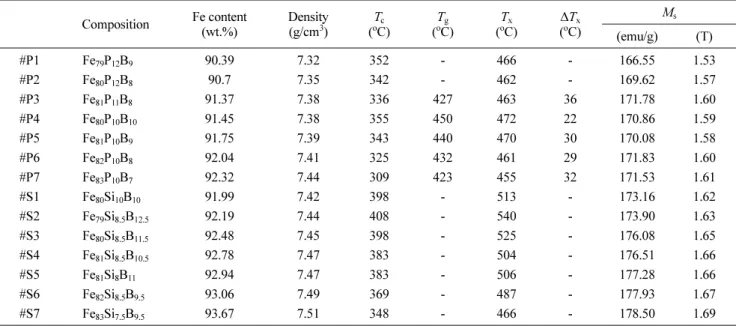
specimens can be determined from the DSC thermal scans and are summarized in Table 1. Many Fe–P–B ribbons show a clear glass transition, followed by an extended supercooled liquid region. Compared with Fe–Si–B ribbons, Fe–P–B ribbons have lower Tc and Tx. As we
know that the onset crystallization temperature mainly depends on the atomic bonding strength among the constitution elements [10]. The heat of mixing value
(∆Hmix) is –35 kJ/mol, –39.5 kJ/mol and –26 kJ/mol for Fe–Si, Fe–P and Fe–B atomic pairs, respectively [11]. The ∆Hmix of Fe–Si and Fe–P atomic pairs are similar, but the Tx of Si-B ribbons are quite different from those of
Fe-P-B. It may be the difference in ∆Hmix between P–B (0.5 kJ/mol) and Si–B (–14 kJ/mol) atomic pairs, it can be expected that the atomic bond strength between Si and B can be stronger than that between P and B, thus Fe–Si–B ribbons have higher Tx.
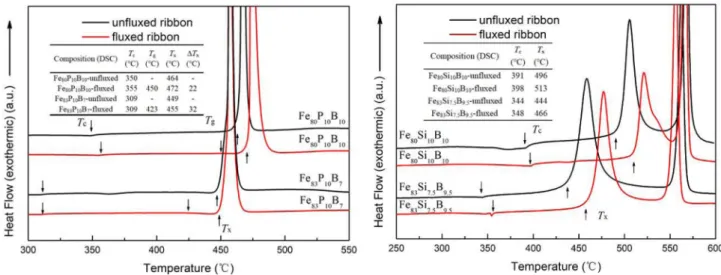
Effects of the flux treatment on the thermal behaviors of the ribbons were studied. We prepared the Fe80P10B10,
Fig. 3. DSC curves of as-quenched (a) Fe–P–B and (b) Fe–Si–B fluxed amorphous ribbons.
Table 1. Thermal properties and magnetic properties of the as-prepared amorphous ribbons
Composition Fe content (wt.%) Density (g/cm3) Tc (oC) Tg (oC) Tx (oC) ΔTx (oC) Ms (emu/g) (T) #P1 Fe79P12B9 90.39 7.32 352 - 466 - 166.55 1.53 #P2 Fe80P12B8 90.7 7.35 342 - 462 - 169.62 1.57 #P3 Fe81P11B8 91.37 7.38 336 427 463 36 171.78 1.60 #P4 Fe80P10B10 91.45 7.38 355 450 472 22 170.86 1.59 #P5 Fe81P10B9 91.75 7.39 343 440 470 30 170.08 1.58 #P6 Fe82P10B8 92.04 7.41 325 432 461 29 171.83 1.60 #P7 Fe83P10B7 92.32 7.44 309 423 455 32 171.53 1.61 #S1 Fe80Si10B10 91.99 7.42 398 - 513 - 173.16 1.62 #S2 Fe79Si8.5B12.5 92.19 7.44 408 - 540 - 173.90 1.63 #S3 Fe80Si8.5B11.5 92.48 7.45 398 - 525 - 176.08 1.65 #S4 Fe81Si8.5B10.5 92.78 7.47 383 - 504 - 176.51 1.66 #S5 Fe81Si8B11 92.94 7.47 383 - 506 - 177.28 1.66 #S6 Fe82Si8.5B9.5 93.06 7.49 369 - 487 - 177.93 1.67 #S7 Fe83Si7.5B9.5 93.67 7.51 348 - 466 - 178.50 1.69
Fe83P10B7 and Fe80Si10B10 and Fe83Si7.5B9.5 ribbons without
flux treatment. The comparison of DSC curves between fluxed and unfluxed samples is shown in Fig. 4, indicating great influences of the impurity removal on crystallization. The samples after flux treatment exhibit a higher Tx, which
can be attributed to the influence of potential heterogeneous nucleation sites [12]. The value of Tx reflects the thermal
stability and resistance to the crystallization of amorphous alloy in the supercooled liquid region. Thus the improvement of Tx indicates that the thermal stability of
ribbons can be enhanced by flux treatment. In addition, compared with unfluxed ribbons, fluxed Fe–P–B ribbons showed the Tg, which indicates that flux treatment can
improve the glass forming ability [13]. Flux agent B2O3
reacts with other oxides to form metalborates which are soluble in the agent[14]. After flux treatment at a high temperature for a long time, the impurities and oxides will be passivated and transferred from the melt inside to the surface. Therefore, the flux treatment can efficiently improve the GFA of amorphous alloys. In addition, the Tc
of the amorphous alloys correlates to the composition and state determined magnetic atomic interaction. The flux treatment ribbon exhibits a high Tc, which can be attributed
to the composition change and the influence of potential heterogeneous nucleation sites [15].
Fig. 5(a) and 5(b) present the hysteresis loops of the
as-Fig. 4. Comparison of DSC curves between fluxed and unfluxed samples.
Fig. 5. Hysteresis loops of the as–prepared (a) Fe–P–B and (b) Fe–Si–B fluxed ribbons at room temperature. The inset depicts the enlarged partial curves of the hysteresis loops.
quenched (a) Fe–P–B and (b) Fe–Si–B amorphous ribbons at room temperature. The inset depicts the enlarged partial curves of the hysteresis loops. All the samples exhibit typical soft magnetic properties. The saturation magnetization values (Ms) of the specimens were determined from the
hysteresis loops and summarized in Table 1. The Ms is
contributed by the magnetic moment of transition elements, which here is provided by the Fe atoms. Therefore, the Ms
value tends to increase as the Fe content. Compared with the Fe–P–B series amorphous ribbons, Fe–Si–B amorphous ribbons have higher saturation magnetization. Based on the charge transfer model [16, 17] and rigid–band model [18], for Fe–metalloid amorphous alloys, the valence elements, i.e. sp electrons, of metalloid elements will transfer to the 3d minority–spin band of Fe atom, leading to decrease of the magnetic moment, thus reducing the Ms of Fe–metalloid
amorphous alloys. The number of sp electrons of P and Si atoms is 5 and 4, respectively. Thus, the Fe–Si–B amorphous ribbons have higher saturation magnetization than the Fe– P–B system. In addition, the amorphous ribbons exhibit slightly high Ms after flux treatment [7, 15]. It is known
that the magnetic property is determined by the magnetic composition of materials. The flux treatment can effectively remove the heterogeneous nucleation sites which may include some antiferromagnetc atoms, resulting in slightly high Ms value after flux treatment.
4. Conclusion
We systematically investigated the thermal stability and magnetic properties of Fe–P–B and Fe–Si–B amorphous ribbons by flux treatment with high Fe content, and discuss the effect of flux treatment. The results show the flux treatment can improve the thermal stability and glass forming ability. In addition, it is found that Fe–Si–B series ribbons have higher saturation magnetization than Fe–P–B system.
Acknowledgements
This research was supported by Kyungpook National University Development Project Research Fund, 2018.
References
[1] A. Inoue, Materials Science and Engineering: A, “Bulk
amorphous alloys with soft and hard magnetic properties”, 226 (1997) 357-363.
[2] A. Inoue, A. Takeuchi and B. Shen, Materials transactions, “Formation and functional properties of Fe-based bulk glassy alloys”, 42 (2001) 970-978.
[3] H.W. Kui, A.L. Greer and D. Turnbull, Applied Physics Letters, “Formation of bulk metallic glass by fluxing”, 45 (1984) 615-616.
[4] N. Nishiyama, K. Takenaka, H. Miura, N. Saidoh, Y. Zeng and A. Inoue, Intermetallics, “The world's biggest glassy alloy ever made”, 30 (2012) 19-24.
[5] M. Zuo, S. Meng, Q. Li, H. Li, C. Chang and Y. Sun, Intermetallics, “Effect of metalloid elements on magnetic properties of Fe-based bulk metallic glasses”, 83 (2017) 83-86.
[6] W. Yang, C. Wan, H. Liu, Q. Li, Q. Wang, H. Li, J. Zhou, L. Xue, B. Shen and A. Inoue, Materials & Design, “Fluxing induced boron alloying in Fe-based bulk metallic glasses”, 129 (2017) 63-68.
[7] Q. Li and S. Yi, Metals and Materials International, “Improvement of glass forming ability and soft magnetic properties of Fe-C-Si-P amorphous alloys through a flux treatment technique”, 20 (2014) 7-11.
[8] Q. Li, J. Li, P. Gong, K. Yao, J. Gao and H. Li, Intermetallics, “Formation of bulk magnetic ternary Fe80P13C7 glassy alloy”,
26 (2012) 62-65.
[9] C. Duhamel, K. Georgarakis, A. LeMoulec, A. Yavari, G. Vaughan, A. Baron and N. Lupu, Journal of alloys and compounds, “Influence of fluxing in the preparation of bulk Fe-based glassy alloys”, 483 (2009) 243-246.
[10] H. Chen, Glassy metals, Reports on Progress in Physics, 43 (1980) 353.
[11] A. Takeuchi and A. Inoue, Materials Transactions, “Classification of bulk metallic glasses by atomic size difference, heat of mixing and period of constituent elements and its application to characterization of the main alloying element”, 46 (2005) 2817-2829.
[12] D. Turnbull, Contemporary physics, “Under what conditions can a glass be formed?”, 10 (1969) 473-488.
[13] Z. Lu and C. Liu, Acta materialia, “A new glass-forming ability criterion for bulk metallic glasses”, 50 (2002) 3501-3512.
[14] D. Granata, E. Fischer, V. Wessels and J.F. Löffler, Acta Materialia, “Fluxing of Pd–Si–Cu bulk metallic glass and the role of cooling rate and purification”, 71 (2014) 145-152. [15] J. Pang, A. Wang, S. Yue, F. Kong, K. Qiu, C. Chang, X. Wang
and C.-T. Liu, Journal of Magnetism and Magnetic Materials, “Fluxing purification and its effect on magnetic properties of high-Bs FeBPSiC amorphous alloy”, 433 (2017) 35-41. [16] K. Yamauchi and T. Mizoguchi, Journal of the Physical
Society of Japan, “The magnetic moments of amorphous metal-metalloid alloys”, 39 (1975) 541-542.
[17] K. Schwarz and D.R. Salahub, Physical Review B, “Band theory for the magnetic moment in the bcc fe-co alloy”, 25 (1982) 3427-3429.
[18] Y. Kakehashi, Springer Science & Business Media, Modern Theory of Magnetism in Metals and Alloys, 2013.