Does Intravenous Ketamine Enhance Analgesia after
Arthroscopic Shoulder Surgery with Ultrasound Guided
Single-Injection Interscalene Block?: A Randomized, Prospective,
Double-Blind Trial
Ketamine has anti-inflammatory, analgesic and antihyperalgesic effect and prevents pain associated with wind-up. We investigated whether low doses of ketamine infusion during general anesthesia combined with single-shot interscalene nerve block (SSISB) would potentiate analgesic effect of SSISB. Forty adult patients scheduled for elective
arthroscopic shoulder surgery were enrolled and randomized to either the control group or the ketamine group. All patients underwent SSISB and followed by general anesthesia. During an operation, intravenous ketamine was infused to the patients of ketamine group continuously. In control group, patients received normal saline in volumes equivalent to ketamine infusions. Pain score by numeric rating scale was similar between groups at 1, 6, 12, 24, 36, and 48 hr following surgery, which was maintained lower than 3 in both groups. The time to first analgesic request after admission on post-anesthesia care unit was also not significantly different between groups. Intraoperative low dose ketamine did not decrease acute postoperative pain after arthroscopic shoulder surgery with a preincisional ultrasound guided SSISB. The preventive analgesic effect of ketamine could be mitigated by SSISB, which remains one of the most effective methods of pain relief after arthroscopic shoulder surgery.
Keywords: Ketamine; Interscalene Nerve Block; Shoulder Surgery; Pain, Postoperative
Jae Hee Woo, Youn Jin Kim, Hee Jung Baik, Jong In Han, and Rack Kyung Chung
Department of Anesthesiology and Pain Medicine, School of Medicine, Ewha Womans University, Seoul, Korea
Received: 26 December 2013 Accepted: 30 April 2014 Address for Correspondence: Youn Jin Kim, MD
Department of Anesthesiology and Pain Medicine, School of Medicine, Ewha Womans University, 1071 Anyangcheon-ro, Yangcheon-gu, Seoul 158-710, Korea
Tel: +82.2-2650-2885, Fax: +82.2-2655-2924 E-mail: [email protected]
http://dx.doi.org/10.3346/jkms.2014.29.7.1001 • J Korean Med Sci 2014; 29: 1001-1006
INTRODUCTION
Arthroscopic shoulder surgery (ASS) is associated with moder-ate to severe postoperative pain, which is comparable to the pain following a gastrectomy or thoracotomy and can require intensive pain management for several days (1-3). Several mo-dalities have been proven effective for postoperative analgesia, including a single-shot interscalene nerve block (SSISB), con-tinuous interscalene nerve block (CISB), subacromial injection of local anesthetic, and suprascapular nerve block (4). The CISB is the gold standard for postoperative analgesia following ASS because it provides better analgesia than the other modalities (4). However, it remains a technically challenging procedure and needs more time and effort of anesthesiologists for patient care. The SSISB is the preferred technique, which might be at-tributable to its analgesic effectiveness and the relative ease of the procedure despite the limited duration of analgesia (4). Re-gardless of the type of nerve block, a single-injection nerve block is simple but has a limited duration. Many studies have attempt-ed to prolong the analgesic effect of single-injection nerve blocks by adding adjuvants such as clonidine (5), opioids (6), dexa-methasone (7, 8), and ketamine (9-11). An effective adjuvant
that prolongs the duration of a single-injection nerve block may be a good alternative to a continuous nerve block.
Blockade of the N-methyl-D-aspartate (NMDA) receptor an-tagonist reduces the development of perioperative nociception-related neural sensitization, hypersensitivity, and opioid toler-ance. The NMDA receptor-mediated spinal reflex is the phar-macological basis for the wind-up phenomenon. Ketamine, a non-competitive NMDA receptor antagonist, has analgesic, anti-inflammatory, and antihyperalgesic effects (12) and pre-vents the pain associated with wind-up (13). However, random-ized studies of perioperative ketamine infusion have reported conflicting results. Studies conducted in total knee placement (10) and open thoracotomy (11) have shown better early post-operative pain relief, whereas studies conducted in abdominal hysterectomy (14) and open colorectal surgery (15) did not con-firm such relief.
To our knowledge, no study has assessed the analgesic ef-fects of ketamine when used as an intravenous adjuvant com-bined with SSISB on postoperative pain following ASS. There-fore, this double-blind, randomized, prospective study investi-gated the effects of low-dose ketamine infusions on postopera-tive pain relief. We hypothesized that pre-incisional and intra-Anesthesiology & Pain
operative ketamine infusion during general anesthesia com-bined with an SSISB would provide an additional benefit to the SSISB with a limited duration.
MATERIALS AND METHODS
Forty adult American Society of Anesthesiologists (ASA) physi-cal status I-III patients scheduled for elective ASS were enrolled. Exclusion criteria were coagulopathy, pregnancy, the presence of infection at the site of the block, cerebrovascular disease, any neurological deficit in the surgical limb, uncontrolled hyperten-sion, elevated intraocular pressure, severe lung disease, contra-lateral diaphragmatic paralysis, a known allergy to levobupiva-caine and ketamine, neurological and psychiatric disorders and contraindications to nonsteroidal anti-inflammatory drugs. Patients were randomized using a computer-generated ran-domization table to either the normal saline (N) or ketamine (K) group. An anesthesiologist blinded to group assignment prepared all of the study drugs. Patients and the attending an-esthesiologists participating in the study were unaware of the group assignment. Investigators who evaluated postoperative pain were blinded to the study groups. On arrival in the operat-ing room, standard ASA monitors were used throughout the surgery. All patients were given a standard SSISB under ultra-sound guidance (SonoSite®, M-TurboTM, SonoSite; Bothell, WA, USA). The blocks were performed by one experienced anesthe-siologist and were facilitated by sedation with intravenous (IV) midazolam 1-3 mg and fentanyl 25-50 µg. The patient was placed in a supine position with the head turned away from the side to be blocked. Using a 5-12 MHz linear probe, hypoechoic nerve roots or the superior trunk located between the anterior and middle scalene muscles were identified by their round to oval appearance in the short-axis view. A 50-mm, 22-gauge insulat-ed neinsulat-edle (Stimuplex® A, B-Braun; Melsungen, Germany) at-tached to a nerve stimulator (Stimuplex® Dig RC, B-Braun) was used. After sterile skin preparation, the point where the C5, C6, and C7 roots or superior trunk were most visible was selected. The needle tip was advanced to between the C5 and C6 roots or superior trunk within the sheath using the in-plane method. The needle placement was considered adequate if the deltoid, pectoralis major, triceps, or biceps motor response was still pres-ent at less than 0.5 mA of electrical stimulation. After localiza-tion of the brachial plexus and negative aspiralocaliza-tion, 10 mL of 0.5% levobupivacaine (Chirocaine®, Abbott Scandinavia; Solna, Sweden) mixed with dexamethasone 5 mg was injected in in-crements.
After the procedure, general anesthesia was induced with in-travenous propofol and remifentanil, which were also used for intraoperative maintenance as a continuous infusion using a TCI device (Orchestra Base Primea®, Fresenius Kabi; France) with a 50% oxygen-air mixture. Tracheal intubation was
facili-tated with 0.6 mg/kg of rocuronium. The patients in group K (n = 20) received an intravenous bolus of 0.3 mg/kg ketamine (Ke-tomin®, Dai Han Pharm, Seoul, Korea) after anesthesia induc-tion and before the surgical incision and a continuous intraop-erative infusion of ketamine 0.15 mg/kg/h, which was stopped 5 min before the end of surgery. In group N (n = 20), the pati-ents received a preincisional bolus and continuous intraopera-tive normal saline in volumes equivalent to the ketamine infu-sions until 5 min before the end of surgery. Propofol was target-ed to achieve a bispectral index of 40-60. The systolic arterial pressure and heart rate were kept within 20% of baseline values. Patients were then placed in the lateral decubitus position, and all surgeries were performed by one surgeon. Propofol and remi-fentanil were discontinued when suturing the skin. In all pati-ents, ramosetron 0.3 mg IV (Nasea®, Astellas Pharma Korea, To-kyo, Japan) was administered for antiemetic prophylaxis. Pa-tients were extubated in the operating room after reversing the residual muscle relaxation.
In the recovery room, an intravenous patient-controlled an-algesia (IV-PCA) pump, which contained a mixture of 1,500 µg fentanyl and 150 mg ketorolac diluted with saline solution to a total volume of 100 mL, was attached to all patients. A 2-mL bo-lus was administered on demand, with a 20-min lockout time. A doctor blinded to the groups visited the patients and evaluat-ed pain using a numerical rating scale (NRS: 0 = no pain, 10 = most severe pain imaginable) 0, 1, 6, 12, 24, 36, and 48 hr after an arrival at the recovery room. Patients were educated to press the button when the NRS was > 3 or the patient requested an-algesic. All patients had a plain chest radiograph taken to rule out phrenic nerve palsy. Patients were assessed for possible complications such as arm weakness, arm numbness, nausea, vomiting, dizziness, respiratory difficulties, and Horner syn-drome. The number of total attempts and the amount of PCA medication used for 48 hr was printed automatically by the PCA machine (Baxter PCA II, Baxter Corporation; Mississauga, On-tario, Canada).
Statistical analysis
SPSS (ver. 18.0, Chicago, IL, USA) was used for the statistical analysis. The sample size was based on postoperative pain. The primary endpoint is NRS 24 hr postoperatively. Data from a pre-liminary study in our institution, detection of a mean shift of 2 points (an SD of 2.0 points) in NRS after dropouts would require 20 subjects in each group (unpaired t test, α = 0.05, 2-tailed, pow-er = 80%). Student’s t-tests wpow-ere done to compare continuous variables between groups. Discrete variables were analyzed us-ing chi-squared tests. Pain score durus-ing postoperative 48 hr, cu-mulative number of PCA attempts and total consumption of PCA medication were analyzed using repeated measured AN-OVA. The time to first analgesic request was analyzed using Mann-Whitney U test. P values of less than 0.05 were considered
statis-tically significant. Data are presented as the mean ± standard deviation unless noted otherwise.
Ethics statement
This study was approved by the institutional review board (IRB) of Ewha Womans Hospital (IRB No. ECT 12-29-04). Written in-formed consent was obtained from all participating subjects.
RESULTS
Forty patients scheduled to undergo ASS were enrolled. Demo-graphic data were similar in both groups (Table 1). The
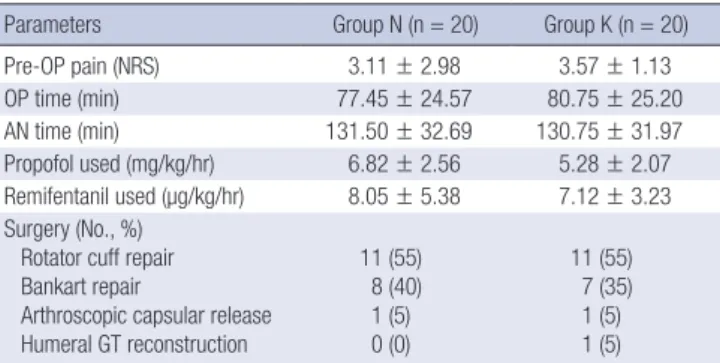
preop-erative NRS pain score, durations of anesthesia and surgery, type of surgery, and amounts of propofol and remifentanil used during anesthesia did not differ significantly between the groups (Table 2).
The NRS pain score was similar in both groups at 1, 6, 12, 24, 36, and 48 hr postoperatively (Fig. 1). The NRS was maintained at < 3 in both groups during the 48 postoperative hours. There was no appreciable difference between groups in the cumula-tive number of attempts at PCA (Fig. 2A) and total consumption of PCA medication during the 48 hr (Fig. 2B). The median time (inter-quartile range) to first analgesic request after admission to the post-anesthesia care unit was 520.00 min (37.75-1,272.25 min) in group N and 670.50 min (57.75-1,263.75 min) in group K (P = 0.925).
Adverse effects observed during the study period are sum-marized in Table 3. There were no significant differences in com-plications, including arm weakness, numbness, nausea, vomit-ing, dizziness, phrenic nerve palsy (ipsilateral diaphragm eleva-tion), and dyspnea. Arm numbness for the second 24 postoper-ative hours was noted in five patients in group N and one in Table 1. Demographic characteristics by groups
Parameters Group N (n = 20) Group K (n = 20)
Age (yr) 49.65 ± 14.11 42.85 ± 18.97
Height (cm) 163.20 ± 11.66 169.10 ± 10.03 Weight (kg) 67.15 ± 11.89 69.90 ± 9.24
Gender (Male/Female) 12/8 15/5
ASA physical status (I/II/III) 9/10/1 10/10/0 Values are mean ± SD or numbers. There were no significant differences between groups. Group N, the control group; Group K, the ketamine group; ASA, American So-ciety of Anesthesiologists.
Table 2. The perioperative data by groups
Parameters Group N (n = 20) Group K (n = 20) Pre-OP pain (NRS) 3.11 ± 2.98 3.57 ± 1.13 OP time (min) 77.45 ± 24.57 80.75 ± 25.20 AN time (min) 131.50 ± 32.69 130.75 ± 31.97 Propofol used (mg/kg/hr) 6.82 ± 2.56 5.28 ± 2.07 Remifentanil used (µg/kg/hr) 8.05 ± 5.38 7.12 ± 3.23 Surgery (No., %)
Rotator cuff repair Bankart repair
Arthroscopic capsular release Humeral GT reconstruction 11 (55) 8 (40) 1 (5) 0 (0) 11 (55) 7 (35) 1 (5) 1 (5)
Values are mean ± SD or number (percentage). There were no significant differences between groups. Group N, the control group; Group K, the ketamine group; OP, oper-ation; AN, anesthesia; NRS, numeric rating scale; GT, greater tuberosity.
Fig. 1. Numeric rating scale of pain during postoperative 48 hr. There was no signifi-cant difference between groups. Group N, the control group; Group K, the ketamine group. Numeric rating scale; 0, no pain; 10, worst pain imaginable.
Postopera tive pain (Numeric ra ting scale) Postoperative time (hr) 0 1 6 12 24 36 48 10 9 8 7 6 5 4 3 2 1 0 Group N Group K
Fig. 2. The cumulative number of PCA attempts (A) and total consumption of PCA medication (B) for postoperative 48 hr. There was no significant difference between groups. Group N, the control group; Group K, the ketamine group; PCA, patient-controlled analgesia.
The cumula tive number of a ttempts Postoperative time (hr) 0 1 6 12 24 36 48 40 35 30 25 20 15 10 5 0 Group N Group K
Total volume infused (mL)
Postoperative time (hr) 0 1 6 12 24 36 48 60 50 40 30 20 10 0 Group N Group K A B
group K; all cases resolved by the following day. Complications related to ketamine such as hallucinations or drowsiness were not observed.
DISCUSSION
This study found no beneficial effects of adding intravenous low-dose ketamine during the operation to SSISB for patients un-dergoing ASS under total IV anesthesia with propofol and remi-fentanil. Low-dose ketamine did not reduce the early postoper-ative pain score or prolong the time to first analgesic request. Whether intraoperative ketamine infusion reduces postoper-ative pain remains controversial. Previous studies of ketamine infusion can be divided into two types according to whether ketamine was also infused during the postoperative period (16). Peripheral tissue injury during an operation induces peripheral and central sensitization, which contribute to postoperative pain. The inflammatory response to the damaged tissue also leads to postoperative nociceptive input, which can sustain the hyper-sensitive state (17). Therefore, limiting central sensitization dur-ing the preoperative and intraoperative periods may be insuffi-cient. In this study, an IV bolus of ketamine was given after in-ducing anesthesia and before the surgical incision, and the ket-amine was infused continuously until 5 min before the end of surgery. Our design might be criticized for the lack of postoper-ative ketamine infusion. In clinical practice, ASS is commonly performed as outpatients surgery or it requires only a short hos-pital stay so that continuous ketamine infusion in a postopera-tive period would not be available to the general surgical popu-lation. Interestingly, ketamine also inhibits the early
postopera-tive inflammatory response, which contributes to sustained no-ciceptive input and the hypersensitive state (12, 18). This study sought to evaluate whether intraoperative ketamine infusion it-self potentiated the analgesia of SSISB and extended its duration. We postulated that intravenous ketamine did not confer any benefit on the analgesic effect of SSISB for two reasons. First, we used a dexamethasone as an adjuvant to local anesthetics for the SSISB. Many studies have shown that dexamethasone prolongs the sensory block of SSISB significantly (7, 8, 19). In our institution, we routinely add 5 mg of dexamethasone to the local anesthetics for SSISB. It is possible that the potent anti-in-flammatory effect of dexamethasone may have limited the im-pact of any additional anti-inflammatory effect of ketamine on the postoperative inflammatory response. Second, SSISB is com-monly used for anesthesia for shoulder surgery, as well as for postoperative analgesia. The pain score was zero in most pa-tients when they recovered from the general anesthesia. This might involve a limited effect of ketamine, which prevents an activity-dependent increase in the excitability of spinal neurons. Mathisen et al. (20) stated that intravenous ketamine might not provide any additional benefit when adequate analgesia is ob-tained with a conventional multimodal approach.
Previous studies tried various doses of ketamine (0.12-1 mg/ kg bolus before the surgical incision and 0.12-1 mg/kg/hr infu-sion until skin closure) for abdominal, gynecological, thoracic, and orthopedic surgery (16). The plasma ketamine concentra-tions for analgesia and anesthesia are 100-200 ng/mL and 700 ng/mL, respectively, and the dose of ketamine for analgesia is 0.2-0.4 mg/kg (21). We chose 0.3 mg/kg pre-incisional and 0.15 mg/kg/hr intraoperative ketamine as the dosing regimen based on our previous study with positive results (22). A quantitative meta-analysis of 37 trials showed that there was no morphine-sparing effect from increasing the ketamine dose above 30 mg/24 hr (16). The mean ketamine doses infused during the operation in our series was 43.05 mg, as calculated using the weight and anesthesia time for our patients.
Ketamine reduces postoperative nausea and vomiting (16). The incidence of nausea and vomiting was similarly low in both groups of our study. This likely resulted from the reduced opi-oid consumption due to the low pain scores, routine use of pre-ventive antiemetics, and antiemetic effect of dexamethasone in both groups (23). This concurs with previous articles that de-scribed the adverse effects as mild or absent (16).
There are the concerns about the ‘off-label’ use of perineural dexamethasone. Although no previous clinical trials using peri-neural dexamethasone have reported neurotoxicity related with dexamethasone, it requires enormous sample sizes to conclude safety concerns with rare adverse events. Though, several ani-mal experiments (24, 25) demonstrated no significant long-term adverse effects. In addition, epidural injections of corticoste-roids have been used to treat radiculopathy for a long time, and Table 3. Adverse effects by groups
Symptoms or signs Group N (n = 20) Group K (n = 20) P value Arm weakness T1 T2 3 0 1 0 0.600 Arm numbness T1 T2 7 5 13 1 0.080 Nausea T1 T2 0 0 2 0 0.492 Vomiting T1 T2 0 0 1 0 1.000 Dizziness T1 T2 1 0 1 0 1.000
Phrenic nerve palsy 2 2 1.000
Dyspnea 0 1 1.000
Horner syndrome 0 0 1.000
Hallucination 0 0 1.000
Drowsiness 0 0 1.000
Values are numbers. Group N, the control group; Group K, the ketamine group; T1, 0-24 hr postoperatively; T2, 24-48 hr postoperatively.
the neurologic risk of single use of small amounts (less than 8 mg) of dexamethasone, or use within 24 hr is considered to be small for adults (7, 26). Neural damage is also related to direct trauma by the needle. In our study, SSISB was conducted with-in the sheath of the with-interscalene brachial plexus. Uswith-ing the with- in-plane approach, direct damage to nerves and surrounding tissue from needle insertion was prevented by checking ultrasound images, and appropriate spread of local anesthetics within the interscalene brachial plexus sheath was ascertained during ad-ministration. This allowed local anesthetics to spread into the appropriate areas for sufficient perfusion through the nerve trunk and roots so successful nerve block was properly achieved in all patients without serious neurologic complications.
There are several limitations to this study. First, we focused on acute postoperative pain and did not evaluate the postoper-ative shoulder function or rehabilitation outcomes. Secondly, this study included a relatively small number of patients. Fur-ther studies with prolonged use of ketamine until the postoper-ative period or pre-incisional SSISB without the use of dexame-thasone in a larger patient population might find different results. In conclusion, intraoperative low-dose ketamine does not decrease acute postoperative pain following ASS. The preven-tive analgesic effect of ketamine found in other studies could be mitigated by SSISB, which remains one of the most effective methods of pain relief after ASS.
DISCLOSURE
The authors have no conflicts of interest to disclose.
ORCID
Jae Hee Woo http://orcid.org/0000-0002-1993-1687 Youn Jin Kim http://orcid.org/0000-0001-9189-5839 Hee Jung Baik http://orcid.org/0000-0002-8877-0274 Jong In Han http://orcid.org/0000-0002-8231-7161 Rack Kyung Chung http://orcid.org/0000-0003-4216-1665
REFERENCES
1. Borgeat A, Schäppi B, Biasca N, Gerber C. Patient-controlled analgesia after major shoulder surgery: patient-controlled interscalene analgesia versus patient-controlled analgesia. Anesthesiology 1997; 87: 1343-7. 2. Wilson AT, Nicholson E, Burton L, Wild C. Analgesia for day-case
shoul-der surgery. Br J Anaesth 2004; 92: 414-5.
3. Tuominen M, Pitkänen M, Rosenberg PH. Postoperative pain relief and bupivacaine plasma levels during continuous interscalene brachial plex-us block. Acta Anaesthesiol Scand 1987; 31: 276-8.
4. Fredrickson MJ, Krishnan S, Chen CY. Postoperative analgesia for shoul-der surgery: a critical appraisal and review of current techniques. Anaes-thesia 2010; 65: 608-24.
5. Hutschala D, Mascher H, Schmetterer L, Klimscha W, Fleck T, Eichler
HG, Tschernko EM. Clonidine added to bupivacaine enhances and pro-longs analgesia after brachial plexus block via a local mechanism in healthy volunteers. Eur J Anaesthesiol 2004; 21: 198-204.
6. Karakaya D, Büyükgöz F, Bariş S, Güldoğuş F, Tür A. Addition of fentanyl to bupivacaine prolongs anesthesia and analgesia in axillary brachial plexus block. Reg Anesth Pain Med 2001; 26: 434-8.
7. Vieira PA, Pulai I, Tsao GC, Manikantan P, Keller B, Connelly NR. Dexa-methasone with bupivacaine increases duration of analgesia in ultra-sound-guided interscalene brachial plexus blockade. Eur J Anaesthesiol 2010; 27: 285-8.
8. Tandoc MN, Fan L, Kolesnikov S, Kruglov A, Nader ND. Adjuvant dexa-methasone with bupivacaine prolongs the duration of interscalene block: a prospective randomized trial. J Anesth 2011; 25: 704-9.
9. Joseph C, Gaillat F, Duponq R, Lieven R, Baumstarck K, Thomas P, Pe-not-Ragon C, Kerbaul F. Is there any benefit to adding intravenous ket-amine to patient-controlled epidural analgesia after thoracic surgery? a randomized double-blind study. Eur J Cardiothorac Surg 2012; 42: e58-65.
10. Adam F, Chauvin M, Du Manoir B, Langlois M, Sessler DI, Fletcher D. Small-dose ketamine infusion improves postoperative analgesia and re-habilitation after total knee arthroplasty. Anesth Analg 2005; 100: 475-80.
11. Suzuki M, Haraguti S, Sugimoto K, Kikutani T, Shimada Y, Sakamoto A. Low-dose intravenous ketamine potentiates epidural analgesia after thoracotomy. Anesthesiology 2006; 105: 111-9.
12. Dale O, Somogyi AA, Li Y, Sullivan T, Shavit Y. Does intraoperative ket-amine attenuate inflammatory reactivity following surgery? a systematic review and meta-analysis. Anesth Analg 2012; 115: 934-43.
13. Hughes AM, Rhodes J, Fisher G, Sellers M, Growcott JW. Assessment of the effect of dextromethorphan and ketamine on the acute nociceptive threshold and wind-up of the second pain response in healthy male vol-unteers. Br J Clin Pharmacol 2002; 53: 604-12.
14. Grady MV, Mascha E, Sessler DI, Kurz A. The effect of perioperative in-travenous lidocaine and ketamine on recovery after abdominal hyster-ectomy. Anesth Analg 2012; 115: 1078-84.
15. Guignard B, Coste C, Costes H, Sessler DI, Lebrault C, Morris W, Simon-net G, Chauvin M. Supplementing desflurane-remifentanil anesthesia with small-dose ketamine reduces perioperative opioid analgesic require-ments. Anesth Analg 2002; 95: 103-8.
16. Bell RF, Dahl JB, Moore RA, Kalso E. Peri-operative ketamine for acute post-operative pain: a quantitative and qualitative systematic review (Cochrane review). Acta Anaesthesiol Scand 2005; 49: 1405-28. 17. Woolf CJ, Chong MS. Preemptive analgesia: treating postoperative pain
by preventing the establishment of central sensitization. Anesth Analg 1993; 77: 362-79.
18. Hirota K, Lambert DG. Ketamine: new uses for an old drug? Br J Anaesth 2011; 107: 123-6.
19. Cummings KC 3rd, Napierkowski DE, Parra-Sanchez I, Kurz A, Dalton JE, Brems JJ, Sessler DI. Effect of dexamethasone on the duration of in-terscalene nerve blocks with ropivacaine or bupivacaine. Br J Anaesth 2011; 107: 446-53.
20. Mathisen LC, Aasbø V, Raeder J. Lack of pre-emptive analgesic effect of (R)-ketamine in laparoscopic cholecystectomy. Acta Anaesthesiol Scand 1999; 43: 220-4.
ket-amine in man. Br J Anaesth 1981; 53: 27-30.
22. Kim YJ, Baik HJ, Kim JH. The effects of the intravenous continuous infu-sion of low-dose ketamine on postoperative pain after total intravenous anesthesia. Korean J Anesthesiol 2005; 48: 163-70.
23. Choi DH, Ko JS, Ahn HJ, Kim JA. A Korean predictive model for postop-erative nausea and vomiting. J Korean Med Sci 2005; 20: 811-5. 24. Williams BA, Hough KA, Tsui BY, Ibinson JW, Gold MS, Gebhart GF.
Neurotoxicity of adjuvants used in perineural anesthesia and analgesia
in comparison with ropivacaine. Reg Anesth Pain Med 2011; 36: 225-30. 25. Ma R, Wang X, Lu C, Li C, Cheng Y, Ding G, Liu L, Ding Z. Dexametha-sone attenuated bupivacaine-induced neuron injury in vitro through a threonine-serine protein kinase B-dependent mechanism. Neuroscience 2010; 167: 329-42.
26. Frederick HA, Carter PR, Littler JW. Injection injuries to the median and ulnar nerves at the wrist. J Hand Surg Am 1992; 17: 645-7.