International Journal of Ocean System Engineering 4(1) (2014) 19-28
http://dx.doi.org/10.5574/IJOSE.2014.4.1.019
System Engineering
Influence of Tether Length in the Response Behavior of Square
Ten-sion Leg Platform in Regular Waves
Amr R. El-gamal
1and Ashraf Essa
21 Civil Engineering Department, Faculty of Engineering at Benha, Benha University, Egypt. 2 Steel and structure Engineering Department, National Building Research Center, Egypt
(Manuscript Received December 14 2013; Revised January 10, 2014; Accepted February 17, 2014)
Abstract
The tension leg platform (TLP) is a vertically moored structure with excess buoyancy. The TLP is regarded as moored structure in horizontal plan, while inherit stiffness of fixed platform in vertical plane. In this paper, a numerical study using modified Morison equation was carried out in the time domain to investigate the influence of nonlinearities due to hydrodynamic forces and the coupling effect between surge, sway, heave, roll, pitch and yaw degrees of freedom on the dynamic behavior of TLP's. The stiffness of the TLP was derived from a combi-nation of hydrostatic restoring forces and restoring forces due to cables and the nonlinear equations of motion were solved utilizing Newmark’s beta integration scheme. The effect of tethers length and wave characteristics such as wave period and wave height on the response of TLP's was evaluated.
Only uni-directional waves in the surge direction was considered in the analysis. It was found that for short wave periods (i.e. 10 sec.), the surge response consisted of small amplitude oscillations about a displaced posi-tion that is significantly dependent on tether length, wave height; whereas for longer wave periods, the surge response showed high amplitude oscillations about that is significantly dependent on tether length.
Keywords:hydrodynamic wave forces; tension leg platforms; tethers length; wave characteristic.
1. Introduction
A tension leg platform (TLP) is one of the compli-ant structures which are well established in offshore industry to minimize the structure resistance to environmental loads by making the structure flexi-ble. The TLP is basically a floating structure moored by vertical cables or "tethers". Tethers are pre-tensioned to the sea floor due to the excess buoyancy of the platform. This tension fluctuates due to variable submergence, wind gustiness, wave loading and resulting coupled response. The instan-taneous tension in tethers acts as a restoring force.
The TLP can be modeled as a rigid body with six
degrees of freedom (refer to Fig. 1), which can be conveniently divided into two categories, those controlled by the stiffness of tethers, and those con-trolled by the buoyancy. The former category in-cludes motion in the vertical plane and consists of heave, roll and pitch; whereas the latter comprises the horizontal motions of surge, sway and yaw.
A number of studies have been conducted on the dynamic behavior of TLP's under both regular and random waves, Chandrasekaran and Roy [3]. They presented phase space studies of offshore structures subjected to nonlinear dynamic loading through Poincare maps for certain hydrodynamic parame-ters. Bhattachatya et al. [2] investigated coupled dynamic behavior of a mini TLP giving special attention to hull-tether coupling. Ketabdari and
*
Corresponding author. Tel.: ++201000941720, Fax.: +201000413512, E-mail address: [email protected]
Ardakani [6] developed a computer program to evaluate the dynamic response of sea-
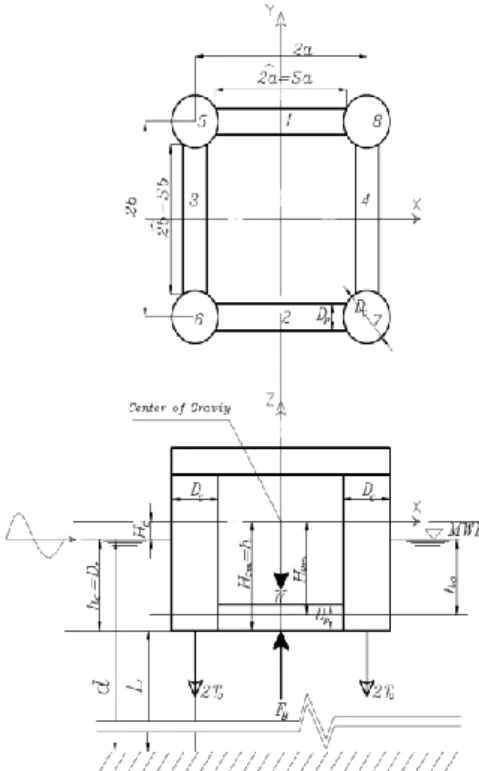
star TLP to regular wave forces considering cou-pling between different degrees of freedom. Wave forces were computed numerically using linear wave theory and Morison equation, neglecting dif-fraction effects due to small ratio of diameter to wave length. Low [9] presented a formulation for the linearization of the tendon restoring forces of a TLP. Chandrasekaran et al. [4] conducted dynamic analysis of triangular TLP models at different water depths under the combined action of regular waves and an impulse load affecting the TLP column. Chandrasekaran et al. [5] focused on the response analysis of triangular tension leg platform (TLP) for different wave approach angles and studied its in-fluence on the coupled dynamic response of trian-gular TLPs. Kurian et al. [7] developed a numerical study on the dynamic response of square TLPs sub-jected to regular and random waves. They also con-ducted parametric studies with varying parameters such as water depth, pretension, wave angle and position of center of gravity. Kurian et al. [8] de-veloped a numerical study on determining the dy-namic responses of square and triangular TLPs subjected to random waves. They found that the responses of triangular TLPs are much higher than those of square TLP. A.M.Abou-Rayan, Ayman A. Seleemah, and Amr R. El-gamal [1] developed a numerical study on determining the dynamic re-sponses of TLPs subjected to regular wave. They found that coupling between various degrees of freedom has insnificantly dependent on the wave height; whereas for longer wave periods of 15 sec. In this paper, a numerical study was con-ducted to investigate the dynamic response of a square TLP (shown in Fig. 2) under hydrodynamic forces considering all degrees of freedom of the system. The analysis was carried out using modi-fied Morison equation in the time domain with wa-ter particle kinematics using Airy’s linear wave theory. The influence of nonlinearities due to hy-drodynamic forces and the coupling effect between surge, sway, heave, roll, pitch and yaw degrees of freedom on the dynamic behavior of TLP's was investigated. The stiffness of the TLP was derived from a combination of hydrostatic restoring forces and restoring forces due to cables. The nonlinear equations of motion were solved utilizing New-mark’s beta integration scheme. The effect of
teth-ers length and wave characteristics such as wave period and wave height on the response of TLP's was evaluated. Only uni-directional waves in the surge direction was considered in the analysis
2. Structural Idealization and Assumptions The general equation of motion of the square con-figuration TLP model under a regular wave is given as )} ( { } ]{ [ } ]{ [ } ]{ [M x C x K x Ft (1)
Where, {x} is the structural displacement vector, {x˙} is the structural velocity vector, {x¨} is the structural acceleration vector; [M] is the structure mass matrix; [C] is the structure damping matrix; [K] is the structure stiffness matrix; and {F (t)} is the hydrodynamic force vector.
The mathematical model derived in this study as-sumes that the platform and the tethers are treated as a single system and the analysis is carried out for the six degrees of freedom under different envi-ronmental loads where wave forces are estimated at the instantaneous equilibrium position of the plat-form utilizing Morison’s equation and using Airy’s linear wave theory. Wave force coefficients, Cd and
Cm, are the same for the pontoons and the columns
and are independent of frequencies as well as con-stant over the water depth. The following assump-tions were made in the analysis.
1) The platform has been considered symmetrical along the surge axis. Directionality of wave approach to the structure has been ignored in the analysis and only a uni-directional wave train has been considered.
2) The damping matrix has been assumed to be mass and stiffness proportional.
3) The force on tethers (gravity, inertia, and drag, hydrostatic and hydrodynamic forces) has been neglected because of its small area and also the tether curvature is not significant in motion; only the axial forces acting on tethers have been considered.
4) Hydrodynamic forces on connecting members and mooring legs have been neglected. 5) The wave, current and structure motions are
taken to occur in the same plane and in the same direction, the interaction of wave and current has been ignored.
Fig. 1. The global and local coordinate system of TLP. Fig. 2. The Square TLP (plan and elevation). 6) Integration of hydrodynamic inertia and drag
forces are carried out up to the actual level of submergence, when variable submergence is considered.
3. Development of a Rectangle TLP Model
3.1. Draft Evaluation
At the original equilibrium position, Fig. 2, sum-mation of forces in the vertical direction gives:
B F T W (2) We find that
2 2 2 [ ( ) / (0.25 )} (2 ) (2 )] 4 p a p b r c W T g D s D s D D (3) where, FB is the total buoyancy force; W is the totalweight of the platform in air; T is the total instanta-neous tension in the tethers; To is the initial
pre-tension in the tether; p is the mass density of sea water; Dc is the diameter of TLP columns; Dp is the
diameter of pontoon; Sa and Sb are the length of the
pontoon between the inner edges of the columns in the x and y directions, respectively; and Dr is the
draft.
3.2. Stiffness Matrix of Rectangle TLP Configura-tion
The stiffness of the platform is derived from a combination of hydrostatic restoring forces and restoring forces due to the cables. Restoring force for motions in the horizontal plane (surge, sway, and yaw) are the horizontal component of the pre-tension in the cables, while restoring forces for motions in the vertical plane arise primarily from the elastic properties of the cables, with a relatively small contribution due to hydrostatic forces.
The coefficients, Kij, of the stiffness matrix of
square TLP are derived from the first principles as the reaction in the degree of freedom i, due to unit displacement in the degree of freedom j, keeping all other degrees of freedom restrained. The coeffi-cients of the stiffness matrix have nonlinear terms. Moreover, the tether tension changes due to the motion of the TLP in different degrees of freedom leads to a response-dependent stiffness matrix. The
coefficients of the stiffness matrix [K] of a rectan-gle TLP are 0 0 0 0 11 15 0 22 0 24 0 0 31 32 33 34 35 36 [ ] 0 42 0 44 0 0 0 0 0 55 0 51 0 0 0 0 0 66 K K K K K K K K K K K K K K K K (4)
For more detailed about the derivation of the stiff-ness matrix, the reader is referred to [1]
The overall stiffness matrix given by Eq. 4 shows: 1) The presence of off-diagonal terms, which reflects the coupling effect between the various degrees of freedom.
2) The coefficients depend on the change in the tension of the tethers, which is affecting the buoyancy of the system. Hence, the matrix is response dependent.
3) Hence, during the dynamic analysis, the [K] matrix is not constant for all time instants, but its components are continuously changing at each time step depending upon the response values at the previous time step.
3.3. Mass Matrix, [M]
The mass matrix is assumed to be lumped at each degree of freedom. Hence, it is diagonal in nature and is constant. However, the added mass, Ma, due to the water surrounding the structural members has been considered up to the mean sea level (MSL) and arising from the modified Morison equation. The presence of off diagonal terms in the mass ma-trix indicates a contribution of the added mass due to the hydrodynamic loading. The fluctuating com-ponents of added mass due to the variable submerg-ence of the structure in water is considered in the force vector depending upon whether the sea sur-face elevation is above or below the MSL. The loading will be attracted only in the surge, heave and pitch degrees of freedom due to the unidirec-tional wave acting in the surge direction on a sym-metric configuration of the platform about the x and z axes.
Therefore, the mass matrix can be written as
2 55 2 53 51 2 42 35 33 32 31 15 13 11 0 0 0 0 0 0 0 0 0 0 0 0 0 0 0 0 0 0 0 0 0 0 ] [ z a y a a x a a a a a a a a Mr M Mr M M Mr M M M M M M M M M M M M (5)
Where, M is the mass of the body, rx , ry , and rz
are the radii of gyrations about the x, y, and z-axes, respectively.
For more detailed about the derivation of the mass matrix, the reader is referred to [1]
3.4. Structural Damping [C]
Damping was presented in the form of alpha and beta damping (Rayleigh Damping). The damping matrix [C] is calculated by using alpha and beta constants as multipliers to the mass matrix [M] and stiffness matrix [K], respectively.
[C]=α[M]+β[K] (6)
The values of α and β are calculated based on typ-ical modal damping ratios, ζ.
3.5. Hydrodynamic Force Vector, {F (T)} on Square TLP
The problem of suitable representation of the wave environment or more precisely the wave load-ing is a problem of prime concern. Once the wave environment is evaluated, wave loading on the structure may be computed based on suitable theory. In this study the water particle position η is deter-mined according to Airy’s linear wave theory as following
( , )x t Amcos(kx t )
(7)
Where Am is the amplitude of the wave; k is the
wave number; ω is the wave frequency; x is the horizontal distance from the origin; and φ is the wave phase angle. This description assumes a wave form which have small height, H, in comparison to its wave length, λ, and water depth, d. In order to incorporate the effect of variable submergence which is an important aspect of hydrodynamic
load-ing on TLP, instantaneous sea surface elevation is taken as the still water level (or water depth). The fluctuating free surface effect can be significant when the wave height cannot be ignored compared to the water depth.
The hydrodynamic force vector is calculated in each degree of freedom according to modified
Mo-rison’s equation which takes into account the rela-tive velocity and acceleration between the structure and the fluid particles. It is also worth mentioning that the ratio d/H can be related to d/λ. Based on the limiting heights of breaking waves, it become un-stable and break when H/λ ≥ o.1, (λ is the wave length). ( ) ( ) ( 1) m s d m S du dx dx dx dx dF C A C D U U C A dt dt dt dt dt and d z U u Uc d (8)
Where As is the cross-sectional area; Cm is the
in-ertia coefficient; U is the undisturbed fluid velocity; Uc is the current velocity, if exist; and Cd is the drag
coefficient. Note that in Eq. 8, the first term repre-sents the inertia force, the second term reprerepre-sents the drag force, and the last term represents the add-ed mass force. The term |U| is written in this form to ensure that the drag force
For the uni-directional wave train in the surge di-rection, the force vector {F (t)}, is given by
11 21 31 41 51 61
( ) T
F t F F F F F F (9) Since the wave is unidirectional, there would be no force in the sway degree-of-freedom F21 and
hence there will be no moment in the roll degree of-freedom F41. Because of the vertical water particle
velocity and acceleration, the heave degree-of-freedom would experience wave force F31. The
force in the surge direction F11 on the vertical
members will cause moment in the pitch degree-of-freedom F51. However, forces in the surge
degree-of-freedom are symmetrical about the X axis (due to the symmetry of the platform to the approaching wave) and there will be no net moment caused in the yaw degree-of-freedom F61.
3.6. Solution of the Equation of Motion in The Time Domain
The equation of motion is coupled and nonlinear and can be written as
[M]{x(t t)} [ ]{ (C x t t)} [ ]{ (K x t t)} {F t( t)} (10)
Eq. (10) is nonlinearly coupled, because of the presence of structural displacement, velocity and acceleration in the right hand side of the equation. Therefore, the force vector should be updated at each time step to account for the change in the teth-er tension. To achieve this response variation a time domain analysis is carried out. The Newmark's beta time integration procedure is used in a step wise manner. This procedure was developed by New-mark together with a family of time-stepping meth-ods.The following values are updated
1) Stiffness coefficients which vary with tether tension.
2) Added mass which varies with sea surface fluctuations.
3) Wave forces at the instantaneous position of the displaced structure.
4. Results and Discussion
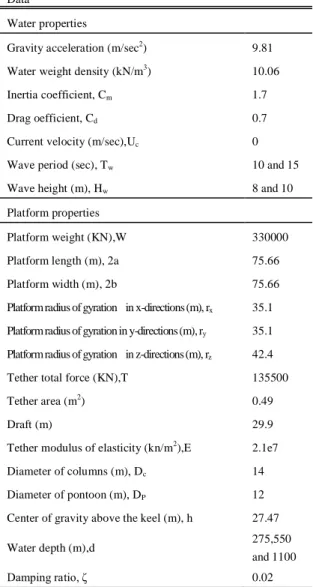
A numerical scheme was developed using MATLAB software where solution based on New-mark's beta method was obtained. The geometric properties of the TLP and the hydrodynamic data considered for force evaluation are given in Table I.
Table II shows the coupled natural time periods of the structure in such case. It is observed that TLPs have natural periods of motion in the horizontal plane are high, whereas in the vertical plane the periods are low. Generally, the surge and sway mo-tions are predominantly high for head seas due to the combined actions of wind, waves and currents. However, due to coupling among various degrees of freedom and relatively low damping of hydrody-namic origin in the vertical plane motion, a com-plete analysis of a six degree-of-freedom system subjected to wind, waves and currents is desirable. Moreover, the structural flexibility in the horizontal
motions causes nonlinearity in the structural stiff-ness matrix because of large deformations.
The natural periods in vertical plane in heave, roll and pitch are observed to be in the range of 1 to 3 seconds which is consistent with typical TLP's. While this range is below the periods of typical storm waves, everyday waves do have some energy in this range (the lowest wave period for most geo-graphical locations is about 3 seconds). Thus, wave–excited vibrations can cause high-cycle fa-tigue of tethers and eventually instability of the platform. One alternative to this problem is to in-crease the moored stiffness as to further lower the natural periods in heave, roll and pitch movement. The other alternative is to install damping devices in the tethers to mitigate vertical motion.
It is observed that the tether length is directly pro-portional to the natural time period and that because of any increase in tether tension leads to decrease in the tether stiffness.
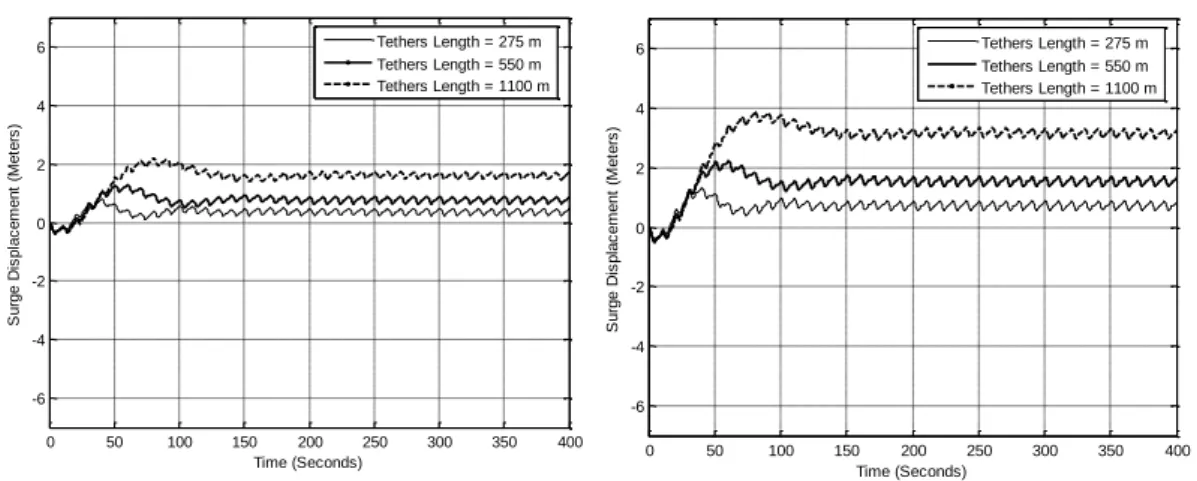
Time histories of the coupled responses are shown in Figs. 3 to 14. Before going into detailed discus-sion for each response it is clear from the figures that the tether length effect the drift value of the displaced position in the surge direction as the teth-er length increase the value of the drift increase.
A. Surge Response
The time histories of the surge responses for the square TLP are shown in Fig. 3 to 6. It is observed that, for a specific wave period, the amplitude of oscillations increases as the wave height increases. For short period the system responds in small amplitude oscillations about a displaced position that is directly proportional to wave height. The amplitude of oscillations increases with the increase in the wave period, which is expected because as the wave period increases, it becomes closer to the surge natural period of vibration (about 100 sec.). Moreover, in all cases, the surge response seems to have periodic oscillations that have the same excit-ing wave period.
The effect of tether length is obvious in fig. 3 to 6 which indicate that it affect the drift value of the displaced position. As length becomes bigger the drift increases but the length of the tethers has little effect on the amplitude of the oscillation. Finally, the transient state takes about 40-150 seconds where the stationary state begins depends on the wave period as wave period increase it increases.
Table 1geometric Properties Of The Square Tlp And Load Data
Water properties
Gravity acceleration (m/sec2) 9.81
Water weight density (kN/m3) 10.06
Inertia coefficient, Cm 1.7
Drag oefficient, Cd 0.7
Current velocity (m/sec),Uc 0
Wave period (sec), Tw 10 and 15
Wave height (m), Hw 8 and 10
Platform properties
Platform weight (KN),W 330000
Platform length (m), 2a 75.66
Platform width (m), 2b 75.66
Platform radius of gyration in x-directions (m), rx 35.1
Platform radius of gyration in y-directions (m), ry 35.1
Platform radius of gyration in z-directions (m), rz 42.4
Tether total force (KN),T 135500
Tether area (m2) 0.49
Draft (m) 29.9
Tether modulus of elasticity (kn/m2),E 2.1e7
Diameter of columns (m), Dc 14
Diameter of pontoon (m), DP 12
Center of gravity above the keel (m), h 27.47
Water depth (m),d 275,550
and 1100
Damping ratio, ζ 0.02
Table 2 Calculated natural structural periods for different analysis cases (in seconds)
DOF Analysis Case Water depth of 275 m Water depth of 550 m Water depth of 1100 m Surge 63.7196 92.820 133.1401 Sway 63.7196 92.820 133.1401 Heave 1.1210 1.6296 2.3279 Roll 1.0219 1.483 2.1112 Pitch 1.01219 1.483 2.1112 Yaw 51.0887 74.4208 106.7485
0 50 100 150 200 250 300 350 400 -6 -4 -2 0 2 4 6 S u rg e D is p la c e m e n t (M e te rs ) Time (Seconds) Tethers Length = 275 m Tethers Length = 550 m Tethers Length = 1100 m 0 50 100 150 200 250 300 350 400 -6 -4 -2 0 2 4 6 S u rg e D is p la c e m e n t (M e te rs ) Time (Seconds) Tethers Length = 275 m Tethers Length = 550 m Tethers Length = 1100 m . 0 50 100 150 200 250 300 350 400 -6 -4 -2 0 2 4 6 S u rg e D is p la c e m e n t (M e te rs ) Time (Seconds) Tethers Length = 275 m Tethers Length = 550 m Tethers Length = 1100 m 0 50 100 150 200 250 300 350 400 -6 -4 -2 0 2 4 6 S u rg e D is p la c e m e n t (M e te rs ) Time (Seconds) Tethers Length = 275 m Tethers Length = 550 m Tethers Length = 1100 m . 0 10 20 30 40 50 60 70 80 90 100 -0.1 -0.05 0 0.05 0.1 H e a v e D is p la c e m e n t (M e te rs ) Time (Seconds) Tethers Length = 275 m Tethers Length = 550 m Tethers Length = 1100 m 0 10 20 30 40 50 60 70 80 90 100 -0.1 -0.05 0 0.05 0.1 H e a v e D is p la c e m e n t (M e te rs ) Time (Seconds) Tethers Length = 275 m Tethers Length = 550 m Tethers Length = 1100 m
Fig. 3 Coupled Surge response of square TLP forWave Height = 8 m and wave period = 15 sec
Fig. 4 Coupled Surge response of square TLP forWave Height = 10 m and wave period = 15 sec
Fig. 5 Coupled Surge response of square TLP for Wave Height = 8 m and wave period = 10 sec
Fig. 6 Coupled Surge response of square TLP forWave Height = 10 m and wave period = 10 sec.
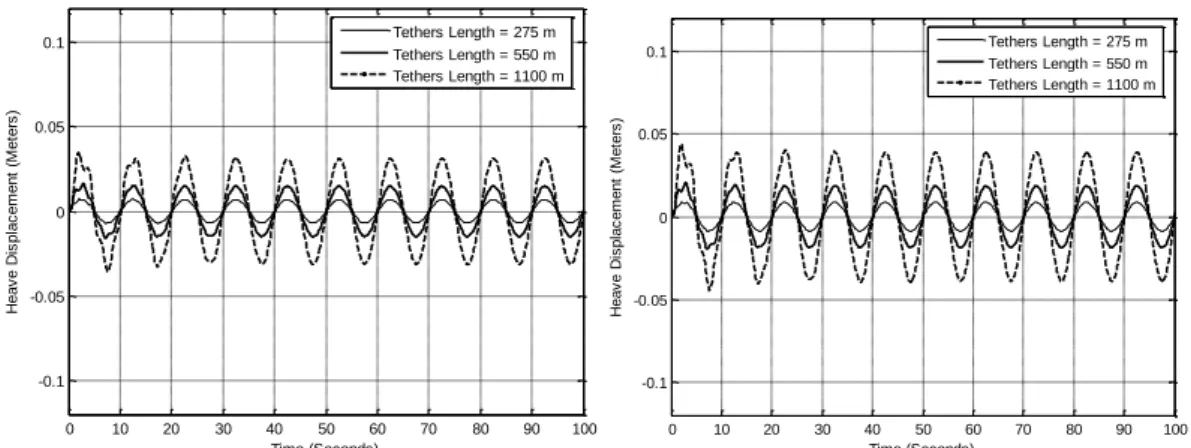
Fig. 7 Coupled Heave response of square TLP forWave Height = 8 m and wave period = 15 sec.
Fig. 8 Coupled Heave response of square TLP for Wave Height = 10 m and wave period = 15 sec
0 10 20 30 40 50 60 70 80 90 100 -0.1 -0.05 0 0.05 0.1 H e a v e D is p la c e m e n t (M e te rs ) Time (Seconds) Tethers Length = 275 m Tethers Length = 550 m Tethers Length = 1100 m 0 10 20 30 40 50 60 70 80 90 100 -0.1 -0.05 0 0.05 0.1 H e a v e D is p la c e m e n t (M e te rs ) Time (Seconds) Tethers Length = 275 m Tethers Length = 550 m Tethers Length = 1100 m B. Heave response
The time histories are shown in Fig. 7 to 10. As expected, the response in the heave direction has very small values compared to that of the surge direction. This is attributed to the relatively high stiffness of the tethers in this direction together with the fact that the excitation is indirect in this case. Moreover, the heave response is inversely propor-tional to the wave period and directly proporpropor-tional- but to a less extent- to wave height. The heave re-sponse appears to have a mean value of nearly zero. It is obvious that the increase of tether length in-crease the amplitude of the heave response. Also, the transient state takes about 10 seconds where the stationary state begins and the motion is almost periodic.
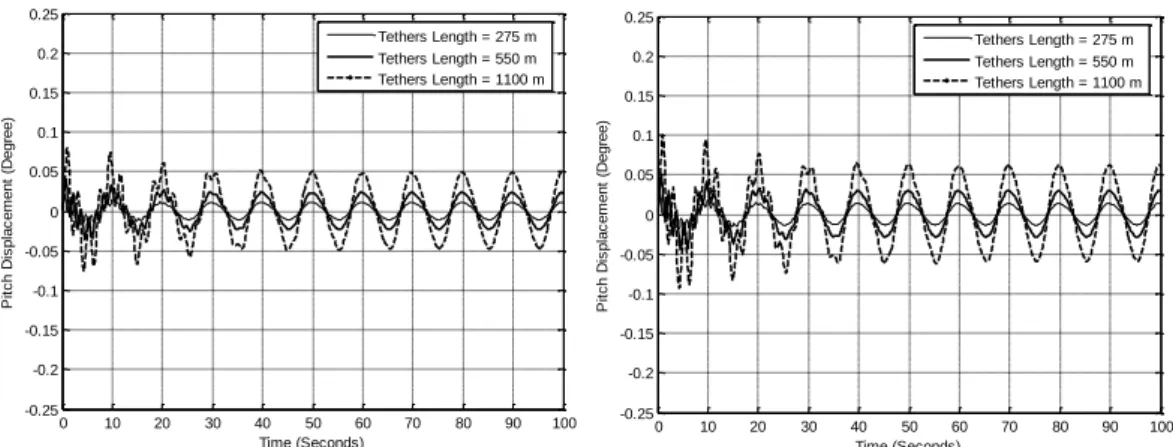
C. Pitch response
The time histories shown in Fig. 11 to 14 it is clear that as the wave period increases the response becomes closer to being periodic in nature. For short wave periods (10 sec.), a higher mode contri-bution to the response appears to take place. For long wave periods (15 sec.), the higher mode con-tribution vanishes after one or two cycles and we have a one period response (wave period) as in the surge and heave cases. It is obvious that the in-crease of tether length inin-crease the amplitude of the pitch response and that effect is more obvious for small wave period. Also the tether length affect the transient stat time. The time of the transient state increases as the tether length increase. Moreover, the transient state takes about 20-40 seconds before the stationary state begins.
0 10 20 30 40 50 60 70 80 90 100 -0.25 -0.2 -0.15 -0.1 -0.05 0 0.05 0.1 0.15 0.2 0.25 P it c h D is p la c e m e n t (D e g re e ) Time (Seconds) Tethers Length = 275 m Tethers Length = 550 m Tethers Length = 1100 m 0 10 20 30 40 50 60 70 80 90 100 -0.25 -0.2 -0.15 -0.1 -0.05 0 0.05 0.1 0.15 0.2 0.25 P it c h D is p la c e m e n t (D e g re e ) Time (Seconds) Tethers Length = 275 m Tethers Length = 550 m Tethers Length = 1100 m
Fig. 9 Coupled Heave response of square TLP forWave Height = 8 m and wave period = 10 sec.
Fig. 10 Coupled Heave response of square TLP forWave Height = 10 m and wave period = 10 sec.
Fig. 11 Coupled Pitch response of square TLP forWave Height = 8 m and wave period = 15 sec.
Fig. 12 Coupled Pitch response of square TLP forWave Height = 10 m and wave period = 15 sec.
0 10 20 30 40 50 60 70 80 90 100 -0.25 -0.2 -0.15 -0.1 -0.05 0 0.05 0.1 0.15 0.2 0.25 P it c h D is p la c e m e n t (D e g re e ) Time (Seconds) Tethers Length = 275 m Tethers Length = 550 m Tethers Length = 1100 m 0 10 20 30 40 50 60 70 80 90 100 -0.25 -0.2 -0.15 -0.1 -0.05 0 0.05 0.1 0.15 0.2 0.25 P it c h D is p la c e m e n t (D e g re e ) Time (Seconds) Tethers Length = 275 m Tethers Length = 550 m Tethers Length = 1100 m V. Conclusions
The present study investigates the dynamic re-sponse of a square TLP under hydrodynamic forces in the surge direction considering all degrees of freedom of the system. A numerical dynamic model for the TLP was written where Morison’s equation with water particle kinematics using Airy’s linear wave theory was used. The scope of the work was to accurately model the TLP system considering added mass and nonlinearity in the system together with the coupling between various degrees of free-dom. Results for the time histories for the affected degrees of freedom have been presented. Based on the results shown in this paper, the following con-clusions can be drawn:
1) The natural periods of the horizontal plane motions (60 to 140) are higher than typical wave spectral peaks (8 to 15) which precludes resonance with the wave diffraction forces. However, the wave-induced low frequency forces, namely the wave drift forces, could be close (to some extent) to the natural periods of motion in the horizontal plane causing a signif-icant response of a TLP despite the low ampli-tude of these forces. The maximum TLP re-sponse at low frequencies in various extreme environmental conditions is of primary im-portance from the point of view of platform stability, serviceability and fatigue of tethers. 2) The tether length is directly proportional to the
natural time period of TLP. and that because of any increase in tether tension leads to decrease in the tether stiffness.
3) The surge displaced position increased as teth-er length increase while the amplitude is slight-ly affected.
4) The surge response oscillations about a dis-placed position that directly proportional to wave height and tether length.
5) The amplitude of surge oscillations increases with the increase in the wave period.
6) The heave response is inversely proportional to the wave period and directly proportional to wave height.
7) The heave response is directly proportional to the tether length.
8) The Pitch response is directly proportional to the tether length and that effect is more obvi-ous for small wave period.
References
[1] A.M.Abou-Rayan, Ayman A. Seleemah, and Amr R. El-gamal," Wave induced motions of a squared tension leg platform in deep waters", Al-Azhar University Engineering Journal, Vol. 5, No. 1, DEC 2010, pp. 340-360.
[2] Bhattachatya, S.K., Anitha, J., Idichandy, V.G., "Experimental and numerical study of coupled dynamic response of a mini-tension leg platform", Journal of Offshore Mechanics and Arctic, Engineering, 126(4), 2004, pp.318–330. [3] Chandrasekaran, S. and Roy, A. , "Phase space study of offshore structures subjected to non-linear hydrodynamic loading", Proceedings of the International Conference on Structural En-gineering, Indian Institute of Science, Banga-lore, SEC 2005.
Fig. 13 Coupled Pitch response of square TLP forWave Height = 8 m and wave period = 10 sec.
Fig. 14 Coupled Pitch response of square TLP forWave Height = 10 m and wave period = 10 sec.
[4] Chandrasekaran, S., Jain, A. K., Gupta, A., Srivastava, A., "Response behaviour of triangu-lar tension leg platforms under impact loading", Ocean Engineering, Vol. 34, 2007, pp.45–53. [5] Chandrasekaran, S., Jain, A. K., Gupta, A.,
"Influence of wave approach angle on TLP’s response", Ocean Engineering, Vol. 34, 2007, pp. 1322–1327.
[6] Ketabdari, M. J. and Ardakani, H. A., "Nonlin-ear response analysis of a sea star offshore ten-sion leg platform in six degrees of freedom", WIT Transactions on the Built Environment 84,2005.
[7] Kurian, V.J., Gasim, M.A., Narayanan, S.P., Kalaikumar, V., "Parametric Study of TLPs Subjected to Random Waves", ICCBT-C-19, pp.213-222, 2008.
[8] Kurian, V.J., Gasim, M.A., Narayanan, S.P., Kalaikumar, V., "Response of Square and Tri-angular TLPs Subjected to Random Waves", ICCBT-C-12, 2008, pp. 133-140.
[9] Low, Y. M., "Frequency domain analysis of a tension leg platform with statistical lineariza-tion of the tendon restoring forces", Marine Structures, Vol. 22, 2009, 480–503.