66-3 / G. –S.Lee
• IMID 2009 DIGEST
Abstract
Generally, if we want to change the perspectivity of objects, we should change the position of object or camera, forward or backward. In this paper, recognition of the perspectivity of objects is proposed by using a new elemental image array which is made change the pinhole points horizontally.
1. Introduction
Integral imaging(II) technique was proposed by Lipmman in 1908.[1-2] II is consisted of two parts, pickup and reconstruction part. In the pickup part, intensity and direction information of the rays coming from a 3-D object through a lenslet array is optically recorded by use of recording device such as a charge coupled device(CCD) as an elemental image array(EIA) representing different perspectives of a 3-D object. On the other hand, in the reconstruction part, the recorded EIA is displayed on a display panel such as a liquid crystal display(LCD) and then the 3-D image can be optically reconstructed and observed through a display lenslet array.In general, if the image of object is picked up the focal length changed, a distant object image is picked up magnify. but, it is not able to pick up the real perspectivity.[3]
In this paper, a novel approach for recognition of object perspectivity using a new elemental image array is proposed.
2. Experimental
A novel approach for extraction of object perspectivity using optically picked up elemental image array is explained.
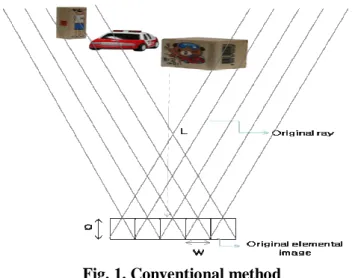
Conventional method that the elemental images are picked up by using pinhole array in view of geometrical optics is shown in Fig. 1
.
Fig. 1. Conventional method
L is the distance between object and pinhole array, W is the width of a picked up elemental image at one dimension, and g is the gap between lens array and elemental image. Optical rays pass through pinhole array and are projected on recording planes which the elemental images are written within field of view of pinhole camera. The number of pixels on the recording plane determines that of ray. If we assume that there is not any optical distortion when the elemental image is photographed, it is considered that each pixel is the end point of ray comes from one point on the surface of objects. We can build up virtual pinhole array on the cross-points of rays which is to construct a brunch of ray passing through the one point before the rays is not arrived at their original recording plane.
Extraction of the elemental images of object
With variant perspectivity at computational integral imaging
Guen-Sik Lee, Yong-Seok Hwang, Eun-Soo Kim
3D Display Research Center, National Research Lab. of 3D Media,
Dept. of Electronic Eng., Kwangwoon University,
447-1Wolge-Dong, Nowon-Gu, Seoul 139-701, Korea
Tel: 82-2-940-5520, E-mail:
[email protected]
;
66-3 / G. –S.Lee
IMID 2009 DIGEST • Fig. 2. Proposed method
The proposed method using the geometrical optics theory is shown in Fig. 2. That is, picked up point of elemental image is moved and virtual elemental image array is made. The ray points of original elemental image array. q is the distance of moving and p is the distance of the nearest point.
After first picking up, lens array is moved by q and pick up again. In the Fig.2, the pixel of the virtual array is matched at the first array’s pixel. Ultimately, the image is gotten like the object is nearer
3. Results and discussion
Fig.3 is the image that is picked up by conventional method. The distance from camera and small wood block is 460mm. the distance from small wood block and car is 45mm, car and big wood block is 60mm.
Fig. 3. Pick up image by conventional method
Fig.4 is the image of proposed method. That is, after
first picking up, lens array is moved and pick up again. The image is grown larger at horizontal size. because, it is extracted at only horizontal direction.
Fig. 4. The image of proposed method(near)
In the Fig.4, the image is nearer than Fig.3 so, It is changed of the object’s perspectivity. That is, it is different from occlude area of big wood block in the Fig.4. it is show that the perspectivity is different from conventional method and proposed method. On the other hand, Fig. 5 is further image than Fig.3
Fig. 5. The image of proposed method(far)
In the Fig.5, the image is further than Fig.3. also, the viewing area is wider than Fig.3. because the distance from object and viewer is further than before. However, this effect is the same that zoom in zoom out. That is, if use the method of the zoom in or zoom out, the same result is presented. But, the result of the proposed method is different. That is, the perspectivity of objects is changed. In the Fig.3, the right corner of the car is man’s left leg. But, in the Fig.4, the corner is man’s right leg. Also, in the Fig.5, the corner point is
66-3 / G. –S.Lee
• IMID 2009 DIGEST
shifted.
4. Summary
In this paper, a novel approach for recognition of object perspectivity using a new elemental image array is proposed. Generally, if we want to change the perspectivity of objects, we should change the position of object or camera, forward or backward. However, in this paper, the perspectivity of objects is realized by using a new elemental image array which is made change the pinhole points horizontally. Show the feasibility of the proposed method, some experiments with test objects are carried out and the results are presented
Acknowledgements
This research was supported by the MKE (Ministry of Knowledge Economy) of Korea under the ITRC (Information Technology Research Center) support program supervised by the IITA (Institute of Information Technology Assessment) (IITA-2009-C1090-0902-0018)
5. References
1. G. Lippmann, “La photographic integrale,” C.R. Acad. Sci. 146, 446-451, 1908.
2. H. E. Ives, “Optical properties of a Lippmann
lenticulated sheet,” J. Opt. Soc. Am. 21, 171-176,
1931.
3. S.-H. Hong, J.-S. Jang, and B. Javidi,
"Three-dimensional volumetric object reconstruction using computational integral imaging," Opt. Exp.