29-3 / G. S. Ryu
• IMID 2009 DIGEST
Abstract
We successfully fabricated flexible electronic paper display (EPD) by using toner particles on plastic (PC) substrate. It has high resolution (WVGA : 800 x 480) and 7 inch diagonal viewable image size. The response time was about 0.25 msec at 90 V, a contrast ratio of about 2, a driving voltage of 60 V which we successfully demonstrated to display several images at.
1. Introduction
Electronic paper Display (EPD) is the new type display that unite with the advantages of paper and electronic display. Like reflective display which expresses information reflecting light similar with paper, it is easily shown in bright outside and can keep up the information when the power supply is cut off. The main features of EPD are that it can contain lots of information without change of volume, and it also can modify or renew the data as occasion demands. At present, there are some noteworthy EPD technologies that Micro Capsule made by E-Ink, technology of electrophoretic method using Micro Cup by Sipix1-3,
Cholesteric liquid technology by Kent Display4,5, and
QR-LPD(quick response liquid powder display) technology by Bridgestone6~10. EPD maybe extend to
display market from the existing publication industry as e-books, e-papers.
In this paper, we report the results of developing 7” WVGA flexible electronic paper display by using toner particles
2. Experimental
The EPD using toner particles is comprised of two
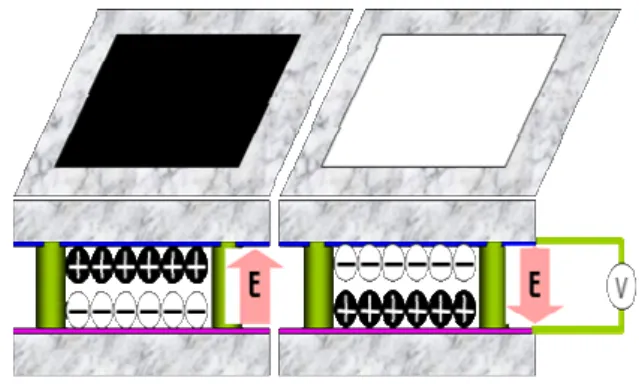
substrates which have an electrode, ribs, and toner particles. The structure of EPD using toner particles is shown in Fig. 1. The electrodes of two substrates are face each other and ribs are between electrodes. The ribs maintain space between electrodes to provide particles for move free and keep up uniformity of display to restrict side movement of particles. Toner particles are micro-size one that has an electric charge and color. In this paper, we used black positive charge particles and white negative charge particles.
Fig. 1.The schematic representation of structure and the driving principles of electronic paper display using toner particles.
We designed 7” WVGA(800 x 480) electronic paper display panel and fabricated passive matrix type display on plastic substrate (PC/IZO) for flexible display.
We fabricated EPD using plastic substrate in Fig. 2. Plastic substrates which transparent electrode (IZO) is spread on are cut and cleaned by suitable size. After cleaning, the electrodes which are spread on all area of upper and bottom substrates are formed by photo lithography process and wet etching process. The ribs
Fabrication of 7” WVGA flexible electronic paper display by using toner particles
Gi Seong Ryu1, Chang Bin Lee1, Sang Kwuon Han2, Seung Hee Chun2
and Chung Kun Song1
1Dept. of Electronics Eng., media device lab, Dong-A University, Busan, Korea
Phone: +82-51-200-7363 , E-mail: [email protected]
2Human Interface Technology Development Team, Institute of Future Technology, SK
Telecom, Seoul, Korea
29-3 / G. S. Ryu
IMID 2009 DIGEST •
are made on the electrode formed bottom substrate. Rib’s material is PR, its’ height is about 40 um. The ribs are fabricated by photo lithography process. The bottom rib made by photo lithography process was narrower than upper one. So, fabricating ribs at bottom substrate are better at the side of display. We also observe PR for ribs swelling during development process of ribs on plastic substrate. We could solve this problem by controlling exposure time. We injected white and black particles which were mixed by 1:1 mass ratio at the ribs formed bottom substrate. Particles’ injection as regular electric charge quantity is very important because toner particles are fabricated by regular electric charge quantity as voltage. The corona-gun which is popular injection method nowadays is not suitable because this method inject toner particles at high voltage. In this paper, we injected particles as making electric affect minimum. We make UV cured sealant on the bottom substrate which formed ribs and injected particles and complete panel assembly upper and bottom substrates.
Fig. 2. Fabrication process of EPD using toner particles
The fabricated display panel is very thin and light as about 300 um thickness and about 7.54 g weight. We analyze optical properties of display panel. The contrast ratio of flexible display panel was about 2. The response time was about 0.25 msec at 90 V and about 0.15 msec at 200 V. Fig. 3 shows the driving voltage was about 60 V at reflectance 90 %.
Fig. 3. The relationship between voltage and reflectance
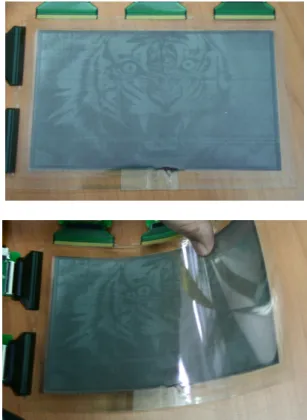
The 7” WVGA flexible electronic paper display prepared in this study are shown in Fig. 4. We successfully drive variety of images by connecting fabricated display panel and driving circuit. The display panel can flexible during driving and maintain images despite of eliminating power.
Fig. 4. The demonstrated image of 7” WVGA flexible electronic paper display
29-3 / G. S. Ryu
• IMID 2009 DIGEST
3. Results and discussion
In this paper, we fabricate EPDs on plastic substrate using toner particles. We design display panel considering plastic substrate. This display’s size is 7
inch, resolution is WVGA(800 × 480), and passive
matrix type. We fabricate display panel electrode patterning, ribs formation, particles’ injection,
substrate assembly. We measure optical features of fabricated display panel. Response time is ≤ 0.25
msec (@ ±90 V), ≤ 0.15 msec (@ ±200 V), so
we can consider that it is able to play moving pictures. Shade ratio is about 2(1.9 when play moving pictures), so it need more improvement. Driving voltage is ≤
60 V (@ 90 % reflectance). We successfully drive variety of images by connecting fabricated display panel and driving circuit. The display panel can flexible during driving and maintain images despite of eliminating power. In the future, we will study about improvement of CR and the color EPD display.
Acknowledgement
This work was supported by SK telecom.
5. References
1. K. Amundson, T. Sjodin, SID'06 Digest, p.1918–
1921 (2006).
2. R. C. Liang, J. Hou, J. Chung, X. Wang, C. Pereira, and Y. Chen, SID'03 Digest, p.838-841 (2003). 3. R. C. Liang, J. Hou, H. Zang, J.Chung, and S.
Tseng, Journal of the SID, Volume 11, Issue 4, p.621-628 (2003).
4. E.L.Wood. P.J.Bryan-Brown, A.Graham, R.M.Amos, S.Beldon, E.Cubero, J.C.Jones, SID 02 Digest, p. 22 (2002).
5. C. Joubert, J. Angele, A. Boissier, P. Davi, I. Dozov, T. Elbhar, B. Pecout, D. Stoenescu and R. Vercelletto, SID’02 Digest, p.30 (2002).
6. I.Shiyanovskaya. A.Khan, S.Green, G.Magyar and J.W.Doane, SID Symposium Digest, p.1556-1559 (2005).
7. H.Fujikake, T.Murashige, H.Sato, H.Kikuchi, T.Kunita and Y.Suzuki, Euro Display Symoposium Digest, p.510-513 (2005).
8. C.Joubert, J.Angele, N.Bollenbach, J.D.Laffitte, B.Pecout and Z.Zenati, SID Symposium Digest, p.1766-1799 (2005).
9. G.T.McCollough, C.M.Rankin and M.L.Weiner,
SID Symposium Digest, p.64-67 (2005).
10. R.Sakurai, S.Ohno, S.Kita and Y.Masuda, SID Symposium Digest, p.1922-1925 (2006).