23-2 / J. S. Kim
• IMID 2009 DIGEST
Abstract
Using a mechano-luminescent (ML) material enabling the visualization of fast propagating cracks with bridging or transformed wake evolutions under a conventional loading condition, the quasi-dynamic fracture mechanisms in association with two different types of crack wake developments wewe investigated in various ceramic.
1. Introduction
New rate equation model elucidating the time evolution of ML in association with an instantaneous loading rate was suggested to lend a promising interpretation of mechano-luminescent phenomenon. Using a mechano-luminescent (ML) paint enabling the visualization of fast propagating cracks with bridging or transformed wake evolutions under a conventional loading condition, the quasi-dynamic fracture mechanisms in association with two different types of crack wake developments were also investigated in various ceramics.
2. Experimental
The ML paint was prepared by mixing an epoxy resin with 15 vol. % of SrAl2O4:Eu,Dy powder, which was then either evenly plastered or sprayed on the specimen surface. Hard epoxy resins, with a Young’s moduli of 2.6 GPa, were prepared. The tensile samples were sintered in a rectangular bar shape, consistent with ASTM specifications.
The specimen was exposed to high intensity 365 nm UV light for 5 minutes, and then aged in the dark for 5 minutes to allow the long phosphorescence to relax to an acceptable level before loading. The tensile crosshead speed were 50 and 250 mm/min, The entire light emission zone was then photographed on a
macro scale using a high-speed imaging system. A multi channel data link (MCDL) made it possible to record the load data from a piezoelectric load cell for each image frame.
3. Results and discussion
The effect of the loading rate on the ML of SAO was investigated in a systematic manner using rate equations involving the loading rate term as shown in Fig 1, 2, and 3. Dy3+ ions constitute hole trap levels just above the valence band. Photo-excitation of Eu2+ activators creates hole emission to the valence band and they are consecutively trapped to the Dy4+ trap. When stress is applied then they are released and recombined with Eu+ activators leading to excited Eu2+ state. The hole can be released from the trap through either the emission to valence band or the tunneling. The origin to trigger ML, namely, the origin of the trap releasing process should be strain rate, as evidenced by simple experimental data such as plots of load vs ML and loading rate vs ML. Since such a process is taking place in the elastic range, the instantaneously measured load, which will be called applied load hereafter for convenience’s sake, can be considered to be simply proportional to strain (or stress) acting on traps, so the loading rate corresponds to strain rate as well.
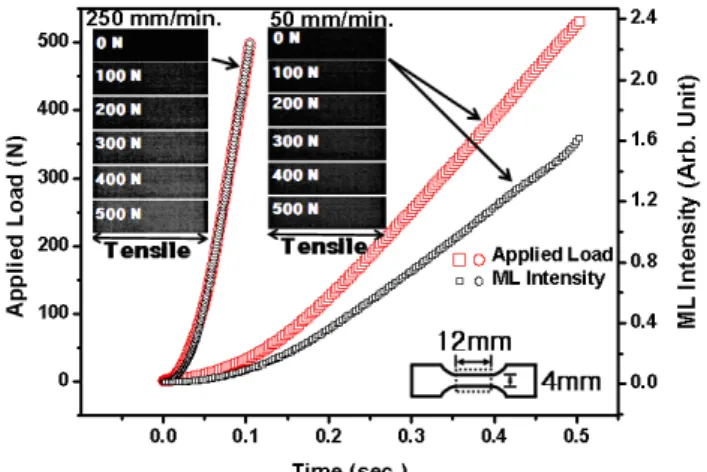
Fig. 2 shows instantaneous load and ML intensity (photomultiplier tube voltage) as a function of time for two different crosshead speeds. the load can be approximated to be equivalent to strain (or stress) without any discrimination since the ML took place in the elastic regime. It is obvious that the higher the loading rate the higher the ML intensity. The ML produced a transient signal, so its intensity was not related to the strain, but the strain rate. Therefore the total strain at any point in the ML area has been evaluated by integrating the ML intensity with respect
The Application of Mechano-luminescence for Dynamic
Visualization in Various Ceramics Fractures
Ji Sik Kim
1, and Kee-Sun Sohn
21Dept. of Adv. Mat. Eng., Kyungpook Nat’l Univ., Kyungbuk 742-711, Korea
TEL: 82-54-530-1413, e-mail: [email protected]
2Dept. of Printed Electronics, Sunchon Nat’l Univ., Chonnam 540-742, Korea
TEL: 82-61-750-3557, e-mail:
[email protected]
Keywords : Mechano-luminescence, Ceramics, Fracture23-2 / J. S. Kim
IMID 2009 DIGEST •
to time at that point. The most appropriate approach to mathematically describe the ML process should be to build up rate equations. No matter whether the valence band emission or the tunneling process are dominant, it is clear that the number of excited (light emitting) activators increases as the number of traps holding holes decreases. A rate equation model describing the ML process was given as below;
+ + + + + + + + + + + − = − = = = − = 4 3 4 2 * 2 2 * 4 2 * Dy Eu T Dy Dy Eu Eu P Eu Eu P Dy Eu T Eu N N dt dP K dt dN dt dN dt dN N K dt dN N K N N dt dP K dt dN
Fig. 3 shows calculated NEu*2+ for two different crosshead speeds along with experimentally measured ML intensity data. The rate equations as follows and the experimental data matched well. We confirmed that the ML of SAO was created by the change in load rather than by the static load, and that the loading rate determined the shape of the ML vs. the time curve in the transient regime. The fracture mechanism in bridging ceramics contravenes the existent R-curve concepts. The bridging stress distribution evolves in its magnitude and shape as crack advances and keeps changing as load changes even for a stationary crack.
4. Summary
The ML is the photo-emission from some special materials such as SrAl2O4:Eu,Dy phosphors due to an applied mechanical stimulation including friction, pressure, bending, erasing or rubbing, shocking and fracture etc. The ML technology provides not only a versatile tool for fracture mechanism study in ceramic materials but also a practical possibility of being used for low-cost safety diagnosis of structural components.
5. References
1. J. S. Kim, Y. N. Kwon, and K.-S. Sohn, Acta Mater.
51, pp6437-6442 (2003).
2. J. S. Kim, Y. N. Kwon, N. Shin, and K.-S. Sohn.
Acta Mater. 53, pp4337-4343 (2005).
3. J. S. Kim, Y. N. Kwon, N. Shin, and K.-S. Sohn,
Appl. Phys. Lett. 90, pp241916-8 (2007).
Fig. 1. Schematic diagram showing the trap-releasing (recombination) process for ML.
Fig. 2. Profiles of applied load and ML intensity with CCD images. The schematics of specimens are also present.
Fig. 3 Calculated and measured ML intensity as a function of time. Normalized by an ML intensity value measured at 500 N.