Gilsang Jeong1* , Hansu Choi2 , Hyejin Kang3 , Seon Deok Jin3
Genetic Structure of the Neglected Decomposer,
Ptecticus tenebrifer
, with an Introduced Decomposer,
Hermetia illucens
ABSTRACT
Introduction
The era of mass production of agricultural and dairy systems inevitably causes a huge amount of biowastes during their processes. Modern consumption patterns of the general public also contribute to biowaste formation. Thus, processing biowastes has attracted much attention. The introduced black soldier fly (BSF) (Hermetia illucens) is considered as one of environmentally friendly manage-ment options for solving biowaste issues. However, an indigenous species, Ptecticus tenebrifer, is also a powerful decomposer that has been largely neglected. This species can be easily found on biowastes such as manure dump, agricultural wastes, and human food wastes. It can be also easily found in the field. It is even attracted to a food trap. To the best of our knowledge, this is the first ecological study on this species.
Keywords: Biowaste, Black soldier fly, Genetic structure, Hermetia illucens, Ptecticus tenebrifer 1Division of Climate Ecology, National Institute of Ecology, Seocheon, Korea
2Eco-Eng. Ltd, Seoul, Korea
3Team of Long Term Ecological Research, National Institute of Ecology, Seocheon, Korea
In terms of nutrient cycling in the ecosystem, carbon fixation by photosynthesis has been paid much attention (Blodau, 2002; Nielsen et al., 2011; Zhi et al., 2015). However, when trophic level is considered, there are a lot more actors involved. For example, decomposers such as microbes have an essential role in the cycle (Moorhead et al., 2014). In this regard, insects also play a pivotal role in degrading ingredients by simply consuming organic materials. In this way, organic materials are incorporated into nutrient cycling. Most notably, black soldier fly (BSF), Hermetia illucens (Diptera; Stratiomyidae), has been
uti-lized for processing manures and other organic wastes such
as human food waste (Kim et al., 2008; Lord et al., 1994; Park et al., 2017; Sheppard et al., 1994). In Korea, this in-sect is in mass production since its accidental introduction in early 2000s (Kim et al., 2008). This insect is also easily noticeable with its metallic black color. However, due to its sensitiveness to temperature and light availability, it is somewhat limited both in annual and diurnal activities. Family Stratiomyidae is composed of at least 150 spe-cies worldwide (Rozkošný & Kovac, 2000). In Korea, 15 species belonging to this family have been identified (Paek et al., 2010). Among them, Ptecticus tenebrifer is native to Korea. It seems to have remarkably similar ability to decompose organic materials as H. illucens does. Larvae of this insect consume wastes until they molt into pupae. Its adults usually hover over wastes. With this regard, we hypothesized potential competition between these two species in their adult stage to keep others from laying eggs in wastes. Thus, the objective of this study was to investigate their distribution and adult fighting to see their potential competition in the natural field.
Received January 5, 2021; Revised March 30, 2021;
Accepted March 30, 2021
*Corresponding author: Gilsang Jeong e-mail [email protected]
https://orcid.org/0000-0001-8297-3532
PNIE 2021;2(2):96-100 https://doi.org/10.22920/PNIE.2021.2.2.96 pISSN 2765-2203, eISSN 2765-2211
Materials and Methods
Locations of the insect
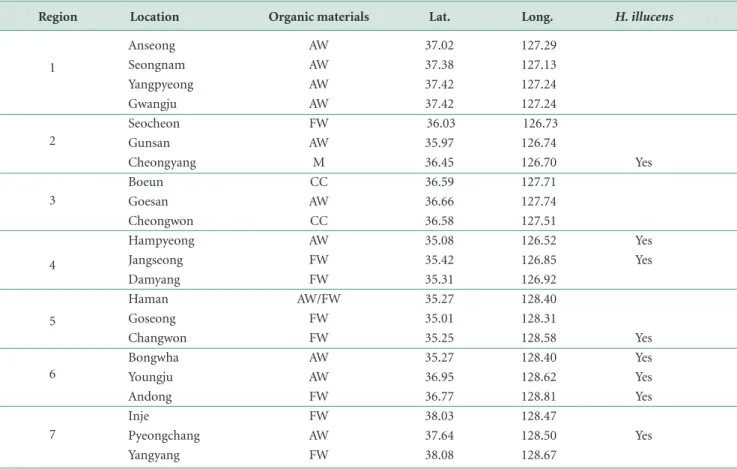
In 2019, we surveyed 22 sites based on administrative
district nationwide. Both adult insects were marked as presence/absence. Types of the wastes were also described (Table 1). These insects were also collected using insect nets for future genetic analyses.
Region Location 1 2 3 4 5 6 7 Anseong Seongnam Yangpyeong Gwangju Seocheon Gunsan Cheongyang Boeun Goesan Cheongwon Hampyeong Jangseong Damyang Haman Goseong Changwon Bongwha Youngju Andong Inje Pyeongchang Yangyang Organic materials AW AW AW AW FW AW M CC AW CC AW FW FW AW/FW FW FW AW AW FW FW AW FW
Lat. Long. H. illucens
37.02 37.38 37.42 37.42 36.03 35.97 36.45 36.59 36.66 36.58 35.08 35.42 35.31 35.27 35.01 35.25 35.27 36.95 36.77 38.03 37.64 38.08 Yes Yes Yes Yes Yes Yes Yes Yes
Table 1. Observation sites and presence of H. illucens
Region 1: Gyeonggi, 2: Chungnam, 3: Chungbuk, 4: Jeonnam, 5: Gyeongnam, 6: Gyeongbuk, 7. Gangwon.
127.29 127.13 127.24 127.24 126.73 126.74 126.70 127.71 127.74 127.51 126.52 126.85 126.92 128.40 128.31 128.58 128.40 128.62 128.81 128.47 128.50 128.67
Mitochondrial (Mt) CO1 gene sequence and phyloge-netic analysis of Stratiomyidae
Genomic DNA (gDNA) was extracted from the posteri-or end of each individual using a commercial kit (ExGen Tissue SV, Geneall, Korea, Cat No. 104-152) according to the manufacturer’s instructions with slight modifications. Extracted gDNA was kept at -20°C until further analyses. PCR was performed on a thermocycler (Peqlab, Germany). LCO-1490 (GGT CAA CAA ATC ATA AAG ATA TTG G) and HCO-2148 (TAA ACT TCA GGG TGA CCA AAA AAT CA) were used to obtain partial sequence of Mt-CO1 gene. PCR conditions were: pre-denaturing for 3 min at 94℃; 35 cycles of 1 min at 94℃, 1 min at 55℃, and 1 min at 72℃; and a final extension step for 4 min at 72℃. PCR reac-tion had a total volume of 20 ㎕, containing 0.5 mM of each primer and 1 ㎕ of gDNA in the premix (Intron, Korea).
A total OF 196 individuals of P. tenebrifer were tested for this genetic study.
Data analyses
Resultant CO1 sequences were aligned and analyzed initially on MEGA (Tamura et al., 2013; Thompson et al., 1994). Haplotype frequency was determined using DnaSP version 5 (Librado & Rozas, 2009). Genetic distance and diversity among haplotypes were calculated after select-ing the best fit model for haplotypes on MEGA. Maximum likelihood was adopted to infer phylogenetic relationship of insects within the family using 1000 boot strapping on MEGA (Tamura et al., 2013). Analysis of molecular vari-ance was conducted to determine the population genetic structure with 1000 permutations among regions includ-ing Fst statistics on Arlequin (ver. 3.5.1.2) (Excoffier &
Lischer, 2010). Additionally, neutrality tests were per-formed to determine whether the gene was subjected to a neutral evolution model Arlequin (ver. 3.5.1.2) (Excoffier & Lischer, 2010; Tajima, 1989). All other sequences were retrieved from GenBank.
Competition over resources
To test whether there was a potential conflict between the two insects, we observed contact interactions between adults of both insects. In this study, we were unable to examine larval stage competition.
Genetic analysis of partial CO1 gene
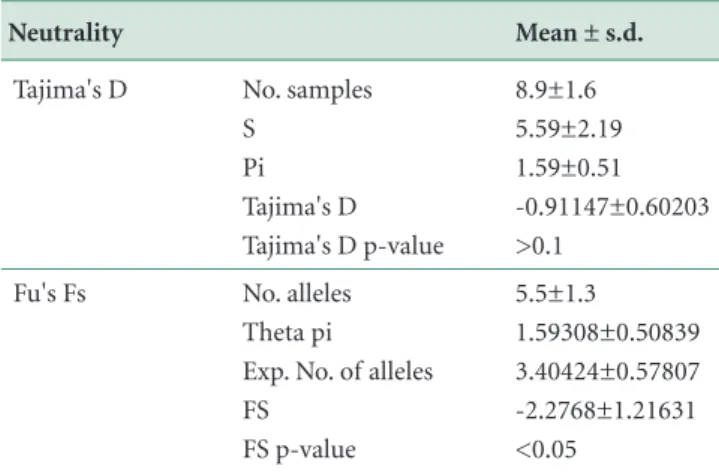
Results showed that there was no genetic isolation among seven regions (Fst: 0.01935, p > 0.05). The genet-ic diversity of the insect can be explained by the diversity within populations (Table 2). In fact, the insect has very robust wings and flies actively. Therefore, it may fly or spread long distance and exchange genes in a frequent manner. Two neutrality tests showed negative values with
Results and Discussion
Distribution
Results showed that these insects were distributed
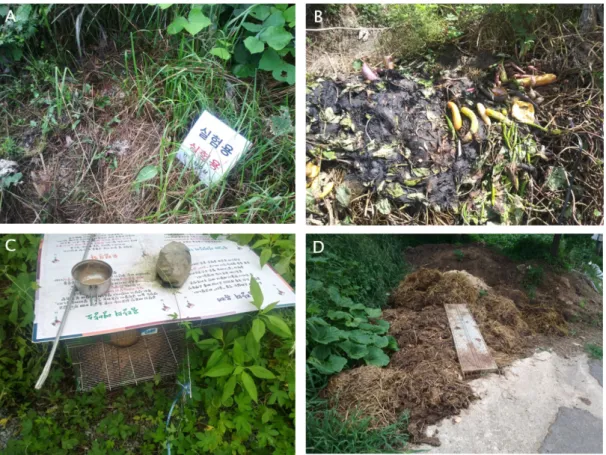
nationwide. Both insects were located on or near food wastes, organic wastes from various farm lands, and manures from cattle sheds (Fig. 1). Contrary to P. ten-ebrifer, BSF was found in eight localities (Table 1). This
might mean that the introduced BSF is still in its expan-sion process. We were unable to estimate local population sizes of the two in this study.
opposite statistical values (Table 3). It is too early to con-clude that the population has expanded recently. Further study is needed to reach conclusion on its population size change. Compared to P. tenebrifer, BSF showed a remark-ably lower genetic diversity (Table 4). This indicates that the insect might have experienced a genetic bottleneck in the introduction period, although there is no conclusive evidence (Park et al., 2017).
Fig. 1. Typical types of habitats of P. tenebrifer
Source of variation Neutrality P. tenebrifer d.f. 6 15 174 195 No. samples S Pi Tajima's D Tajima's D p-value 245 10 low No. tested No. haplotypes Genetic diversity No. alleles Theta pi Exp. No. of alleles FS
FS p-value Among 7 groups
Among populations within groups Within populations Total Tajima's D Fu's Fs Sum of squares Mean ± s.d. H. illucens 5.721 13.94 138.681 158.342 8.9±1.6 5.59±2.19 1.59±0.51 -0.91147±0.60203 >0.1 196 46 high 5.5±1.3 1.59308±0.50839 3.40424±0.57807 -2.2768±1.21631 <0.05
Variance components Percentage of variation
0.00071Va 0.01502Vb 0.79702Vc 0.81274
Table 2. Genetic differences among regions (Fst)
Table 3. Neutrality test for population expansion
Table 4. Comparison between P. tenebrifer and BSF
0.09 1.85 98.07
Phylogenetic status of P. tenebrifer
Results of phylogenetic analysis showed that P. tene-brifer was grouped with P. trivittatus, a Stratyiomidae sp.
and H. illucens (Fig. 2). This was unexpected since H. illu-cens was placed as an outgroup. This result may reflect
that partial gene sequence is not appropriate to resolve the phylogenetic status of this taxa. More sequence data are needed to further understand their evolutionary relationship.
Fig. 2. Phylogenetic relationships of P. tenebrifer with other Stratiomyid insects
Competition over the resources
We initially hypothesized that the exotic BSF might encounter severe competition with the endemic P. ten-ebrifer over resources (Park et al., 2017). Although both insects frequently flied over organic matters, there was no detectable competition between the two. Instead, intra-specific interaction, flight interruption, was routinely observed, especially for P. tenebrifer adults. This indicates that the introduced BSF might not have experienced any barrier in its settling period. Whether BSF competitively exclude the endemic P. tenebrifer in the future remains unknown.
In the field, P. tenebrifer should play a pivotal role in decomposing organic wastes. In the future, its abili-ty to decomposition should be assessed. Recently, larvae of the insect have been tested as a food source for pigs (Ao & Kim, 2019). Therefore, this insect should be taken care of for future insect industry. This also will help pro-tect invaluable genetic resources. In conclusion, this study shows that P. tenebrifer inhabits nationwide and that its genetic diversity is higher than that of BSF. There may be no interruption between these two insects. However, this needs to be elaborately examined in the future.
Conflict of Interest
The authors declare that they have no competing inter-ests.
Acknowledgments This study was supported by NIE-B-2021-02.
References
Ao, X., and Kim, I.H. (2019). Effects of dietary dried mealworm (Ptecticus tenebrifer ) larvae on growth performance and nutrient digestibility in weaning pigs. Livestock Science , 230, 103815. doi:10.1016/j.livs-ci.2019.09.031
Blodau, C. (2002). Carbon cycling in peatlands – A review of processes and controls. Environmental Reviews, 10, 111-134. doi:10.1139/a02-004
Excoffier, L., and Lischer, H.E.L. (2010). Arlequin suite ver 3.5: A new series of programs to perform population genetics analyses under Linux and Windows. Molecular Ecology Resources, 10, 564-567. doi: 10.1111/j.1755-0998.2010.02847.x
Kim, J.G., Choi, Y.C., Choi, J.Y., Kim, W.T., Jeong, G., Park, K.H., et al. (2008). Ecology of the black soldier fly, Hermetia illucens (Diptera, Stratiomyidae) in Korea. Korean Journal of Applied Entomology, 47, 337-343. doi:10.5656/KSAE.2008.47.4.337
Librado, P., and Rozas, J. (2009). DnaSP v5: A software for comprehensive analysis of DNA polymorphism data. Bioinformatics, 25, 1451-1452. doi:10.1093/bioinfor-matics/btp187
Lord, W.D., Goff, M.L., Adkins, T.R., and Haskell, N.H. (1994). The black soldier fly Hermetia illucens (Diptera, Stratiomyidae) as a potential measure of human postmortem interval, observations and case histories. Journal of Forensic Sciences, 39, 215-222.
Moorhead, D., Lashermes, G., Recous, S., and Bertrand, I. (2014). Interacting microbe and litter quality controls on litter decomposition: a modeling analysis. PloS One, 9, e108769. doi:10.1371/journal.pone.0108769
Nielsen, U.N., Ayres, E., Wall, D.H., and Bardgett, R.D. (2011). Soil biodiversity and carbon cycling: a review and synthesis of studies examining diversity–function relationships. European Journal of Soil Science , 62, 105-116. doi:10.1111/j.1365-2389.2010.01314.x Paek, M.K., Hwang, J.M., Jung, K.S., Kim, T.W., Kim, M.C.,
Lee, Y.J., et al. (2010). Checklist of Korean insects. Seoul:
Nature & Ecology.
Park, S., Choi, H., Choi J.Y., and Jeong, G. (2017). Popula-tion structure of the exotic black soldier fly, Herme-tia illucens (Diptera: Stratiomyidae) in Korea. Korean Journal of Environmental Ecology , 31, 520-528.
doi:10.13047/KJEE.2017.31.6.520
Rozkošný, R., and Kovac, D. (2000). A revision of the Ptecticus tenebrifer species group (Insecta: Diptera: Stratiomyidae). Raffles Bulletin of Zoology, 48, 103-110. Sheppard, D.C., Newton, G.L., Thompson, S.A., and Savage,
S. (1994). A value added manure management system using the black soldier fly. Bioresource Technology, 50, 275-279. doi:10.1016/0960-8524(94)90102-3
Tajima, F. (1989). Statistical method for testing the neutral mutation hypothesis by DNA polyhomrphism. Genetics, 123, 585-595.
Tamura, K., Stecher, G., Peterson, D., Filipski, A., and Kumar, S. (2013). MEGA6: Molecular evolutionary genetics analysis Version 6.0. Molecular Biology and Evolution, 30, 2725-2729. doi:10.1093/molbev/mst197 Thompson, J.D., Higgins, D.G., and Gibson, T.J. (1994).
CLUSTAL W: improving the sensitivity of progres-sive multiple sequence alignments through sequence weighting, position specific gap penalties and weight matrix choice. Nucleic Acids Research, 22, 4673-4680. doi:10.1093/nar/22.22.4673
Zhi, W., Yuan, L., Ji, G., Liu, Y., Cai, Z., and Chen, X. (2015). A bibliometric review on carbon cycling research during 1993–2013. Environmental Earth Sciences, 74, 6065-6075. doi:10.1007/s12665-015-4629-7