Success Rate and Risk Factors for Failure of Empirical Antifungal
Therapy with Itraconazole in Patients with Hematological
Malignancies: A Multicenter, Prospective, Open-Label,
Observational Study in Korea
We assessed the success rate of empirical antifungal therapy with itraconazole and evaluated risk factors for predicting the failure of empirical antifungal therapy. A multicenter, prospective, observational study was performed in patients with
hematological malignancies who had neutropenic fever and received empirical antifungal therapy with itraconazole at 22 centers. A total of 391 patients who had abnormal findings on chest imaging tests (31.0%) or a positive result of enzyme immunoassay for serum galactomannan (17.6%) showed a 56.5% overall success rate. Positive galactomannan tests before the initiation of the empirical antifungal therapy (P = 0.026, hazard ratio [HR], 2.28; 95% confidence interval [CI], 1.10-4.69) and abnormal findings on the chest imaging tests before initiation of the empirical antifungal therapy (P = 0.022, HR, 2.03; 95% CI, 1.11-3.71) were significantly associated with poor outcomes for the empirical antifungal therapy. Eight patients (2.0%) had premature discontinuation of itraconazole therapy due to toxicity. It is suggested that positive galactomannan tests and abnormal findings on the chest imaging tests at the time of initiation of the empirical antifungal therapy are risk factors for predicting the failure of the empirical antifungal therapy with itraconazole. (Clinical Trial Registration on National Cancer Institute website,
NCT01060462)
Keywords: Hematological Malignancy; Itraconazole; Empirical Antifungal Therapy; Galactomannan Test
Soo-Jeong Kim,1 June-Won Cheong,1 Yoo Hong Min,1 Young Jin Choi,2 Dong-Gun Lee,3 Je-Hwan Lee,4 Deok-Hwan Yang,5 Sang Min Lee,6 Sung-Hyun Kim,7 Yang Soo Kim,8
Jae-Yong Kwak,9 Jinny Park,10 Jin Young Kim,11 Hoon-Gu Kim,12 Byung Soo Kim,13
Hun-Mo Ryoo,14 Jun Ho Jang,15 Min Kyoung Kim,16 Hye Jin Kang,17 In Sung Cho,18 Yeung Chul Mun,19 Deog-Yeon Jo,20 Ho Young Kim,21 Byeong-Bae Park,22 and Jin Seok Kim1
1Division of Hematology, Department of Internal
Medicine, Yonsei University College of Medicine, Severance Hospital, Seoul; 2Department of Hematology/
Oncology, Pusan National University Hospital, Pusan National University School of Medicine, Busan;
3Department of Internal Medicine, Seoul St. Mary’s
Hospital, The Catholic University of Korea, Seoul;
4Department of Hematology, Asan Medical Center,
University of Ulsan College of Medicine, Seoul;
5Department of Hematology/Oncology, Chonnam
National University Hwasun Hospital, Hwasun;
6Department of Internal Medicine, Busan Paik Hospital,
Inje University, Busan; 7Department of Internal Medicine,
Dong-A University College of Medicine, Busan;
8Department of Internal Medicine, Kosin University
Gospel Hospital, Busan; 9Department of Internal
Medicine, Chonbuk National University Medical School, Jeonju; 10Department of Internal Medicine, Gachon
University Gil Medical Center, Incheon; 11Department of
Internal Medicine, Dongsan Medical Center, Keimyung University School of Medicine, Daegu; 12Department of
Internal Medicine, Gyeongsang National University Hospital, Gyeongsang National University School of Medicine, Jinju; 13Department of Internal Medicine,
Korea University Medical Center, Seoul; 14Department of
Internal Medicine, Daegu Catholic University Medical Center, Daegu; 15Department of Medicine, Samsung
Medical Center, Sungkyunkwan University School of Medicine, Seoul; 16Department of Internal Medicine,
Yeungnam University College of Medicine, Daegu;
17Department of Internal Medicine, Korea Cancer Center
Hospital, Korea Institute of Radiological and Medical Sciences, Seoul; 18Department of Internal Medicine, Eulji
University Hospital, Daejeon; 19Department of Internal
Medicine, Ewha Womans University School of Medicine, Seoul; 20Department of Internal Medicine, Chungnam
National University Hospital, Chungnam National University College of Medicine, Daejeon; 21Department
of Internal Medicine, Hallym University Sacred Heart Hospital, Anyang; 22Department of Internal Medicine,
Hanyang University College of Medicine, Seoul, Korea Received: 11 August 2013
Accepted: 22 October 2013 Address for Correspondence: Jin Seok Kim, MD
Department of Internal Medicine, Yonsei University College of Medicine, Severance Hospital, 50 Yonsei-ro, Seodaemun-gu, Seoul 120-752, Korea
Tel +82.2-2228-1972, Fax: +82.2-393-6884 E-mail: [email protected]
This work was supported in part by a grant from the Janssen Korea (2008, ITR-KOR-5083), Seoul, Korea.
http://dx.doi.org/10.3346/jkms.2014.29.1.61 • J Korean Med Sci 2014; 29: 61-68
INTRODUCTION
Most patients with hematological malignancies belong to the intermediate-to-high risk group of infection (1). Among the various causes of infection, invasive fungal dis-ease (IFD) is one of the most important causes of morbidity and mortality (2). Europe-an data report Europe-an overall incidence of 4.6% of IFD in patients with hematological ma-lignancies (3). Therefore, early diagnosis and proper treatment of IFD is very impor-tant. However, it is difficult to make a definitive diagnosis of proven IFD because most patients with suspected IFD are usually hemodynamically unstable and accompanied by advanced coagulation deficits (4, 5). To overcome these issues, the use of empirical antifungal therapy for suspected IFD has been established for neutropenic cancer pa-tients with persistent fever, despite the use of broad-spectrum antibiotics (6-9); and appropriate empirical antifungal therapy is still a very important strategy in the man-agement of patients with hematological malignancies (10).
Although deoxycholate amphotericin B (D-AMB) has been used in empirical anti-fungal therapy, liposomal amphotericin B (L-AMB), itraconazole, voriconazole, or ca-spofungin are commonly recommended for empirical antifungal therapy (11, 12). Be-cause the efficacies of these antifungal agents as an empirical antifungal therapy were
similar (13-17), we could generalize the results of this study with itraconazole. The previous trials using itraconazole for em-pirical antifungal therapy enrolled a relatively small number of patients and used different criteria of success for empirical an-tifungal therapy (14, 18-20). Under such conditions, it was very difficult to compare the efficacy of itraconazole for empirical antifungal therapy with that of other antifungal agents. In addi-tion, it is also difficult to evaluate risk factors for failure of em-pirical antifungal therapy.
In this study, we assessed the success rate of empirical anti-fungal therapy with itraconazole using 5 endpoints for success outcomes of empirical antifungal therapy (13, 15, 16) and also evaluated risk factors for failure of empirical antifungal therapy using these standardized results for success.
MATERIALS AND METHODS Study design
This study was a multicenter, prospective, observational study conducted at 22 medical centers in Korea. Between July 2008 and March 2009, 438 patients with hematological malignancies who had persistent or recurrent neutropenic fever had been enrolled. The primary objective of this study was to evaluate the overall success rate of empirical antifungal therapy with itra-conazole. The secondary objective was to define the risk factors for failure of empirical antifungal therapy with itraconazole. To compare the effect of the time to initiation of empirical antifun-gal therapy on the efficacy and safety of empirical antifunantifun-gal therapy with itraconazole, we divided the patients into 2 groups (1-3 days vs ≥ 4 days after the onset of neutropenic fever) be-cause empirical antifungal therapy is usually recommended when the fever does not resolve within 3-to-7 days of initial ad-ministration of antibacterial agents (5, 8, 9). Efficacy was as-sessed for the patients who received intravenous (IV) itracon-azole for 3 or more days. Safety was assessed for all patients who received at least one dose of IV itraconazole.
Patient eligibility
Patients 18 yr or older with persistent (more than 2 days) or re-current neutropenic fever despite empirical broad-spectrum systemic antibacterial therapy (9) were eligible. Fever was de-fined as a single oral temperature of above 38.3°C or a tempera-ture of above 38.0°C for 1 hr (8, 9). Neutropenia was defined as an absolute neutrophil count (ANC) < 500/μL, or an ANC < 1,000/μL with a predicted decrease to below 500/μL (8, 9). We started the granulocyte colony stimulating factor (G-CSF) ad-ministration from the day of the ANC < 1,000/μL until recovery of ANC > 3,000/μL. The patients with possible or probable cat-egories of IFD according to the European Organization for Re-search and Treatment of Cancer/Mycoses Study Group (EOR-TC/MSG) criteria were enrolled (4). Patients with a proven IFD
were not eligible. However, we included patients with candidia-sis. Other exclusion criteria were a history of hypersensitivity to itraconazole, a severe liver dysfunction (defined as a bilirubin level > 3 times the upper limit of normal [ULN] or an amino-transferase/alkaline phosphatase level > 5 times the ULN) and severe renal dysfunction (defined as a calculated creatinine clear-ance < 30 mL/min) (21).
Treatment schedule and dose
IV itraconazole (Janssen Pharmaceutica, Beerse, Belgium) at a dose of 200 mg was administered every 12 hr for the first 2 days, followed by 200 mg once a day for the 14th day at maximum. After using IV itraconazole, an oral solution form of itraconazole at a dose of 200-400 mg/day replaced IV itraconazole when necessary. The patients with no evidence of baseline or break-through fungal infections were recommended to continue em-pirical antifungal therapy with IV itraconazole until deferves-cence and recovery from neutropenia (ANC > 500/μL for at least 3 successive days). The patients who received a combina-tion therapy with other antifungal agents were excluded.
Analysis of efficacy and safety
The efficacy assessments for empirical antifungal therapy have been determined by 5 endpoints that have been used in previ-ous studies (13, 15, 16). Treatment was considered successful if all 5 of the following criteria were met: 1) successful treatment of any baseline fungal infection, 2) the absence of any break-through fungal infection, 3) survival for at least 7 days after dis-continuation of itraconazole therapy, 4) resolution of fever (de-fined as a temperature below 38°C for at least 2 days) during neutropenia, and 5) no premature discontinuation of the itra-conazole therapy because of drug-related toxicity or lack of effi-cacy.
Baseline fungal infections were defined as those that devel-oped within the first 48 hr after entry into the study (13, 15, 16). Breakthrough fungal infections were defined as those that oc-curred from the 3rd day of treatment of IV itraconazole therapy or within 7 days after completion of itraconazole therapy (13, 15, 16). The diagnosis of baseline or breakthrough fungal infec-tion was confirmed when the patients were diagnosed as prov-en or probable IFD according to the EORTC/MSG consprov-ensus criteria (4).
The patients who received empirical IV itraconazole therapy between the 1st and 3rd day after initiation of antibacterial ther-apy for neutropenic fever were defined as the “early administra-tion” group. And the other patients who used empirical IV itra-conazole therapy from the 4th day of antibacterial therapy were considered as the “routine administration” group.
The safety assessments were performed according to the NCI Common Terminology Criteria for Adverse Effects, version 3.0 (22). Clinical adverse events were monitored prospectively and
toxicities were defined as 2 or more grade toxicity and an incre-ment of one or more grades above the baseline grade level.
Statistical analysis
The defervescence rate prior to the recovery of ANC expected in this study was 40% ± 10% based on the results of previous studies (14, 20). The calculated number of patients was 369 based on a 95% confidence interval (CI) with estimated differences of 10%. We also estimated a total sample size of 440 considering about a 15% drop-out rate. Categorical values were compared using a chi-square test or Fisher’s exact test. Continuous vari-ables were compared using an independent sample t-test. All results were considered statistically significant at P < 0.05. Two-sided 95% CIs were calculated where appropriate. The multi-variate logistic regression analysis using identified significant factors in univariate analysis was performed. All calculations were performed with the SPSS system, version 18.0 (SPSS, Inc., Chicago, IL, USA).
Ethics statement
This study was conducted according to the Declaration of Hel-sinki and approved by institutional review board of Severance Hospital (IRB No. 4-2008-0232) and the institutional review boards of 21 other participating institutions. All subjected pa-tients signed an informed consent. This study was registered on National Cancer Institute (NCI) website, NCT01060462.
RESULTS
Clinical characteristics
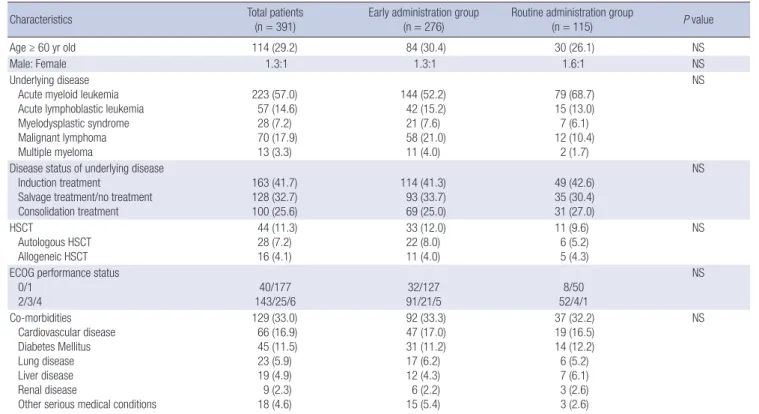
Among the 438 patients recruited, 9 were excluded because the patients did not receive IV itraconazole for 3 or more days while 38 patients were excluded because of inappropriate inclusion/ exclusion criteria. A total of 391 patients was analyzed. The clin-ical characteristics are summarized in Table 1. The median age was 50 yr (range, 18-78 yr). At the initiation of empirical anti-fungal therapy, 291 patients (74.4%) had the status of residual hematological malignancies and 174 patients (44.5%) had a high score of Eastern Cooperative Oncology Group (ECOG) performance status (≥ 2). Co-morbidities were reported in 129 patients (33.0%). There were no differences in these clinical char-acteristics between the “early administration” group and the “routine administration” group (Table 1).
At the initiation of empirical antifungal therapy, 121 patients (31.0%) showed abnormalities (some evidence of infection) on chest X-rays or high-resolution computerized tomography (CT); and 23.2% of patients (22/95) had definite evidences of fungal infection on chest CT such as dense, well-circumscribed lesi-ons(s) with or without a halo sign, air-crescent sign and cavity (4). Thirty-nine (17.6%) out of 221 patients had a positive result of enzyme immunoassay for serum galactomannan when us-ing a cut-off index of 0.5 (23, 24). Among the 22 patients with definite evidences of fungal infection, 11 patients performed
Table 1. Patient characteristics
Characteristics Total patients
(n = 391)
Early administration group (n = 276)
Routine administration group
(n = 115) P value
Age ≥ 60 yr old 114 (29.2) 84 (30.4) 30 (26.1) NS
Male: Female 1.3:1 1.3:1 1.6:1 NS
Underlying disease Acute myeloid leukemia Acute lymphoblastic leukemia Myelodysplastic syndrome Malignant lymphoma Multiple myeloma 223 (57.0) 57 (14.6) 28 (7.2) 70 (17.9) 13 (3.3) 144 (52.2) 42 (15.2) 21 (7.6) 58 (21.0) 11 (4.0) 79 (68.7) 15 (13.0) 7 (6.1) 12 (10.4) 2 (1.7) NS
Disease status of underlying disease Induction treatment
Salvage treatment/no treatment Consolidation treatment 163 (41.7) 128 (32.7) 100 (25.6) 114 (41.3) 93 (33.7) 69 (25.0) 49 (42.6) 35 (30.4) 31 (27.0) NS HSCT Autologous HSCT Allogeneic HSCT 44 (11.3) 28 (7.2) 16 (4.1) 33 (12.0) 22 (8.0) 11 (4.0) 11 (9.6) 6 (5.2) 5 (4.3) NS ECOG performance status
0/1 2/3/4 143/25/640/177 91/21/532/127 52/4/1 8/50 NS Co-morbidities Cardiovascular disease Diabetes Mellitus Lung disease Liver disease Renal disease
Other serious medical conditions
129 (33.0) 66 (16.9) 45 (11.5) 23 (5.9) 19 (4.9) 9 (2.3) 18 (4.6) 92 (33.3) 47 (17.0) 31 (11.2) 17 (6.2) 12 (4.3) 6 (2.2) 15 (5.4) 37 (32.2) 19 (16.5) 14 (12.2) 6 (5.2) 7 (6.1) 3 (2.6) 3 (2.6) NS
serum galactomannan tests and 4 patients showed a positive galactomannan test. The median duration of baseline (prior to starting IV itraconazole) neutropenia (ANC < 500/μL) was 7 days (interquartile range, 4-11). Prolonged baseline neutrope-nia (> 10 days) was observed in 29.4% (n = 115) of the patients. The median duration of severe baseline neutropenia (ANC < 100/μL) was 5 days (interquartile range, 2-9). Prolonged severe neutropenia (> 10 days with ANC < 100/μL) was observed in 61 patients (15.6%). Baseline duration of neutropenia was short-er in the patients from the “early administration” group com-pared with the “routine administration” group (Table 2). The median time to the start of empirical antifungal therapy with IV itraconazole after developing neutropenic fever was 2 days (ran-ge, 1-18 days).
Approximately half of patients had received antifungal pro-phylaxis (n = 190, 48.6%) and about half of them received a flu-conazole as antifungal prophylaxis. The rate of prophylactic use
of antifungal agents was lower in the patients in the “early ministration” group (43.1%) compared with the “routine ad-ministration” group (61.7%) (P = 0.001, Table 2). Thirty patients (7.7%) had baseline fungal infections.
Efficacy analysis
The median treatment duration of IV itraconazole for empirical antifungal therapy was 9 days (range, 3-41 days). Forty-five pa-tients (11.5%) switched from IV to the oral solution itraconazole. The overall success rate was 56.5% and there was no significant difference in the success rate between the two groups (Table 3). Of the 30 patients with baseline fungal infections, 15 patients (50.0%) had a successful outcome. Among 20 patients with in-vasive aspergillosis as a baseline fungal infection, 10 patients had a successful outcome. The rate of breakthrough of fungal infections was 2.8% (11/391) and 9 of those patients were prob-able or proven invasive aspergillosis. Other breakthrough
fun-Table 2. Baseline characteristics and risk factors for invasive fungal diseases
Characteristics Total patient (n = 391) Early administration group (n = 276) Routine administration group (n = 115) P value Positive serum galactomannan tests 39/221 (17.6) 26/147 (17.7) 13/74 (17.6) NS
Abnormal findings on chest X-rays or CT 121 (31.0) 89 (32.4) 32 (27.8) NS
Definite evidence of fungal infection on CT 22 (5.6) 15 (5.4) 7 (6.1) NS
Duration of baseline neutropenic fever, median (range) 2 (1-18) 1 (1-3) 5 (4-18) < 0.001 Duration of baseline neutropenia
> 6 days with ANC < 500/µL > 10 days with ANC < 500/µL > 4 days with ANC < 100/µL > 10 days with ANC < 100/µL
204 (52.2) 115 (29.4) 196 (50.1) 61 (15.6) 118 (42.8) 62 (22.5) 114 (41.3) 34 (12.3) 86 (74.8) 53 (46.1) 82 (71.3) 27 (23.5) < 0.001 < 0.001 < 0.001 0.009 Antifungal prophylaxis Nystatin D-AMB Fluconazole Itraconazole Voriconazole Micafungin 190 (48.6) 13 11 99 59 1 7 119 (43.1) 10 7 60 37 0 5 71 (61.7) 3 4 39 22 1 2 0.001
Baseline fungal infection Candida Aspergillus Other species 30 (7.7) 5 20 5 20 (7.2) 4 12 4 10 (8.7) 1 8 1 NS
Data are number (%) of patients, unless otherwise indicated. CT, computed tomography; ANC, absolute neutrophil count; D-AMB, deoxycholate amphotericin B; NS, no signifi-cance.
Table 3. Outcomes of empirical antifungal therapy with itraconazole
Outcomes Total patients (n = 391) Early administration group (n = 276) Routine administration group (n = 115) P value
Overall success rate 221/391 (56.5) 152/276 (55.1) 69/115 (60.0) 0.433
Successful treatment of baseline fungal infection 15/30 (50.0) 11/20 (55.0) 4/10 (40.0) 0.700 Absence of breakthrough fungal infection 380/391 (97.2) 269/276 (97.5) 111/115 (96.5) 0.738 Survival for ≥ 7 days after completion of itraconazole 368/391 (94.1) 258/276 (93.5) 110/115 (95.7) 0.486 Resolution of fever in setting of neutropenia
Time to defervescence during neutropenia, median days (range) 232/391 (59.3) 2 (range, 0-9) 160/276 (58.0) 2 (range, 0-9) 72/115 (62.6) 2 (range, 0-8) 0.4300.167 Itraconazole discontinued prematurely because of toxicity or lack of efficacy
Yes Lack of efficacy Drug toxicity 96/391 (24.6) 88/391 (22.5) 8/391 (2.0) 66/276 (23.9) 59/276 (21.4) 7/276 (2.5) 30/115 (26.1) 29/115 (25.2) 1/115 (0.9) 0.247
gal infections were candidiasis (n = 1) and coccidioidomycosis (n = 1). The proportion of patients who survived for at least 7 days after completion of itraconazole therapy was 94.1% and the rate of resolution of fever during the neutropenic period was 59.3%. Premature discontinuation of itraconazole therapy because of toxicity or lack of efficacy occurred in 96 patients (24.6%). After failure of empirical antifungal therapy with itra-conazole, 76 patients (19.4%) received second-line IV antifun-gal therapies with D-AMB (n = 71), L-AMB (n = 2), caspofungin (n = 1), fluconazole (n = 1), or voriconazole (n = 1). The success rate was significantly lower in the patients with positive galac-tomannan test and/or definite evidences of fungal infection on imaging study (pre-emptive therapy, 42.1%, 24/57) than the pa-tients with negative galactomannan test and no evidences of fungal infection (58.9%, 103/175, P = 0.032)
Safety and toxicity
Adverse events that might be related to itraconazole developed in 79 patients (18.0%). Hepatotoxicity (n = 68, 15.5%) and neph-rotoxicity (n = 11, 2.5%) were commonly observed. Three pa-tients experienced a generalized skin rash. Eight papa-tients (2.0%) had premature discontinuation of itraconazole therapy due to toxicity. The causes of withdrawal from itraconazole therapy were hepatotoxicity (n = 6), nephrotoxicity (n = 2) and skin tox-icity (n = 1).
Clinical characteristics and success rate of empirical antifungal therapy
There were no significant differences in success rates according to the underlying hematological malignancies (Table 4). The patients with cardiovascular co-morbidity were relatively less likely to achieve a successful outcome with empirical antifungal therapy (P = 0.056). Abnormal findings on chest X-rays or CT
and positive galactomannan tests before initiation of empirical antifungal therapy were significantly associated with decreased success rates (P = 0.006, P = 0.033, respectively).
Multivariate analysis revealed that positive galactomannan tests before initiation of empirical antifungal therapy (P = 0.026, hazard ratio [HR], 2.28; 95% CI, 1.10-4.69) and abnormal find-ings on chest X-rays or CT before initiation of empirical antifun-gal therapy (P = 0.022, HR, 2.03; 95% CI, 1.11-3.71) were signifi-cantly associated with poor outcomes of empirical antifungal therapy with itraconazole.
The success rate of empirical antifungal therapy in the pa-tients with positive baseline galactomannan tests was 38.5%. A total of 13 baseline fungal infections in 39 patients with positive baseline galactomannan tests developed due to Aspergillus and 5 (38.5%) out of 13 patients were successfully treated. Among the patients with positive baseline galactomannan tests, pre-mature discontinuation of itraconazole therapy because of a lack of efficacy occurred in 46.2% (Table 5). The success rate of empirical antifungal therapy in the patients with abnormal findings on chest X-rays or CT was 46.3%. Meanwhile, 33.9% engaged in premature discontinuation of itraconazole therapy because of a lack of efficacy.
DISCUSSION
We demonstrated that empirical antifungal therapy with itra-conazole is effective and safe in Korean patients with hemato-logical malignancies. In this study, we analyzed the success rate using the 5 well-known criteria for success of empirical antifun-gal therapy (13, 15, 16) and reported a 56.5% overall success rate, which was comparable to previous trials with other antifungal agents (13, 15, 16). Moreover, we also reported that positive ga-lactomannan tests and abnormal findings on the chest imaging
Table 4. Overall success rate according to the risk factors of invasive fungal diseases
Risk factors Yes No P value
Age ≥ 60 yr old 60/114 (52.6) 161/277 (58.1) 0.369
Induction/salvage treatment (vs consolidation) 158/291 (54.3) 63/100 (63.0) 0.160
Co-morbidities- cardiovascular disease 30/66 (45.5) 191/325 (58.8) 0.056
Poor ECOG performance status ≥ 2 (vs 0 or 1) 90/174 (51.7) 131/217 (60.4) 0.101
Positive serum galactomannan tests 15/39 (38.5) 106/182 (58.2) 0.033
Abnormal findings on chest X-rays or CT 56/121 (46.3) 165/269 (61.3) 0.006
Definite evidence of fungal infection on CT 10/22 (45.5) 211/368 (57.3) 0.279 Duration of baseline neutropenia
> 6 days with ANC < 500/µL > 10 days with ANC < 500/µL > 4 days with ANC < 100/µL > 10 days with ANC < 100/µL
117/204 (57.4) 65/115 (56.5) 112/196 (57.1) 36/61 (59.0) 104/187 (55.6) 156/276 (56.5) 109/195 (55.9) 185/330 (56.1) 0.760 1.000 0.839 0.779 Duration of baseline neutropenic fever
≥ 4 days (vs ≤ 3 days)
≥ 5 days (vs ≤ 4 days) 69/115 (60.0) 45/71 (63.4) 152/276 (55.1) 176/320 (55.0) 0.4330.234
Antifungal prophylaxis 99/190 (52.1) 122/201 (60.7) 0.102
Data are number of patients with positive results/number of patients tested (%), unless otherwise indicated. ECOG, Eastern Cooperative Oncology Group; CT, computed tomog-raphy; ANC, absolute neutrophil count.
tests were risk factors for failure of empirical antifungal therapy with itraconazole.
Although empirical antifungal therapy was usually recom-mended 3-to-7 days after the onset of neutropenic fever (5, 8, 9), early application of empirical antifungal therapy could be pos-sible in patients with high risk factors for developing IFD. There-fore, there were no limitations for the time to initiation of em-pirical antifungal therapy in this study. The median time to start empirical antifungal therapy with IV itraconazole was 2 days af-ter the onset of neutropenic fever. Because the rate of antifungal prophylaxis was lower in the “early administration” group, many doctors preferred the early use of empirical antifungal agent in spite of the short duration of neutropenia. In this study, 291 pa-tients (74.4%) were considered as the high-risk papa-tients for IFD because of residual underlying disease and only about 50% of patients received antifungal prophylaxis in spite of general rec-ommendation of antifungal prophylaxis for high-risk patients (25). Furthermore, antifungal agents with weak anti-mold ac-tivity were used in about 60% of patients. Therefore, we could use these data for analyzing risk factors for failure of empirical antifungal therapy in spite of relatively early start of empirical antifungal therapy.
Because there was no significant difference in the success rate between the “early administration” group and the “routine administration” group in this study, we could not consider the time to initiation of empirical antifungal therapy as a risk factor for failure of empirical antifungal therapy. Although empirical antifungal therapy is still recommended because of a high rate of mortality and morbidity of IFD (6, 7), a pre-emptive approach in which a patient with suspected IFD is treated according to the radiologic studies or laboratory markers such as the galac-tomannan test has recently been emphasized to minimize tox-icities and costs related to antifungal therapy (17, 26). Therefore, we should consider the early application of pre-emptive thera-py only in the patients with some evidence of IFD.
The diagnosis of pulmonary IFD is typically difficult because invasive diagnostic approaches are not easily available and the findings of chest CT are very diverse according to the underly-ing disease and ANC (27). Therefore, a serum assay for
galacto-mannan has been considered as the most important test for the diagnosis of invasive aspergillosis because of its noninvasive blood test with high sensitivity and specificity (28). The serum galactomannan test can be used for predicting the clinical out-come in patients with probable or proven invasive aspergillosis (29), but little is known about the role of the serum galactoman-nan test in the setting of empirical antifungal therapy. In this study, 39 patients with a positive galactomannan test prior to initiation of empirical antifungal therapy were associated with a low success rate (38.5%). There were more premature discon-tinuations of itraconazole therapy in the patients with positive baseline galactomannan tests (n = 19, 48.7%) than in the pa-tients with negative baseline galactomannan tests (23.6%, P = 0.003). Because these patients had poor outcomes of empirical antifungal therapy even after receiving the empirical antifungal therapy for a sufficient duration (median 9 days), it seems rea-sonable to consider the positive baseline galactomannan test as a risk factor for failure of empirical antifungal therapy. There-fore, we may need to consider more potent or combination an-tifungal therapies in the patients with a positive galactomannan test prior to initiation of empirical itraconazole therapy. Because the early trend of serum galactomannan levels in the course of IFD might be useful in predicting eventual clinical outcomes (30, 31), we could consider the early trend of the galactoman-nan test during the empirical antifungal therapy when we sus-pected failure of empirical antifungal therapy.
In this study, the presence of abnormal findings on chest im-aging tests was also considered an independent risk factor for predicting the failure of empirical antifungal therapy. There was a significantly higher incidence of abnormal findings on chest imaging tests in elderly (≥ 60 yr old) patients (54.5% vs 26.0%,
P = 0.036) and the patients with underlying lung disease (73.9%
vs 28.3%, P < 0.001). Because abnormal findings on chest imag-ing tests are usually associated with underlyimag-ing bacterial infec-tions, high-resolution CT before initiating empirical antifungal therapy is required to find out whether or not the lesions are re-lated to IFD (4, 5, 11). Although the patients with abnormal find-ings on chest X-rays or CT also experienced a higher rate of pre-mature discontinuations of itraconazole therapy (38.0% vs 25.5%,
Table 5. Comparison of the success rates in the patients with risk factors for failure of empirical antifungal therapy with itraconazole
Risk factors The patients with positive galactomannan tests (n = 39) The patients with abnormal findings on chest X-rays or CT (n = 121)
Overall success rate 15/39 (38.5) 56/121 (46.3)
Successful treatment of baseline fungal infection 5/13 (38.5) 10/20 (50.0)
Absence of breakthrough fungal infection 38/39 (97.4) 119/121 (98.3)
Survival for ≥ 7 days after completion of itraconazole 35/39 (89.7) 110/121 (90.9)
Resolution of fever in setting of neutropenia 18/39 (46.2) 64/121 (52.9)
Itraconazole discontinued prematurely because of toxicity or lack of efficacy Yes Lack of efficacy Drug toxicity 19/39 (48.7) 18/39 (46.2) 1/39 (2.6) 46/121 (38.0) 41/121 (33.9) 5/121 (4.1) Data are number of patients with positive results/number of patients tested (%), unless otherwise indicated. CT, computed tomography.
P < 0.001), these results might be analyzed with caution because
there were relatively few patients who performed CT (n = 95, 24.3%) and few patients with definite evidence of fungal infec-tion on CT (n = 22, 5.6%). Among the 39 patients with positive baseline galactomannan tests, 36 patients had normal findings on chest X-rays. Therefore, we should perform a high-resolu-tion CT regardless of the results of chest X-rays if we consider the empirical antifungal therapy.
There were several limitations of this study. Because this study was conducted in the form of an observation study at 22 differ-ent institutions, we did not standardize the initial antibiotic ther-apy for neutropenic fever and prophylactic antifungal therther-apy. Two distinct host factors for developing IFD are prolonged neu-tropenia ( > 10 days) and allogeneic hematopoietic stem cell transplantation (HSCT) (4). However, we had relatively few pa-tients with prolonged baseline neutropenia (29.4%) and few patients who received an allogeneic HSCT (4.1%). Because this observational study was closer to actual clinical practice and a sufficient number of patients for evaluating the characteristics of empirical antifungal therapy were enrolled in this study, the results from this population could be useful for clinical applica-tion. Because we did not evaluate the effect of blood concentra-tion of itraconazole on the success rate in this study, we try to make a protocol with therapeutic drug monitoring in a future trial.
In conclusion, this study demonstrated that itraconazole was effective and safe in Korean patients with hematological malig-nancies. Positive galactomannan tests and abnormal findings on chest imaging tests at the time of initiation of empirical anti-fungal therapy are risk factors for failure of empirical antianti-fungal therapy with itraconazole. Therefore, we should confirm the re-sults of serum galactomannan tests and high-resolution CT be-fore initiation of empirical antifungal therapy to estimate the results of empirical antifungal therapy.
DISCLOSURE
The authors declare that they have no competing interests.
REFERENCES
1. Baden LR, Bensinger W, Angarone M, Casper C, Dubberke ER, Freifeld AG, Garzon R, Greene JN, Greer JP, Ito JI, et al. Prevention and treatment of cancer-related infections. J Natl Compr Canc Netw 2012; 10: 1412-45. 2. Pagano L, Caira M, Candoni A, Offidani M, Martino B, Specchia G,
Pas-tore D, Stanzani M, Cattaneo C, Fanci R, et al. Invasive aspergillosis in patients with acute myeloid leukemia: a SEIFEM-2008 registry study. Haematologica 2010; 95: 644-50.
3. Pagano L, Caira M, Candoni A, Offidani M, Fianchi L, Martino B, Pas-tore D, Picardi M, Bonini A, Chierichini A, et al. The epidemiology of fungal infections in patients with hematologic malignancies: the
SEIF-EM-2004 study. Haematologica 2006; 91: 1068-75.
4. De Pauw B, Walsh TJ, Donnelly JP, Stevens DA, Edwards JE, Calandra T, Pappas PG, Maertens J, Lortholary O, Kauffman CA, et al. Revised defi-nitions of invasive fungal disease from the European Organization for Research and Treatment of Cancer/Invasive Fungal Infections Coopera-tive Group and the National Institute of Allergy and Infectious Diseases Mycoses Study Group (EORTC/MSG) Consensus Group. Clin Infect Dis 2008; 46: 1813-21.
5. Ruhnke M, Böhme A, Buchheidt D, Cornely O, Donhuijsen K, Einsele H, Enzensberger R, Hebart H, Heussel CP, Horger M, et al. Diagnosis of invasive fungal infections in hematology and oncology: guidelines from the Infectious Diseases Working Party in Haematology and Oncology of the German Society for Haematology and Oncology (AGIHO). Ann On-col 2012; 23: 823-33.
6. Wingard JR. Empirical antifungal therapy in treating febrile neutropenic patients. Clin Infect Dis 2004; 39: S38-43.
7. Martino R, Viscoli C. Empirical antifungal therapy in patients with neu-tropenia and persistent or recurrent fever of unknown origin. Br J Hae-matol 2006; 132: 138-54.
8. Lee DG, Kim SH, Kim SY, Kim CJ, Park WB, Song YG, Choi JH. Evidence-based guidelines for empirical therapy of neutropenic fever in Korea. Ko-rean J Intern Med 2011; 26: 220-52.
9. Freifeld AG, Bow EJ, Sepkowitz KA, Boeckh MJ, Ito JI, Mullen CA, Raad II, Rolston KV, Young JA, Wingard JR, et al. Clinical practice guideline for the use of antimicrobial agents in neutropenic patients with cancer: 2010 update by the Infectious Diseases Society of America. Clin Infect Dis 2011; 52: 427-31.
10. Wingard JR, Carter SL, Walsh TJ, Kurtzberg J, Small TN, Baden LR, Ger-sten ID, Mendizabal AM, Leather HL, Confer DL, et al. Randomized, double-blind trial of fluconazole versus voriconazole for prevention of invasive fungal infection after allogeneic hematopoietic cell transplanta-tion. Blood 2010; 116: 5111-8.
11. Walsh TJ, Anaissie EJ, Denning DW, Herbrecht R, Kontoyiannis DP, Marr KA, Morrison VA, Segal BH, Steinbach WJ, Stevens DA, et al. Treatment of aspergillosis: clinical practice guidelines of the Infectious Diseases So-ciety of America. Clin Infect Dis 2008; 46: 327-60.
12. Maertens J, Marchetti O, Herbrecht R, Cornely OA, Flückiger U, Frêre P, Gachot B, Heinz WJ, Lass-Flörl C, Ribaud P, et al. European guidelines for antifungal management in leukemia and hematopoietic stem cell transplant recipients: summary of the ECIL 3: 2009 update. Bone Mar-row Transplant 2011; 46: 709-18.
13. Walsh TJ, Finberg RW, Arndt C, Hiemenz J, Schwartz C, Bodensteiner D, Pappas P, Seibel N, Greenberg RN, Dummer S, et al. Liposomal ampho-tericin B for empirical therapy in patients with persistent fever and neu-tropenia: National Institute of Allergy and Infectious Diseases Mycoses Study Group. N Engl J Med 1999; 340: 764-71.
14. Boogaerts M, Winston DJ, Bow EJ, Garber G, Reboli AC, Schwarer AP, Novitzky N, Boehme A, Chwetzoff E, De Beule K. Intravenous and oral itraconazole versus intravenous amphotericin B deoxycholate as empiri-cal antifungal therapy for persistent fever in neutropenic patients with cancer who are receiving broad-spectrum antibacterial therapy: a ran-domized, controlled trial. Ann Intern Med 2001; 135: 412-22.
15. Walsh TJ, Pappas P, Winston DJ, Lazarus HM, Petersen F, Raffalli J, Ya-novich S, Stiff P, Greenberg R, Donowitz G, et al. Voriconazole compared with liposomal amphotericin B for empirical antifungal therapy in
pa-tients with neutropenia and persistent fever. N Engl J Med 2002; 346: 225-34.
16. Walsh TJ, Teppler H, Donowitz GR, Maertens JA, Baden LR, Dmoszyn-ska A, Cornely OA, Bourque MR, Lupinacci RJ, Sable CA, et al. Caspo-fungin versus liposomal amphotericin B for empirical antifungal thera-py in patients with persistent fever and neutropenia. N Engl J Med 2004; 351: 1391-402.
17. Klastersky J. Antifungal therapy in patients with fever and neutropenia: more rational and less empirical? N Engl J Med 2004; 351: 1445-7. 18. Schuler U, Bammer S, Aulitzky WE, Binder C, Böhme A, Egerer G,
Sand-herr M, Schwerdtfeger R, Silling G, Wandt H, et al. Safety and efficacy of itraconazole compared to amphotericin B as empirical antifungal ther-apy for neutropenic fever in patients with haematological malignancy. Onkologie 2007; 30: 185-91.
19. Ohta K, Nishiki Kosaka S, Nakao Y, Kumura T, Hagihara K, Sakamoto E, Okamoto S, Hirose A, Aoyama Y, Yamamura R, et al. Efficacy and safety of intravenous itraconazole as empirical antifungal therapy for persis-tent fever in neutropenic patients with hematological malignancies in Japan. Int J Hematol 2009; 89: 649-55.
20. Park SH, Choi SM, Lee DG, Choi JH, Yoo JH, Min WS, Shin WS. Intrave-nous itraconazole vs. amphotericin B deoxycholate for empirical anti-fungal therapy in patients with persistent neutropenic fever. Korean J In-tern Med 2006; 21: 165-72.
21. KDOQI. KDOQI Clinical Practice Guideline and Clinical Practice Rec-ommendations for anemia in chronic kidney disease: 2007 update of he-moglobin target. Am J Kidney Dis 2007; 50: 471-530.
22. National Cancer Institute. Common terminology criteria for adverse events (CTCAE) v3.0. Available at http://ctep.cancer.gov/protocolDevel-opment/electronic_applications/docs/ctcaev3.pdf [accessed on 10 Au-gust 2013].
23. Maertens JA, Klont R, Masson C, Theunissen K, Meersseman W, La-grou K, Heinen C, Crépin B, Van Eldere J, Tabouret M, et al. Optimiza-tion of the cutoff value for the Aspergillus double-sandwich enzyme im-munoassay. Clin Infect Dis 2007; 44: 1329-36.
24. Leeflang MM, Debets-Ossenkopp YJ, Visser CE, Scholten RJ, Hooft L,
Bijlmer HA, Reitsma JB, Bossuyt PM, Vandenbroucke-Grauls CM. Ga-lactomannan detection for invasive aspergillosis in immunocompro-mized patients. Cochrane Database Syst Rev 2008; (4): CD007394. 25. Robenshtok E, Gafter-Gvili A, Goldberg E, Weinberger M, Yeshurun M,
Leibovici L, Paul M. Antifungal prophylaxis in cancer patients after che-motherapy or hematopoietic stem-cell transplantation: systematic re-view and meta-analysis. J Clin Oncol 2007; 25: 5471-89.
26. Cordonnier C, Pautas C, Maury S, Vekhoff A, Farhat H, Suarez F, Dhé-din N, Isnard F, Ades L, Kuhnowski F, et al. Empirical versus preemptive antifungal therapy for high-risk, febrile, neutropenic patients: a rando-mized, controlled trial. Clin Infect Dis 2009; 48: 1042-51.
27. Bergeron A, Porcher R, Sulahian A, de Bazelaire C, Chagnon K, Raffoux E, Vekhoff A, Cornet M, Isnard F, Brethon B, et al. The strategy for the di-agnosis of invasive pulmonary aspergillosis should depend on both the underlying condition and the leukocyte count of patients with hemato-logic malignancies. Blood 2012; 119: 1831-7.
28. Maertens J, Verhaegen J, Lagrou K, Van Eldere J, Boogaerts M. Screen-ing for circulatScreen-ing galactomannan as a noninvasive diagnostic tool for invasive aspergillosis in prolonged neutropenic patients and stem cell transplantation recipients: a prospective validation. Blood 2001; 97: 1604-10.
29. Miceli MH, Grazziutti ML, Woods G, Zhao W, Kocoglu MH, Barlogie B, Anaissie E. Strong correlation between serum aspergillus galactoman-nan index and outcome of aspergillosis in patients with hematological cancer: clinical and research implications. Clin Infect Dis 2008; 46: 1412-22.
30. Nouér SA, Nucci M, Kumar NS, Grazziutti M, Barlogie B, Anaissie E. Earlier response assessment in invasive aspergillosis based on the kinet-ics of serum Aspergillus galactomannan: proposal for a new definition. Clin Infect Dis 2011; 53: 671-6.
31. Chai LY, Kullberg BJ, Johnson EM, Teerenstra S, Khin LW, Vonk AG, Maertens J, Lortholary O, Donnelly PJ, Schlamm HT, et al. Early serum galactomannan trend as a predictor of outcome of invasive aspergillosis. J Clin Microbiol 2012; 50: 2330-6.