P1-77 / N. Tokmoldin
IMID 2009 DIGEST • New inverted architecture of a hybrid inorganic-organic
light-emitting diode, utilizing ZrO2 electron-injecting layer, is presented. The thickness of the ZrO2, as well as the annealing of the light-emitting polymer, is found critical to obtain good performance. A range of light-emitting polymers is shown to operate efficiently in the proposed architecture.
Huge interest in improving stability and reducing costs of organic light-emitting diodes (OLEDs) has sparked much attention to unconventional device architectures. Stability appears to be the dominant factor with the traditional electrodes made of Ca, Ba, Al, etc. being vulnerable to moisture and oxygen. Transparent electron-injecting layers (EIL) such as TiO2 and ZnO have previously been shown to provide
sufficient electron current to produce bright OLEDs using a well-known polyfluorene derivative poly(9,9-dioctylfluorene-co-benzothiadiazole) (F8BT) [1-4]. Thus, the use of TiO2 EIL allows achieving brightness
levels of 5700 cd/m2 with maximum efficiency of 0.7
cd/A [3]. ZnO has so far produced the highest efficiency single metal-oxide EIL, with device performance reaching 6500 cd/m2 and 1.3 cd/A in
luminance and efficiency, respectively [4].
Herein we demonstrate the use of ZrO2 EIL to
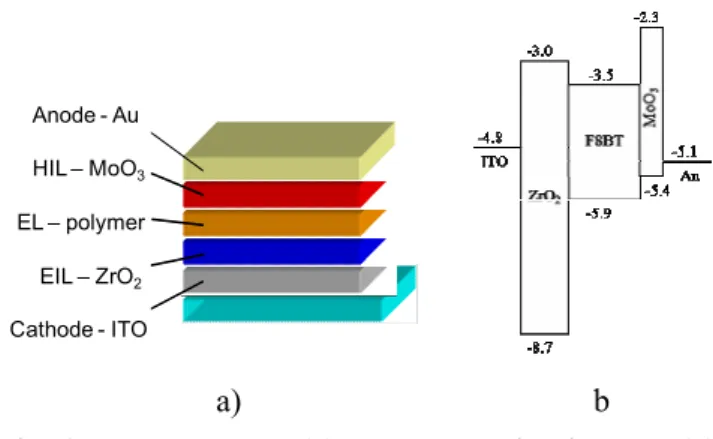
produce an efficient hybrid organic-inorganic LED. The structure of the device, as well as the relative positions of the energy levels of the components, is shown in Fig. 1. Deposition of the ZrO2 layer is done
via spray pyrolysis. All the details of the device fabrication have been reported elsewhere [5].
We will show that the choice of the optimum ZrO2
thickness is critical for the device performance. Moreover annealing of the polymer also has an effect on the operation characteristics of the hybrid LED.
Fig. 1. The structure (a) and energetic diagram (b) of the hybrid metal-oxide/polymer light-emitting diode.
Taking these into account we demonstrate a device reaching the luminance of app. 26000 cd/m2 and the
efficiency of 2.7 cd/A. We will also demonstrate the use of alternative light-emitting polymers, based on polyfluorene. As such, this allows producing multi-colored hybrid metal-oxide/polymer LEDs which, to our knowledge, have not been reported previously.
The enhancement of the device performance upon introducing a wide-bandgap EIL may be attributed to a number of factors: more energetically favourable charge transport from the EIL into the emissive layer, better hole-blocking ability at the interface between the EIL and the polymer, reduced electroluminescence quenching by the same interface. Also a combination of these factors may take place; elucidation of the role of each of them requires further investigation.
In summary, the improvement in performance of a hybrid inorganic-organic LED is observed upon the use of ZrO2 EIL. The reported findings suggest that
a) b Anode - Au HIL – MoO3 EL – polymer EIL – ZrO2 Cathode - ITO
The use of ZrO2 as an electron-injecting layer in hybrid
metal-oxide/polymer light-emitting diodes
Nurlan Tokmoldin
1, Donal D.C. Bradley
2and Saif Haque
11Dept. of Chemistry, Imperial College London, London, SW7 2AZ, United Kingdom
Tel.:+44-2075945710, E-mail: [email protected]
2Dept. of Physics, Imperial College London, London, SW7 2AZ, United Kingdom
P1-77 / N. Tokmoldin
• IMID 2009 DIGEST
metal oxides are good candidates for use as charge-injecting layers in OLEDs.
Acknowledgement
N.T. acknowledges the support of the Bolashak scholarship of the Republic of Kazakhstan.
References
1. K. Morii, M. Ishida, T. Takashima, T. Shimoda, Q. Wang, M. K. Nazeeruddin, and M. Grätzel, Appl.
Phys. Lett., 89, p.183510 (2006).
2. S. A. Haque, S. Koops, N. Tokmoldin, J. R. Durrant, J. S. Huang, D. D. C. Bradley, and E. Palomares,
Adv. Mater., 19, p.683 (2007).
3. H. J. Bolink, E. Coronado, D. Repetto, M. Sessolo, E. M. Barea, J. Bisquert, G. Garcia-Belmonte, J. Prochazka, and L. Kavan, Adv. Funct. Mater., 18, p.145 (2008).
4. H. J. Bolink, E. Coronado, D. Repetto, and M. Sessolo, Appl. Phys. Lett., 91, p.223501 (2007). 5. N. Tokmoldin, N. Griffiths, D. D. C. Bradley, and S.